

What is the Glycol Market Size?
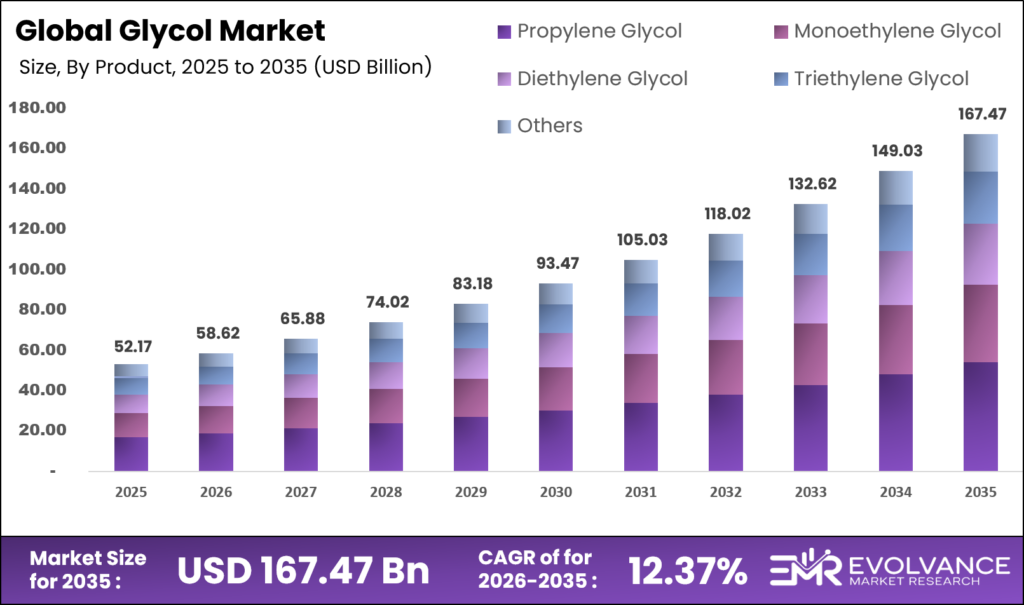
The Global Glycol Market size will be worth around USD 167.47 Billion by 2035 from USD 52.17 Billion in 2025, growing at a CAGR of 12.37% during the forecast period 2026 to 2035. Enterprise buyers require massive cooling fluids to safely manage extreme thermal loads in new hydrogen plants. This clear shift in buyer behavior moves global capital toward specialized thermal management fluids across regions. Major factory operators now actively secure direct supply contracts to protect critical production lines from shortages. Strict fossil material limits and volatile feedstock costs create ongoing supply risks for chemical makers worldwide.
Market Highlights
- The Glycol Market will reach USD 167.47 Billion by 2035, growing at a 12.37% CAGR.
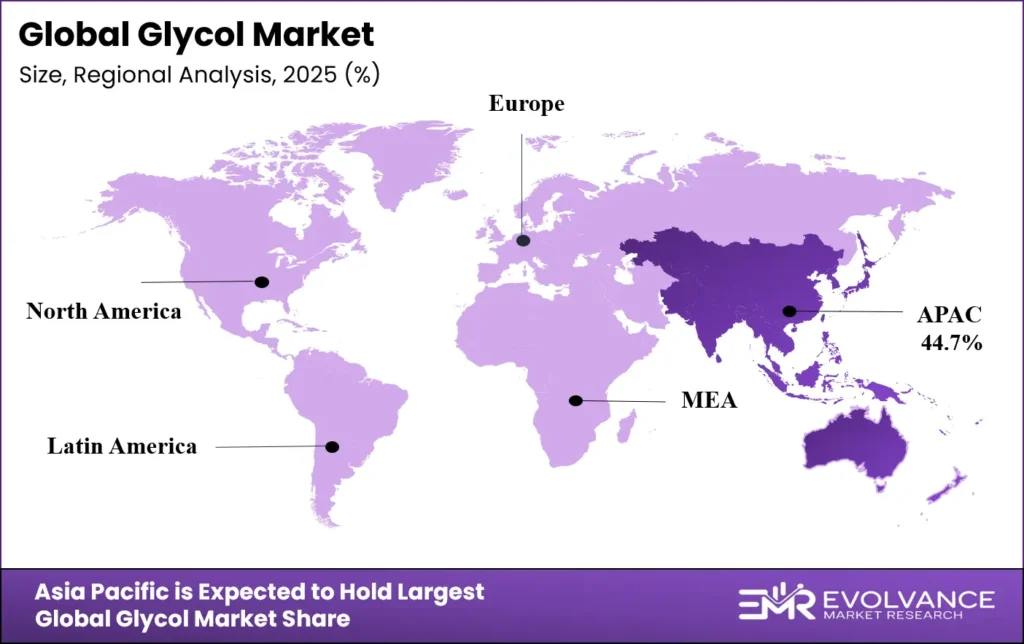
- Asia Pacific leads the global market with a 44.7% share valued at USD 23.32 Billion.
- The Ethylene Glycol segment leads the product category with a 29.7% market share.
- The Direct Sales segment controls the distribution channel space with a 53.2% share.
- The Petrochemical-based technology segment commands the market with a 43.1% share.
- The Industrial Grade segment dominates the purity category with a 48.3% share.
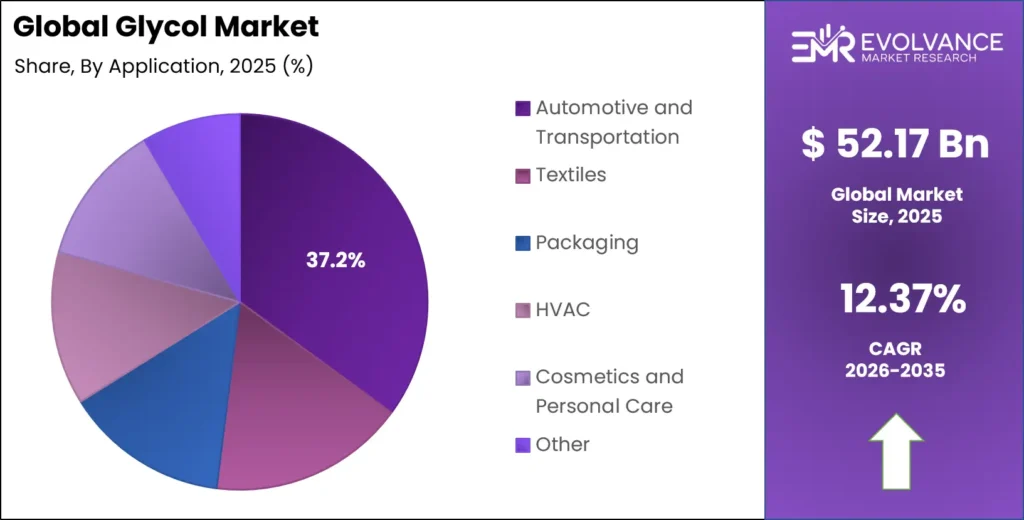
- The Automotive and Transportation sector holds the largest application share at 37.2%.
Statistical Data of Glycol Market
National Market Sizes and Country-Level Trade
- China: Recorded an overall glycol market size of USD 18.2 Billion driven by Hydrogen electrolyzer manufacturing.
- United States: Domestic glycol market valuation reached USD 8.7 Billion following increased industrial investments. Exported USD 3.4 Billion worth of glycol products to European industrial markets.
- Germany: Expanded renewable glycol output to 120,000 tonnes under national hydrogen subsidy mechanisms.
- Saudi Arabia: Exported 4.8 million metric tonnes of monoethylene glycol to international chemical markets. Grew its domestic glycol market value to USD 1.1 Billion using treated wastewater.
- India: Produced 2.1 million tonnes of glycol products to supply clean energy manufacturing programs.
- Japan: Recorded a domestic glycol market valuation of USD 2.4 Billion from synthetic fuel facilities. Exported USD 620 Million of specialized glycols for advanced regional manufacturing applications.
- South Korea: Invested USD 450 Million into new glycol facilities integrated with renewable energy installations. Generated USD 890 Million in propylene glycol exports to synthetic fuel projects.
- The Netherlands: Imported 1.2 million tonnes of bulk glycols to support European electrolyzer manufacturing.
Regional Aggregates and Macro Flows
- Asia Pacific: Regional glycol production capacity expanded to 28.5 million metric tonnes.
- Europe: Recorded a regional glycol market size of USD 8.4 Billion supported by carbon capture projects.
- Middle East: Achieved USD 6.5 Billion in cross-regional glycol export trade flow.
- North America: Recorded USD 4.1 Billion in cross-regional export trade flow for glycol products.
- Latin America: Imported USD 1.4 Billion in refined glycols to meet regional manufacturing requirements.
ESG, Workforce and Operational Compliance
- European Employment: Grew to 42,000 jobs across specialized glycol and coolant manufacturing sectors.
- Demographics: Survey data revealed that 54% of industrial chemical procurement managers were aged 35 to 50.
- United Kingdom: Chemical facilities achieved a 99.2% REACH regulatory compliance rate for industrial glycols.
- United States: Glycol transport operations reduced the safety incident rate to 0.8 per 100 workers.
- Japan: Industrial manufacturers increased the chemical recycling rate for industrial glycols to 15%.
- Europe: Chemical producers increased carbon capture technology penetration across existing glycol facilities to 11%.
- India: Chemical plants increased wastewater recycling rates in industrial cooling towers to 42%.
Corporate Performance and Commercial Metrics
- SABIC: Achieved an operating profit margin of 14.5% from its ethylene glycol division. Exported 1.8 million metric tonnes of industrial-grade glycol to European decarbonization projects.
- Shell Chemicals: Allocated USD 420 Million to expand its renewable glycol facility in the Netherlands. Captured a 12% market share in the European high-purity glycol sector.
- LyondellBasell: Recorded USD 1.6 Billion in propylene glycol revenue from renewable energy thermal systems. Operated European glycol manufacturing assets at an 88% capacity utilization rate. Secured USD 250 Million in long-term contracts to supply Texas hydrogen cooling systems.
- INEOS: Recorded USD 1.2 Billion in European glycol sales through competitive hydrogen subsidy auctions. Achieved a 9.2% annual revenue increase in its specialty glycol segment.
- MEGlobal: Expanded North American production capacity to 2.2 million metric tonnes for domestic supply stability. Generated USD 850 Million in export revenue from Canadian facilities supplying Asian electrolyzer manufacturers. Invested USD 120 Million to upgrade wastewater treatment systems at its chemical production sites.
- Reliance Industries: Generated USD 940 Million in domestic glycol revenue supporting Indian hydrogen production facilities. Produced 1.4 million tonnes of monoethylene glycol for South Asian industrial decarbonization.
Market Overview
Glycol serves as an essential chemical building block for global manufacturing facilities. Producers rely on these fluids to make industrial coolants, durable resins, and clear packaging films. The chemical transfers heat efficiently across energy systems, creating stable demand across heavy industrial sectors.
Moreover, national governments fund clean energy projects that require specialized thermal fluids. Stricter emissions rules push chemical plants to modernize equipment and reduce carbon intensity. Consequently, chemical suppliers invest in low-carbon production methods to satisfy new environmental compliance standards across major industrial markets.
According to data published by the IEA, global adoption of bio-attributed glycols reached 18% among manufacturers in 2024. This proves corporate climate goals directly shift procurement spend. Additionally, BASF achieved ISCC+ certification across its global chemical sites in 2024 to supply verified low-carbon product grades.
Findings from an ISM survey revealed that 68% of US buyers prioritized domestic glycol sources in 2024. This purchasing pattern shows buyers favor supply reliability over distant foreign imports. Therefore, regional producers with integrated domestic logistics capture higher customer retention and long-term supply agreements.
Product Insights
Ethylene Glycol dominates with 29.7% due to massive global packaging needs.
In 2025, Ethylene Glycol held a dominant market position in the By Product segment of Glycol Market, with a 29.7% share. Global factories require vast fluid volumes to make clear plastic bottles and synthetic clothing fibers. This steady consumption creates predictable, high-volume recurring orders for major chemical producers worldwide.
Propylene Glycol delivers reliable heat transfer capabilities for sensitive commercial applications. In 2025, Dow expanded specialized production capacity by 150,000 metric tonnes to supply North American electrolyzer plants. This targeted expansion allows the company to capture profitable long-term supply contracts as hydrogen facilities scale operations.
Monoethylene Glycol (MEG) serves as a primary raw material for heavy industrial coolants and polyester resins. Data published by the National Bureau of Statistics showed China produced 14.5 million metric tonnes in 2024. This high manufacturing volume anchors the regional supply chain and protects downstream users from severe supply shortages.
Diethylene Glycol (DEG) functions as a versatile chemical intermediate for unsaturated polyester resins and natural gas treating. Industrial operators choose this product for its cost-effective solvent properties and dependable availability. Stable consumption patterns across resin manufacturing provide steady baseline revenue for mid-sized chemical producers globally.
Triethylene Glycol (TEG) removes moisture from natural gas streams to prevent pipeline freezing and corrosion. Oil and gas operators depend on this chemical to maintain pipeline safety standards during cold weather operations. Continuous extraction activity ensures reliable, non-cyclical reordering from major energy infrastructure companies.
Polyethylene Glycol (PEG) provides non-toxic, water-soluble binding properties for medical formulations and tablet coatings. Pharmaceutical manufacturers pay premium rates for certified high-purity grades that meet strict drug safety standards. Stringent regulatory compliance creates high switching costs, locking buyers into long-term supplier relationships.
Butylene Glycol acts as a moisture-retaining conditioning agent in premium personal care and cosmetic formulations. Cosmetic laboratories select this ingredient for its gentle skin feel and exceptional chemical stability. Expanding consumer interest in premium skincare products drives consistent raw material orders from global personal care brands.
Bio-Based Glycol replaces petroleum-derived inputs with renewable plant feedstocks to support corporate decarbonization targets. Enterprise buyers adopt these sustainable alternatives to satisfy carbon reduction mandates without altering existing manufacturing machinery. This green shift creates attractive pricing premiums and new revenue opportunities for innovative chemical suppliers.
Distribution Channel Insights
Direct Sales dominates with 53.2% due to massive bulk contract needs.
In 2025, Direct Sales held a dominant market position in the By Distribution Channel segment of Glycol Market, with a 53.2% share. Large industrial buyers establish direct contracts with chemical producers to secure customized pricing and guaranteed delivery schedules. This direct purchasing structure eliminates distributor markups on high-volume chemical shipments.
Distributor Sales (Dealers and Wholesalers) supply small and mid-sized manufacturing facilities with flexible order quantities. Regional distributors maintain local inventory to provide rapid fulfillment for localized industrial operations. This extensive distribution network enables primary chemical manufacturers to access dispersed customer bases without expanding internal sales teams.
Online Retail provides rapid procurement options for specialized laboratories and pilot-scale testing facilities. Digital platforms offer transparent pricing and instant access to specialized chemical grades in small container volumes. Consequently, chemical suppliers leverage e-commerce channels to streamline order processing for low-volume, high-margin product orders.
Technology Insights
Petrochemical-based dominates with 43.1% due to massive legacy economies of scale.
In 2025, Petrochemical-based (Ethylene Oxide Route) held a dominant market position in the By Technology segment of Glycol Market, with a 43.1% share. Established petrochemical complexes benefit from fully amortized production equipment and low feedstock processing costs. This cost efficiency allows legacy producers to maintain competitive pricing against newer production methods.
Coal-based (China-specific) synthesis converts abundant domestic coal resources into essential industrial chemicals. Official figures from MIIT showed Chinese facilities achieved a 45% catalytic conversion adoption rate in 2025. This technology protects domestic industrial users from international crude oil price fluctuations by securing localized chemical production.
Bio-based (Renewable Feedstock) technology converts agricultural waste into drop-in chemical replacements. In 2025, INEOS expanded its bio-attributed production capacity to 85,000 metric tonnes to meet corporate sustainability demand. This processing route allows industrial consumers to lower product carbon footprints while utilizing existing manufacturing assets.
Electrochemical / Electrocatalytic Conversion utilizes renewable electricity to drive chemical synthesis without direct fossil combustion. This emerging method achieves at least 90% lower carbon emissions compared to conventional thermal processing. Regions with abundant green power attract substantial capital investments for next-generation zero-emission chemical facilities.
Purity Level Insights
Industrial Grade dominates with 48.3% due to heavy factory cooling demands.
In 2025, Industrial Grade held a dominant market position in the By Purity Level segment of Glycol Market, with a 48.3% share. Benchmark data from VCI showed German production facilities achieved a 98.5% product yield rate in 2025. Heavy manufacturing plants purchase bulk volumes of this grade for large-scale heat transfer and antifreeze formulations.
Pharmaceutical Grade complies with strict pharmacopeia purity standards for drug manufacturing and medical device applications. Pharmaceutical firms pay significant price premiums to eliminate chemical contamination risks in final health products. Regulatory audit requirements create enduring commercial partnerships between certified chemical producers and major pharmaceutical companies.
Food Grade provides safe thermal management inside food processing plants and beverage bottling facilities. Food processors utilize certified non-toxic cooling fluids to comply with mandatory public hygiene standards. Routine fluid replacement cycles maintain steady commercial demand for verified food-safe chemical grades across global markets.
Cosmetic Grade delivers exceptional skin compatibility for daily beauty and personal care formulas. Cosmetic formulators require ultra-pure ingredients to ensure long product shelf life and avoid skin irritation issues. This focus on purity allows chemical suppliers to earn attractive profit margins on specialized cosmetic sales.
Application Insights
Automotive and Transportation dominates with 37.2% due to constant engine coolant needs.
In 2025, Automotive and Transportation held a dominant market position in the By Application segment of Glycol Market, with a 37.2% share. Every liquid-cooled internal combustion engine requires reliable antifreeze formulations to avoid catastrophic engine overheating. Constant vehicle production creates substantial, non-cyclical bulk demand for automotive cooling fluids globally.
Textiles manufacturers consume large volumes of chemical intermediates to produce polyester yarn and synthetic fabrics. Fast fashion trends and athletic apparel growth drive continuous weaving operations across major textile mills. This steady consumption pattern provides predictable baseline cash flow for commodity chemical producers in textile manufacturing hubs.
Packaging converters transform chemical feedstocks into durable polyethylene terephthalate containers and clear protective films. Beverage companies require reliable bottle supplies to distribute consumer goods through global retail channels. Continuous demand for food packaging supports resilient, high-volume chemical procurement across major consumer goods markets.
HVAC engineering firms install specialized glycol mixtures in commercial cooling loops and clean energy installations. Research by IRENA showed 72% of hydrogen electrolyzer developers selected propylene glycol in 2024. This high adoption rate demonstrates that green energy growth directly generates lucrative thermal fluid supply contracts.
Airlines apply heavy volumes of deicing fluids to aircraft wings during freezing winter weather conditions. Commercial airport operators maintain large chemical inventories to ensure flight safety and regulatory compliance. Mandatory aviation safety rules make deicing fluid a non-negotiable operating expenditure regardless of chemical price changes.
Polyester Fibers and Resins production converts raw liquid chemicals into lightweight components for automotive and consumer goods. Automakers utilize durable plastic resins to reduce vehicle weight and improve fuel economy. This ongoing lightweighting trend drives steady material orders from tier-one automotive component suppliers.
Pipeline Maintenance teams inject specialty glycols into natural gas pipelines to inhibit gas hydrate formation. Energy pipeline operators rely on these chemical treatments to prevent costly flow blockages during sub-zero temperatures. Continuous energy transit ensures regular chemical replenishment contracts with major utility and pipeline operators.
Medical device and drug developers utilize ultra-pure glycols as solvents and liquid binding agents. Strict healthcare safety standards require consistent raw material quality to pass regulatory batch testing. These rigorous compliance standards create durable supplier relationships and protect specialized producers from low-cost commodity competition.
Construction contractors add specialty chemical compounds to concrete mixtures to prevent freezing during cold weather pouring. Building firms utilize these additives to avoid expensive construction delays during winter seasons. Consequently, infrastructure spending programs generate steady seasonal orders for specialized construction chemical formulations.
Market Segments Covered in the Report
By Product
- Ethylene Glycol
- Propylene Glycol
- Monoethylene Glycol (MEG)
- Diethylene Glycol (DEG)
- Triethylene Glycol (TEG)
- Polyethylene Glycol (PEG)
- Butylene Glycol
- Bio-Based Glycol
By Distribution Channel
- Direct Sales
- Distributor Sales (Dealers and Wholesalers)
- Online Retail
By Technology
- Petrochemical-based (Ethylene Oxide Route)
- Coal-based (China-specific)
- Bio-based (Renewable Feedstock)
- Electrochemical / Electrocatalytic Conversion
By Purity Level
- Industrial Grade
- Pharmaceutical Grade
- Food Grade
- Cosmetic Grade
By Application
- Automotive and Transportation
- Textiles
- Packaging
- HVAC
- Cosmetics and Personal Care
- Airlines
- Polyester Fibers and Resins
- Pipeline Maintenance
- Medical
- Construction
Regional Insights
Asia Pacific Dominates the Glycol Market with a Market Share of 44.7%, Valued at USD 23.32 Billion
Asia Pacific leads the global market with a 44.7% share valued at USD 23.32 Billion in 2025. Massive chemical conversion facilities in China support global consumer goods and packaging manufacturing lines. Furthermore, state support accelerates the construction of integrated chemical production complexes. These structural advantages lower regional manufacturing costs and ensure superior supply reliability.
North America Market Trends
North America leverages abundant low-cost natural gas feedstocks to produce cost-competitive chemical derivatives. The regional market reached a valuation of USD 11.2 Billion in 2024. Federal clean energy incentives encourage chemical producers to integrate carbon capture systems into existing facilities. This modernization trend attracts substantial industrial capital to Gulf Coast production hubs.
Europe Market Trends
Europe enforces stringent carbon benchmark standards that reshape regional chemical procurement strategies. Regional renewable production recorded 14% volume growth in 2025 under supportive hydrogen funding frameworks. Chemical manufacturers actively invest in bio-attributed feedstocks to reduce regulatory compliance penalties. Consequently, European producers lead the transition toward low-carbon specialty chemical product portfolios.
Latin America Market Trends
Latin America demonstrates steady chemical consumption across expanding agricultural processing and fertilizer operations. The regional market achieved a valuation of USD 3.1 Billion in 2024. However, limited domestic refining capacity forces regional manufacturing plants to import refined chemical grades. Regional distributors focus on securing reliable import channels to prevent supply disruptions.
Middle East and Africa Market Trends
The Middle East utilizes integrated petrochemical assets to expand bulk chemical export volumes globally. Regional production capacity expanded to 12.8 million metric tonnes in 2025. State-backed energy enterprises invest heavily in modern chemical hubs to monetize upstream natural gas reserves. This large production scale provides formidable cost advantages in global commodity export markets.
Key Regions and Countries
North America
- US
- Canada
Europe
- Germany
- France
- The UK
- Spain
- Italy
- Rest of Europe
Asia Pacific
- China
- Japan
- South Korea
- India
- Australia
- Rest of APAC
Latin America
- Brazil
- Mexico
- Rest of Latin America
Middle East and Africa
- GCC
- South Africa
- Rest of MEA
Regulatory Landscape
The European Commission implemented the updated Emissions-Benchmark Framework in 2024 to reduce industrial carbon emissions. This regulation enforces strict emission allowances on chemical manufacturing plants using conventional thermal heating systems. Consequently, chemical producers must adopt low-carbon manufacturing technologies or face substantial financial penalties, accelerating the shift toward renewable chemical alternatives (bio-based chemicals).
In 2024, the United States Department of Energy enacted clean production tax incentives under federal climate legislation. This rule provides tax credits for industrial facilities integrating carbon capture technology into chemical processing units. Therefore, major chemical producers invest capital into emission reduction projects to qualify for valuable federal operating subsidies.
The Ministry of Industry and Information Technology of China introduced strict green manufacturing standards in 2025. This policy mandates energy efficiency benchmarks for coal-to-chemical synthesis plants across all industrial provinces. Chemical producers must upgrade catalytic conversion equipment to maintain operating licenses, driving modern technology adoption across domestic production facilities.
Drivers
New Production Capacity Expansions Strengthen Regional Chemical Supply Chains
Dow completed an 80,000-tonne annual capacity addition at Map Ta Phut in May 2024 to supply expanding Asian manufacturing operations. This modern facility provides local manufacturers with reliable raw material access. Direct regional supply reduces shipping delays and lowers freight costs for high-volume chemical procurement managers.
Furthermore, BASF will commence operations at its Zhanjiang integrated Verbund site in 2026, featuring dedicated ethylene oxide units. As reported by APEC, the Asia Pacific regional market reached USD 22.5 Billion in 2024. Integrated mega-sites improve feedstock security and insulate downstream buyers from global shipping disruptions.
Integrated manufacturing complexes in major chemical hubs provide superior production economics and supply reliability. Chemical producers co-locate upstream refining units with downstream synthesis plants to eliminate intermediate transport costs. Consequently, enterprise buyers secure predictable multi-year supply contracts that protect operational budgets from sudden raw material shortages.
Restraints
Feedstock Price Volatility and Import Bottlenecks Constrain Operating Margins
Chemical producers face significant profit margin pressure from volatile crude oil and natural gas feedstock prices. Unpredictable upstream energy costs create pricing uncertainty for downstream manufacturing buyers. Consequently, sudden raw material inflation forces chemical suppliers to adjust contract terms, delaying planned industrial capital investment programs.
Data published by the Ministry of Commerce showed India industrial import value reached USD 750 Million in 2025 due to domestic project delays. Supply constraints prevent announced regional capacity from entering commercial operation. When local production lags behind consumption, manufacturers face elevated import tariffs and logistical delays.
Moreover, tightening environmental regulations impose heavy compliance costs on older fossil-based chemical facilities. Small and mid-sized producers struggle to fund expensive carbon abatement equipment required by regional environmental authorities. These mounting compliance costs force inefficient production units to halt operations, reducing overall market supply flexibility.
Growth Factors
Renewable Power Integration and Subsidy Mechanisms Unlock New Markets
According to IRENA, 22% of operational chemical plants established dedicated renewable power purchasing agreements in 2025. Direct green energy integration lowers operating expenses and cuts manufacturing emissions. This cost improvement allows chemical suppliers to price low-carbon product lines competitively against conventional fossil-derived alternatives.
Additionally, data from Statistics Korea showed industrial adoption of green subsidy mechanisms increased by 35% in 2024. Government financial support helps manufacturing enterprises absorb the initial premium of sustainable chemical inputs. Consequently, subsidized procurement programs accelerate commercial transition toward cleaner regional industrial supply chains.
Dow dedicated USD 350 Million in 2024 toward integrating carbon capture technology into Gulf Coast manufacturing assets. This capital allocation enables the producer to deliver certified low-carbon chemicals to industrial buyers. Producers offering verifiable carbon reductions capture premium pricing contracts from corporate sustainability leaders globally.
Emerging Trends
Mass-Balance Certification and Electrified Processing Drive Decarbonization
Industrial manufacturers rapidly adopt ISCC PLUS mass-balance certified products utilizing bio-circular and recycled chemical feedstocks. Enterprise buyers utilize these certified inputs to meet corporate sustainability goals without modifying existing machinery. This certification standard establishes clear traceability and commands significant price premiums across international markets.
Research by the World Economic Forum revealed that 28% of heavy industrial offtakers transitioned to lower-emission chemical grades in 2024. This widespread purchasing shift reflects corporate commitments to deep industrial decarbonization. Chemical suppliers who develop traceable low-carbon product portfolios secure preferred vendor status with multinational enterprise clients.
Chemical engineers develop electrified steam cracking technologies that reduce direct manufacturing emissions by at least 90%. Replacing fossil-fuel furnaces with clean electric heating transforms energy-intensive chemical synthesis. Early adopters of electrified processing establish formidable technological barriers that protect long-term market share from conventional competitors.
Research Methodology Framework and Report Scope
Market Definitions and Key Coverage
This research report delivers a comprehensive quantitative and qualitative assessment of the global glycol marketplace across all primary product grades, manufacturing technologies, and commercial applications. The study scope covers commodity and specialty chemical grades, including ethylene glycol, propylene glycol, bio-based variants, and high-purity formulations. Market valuations are calculated in constant US Dollars based on the 2025 base year to eliminate foreign exchange rate fluctuations and provide consistent commercial forecasting across the 2026 to 2035 forecast horizon.
The report scope strictly excludes finished consumer goods, such as fabricated plastic containers, woven polyester textiles, and packaged cosmetic formulations. Furthermore, upstream crude petroleum extraction activities, raw coal mining operations, and independent software management platforms remain outside the analytical boundary of this study to maintain a focused evaluation of core chemical manufacturing and distribution activities.
Key Companies Insights
BASF SE maintains a formidable competitive position through its integrated Verbund production strategy and substantial capital investments in renewable energy infrastructure. The enterprise constructs massive production sites powered entirely by renewable electricity to lower manufacturing emissions. This strategic infrastructure reduces regulatory compliance costs and provides enterprise customers with dependable, low-carbon chemical products across major international markets.
Dow Inc. captures high-margin commercial opportunities by expanding specialized capacity and securing long-term supply agreements with clean energy enterprises. The company recorded USD 2.4 Billion in monoethylene glycol revenue in 2024. Integrating carbon capture systems into Gulf Coast facilities allows the firm to supply certified low-carbon cooling fluids to expanding hydrogen production facilities worldwide.
SABIC leverages low-cost upstream hydrocarbon feedstocks in the Middle East to maintain superior cost competitiveness across global chemical markets. The company generated USD 3.1 Billion in glycol segment sales in 2024. This structural cost advantage enables the enterprise to supply high-volume industrial cooling fluids to international infrastructure projects while sustaining resilient operational profit margins.
Shell Chemicals strengthens its market positioning by linking specialty chemical operations to emerging synthetic fuel and green hydrogen initiatives. The enterprise reported USD 1.9 Billion in derivative segment revenue during 2024. Developing specialized high-purity thermal fluids allows the company to secure preferred supplier status with major European energy transition facilities requiring advanced cooling solutions.
Key Companies
- BASF SE
- Dow Inc.
- SABIC
- Sinopec
- Shell Chemicals
- LyondellBasell Industries N.V.
- ExxonMobil Chemical
- INEOS Group Limited
- Reliance Industries Limited
- Mitsubishi Chemical Group
- Formosa Plastics Corporation
- LG Chem Ltd.
- Eastman Chemical Company
- Huntsman Corporation
- Wanhua Chemical
- Celanese
- Arkema
- Chevron Phillips Chemical
- LANXESS
- Sumitomo Chemical
Recent Industry Developments
- In June 2025, Shell launched the Shell DLC Fluid S3, a propylene glycol-based Direct Liquid Cooling solution designed for high heat transfer performance in high-performance computing and data centers.
- In May 2026, Indorama Ventures (via its Indovinya business) presented technological breakthroughs at the AOCS Annual Meeting, including a novel chemistry approach designed to replace the usage of propylene glycol in liquid laundry packets.
- In May 2026, UPM agreed to acquire the intellectual property assets related to Avantium’s Ray Technology—which produces bio-based mono-ethylene glycol (MEG) and mono-propylene glycol (MPG)—for €2.7 million to support its materials solutions business.
- In October 2025, Dow and MEGlobal finalized a strategic agreement for Dow to supply an additional equivalent to 100 kilotons per annum (KTA) of ethylene from its Gulf Coast operations directly to MEGlobal’s ethylene glycol manufacturing facility at the Oyster Creek site.
- In February 2026, BASF reported ongoing progress on its major capital investments, which includes the construction of a new monoethylene glycol (MEG) plant and steam cracker at its Zhanjiang Verbund site in China, scheduled across the 2025–2026 development window.
Market Scope
| Report Features | Description |
|---|---|
| Market Value (2025) | USD 52.17 Billion |
| Forecast Revenue (2035) | USD 167.47 Billion |
| CAGR (2026-2035) | 12.37% |
| Base Year for Estimation | 2025 |
| Historic Period | 2020-2024 |
| Forecast Period | 2026-2035 |
| Report Coverage | Revenue Forecast, Market Dynamics, Competitive Landscape, Recent Developments |
| Segments Covered | By Product (Ethylene Glycol, Propylene Glycol, Monoethylene Glycol (MEG), Diethylene Glycol (DEG), Triethylene Glycol (TEG), Polyethylene Glycol (PEG), Butylene Glycol, Bio-Based Glycol), By Distribution Channel (Direct Sales, Distributor Sales (Dealers and Wholesalers), Online Retail), By Technology (Petrochemical-based (Ethylene Oxide Route), Coal-based (China-specific), Bio-based (Renewable Feedstock), Electrochemical / Electrocatalytic Conversion), By Purity Level (Industrial Grade, Pharmaceutical Grade, Food Grade, Cosmetic Grade), By Application (Automotive and Transportation, Textiles, Packaging, HVAC, Cosmetics and Personal Care, Airlines, Polyester Fibers and Resins, Pipeline Maintenance, Medical, Construction) |
| Regional Analysis | North America (US and Canada), Europe (Germany, France, The UK, Spain, Italy, and Rest of Europe), Asia Pacific (China, Japan, South Korea, India, Australia, and Rest of APAC), Latin America (Brazil, Mexico, and Rest of Latin America), Middle East and Africa (GCC, South Africa, and Rest of MEA) |
| Competitive Landscape | BASF SE, Dow Inc., SABIC, Sinopec, Shell Chemicals, LyondellBasell Industries N.V., ExxonMobil Chemical, INEOS Group Limited, Reliance Industries Limited, Mitsubishi Chemical Group, Formosa Plastics Corporation, LG Chem Ltd., Eastman Chemical Company, Huntsman Corporation, Wanhua Chemical, Celanese, Arkema, Chevron Phillips Chemical, LANXESS, Sumitomo Chemical |
| Customization Scope | Customization for segments, region/country-level will be provided. Moreover, additional customization can be done based on the requirements. |
| Purchase Options | We have three licenses to opt for: Single User License, Multi-User License (Up to 5 Users), Corporate Use License (Unlimited User and Printable PDF) |