

What is the Hydrogen Sulphide Market Size?
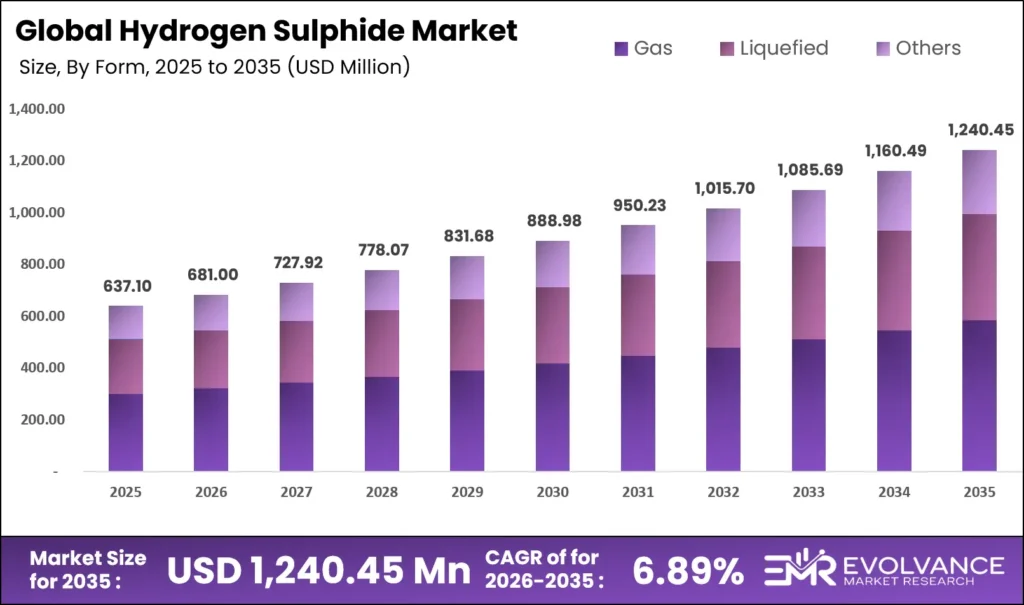
The Global Hydrogen Sulphide Market size will be worth around USD 1,240.45 million by 2035 from USD 637.1 million in 2025, growing at a CAGR of 6.89% during the forecast period 2026 to 2035. Strict environmental safety mandates force heavy industries to adopt advanced sulfur recovery units across major regional production hubs. Consequently, refinery buyers now prioritize integrated gas monitoring systems to stop toxic leaks early during daily tasks. Meanwhile, limited pipeline infrastructure for safe bulk transport currently restricts rapid supply chain expansion across remote processing sites globally.
Market Highlights
- The Global Hydrogen Sulphide Market is projected to grow from USD 637.1 million in 2025 to approximately USD 1,240.45 million by 2035, expanding at a robust CAGR of 6.89% during the forecast period (2026–2035).
- The Gas form held a dominant market position with a 51.7% share, favored by buyers for direct pipeline feeds that avoid costly liquefaction, ensure continuous production cycles, and lower total running costs.
- The 4N (99.99% purity) grade captured a dominant 63.9% share, driven by extreme purity requirements in semiconductor fabrication, where buyers willingly pay premium prices to secure consistent quality and stable yields.
- The Chemicals Industry led with a 42.6% share, fueled by massive consumption of hydrogen sulphide to create sulfur-based acids and organic compounds, necessitating large-scale, uninterrupted supply chains for continuous factory operations.
- The Oil and Gas industry dominated with a 47.1% share, as refineries extensively strip naturally occurring sulfur from crude oil to comply with stringent clean fuel regulations.
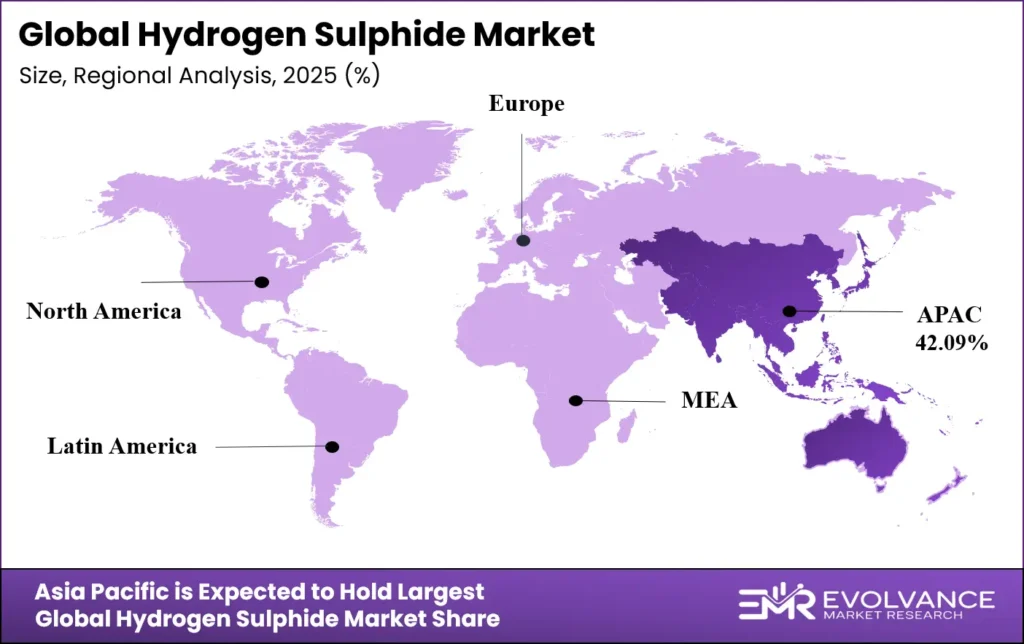
- Geographically, the Asia Pacific region dominated the global Hydrogen Sulphide Market in 2025, holding a significant 42.09% market share, with the regional market valued at USD 268.16 million.
Market Overview
Hydrogen sulphide acts as a core reactive agent in chemical synthesis and sulfur production. Industrial facilities extract this highly toxic gas during crude oil refining and natural gas processing. Companies then purify the compound to support specialized manufacturing tasks. Active extraction methods define current market focus.
Moreover, modern processing plants treat this gas as a vital input rather than mere waste. Chemical makers rely on pure gas streams to create thioorganic compounds and agricultural pesticides. This shift from waste to resource drives capital spending toward better recovery units. Safety protocols shape all handling procedures.
Additionally, state agencies strictly control how facilities process and store these volatile sulfur compounds. Government rules require heavy investment in leak detection and secure storage systems. Consequently, plant managers buy upgraded sensors to maintain legal compliance. These mandatory safety upgrades expand total equipment sales globally.
According to the United States Environmental Protection Agency, managed toxic chemical waste reached 28.6 billion pounds in 2022. This massive volume forces natural gas processors to upgrade their handling systems. Therefore, energy firms must invest heavily in specialized gas capture tools to avoid federal penalties.
Furthermore, modern sensor technologies allow plant managers to detect trace gas amounts instantly. Real-time digital monitors replace slow manual testing protocols across heavy industrial sites. Consequently, facilities respond to pressure changes before full ruptures occur. This digital shift ensures maximum uptime for massive refinery networks.
Statistical Data of Hydrogen Sulphide Market
- PEMEX Deer Park Refinery property damage financial losses totaled 12.3 million dollars in October 2024, representing the financial impact related to the loss of use of its Amine Unit and downstream processes following a catastrophic hydrogen sulfide gas leak that forced operations to halt.
- Amine Regeneration Unit 7 (ARU7) at PEMEX Deer Park adjacent piping segment hydrogen sulfide gas concentration was 90 percent in October 2024, highlighting the extreme volatility, high concentration levels, and processing risks associated with removing toxic gases from sour crude oil refining.
- Amine Regeneration Unit 7 (ARU7) at PEMEX Deer Park operational piping gauge pressure reached 15 pounds per square inch in October 2024, demonstrating the pressurized state of the 90 percent hydrogen sulfide gas line that was inadvertently opened by contract maintenance workers.
- National Institute for Occupational Safety and Health (NIOSH) Immediately Dangerous to Life or Health (IDLH) concentration threshold for hydrogen sulfide was maintained at 100 parts per million in 2024, a regulatory threshold that mandates strict usage of safety equipment and continuous toxic gas monitoring across oil refineries and wastewater facilities.
- United States Gulf Coast (PADD 3) four-week average refinery utilization decreased 14 percent in early 2024, directly impacting the domestic throughput of sour crude and subsequently affecting the overall recovery volumes of hydrogen sulfide and elemental sulfur byproducts from regional refining operations.
- United States Environmental Protection Agency recorded that a catastrophic refinery incident released 27,000 pounds of toxic hydrogen sulfide gas in October 2024, an event that prompted emergency planning updates and highlighted critical containment vulnerabilities in the sour crude refining market.
- Alberta Energy Regulator established a regulatory threshold of 10 moles of hydrogen sulfide gas per kilomole of natural gas in February 2024, triggering elevated technical scrutiny and strict containment compliance requirements for newly constructed oil effluent pipeline projects.
- Alberta Energy Regulator mandated the adoption of its updated AERH2S emergency modeling software effective January 1 2026, compelling the regional oil and gas sector to recalibrate emergency planning zones for all new applications involving hazardous hydrogen sulfide extraction and processing.
- Occupational Safety and Health Administration assessed an initial penalty of 16,550 dollars for a single serious violation in February 2026, reflecting tightened federal enforcement of hazard communication and training standards for workers exposed to hydrogen sulfide in chemical processing environments.
Form Insights
Gas dominates with 51.7% due to direct pipeline transport efficiency.
In 2025, Gas held a dominant market position in the By Form segment of Hydrogen Sulphide Market, with a 51.7% share. Direct pipeline feeds allow chemical plants to maintain continuous production cycles. Furthermore, buyers prefer this state to avoid costly liquefaction processes. Steady flow rates lower total running costs.
Liquefied formats serve buyers needing long-distance transport options without pipeline access. Industrial users buy compressed tanks to supply remote mining or manufacturing sites. Additionally, this form allows higher volume storage in smaller facility footprints. However, complex cooling requirements raise final purchase prices.
Others capture niche demands where standard gas or liquid forms fail. Small research labs often buy specialty mixtures for testing and analysis. Consequently, these buyers prioritize precise blending over bulk volume. High custom delivery costs limit broad adoption for this specific segment.
Type (Purity Grade) Insights
4N dominates with 63.9% due to strict electronic manufacturing standards.
In 2025, 4N held a dominant market position in the By Type (Purity Grade) segment of Hydrogen Sulphide Market, with a 63.9% share. Chip makers require extreme purity to prevent defects during semiconductor fabrication. Consequently, buyers willingly pay premium prices to secure this high-grade gas. Consistent quality ensures stable yields.
2.5N/3N grades support standard chemical synthesis where ultra-high purity is unnecessary. Agricultural chemical makers buy this grade to produce bulk pesticides and fertilizers. Furthermore, lower refinement costs make these grades highly attractive for large-scale industrial buyers. Broad availability ensures steady supply for commodity producers.
Application Insights
Chemicals Industry dominates with 42.6% due to massive bulk synthesis demands.
In 2025, Chemicals Industry held a dominant market position in the By Application segment of Hydrogen Sulphide Market, with a 42.6% share. Producers consume vast gas volumes to create sulfur-based acids and organic compounds. Consequently, continuous factory tasks require massive, uninterrupted supply chains. High baseline consumption defines this leading industrial segment.
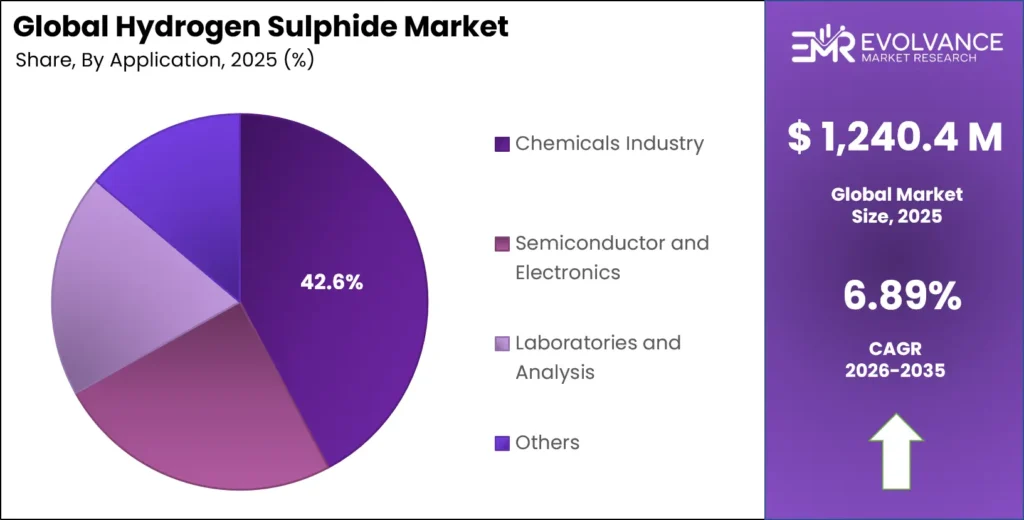
Semiconductor and Electronics buyers rely on precise gas flows to dope silicon wafers. Factories use the compound to alter electrical properties in advanced microchips. Therefore, facility managers demand absolute supply reliability to prevent costly assembly line shutdowns. Strict technical limits define this application.
Laboratories and Analysis units use tiny gas amounts to calibrate testing sensors. Researchers depend on precise mixtures to study environmental impacts and chemical reactions. Additionally, safety trainers buy small gas cylinders to test worker alarm systems. Low volumes but high margins characterize these sales.
End-Use Insights
Oil and Gas dominates with 47.1% due to vast sour crude processing.
In 2025, Oil and Gas held a dominant market position in the By End-Use segment of Hydrogen Sulphide Market, with a 47.1% share. Refineries strip naturally occurring sulfur from crude to meet clean fuel rules. According to the United States Bureau of Labor Statistics, gas inhalation caused 38 fatal injuries between 2011 and 2019. This danger drives heavy safety spending.
Semiconductors and Electronics plants consume purified gas to build advanced memory chips. Fabrication units require flawless gas delivery systems to prevent tiny product defects. Furthermore, rapid tech cycles force these end-users to secure long-term supply contracts. Stable sourcing protects complex production timelines.
Market Segments Covered in the Report
By Form
- Gas
- Liquefied
- Others
By Type (Purity Grade)
- 4N
- 2.5N/3N
By Application
- Chemicals Industry
- Semiconductor and Electronics
- Laboratories and Analysis
- Others
By End-Use
- Oil and Gas
- Semiconductors and Electronics
- Others
Regional Insights
Asia Pacific Dominates the Hydrogen Sulphide Market with a Market Share of 42.09%, Valued at USD 268.16 Million
Asia Pacific commands the global landscape because massive chemical hubs rapidly expand across regional borders. Local governments push industrial growth, forcing domestic refineries to scale up raw sulfur extraction. Consequently, heavy factory output sustains continuous bulk gas consumption. Strong export targets keep plant output high.
North America Market Trends
North America maintains a strong position because strict environmental rules govern sour gas processing. Regulators force energy firms to invest in highly advanced sulfur recovery technology. Therefore, facility owners constantly upgrade equipment to prevent toxic emissions. Mature oil infrastructure guarantees steady product demand.
Europe Market Trends
Europe focuses deeply on worker safety and clean energy transitions across industrial sectors. Strict union laws require chemical plants to deploy state-of-the-art leak detection systems. Additionally, green energy policies push refineries to capture and reuse sulfur byproducts. These rigid compliance frameworks dictate regional spending habits.
Latin America Market Trends
Latin America shows steady activity driven by offshore oil exploration and local mining tasks. Regional energy companies extract heavy crude that requires extensive sulfur removal before export. Consequently, extraction sites buy specialized handling equipment to process this sour oil. Infrastructure gaps still limit faster market expansion.
Middle East & Africa Market Trends
The Middle East heavily influences global supply through massive state-owned oil production networks. Regional producers process vast amounts of sour crude, generating immense sulfur volumes. Therefore, large energy firms control the local chemical output and dictate pricing. Rapid refinery modernization currently supports steady equipment sales.
Key Regions and Countries
North America
- US
- Canada
Europe
- Germany
- France
- The UK
- Spain
- Italy
- Rest of Europe
Asia Pacific
- China
- Japan
- South Korea
- India
- Australia
- Rest of APAC
Latin America
- Brazil
- Mexico
- Rest of Latin America
Middle East & Africa
- GCC
- South Africa
- Rest of MEA
Market Drivers
| Driver | (~) % Impact on CAGR Forecast | Geographic Relevance | Impact Timeline |
|---|---|---|---|
| High purity electronic grade demand from semiconductors | +1.3% | Asia Pacific, North America | Short term (2 years or less) |
| Chemical manufacturing and sulfur derivative feedstock use | +1.0% | Asia Pacific, North America | Short term (2 years or less) |
| Refinery sulfur recovery and Claus process throughput | +0.8% | Middle East, Asia Pacific | Medium term (2 to 4 years) |
| Agrochemical and fertilizer intermediate demand | +0.6% | Asia Pacific, Latin America | Medium term (2 to 4 years) |
| Heavy and sour crude processing growth | +0.5% | Middle East, North America | Medium term (2 to 4 years) |
High Purity Electronic Grade Demand From Semiconductors
The key growth driver is rising demand for ultra-high-purity hydrogen sulfide in semiconductor and compound-material fabrication for CVD, doping, and thin-film processes, supported by expanding chip capacity through 2024–2025. Electronic-grade H₂S typically requires 99.999%+ purity, enabling significant price premiums and higher-value specialty gas contracts, with electronic-grade margins estimated 15–25 percentage points above industrial grades. Long-term supply agreements, strict quality certification, and requalification requirements further strengthen incumbent supplier positions and support premium market growth.
Market Restraints
| Restraint | (~) % Impact on CAGR Forecast | Geographic Relevance | Impact Timeline |
|---|---|---|---|
| Acute toxicity driven handling and transport bans | -1.4% | Global | Short term (2 years or less) |
| Stringent occupational exposure limit enforcement | -1.0% | North America, Europe | Short term (2 years or less) |
| High interest rate constrained refining CapEx | -0.7% | Global | Short term (2 years or less) |
| Energy transition pressure on fossil fuel processing | -0.5% | Europe, North America | Medium term (2 to 4 years) |
| Captive onsite production limiting merchant demand | -0.4% | Global | Medium term (2 to 4 years) |
Acute Toxicity Driven Handling And Transport Bans
The key restraint is hydrogen sulfide’s acute toxicity, with exposure above roughly 500 ppm potentially causing rapid unconsciousness and death, triggering stringent transport, storage, and handling requirements. These constraints raise compliance, monitoring, containment, insurance, and logistics costs, while limiting merchant distribution and restricting addressable demand to qualified handlers. Higher operating and liability costs can compress distributor margins by an estimated 200–400 basis points, while deterring new entrants and investment, making this a hard market restraint rather than a gradual growth challenge.
Market Challenges
| Challenge | (~) CAGR Friction Drag | Geographic Relevance | Mitigation Horizon |
|---|---|---|---|
| Corrosion and materials integrity management | -0.9% | Global | Medium term (2 to 4 years) |
| Ultra high purity production consistency | -0.7% | Asia Pacific, North America | Medium term (2 to 4 years) |
| Specialized hazardous chemical handling talent gap | -0.5% | Global | Long term (4 years or more) |
| Emission and effluent abatement compliance load | -0.4% | Europe, North America | Long term (4 years or more) |
| Feedstock sour gas quality variability | -0.3% | Middle East, North America | Medium term (2 to 4 years) |
Corrosion And Materials Integrity Management
The key structural restraint is hydrogen sulfide’s severe corrosivity, which causes sulfide stress cracking and hydrogen embrittlement in carbon-steel equipment. Sour-service compliant systems can increase capital costs by an estimated 15%–30% versus standard carbon steel, while corrosion-related downtime, inspections, inhibitors, monitoring, and integrity management add recurring costs. Full fleet upgrades can take several years alongside turnaround schedules, increasing expansion costs and limiting the speed of capacity growth without disrupting existing qualified operations.
Market Opportunities
| Opportunity | (~) % Potential CAGR Upside | Geographic Relevance | Execution Window |
|---|---|---|---|
| Hydrogen sulfide to clean hydrogen recovery valorization | +1.2% | Middle East, North America, Europe | Long term (4 years or more) |
| Biogas and wastewater derived sulfide recovery streams | +0.8% | Europe, Asia Pacific | Medium term (2 to 4 years) |
| Battery and specialty material sulfur precursor whitespace | +0.7% | Asia Pacific, North America | Long term (4 years or more) |
| Onsite generation service and safety technology models | +0.5% | Global | Medium term (2 to 4 years) |
| M&A roll up of regional specialty gas suppliers | +0.4% | Global | Medium term (2 to 4 years) |
Hydrogen Sulfide To Clean Hydrogen Recovery Valorization
This represents untapped future white space, as thermal, plasma, and electrochemical hydrogen sulfide decomposition technologies remain largely at pilot and demonstration stages as of 2026. By converting H₂S into recoverable hydrogen and elemental sulfur, these routes could create a new low-carbon hydrogen feedstock and dual-revenue stream, potentially reducing hydrogen production costs by 20%–40% versus incremental SMR and expanding gross margins by an estimated 400–700 basis points. Realizing this opportunity would require targeted CapEx in decomposition reactors and process integration beyond conventional sulfur recovery operations.
Regulatory Landscape
The Alberta Energy Regulator established a strict regulatory threshold of 10 moles in February 2024. This rule targets natural gas pipelines handling toxic gas mixtures. Consequently, energy firms face high technical scrutiny for new pipeline construction. This policy forces heavy spending on advanced containment systems.
Furthermore, the Alberta Energy Regulator mandated updated emergency modeling software starting January 1, 2026. This strict directive requires regional oil firms to rethink their hazard zones. Therefore, plant managers must purchase compliant software to map potential toxic releases. This mandate actively shifts software procurement cycles.
Additionally, broader global regulations demand absolute precision in toxic waste reporting. Energy facilities must track all hazardous outputs to prevent local environmental damage. Consequently, industrial leaders invest heavily in digital tracking tools to avoid severe federal fines. Strict global oversight permanently alters daily running costs.
Research Methodology Framework and Report Scope
Market Definitions and Key Coverage
This report analyzes the commercial trade of raw and purified gas forms across industrial sectors. The scope includes chemical synthesis inputs, semiconductor doping gases, and laboratory testing mixtures. Analysts value this market in constant 2025 US dollars to eliminate external currency fluctuations. Full tracking covers all regional supply contracts and bulk purchase agreements.
The scope strictly excludes unrelated sulfur-based solid fertilizers and retail agricultural products. Furthermore, the analysis omits standalone leak detection software unless bundled with physical gas delivery systems. This tight focus ensures accurate revenue tracking for pure chemical producers. Non-industrial academic research volumes also remain outside this valuation model.
Key Companies Insights
Air Liquide captures major market share by building massive gas production plants near client sites. This localized strategy drastically cuts heavy transportation costs for industrial buyers. Furthermore, the company locks end-users into long-term supply contracts to guarantee revenue. This aggressive footprint makes local competition highly difficult.
The Linde Group dominates complex industrial bids through its deep engineering expertise in gas separation. The firm customizes extraction units specifically for large oil refineries. Consequently, heavy industrial clients trust their high-capacity systems to handle dangerous sour gas safely. This technical edge secures massive multinational deals.
Praxair targets high-margin electronic clients by perfecting ultra-pure gas refinement techniques. The company supplies defect-free gas streams directly to major semiconductor factories. Therefore, tech manufacturers rely heavily on their strict quality control to maintain chip yields. This precise focus creates strong barriers against cheap commodity suppliers.
Air Products and Chemicals focuses on rapid delivery logistics to serve remote chemical plants. The firm deploys specialized transport fleets to move volatile liquids safely across long distances. Additionally, they bundle safety training with physical deliveries to add client value. This service model builds deep brand loyalty.
Key Companies
- Air Liquide
- The Linde Group
- Praxair
- Air Products and Chemicals
- Sobegi
- Messer Group
- Matheson Tri-Gas
- Taiyo Nippon Sanso
- Shandong Yanhe Chemical
- Sumitomo Seika Chemicals
- Taihe Gases
- Guangdong Huate Gas
- Sinochem Holdings Corporation
- Zibo Dijia Special Gas Co., Ltd.
- Advanced Specialty Gases
- Merck KGaA
Recent Industry Developments
- In July 2025, MPLX LP announced it will acquire Northwind Midstream for $2.38 billion in cash to expand its sour gas gathering and processing footprint in the Permian Basin. Northwind operates in Lea County, New Mexico, with over 200 miles of pipeline and treats 150 MMcfpd of sour gas, with expansion expected to reach 440 MMcfpd by H2 2026.
- In December 2025, Targa Resources announced it will acquire Stakeholder Midstream for $1.25 billion, expanding its sour gas treating capacity in the Permian Basin’s Northern Delaware region where wells produce large volumes of gas with high hydrogen sulfide content.
- In August 2025, Streamline Innovations Inc., a provider of patented solutions to eliminate hydrogen sulfide emissions, completed a recapitalization with new investors. Eldon Pass led the equity investment, Select Milk was lead equity participant, and Proterra Investment Partners arranged a unitranche loan. Proceeds will fund growth in energy and industrial markets.
- In February 2024, Thiozen received $1.18 million in grants from the U.S. National Science Foundation (NSF) to commercialize its technology that produces clean hydrogen from hydrogen sulfide found in sour natural gas.
- In July 2024, Thiozen announced it received a total of $3.2 million in funding from Emissions Reduction Alberta (ERA) and Alberta Innovates for a clean hydrogen project in Alberta, Canada, to install its proprietary technology at a gas processing site to remove hydrogen sulfide from sour gas while generating zero-emission hydrogen.
Market Scope
| Report Features | Description |
|---|---|
| Market Value (2025) | USD 637.1 Million |
| Forecast Revenue (2035) | USD 1,240.45 Million |
| CAGR (2026-2035) | 6.89% |
| Base Year for Estimation | 2025 |
| Historic Period | 2020-2024 |
| Forecast Period | 2026-2035 |
| Report Coverage | Revenue Forecast, Market Dynamics, Competitive Landscape, Recent Developments |
| Segments Covered | By Form (Gas, Liquefied, Others), By Type (Purity Grade) (4N, 2.5N/3N), By Application (Chemicals Industry, Semiconductor and Electronics, Laboratories and Analysis, Others), By End-Use (Oil and Gas, Semiconductors and Electronics, Others) |
| Regional Analysis | North America (US and Canada), Europe (Germany, France, The UK, Spain, Italy, and Rest of Europe), Asia Pacific (China, Japan, South Korea, India, Australia, and Rest of APAC), Latin America (Brazil, Mexico, and Rest of Latin America), Middle East & Africa (GCC, South Africa, and Rest of MEA) |
| Competitive Landscape | Air Liquide, The Linde Group, Praxair, Air Products and Chemicals, Sobegi, Messer Group, Matheson Tri-Gas, Taiyo Nippon Sanso, Shandong Yanhe Chemical, Sumitomo Seika Chemicals, Taihe Gases, Guangdong Huate Gas, Sinochem Holdings Corporation, Zibo Dijia Special Gas Co., Ltd., Advanced Specialty Gases, Merck KGaA |
| Customization Scope | Customization for segments, region/country-level will be provided. Moreover, additional customization can be done based on the requirements. |
| Purchase Options | We have three licenses to opt for: Single User License, Multi-User License (Up to 5 Users), Corporate Use License (Unlimited User and Printable PDF) |