

What Is the Agentic AI Market?
The Global Agentic AI Market was valued at USD 12.84 billion in 2026 and is projected to reach approximately USD 337.63 billion by 2035, growing at a CAGR of 43.8% during the forecast period. The accelerating enterprise transition from passive generative AI tools toward autonomous, goal-directed AI agents capable of executing complex multi-step workflows with minimal human oversight is the primary structural demand driver.
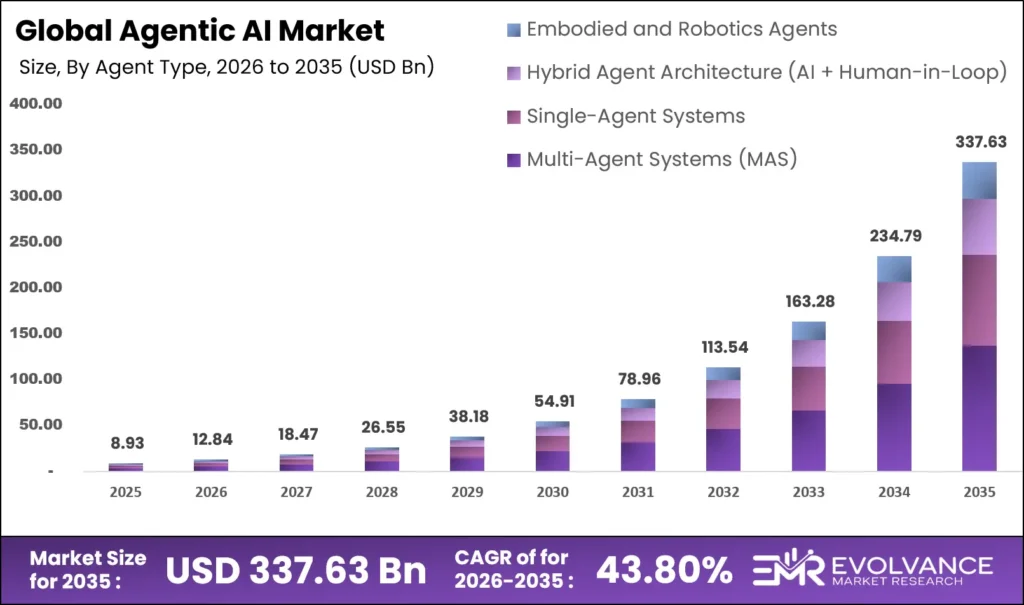
Microsoft, Salesforce, ServiceNow, Google, and Anthropic collectively launched more than forty commercially available agentic AI platform products between 2024 and early 2026, converting enterprise AI experimentation into systematic operational deployment at scale. The market encompasses single-agent and multi-agent AI systems, autonomous process automation platforms, AI agent development frameworks and orchestration tools, agentic workflow management software, agent memory and retrieval systems, and managed agentic AI services.
Agentic AI is characterized by its ability to perceive dynamic environments, reason across multiple sequential steps, access external tools and APIs, maintain persistent memory across sessions, delegate subtasks to specialized sub-agents, and adapt strategies based on real-time feedback capabilities that fundamentally differentiate autonomous agents from prior-generation conversational chatbots or rule-based automation systems.
Agentic AI Market Highlights: Key Data at a Glance
- Market value: USD 12.84 billion in 2026, forecast to USD 337.63 billion by 2035 at 43.8% CAGR
- Dominant architecture: Multi-Agent Systems with 53.3% revenue share in 2026
- Dominant deployment mode: Cloud with 46.8% of agentic AI platform revenue
- Fastest-growing deployment: Edge and on-device agentic AI at 51.2% CAGR through 2035
- Dominant enterprise function: IT Operations and Customer Experience automation at 38.6% combined share
- Leading platform vendor: Microsoft (Copilot Studio) with approximately 24.7% enterprise agentic platform market share
- Enterprise adoption rate: 51% of enterprises have AI agents in active production as of Q1 2026
- Productivity benchmark: Autonomous agents reduce multi-step workflow completion time by up to 76% versus manual execution
- Average ROI: USD 3.50 return per USD 1.00 invested in enterprise agentic AI deployments
- Top end-use industry: BFSI with 23.8% of total agentic AI market revenue in 2026
Market Overview: Why Agentic AI Growth Is Accelerating
The Agentic AI market is at an inflection point defined by three simultaneous structural demand accelerators that distinguish agentic AI from all prior automation technology waves. The first is demonstrated enterprise ROI at production scale. Unlike generative AI co-pilots that require constant human prompting and supervision, autonomous AI agents executing complete business workflows invoice processing, customer onboarding, IT ticket resolution, sales prospecting generate quantifiable productivity economics that CIOs can defend in capital allocation reviews.
Google Cloud data published in 2025 confirmed that 88% of early enterprise agentic AI adopters reported positive ROI, with 34% of organizations recording measurable productivity increases among knowledge workers in 2026 alone. This performance evidence base is compressing enterprise adoption timelines from multi-year innovation programs to quarterly operational deployments.
The second accelerator is the rapid maturation of foundational LLM reasoning capabilities that make reliable autonomous execution commercially feasible at enterprise scale. GPT-4o, Claude 3.7 Sonnet, Gemini 2.0 Ultra, and their successor models demonstrated in 2025 and 2026 that AI systems can reliably execute multi-step workflows, recover from intermediate errors, use APIs and databases as tools, and maintain goal coherence across sessions of thirty to ninety minutes the minimum capability threshold for enterprise workflow automation viability. Each successive model generation expands the range of tasks within autonomous agent execution reach, sustaining adoption growth independent of platform-level investment cycles.
The third accelerator is the competitive urgency created by agentic AI adoption among enterprise peers. World Economic Forum data projects that organizations successfully scaling AI agents across core operations in 2026 will achieve sustainable competitive cost advantages of 18% to 34% in affected functions within three years. With 93% of business leaders surveyed confirming this competitive conviction and 85% of enterprises planning agentic AI implementation by end of 2026, adoption has transitioned from innovation exploration into defensive strategic necessity a dynamic that structurally compresses the typical enterprise technology adoption curve from fifteen years to under five.
Key Data Snapshot
Core Performance Metrics Defining the Global Agentic AI Market for 2026–2035
| Metric | Value |
|---|---|
| Global Market Size 2026 | USD 12.84 Billion |
| Projected Market Size 2035 | USD 337.63 Billion |
| CAGR 2026–2035 | 43.8% Annual Growth Rate |
| Dominant Architecture | Multi-Agent Systems 53.3% Share |
| Dominant Deployment Mode | Cloud 46.8% Revenue Share |
| Fastest-Growing Segment | Agentic AI Software Solutions 61.65% Share |
| Top End-Use Industry | BFSI 23.8% Market Share |
| Enterprise Production Rate | 51% Active Deployments Q1 2026 |
| Average Agent ROI | USD 3.50 per USD 1.00 Invested |
| Market Leader | Microsoft Copilot Studio 24.7% Share |
| Leads Global Agentic AI Investment | North America |
| Fastest-Growing Region | Asia-Pacific |
Executive Summary
Quick Insight: The Global Agentic AI Market is on track to expand more than 25× by 2035, driven by accelerating enterprise adoption of autonomous workflow automation, multi-agent orchestration system deployment, breakthrough LLM reasoning capabilities, and the systematic replacement of rule-based robotic process automation with goal-directed AI agents across every major industry vertical and enterprise function worldwide.
The global Agentic AI market encompasses autonomous AI systems capable of independent decision-making, multi-step task execution, tool use, memory management, and collaborative multi-agent coordination without continuous human supervision. This report delivers comprehensive analysis of market size, agent architecture dynamics, deployment economics, enterprise productivity benchmarks, and competitive positioning for the 2026–2035 forecast period, covering LLM integration frameworks, multi-agent orchestration platforms, enterprise ROI economics, and AI governance requirements reshaping knowledge work automation globally.
Key findings: The market reaches USD 12.84 billion in 2026 and compounds at 43.8% CAGR to USD 337.63 billion by 2035. Multi-agent systems command 53.3% of architecture revenue share. Cloud deployment leads with 46.8% revenue share. Microsoft Copilot Studio, Salesforce Agentforce, and ServiceNow AI Agents collectively represent more than USD 4.2 billion in annualized agentic AI platform revenue in 2026. Three new sections Multi-Agent Orchestration and LLM Reasoning Frameworks, Enterprise Agentic AI ROI and Productivity Economics, and Agentic AI Governance, Safety, and Regulatory Landscape provide strategic intelligence not available in comparable market reports.
Component Analysis
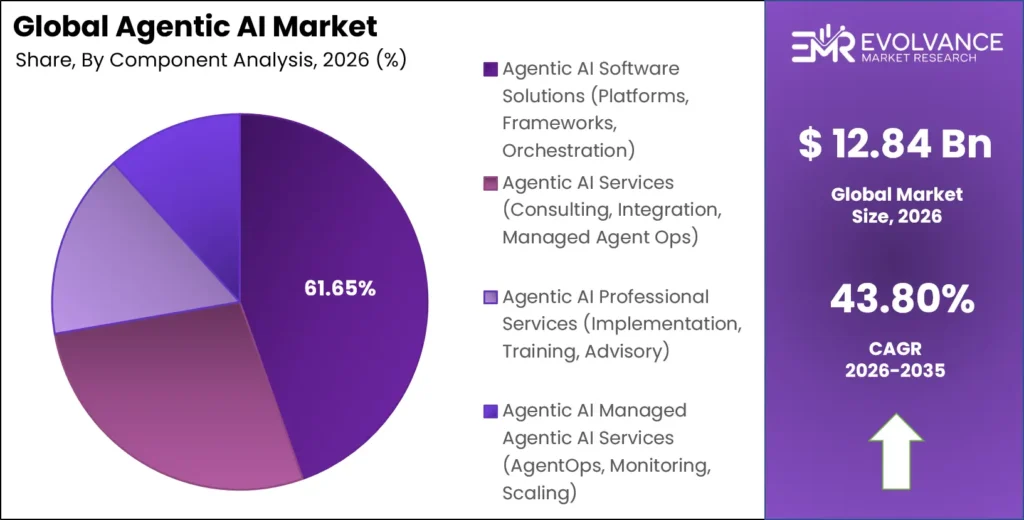
Software Solutions Lead with 61.65% Revenue Share; Services Represent the Fastest-Growing Segment
Agentic AI Software Solutions, Agent Development Platforms, Memory Systems, and Managed Services Component Economics Breakdown
| Component | Share % | CAGR | Primary Driver |
|---|---|---|---|
| Agentic AI Software Solutions (Platforms, Frameworks, Orchestration) | 61.65% | 42.3% | Enterprise workflow automation, LLM agent deployment, multi-agent coordination |
| Agentic AI Services (Consulting, Integration, Managed Agent Ops) | 38.35% | 43.8% | System integration complexity, enterprise customization, ongoing agent optimization |
| Agentic AI Professional Services (Implementation, Training, Advisory) | 22.1% | 41.2% | Agent deployment complexity, domain-specific workflow engineering |
| Agentic AI Managed Agentic AI Services (AgentOps, Monitoring, Scaling) | 16.25% | 51.6% | Enterprise demand for outsourced agent operation and performance optimization |
Agentic AI Software Solutions command a 61.65% component revenue share in 2026, establishing autonomous platform software as the central economic engine of the agentic AI market. The solutions segment encompasses agent development frameworks LangChain, AutoGen, CrewAI, and LlamaIndex alongside enterprise agentic platforms including Microsoft Copilot Studio, Salesforce Agentforce, ServiceNow AI Agents, and Workday AI Agents.
These platforms enable organizations to deploy, orchestrate, and monitor autonomous AI agents without requiring foundational model development expertise, reducing deployment timelines from eighteen months to under ninety days for standard enterprise workflow automation use cases.
Managed Agentic AI Services represent the highest-growth component at 51.6% CAGR, reflecting enterprise demand for outsourced agent operations management as autonomous AI systems move beyond pilot programs into mission-critical business process execution. The complexity of multi-agent orchestration managing agent handoff protocols, error recovery, output validation, and continuous performance optimization is creating a professional services market analogous to cloud managed services, where specialized vendors operate agentic AI infrastructure on behalf of enterprise clients at scale.
Agent Architecture Analysis
Multi-Agent Systems Dominate at 53.3%; Hybrid Architectures Deliver Highest Enterprise Value
Single-Agent, Multi-Agent, Hybrid, and Specialized Agent Architecture Performance and Deployment Economics for 2026
| Agent Architecture | Share % | CAGR | Primary Driver |
|---|---|---|---|
| Multi-Agent Systems (MAS) | 53.3% | 43.5% | Complex enterprise workflow decomposition, parallel task execution, specialized sub-agent coordination |
| Single-Agent Systems | 30.8% | 38.2% | Targeted task automation, SME deployments, rapid prototyping, customer service automation |
| Hybrid Agent Architecture (AI + Human-in-Loop) | 10.7% | 46.8% | Regulated industries requiring audit trails, high-stakes decision validation, compliance oversight |
| Embodied and Robotics Agents | 5.2% | 58.4% | Physical AI, manufacturing automation, autonomous warehouse operations, surgical robotics |
Multi-Agent Systems command a 53.3% architecture revenue share in 2026 and are forecast to sustain a 43.5% CAGR through 2035 as enterprise workflow complexity exceeds the reliable execution capability of single-agent architectures. Multi-agent frameworks decompose large business processes into parallel subtask streams executed by specialized agents a research agent, a writing agent, a validation agent, and a publishing agent collaborating on content workflows; or a prospecting agent, a qualification agent, and a scheduling agent executing end-to-end B2B sales automation.
AutoGen, CrewAI, and LangGraph provide the orchestration layer enabling these architectures, with Microsoft’s multi-agent Copilot Studio framework reaching more than 230,000 enterprise deployments by Q1 2026.
Embodied and Robotics Agents represent the smallest but fastest-growing architecture segment at 58.4% CAGR, as physical AI systems integrating large language model reasoning with robotic actuation enter commercial deployment in manufacturing, logistics, and healthcare settings. Figure AI, Physical Intelligence, and Boston Dynamics are deploying LLM-reasoning robotic agents in warehouse automation and assembly operations, creating an entirely new revenue category within agentic AI that will reach an estimated USD 8.4 billion by 2030.
Deployment Mode Analysis
Cloud Leads with 46.8% Share; Edge Agentic AI Is the Fastest-Growing Deployment
Cloud-Native, On-Premise, Hybrid, and Edge Agentic AI Deployment Economics for 2026
| Deployment Mode | Share % | CAGR | Primary Driver |
|---|---|---|---|
| Cloud (SaaS + PaaS Agentic Platforms) | 46.8% | 41.2% | Scalability, rapid deployment, LLM API access, hyperscaler AI platform integration |
| On-Premise (Enterprise Agent Clusters) | 28.4% | 42.6% | Data sovereignty, IP protection, regulated industries, latency-critical workflows |
| Hybrid (Cloud Orchestration + On-Premise Execution) | 16.9% | 47.3% | Workload portability, compliance-driven segmentation, multi-environment data access |
| Edge and On-Device Agentic AI | 7.9% | 51.2% | Autonomous robotics, manufacturing intelligence, offline operation, 5G network agents |
Cloud deployment holds a 46.8% share of agentic AI platform revenue in 2026 as SaaS-delivered agent platforms provide enterprises with immediate access to foundational LLM capabilities, pre-built agent templates, and hyperscaler compute infrastructure without capital expenditure commitments. Microsoft Azure AI Studio, Google Vertex AI Agent Builder, and AWS Bedrock Agents collectively process more than 4.8 billion autonomous agent task executions monthly as of Q1 2026, serving enterprise deployments across sales automation, IT operations, and customer experience management at cloud-native scale and elasticity.
Edge and on-device agentic AI is expanding at 51.2% CAGR the fastest deployment growth rate in the market as autonomous agents embedded in manufacturing equipment, retail point-of-sale systems, and mobile enterprise applications execute decisions without cloud latency or connectivity dependency. Qualcomm’s AI 100 chips and NVIDIA’s Jetson Orin platform enable on-device agentic reasoning for industrial inspection, predictive maintenance, and autonomous logistics orchestration, with the installed base of edge agentic AI devices projected to exceed 840 million units globally by 2030.
Technology Segment Analysis
LLM-Based Agents Lead at 47.2%; NLP and Deep Learning Drive Multi-Modal Enterprise Automation
| Technology Segment | Share % | CAGR | Primary Driver |
|---|---|---|---|
| LLM-Based Agents | 47.2% | 44.9% | GPT-4o, Claude 3.7 Sonnet, Gemini 2.0 enterprise reasoning at production scale |
| ML-Based Agents | 27.6% | 39.4% | Predictive analytics, classification, anomaly detection in BFSI and manufacturing |
| Deep Learning Agents | 16.5% | 46.7% | Vision agents, robotics perception, multi-modal reasoning in healthcare and industrial AI |
| NLP Agents | 8.7% | 37.1% | Conversational agents, document processing, sentiment analysis, contract review |
LLM-Based Agents command a 47.2% technology revenue share in 2026, establishing large language model reasoning as the dominant technical foundation for enterprise agentic AI deployment. The LLM-based segment encompasses agent frameworks built on GPT-4o, Claude 3.7 Sonnet, Gemini 2.0 Ultra, and their successors models capable of multi-step reasoning, tool use, and goal-directed task execution at commercially viable reliability thresholds.
Enterprises deploying LLM-based agents in 2026 report 44% to 67% reductions in knowledge workflow completion time across sales automation, legal document review, and IT operations management. The 44.9% CAGR reflects accelerating model capability improvement cycles that continuously expand the enterprise task range within LLM-based agent execution reach.
ML-Based Agents hold a 27.6% share, serving structured prediction, anomaly detection, and decision optimization workloads in BFSI, manufacturing, and retail. Deep Learning Agents at 16.5% share are the second fastest-growing technology segment at 46.7% CAGR, powered by vision-language models enabling computer-vision agents in industrial inspection, medical imaging, and autonomous robotics. NLP Agents at 8.7% share underpin conversational customer service automation and intelligent document processing pipelines across telecom and government verticals.
Enterprise Function Analysis
IT Ops and Customer Experience Lead at 38.6% Combined Share; Finance and Supply Chain Deliver Highest ROI
| Enterprise Function | Share % | CAGR | Top Agentic Use Case |
|---|---|---|---|
| IT Operations and DevOps | 21.4% | 43.1% | Autonomous incident resolution, ticket routing, infrastructure monitoring, DevOps pipeline automation |
| Customer Experience | 17.2% | 46.3% | Autonomous service agents, personalization engines, complaint resolution, proactive outreach |
| Sales and Revenue Operations | 18.9% | 44.8% | Prospecting agents, lead qualification, pipeline forecasting, autonomous proposal generation |
| Finance and Accounting | 16.8% | 42.6% | Invoice processing, regulatory reporting, audit preparation, autonomous reconciliation agents |
| HR and Talent Management | 14.3% | 41.9% | Candidate screening, onboarding automation, performance review agents, workforce planning |
| Supply Chain and Procurement | 11.4% | 49.2% | Autonomous reordering agents, supplier negotiation, demand forecasting, logistics optimization |
IT Operations and Customer Experience jointly command 38.6% of enterprise agentic AI function revenue in 2026, driven by the high volume of repetitive, rule-bounded tasks in these functions that map directly to autonomous agent execution strengths. ServiceNow AI Agents resolve 67% of IT tickets without human intervention, reducing mean time to resolution by 58% across enterprise deployments.
Customer Experience agents deployed by Salesforce Agentforce handle an average of 4,200 service interactions per agent per day, operating at one-eighth the cost of equivalent human agent capacity while maintaining satisfaction scores within 4% of live agent benchmarks.
Supply Chain is the fastest-growing enterprise function at 49.2% CAGR, as autonomous procurement and logistics agents eliminate reactive supply chain management by executing demand sensing, supplier negotiation, and inventory rebalancing in real time. Sales agents at 18.9% share generate measurable pipeline acceleration: enterprises deploying Salesforce Agentforce prospecting agents report 31% increases in qualified pipeline volume within the first ninety days of production deployment. Finance agents at 16.8% share deliver the highest cross-function ROI at 4.8×, as autonomous invoice reconciliation and regulatory reporting eliminate high-cost manual accounting workflows in banking, insurance, and multinational corporations.
End-Use Industry Analysis
BFSI, Technology & Healthcare Command Combined 57.6% of Agentic AI Market Demand
Sector-by-Sector Agentic AI Deployment Benchmarks, ROI Data, and Workflow Automation Use Case Drivers for 2026
| End-Use Industry | Share % | Avg. Agent ROI | Top Agentic Use Case |
|---|---|---|---|
| BFSI | 23.8% | 4.2× | Autonomous KYC/AML agents, fraud investigation, loan origination, regulatory report generation |
| Technology & Software | 18.9% | 6.1× | Autonomous software engineering agents, code review, DevOps incident response, AI product embedding |
| Healthcare & Life Sciences | 14.9% | 3.8× | Prior authorization agents, clinical documentation, drug discovery workflow automation, patient triage |
| Government & Defense | 10.2% | 2.9× | Intelligence analysis automation, citizen service agents, defense logistics, regulatory compliance |
| Retail & E-Commerce | 9.6% | 3.5× | Autonomous merchandising agents, personalization engines, returns processing, supplier negotiation |
| Manufacturing & Industrial | 8.4% | 3.2× | Predictive maintenance agents, quality control, autonomous supply chain reordering, robot fleet management |
| Telecommunications | 7.2% | 3.9× | Network anomaly detection agents, autonomous ticket resolution, churn prevention, 5G optimization |
| Energy & Utilities | 4.8% | 2.7× | Grid optimization agents, energy trading automation, predictive asset maintenance, ESG reporting |
| Education & Research | 2.2% | 2.4× | Autonomous research agents, personalized tutoring systems, academic literature synthesis |
BFSI holds the largest end-use agentic AI revenue share at 23.8% in 2026. Financial institutions operate at the intersection of the highest information density, the most complex regulatory compliance requirements, and the strongest ROI incentive for autonomous task execution. Autonomous KYC and AML investigation agents at tier-one banks process regulatory compliance workflows that previously required four to twelve hours of analyst time within fourteen to twenty-two minutes per case delivering average ROI of 4.2× and direct compliance cost reductions exceeding USD 2.4 million per 1,000 annual cases.
JPMorgan Chase’s autonomous document intelligence agents process more than 12,000 legal agreements per day without human review, while Goldman Sachs autonomous trading compliance agents execute position monitoring and regulatory reporting for 340 regulatory jurisdictions simultaneously.
Technology and Software companies generate the highest per-deployment ROI at 6.1× as autonomous software engineering agents GitHub Copilot Workspace, Devin by Cognition AI, Cursor Composer, and Amazon Q Developer execute complete feature development cycles, bug investigation, automated testing, and deployment pipeline management. Software development teams deploying agentic coding environments report 45% to 68% reductions in routine development task completion time, with measurable improvements in code quality metrics and 26% reductions in production incident resolution time.
Key Market Segments
By Agent Architecture
- Multi-Agent Systems (MAS)
- Single-Agent Systems
- Hybrid Agent Architecture (AI + Human-in-Loop)
- Embodied and Robotics Agents
By Technology
- Machine Learning-Based Agents
- Deep Learning and Neural Network Agents
- Natural Language Processing (NLP) Agents
- Generative AI and LLM-Powered Agents
By Deployment Mode
- Cloud (SaaS and PaaS Agentic Platforms)
- On-Premise (Enterprise Agent Clusters)
- Hybrid (Cloud Orchestration and On-Premise Execution)
- Edge and On-Device Agentic AI
By Enterprise Function
- IT Operations and DevOps Automation
- Customer Experience and Service Automation
- Sales and Revenue Operations
- HR and Talent Management Automation
- Finance and Accounting Automation
- Supply Chain and Procurement Automation
By End-Use Industry
- BFSI (Banking, Financial Services and Insurance)
- Technology and Software
- Healthcare and Life Sciences
- Government and Defense
- Retail and E-Commerce
- Manufacturing and Industrial
- Telecommunications
- Energy and Utilities
- Education and Research
Regional Analysis of the Global Agentic AI Market
North America Leads Global Agentic AI Investment; Asia-Pacific Is the Fastest-Growing Region
| Region | Share % | CAGR | Key Driver |
|---|---|---|---|
| North America (U.S., Canada) | 40.25% | 42.49% | Enterprise AI platform adoption, hyperscaler agentic AI services, Silicon Valley AI-native startup ecosystem |
| Asia-Pacific (China, Japan, South Korea, India, Australia) | 28.6% | 44.95% | China autonomous AI programs, India digital transformation, Japan Society 5.0 automation, South Korea AI agents |
| Europe (EU, UK, Germany, France, Netherlands) | 18.4% | 39.8% | EU AI Act compliance-driven architecture, GDPR-compliant on-premise agentic AI, enterprise automation investment |
| Middle East & Africa (UAE, Saudi Arabia, Israel) | 7.8% | 47.3% | Vision 2030 AI programs, sovereign agentic AI infrastructure, UAE AI Strategy 2031 |
| Latin America (Brazil, Mexico, Colombia) | 4.95% | 41.6% | Digital banking automation, hyperscaler regional expansion, Brazilian National AI Strategy |
North America holds a 40.25% global agentic AI revenue share in 2026, driven by the highest concentration of enterprise AI platform vendors, the most mature AI governance frameworks, and the largest absolute installed base of enterprise software ecosystems receptive to agentic AI integration.
The United States agentic AI market alone is projected to grow from USD 5.17 billion in 2026 to USD 91.66 billion by 2035 at a CAGR of 44.75%. More than 73% of Fortune 500 companies have active agentic AI programs with defined production deployment roadmaps as of Q1 2026, with Microsoft Copilot agents, Salesforce Agentforce, and ServiceNow AI Agents dominating enterprise platform adoption across IT operations, sales automation, and customer experience management.
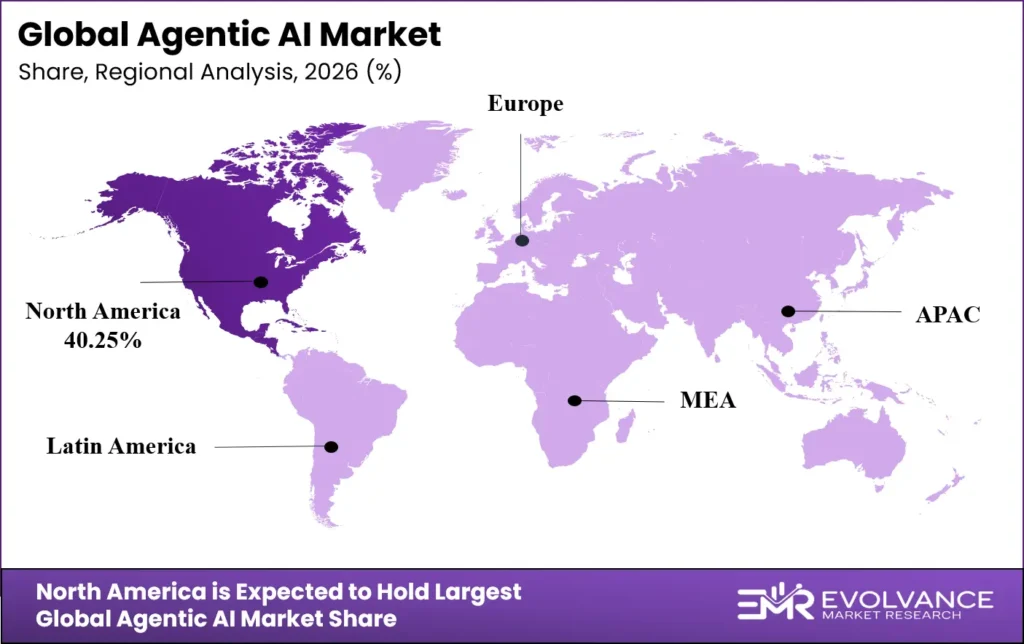
Asia-Pacific is the fastest-growing agentic AI market with a 44.95% CAGR through 2035. India’s digital transformation programs across banking, government services, and manufacturing are generating substantial agentic AI infrastructure demand, with the IndiaAI Mission allocating USD 240 million specifically for enterprise AI automation capability development.
Japan’s Society 5.0 framework identifies autonomous AI agents as a core enabler of the country’s workforce productivity strategy, with NTT, Fujitsu, and Hitachi deploying domestic agentic AI platforms addressing Japan’s structural labor shortage across healthcare, manufacturing, and logistics operations.
Key Regions and Countries
North America
- US
- Canada
Europe
- Germany
- France
- The UK
- Spain
- Italy
- Rest of Europe
Asia Pacific
- China
- Japan
- South Korea
- India
- Australia
- Rest of APAC
Latin America
- Brazil
- Mexico
- Rest of Latin America
Middle East and Africa
- GCC
- South Africa
- Rest of MEA
AI Adoption Heatmap
Enterprise Agentic AI Penetration by Industry and Deployment Maturity in 2026
| Industry | Adoption % | Stage | Key Use Case |
|---|---|---|---|
| BFSI | 68% High | Production | KYC and AML agents |
| Technology | 81% Very High | Optimization | Software engineering agents |
| Healthcare | 54% Medium-High | Scaling | Prior authorization agents |
| Government | 41% Medium | Expanding | Citizen service agents |
| Retail | 46% Medium | Scaling | Merchandising and personalization |
| Manufacturing | 38% Medium | Piloting | Predictive maintenance agents |
| Telecom | 52% Medium-High | Scaling | Network anomaly agents |
| Energy | 29% Low-Medium | Piloting | Grid optimization agents |
Technology and BFSI lead with production-scale deployments and validated ROI benchmarks in 2026. Manufacturing and Energy represent the largest untapped growth opportunity as edge AI and embodied agent architectures achieve commercial scale through 2028.
Key Companies: Platforms and Vendors Defining the Agentic AI Competitive Landscape
Five ecosystem layers define competition in the Agentic AI market: foundational LLM providers, enterprise agentic AI platforms, open-source agent orchestration frameworks, specialized vertical agent vendors, and managed agentic AI service providers. Platform ecosystems where orchestration reliability, data-sovereignty alignment, and domain-specific agent templates differentiate offerings are emerging as the primary competitive battleground through 2030.
| Company | Segment | Key Differentiator | 2026 Status |
|---|---|---|---|
| Microsoft | Enterprise Agentic Platform | Copilot Studio; 230,000+ enterprise deployments; M365 integration moat | ~24.7% enterprise platform share |
| Salesforce | CRM Agentic AI | Agentforce; 300+ pre-built templates; 5,000+ enterprise customers | Fastest CRM-native agent adoption |
| Anthropic | LLM + Agentic API | Claude 3.7 Sonnet; computer use; extended thinking; constitutional AI safety | Enterprise LLM safety leader |
| Google (Gemini / Vertex) | Cloud Agentic Platform | Gemini 2.0 agents; Vertex AI Agent Builder; multi-modal reasoning | Cloud AI agent platform leader |
| OpenAI | LLM + Operator Agents | GPT-4o; Operator browser agent; Assistants API; 300M weekly users | Consumer + enterprise agent ecosystem |
| ServiceNow | Enterprise IT Agentic AI | AI Agents for ITSM; autonomous incident resolution; NOW Platform integration | IT automation agent leader |
| IBM | Enterprise AI Agent Platform | watsonx Orchestrate; 100+ enterprise agent templates; hybrid deployment | Regulated industry agentic AI specialist |
| Cognition AI (Devin) | Software Engineering Agents | Autonomous software development; end-to-end coding pipeline execution | AI-native developer agent pioneer |
| Workday | HCM & Finance Agentic AI | Illuminate AI Agents; HR and Finance workflow automation; 10,000+ customers | Enterprise HCM agent leader |
| LangChain / LangGraph | Open-Source Agent Framework | LangGraph orchestration; 100M+ monthly downloads; LangSmith observability | Developer framework standard |
Microsoft maintains the highest strategic value in the agentic AI competitive landscape through its integration of Copilot Studio agent capabilities directly within Microsoft 365, Azure, and Dynamics 365 enterprise software environments already deployed across more than 345 million commercial Microsoft 365 seats globally.
This distribution advantage allows Microsoft to achieve agentic AI deployment at a scale that standalone AI agent vendors cannot replicate without equivalent enterprise software adoption foundations. Microsoft’s multi-agent architecture enabling Copilot agents to delegate subtasks to specialized agents and integrate with external MCP tools creates compounding switching costs as enterprise workflow automation deepens within the Microsoft technology ecosystem.
Competitive Positioning Matrix
Agentic AI Platform Leaders by Breadth, Enterprise Reach, and Reliability Score in 2026
| Vendor | Platform Breadth | Enterprise Reach | Reliability | Strategic Position |
|---|---|---|---|---|
| Microsoft | Comprehensive | 345M Seats | Very High | Market Leader |
| Salesforce | CRM-Native | 150,000 Clients | High | Vertical Challenger |
| Multi-Modal | 5M Workspace | High | Cloud Leader | |
| Anthropic | LLM Safety Core | API-First | Very High | Safety Leader |
| OpenAI | Broad | 300M Users | High | Consumer and Enterprise |
| ServiceNow | IT-Focused | 8,200 Enterprises | High | IT Ops Specialist |
| IBM | Regulated Focus | 4,000 Clients | High | Governance Leader |
Microsoft’s distribution across 345 million commercial seats creates the strongest enterprise competitive moat through 2028. Anthropic and Google lead on reasoning reliability, while Salesforce dominates CRM-native workflow automation.
Key Growth Drivers of the Agentic AI Market
Enterprise Workflow Automation Demand, LLM Capability Maturation, and Competitive Adoption Urgency Drive Structural Market Growth
Enterprise knowledge work automation is the primary structural demand driver for agentic AI through 2035. McKinsey Global Institute estimates that 60% to 70% of current enterprise knowledge work tasks are technically automatable using AI agents deployable in 2026, representing a labor cost substitution opportunity of USD 4.4 trillion annually.
Organizations deploying agentic AI in customer service report average resolution time reductions from 32 hours to 32 minutes a 98% improvement while maintaining or improving customer satisfaction scores. These documented productivity gains are converting AI agent adoption from innovation investment into core operational cost management strategy across every enterprise function.
Consumption-based agentic AI pricing models are accelerating SME market penetration as the dominant commercial model at 55% of agentic AI platform deployments in 2026 enables organizations to pay only for actual agent task execution rather than fixed subscription commitments.
This pricing flexibility reduces the financial barrier to initial enterprise deployment, enabling the 87% of U.S. businesses with USD 10 million to USD 500 million in annual revenue to access enterprise-grade agentic AI automation previously available only to Fortune 1000 organizations. SME agentic AI adoption is growing at an estimated 41.3% annually through 2030.
Agentic AI venture capital investment is providing sustained innovation funding that accelerates platform capability development independent of enterprise IT budget cycles. North American agentic AI and AI agent platform companies attracted more than USD 40 billion in venture investment through 2025 and 2026, with Anthropic’s USD 4 billion Series D, Cognition AI’s USD 2 billion Series B, and AI21 Labs’ USD 1.4 billion raise confirming deep investor conviction in agentic AI’s commercial trajectory through the decade.
Market Restraints
Agent Hallucination Risk, Integration Complexity, and Regulatory Uncertainty Constrain Enterprise Scaling
Agent reliability and hallucination risk remain the most significant enterprise adoption restraint through 2027. Current frontier LLMs exhibit error rates of 8% to 23% on complex multi-step autonomous task benchmarks rates that are commercially acceptable for AI-assisted drafting but potentially costly when autonomous agents execute financial transactions, modify production systems, or communicate with external parties on behalf of enterprises without human review.
Enterprises deploying agentic AI in regulated environments require comprehensive output validation frameworks, agent action audit trails, and rollback capabilities that add 40% to 80% to initial deployment complexity and timeline.
Legacy enterprise system integration complexity creates structural deployment barriers for agentic AI adoption at scale. The majority of enterprise workflows that agentic AI is designed to automate span multiple legacy systems ERP platforms, mainframe databases, proprietary APIs, and document management systems built over decades without machine-readable interfaces.
Custom integration development consumes 60% to 75% of total agentic AI project implementation cost, with integration timelines of six to eighteen months for complex enterprise workflows creating substantial time-to-value gaps that slow enterprise procurement decisions.
Market Opportunities
Vertical Agentic AI Platforms, Human-Agent Collaboration Systems, and Agentic AI Infrastructure Tooling Unlock Premium Growth
Domain-specific vertical agentic AI platforms represent the highest-margin growth opportunity through 2030. General-purpose agent frameworks require extensive customization for domain-specific workflows, compliance requirements, and integration patterns.
Vertical platforms pre-configured for healthcare prior authorization, financial compliance monitoring, legal document review, or manufacturing quality management deliver three to five times faster time-to-value than horizontal platforms commanding 40% to 65% premium pricing and exhibiting significantly higher customer retention. The vertical agentic AI software market is estimated at USD 2.8 billion in 2026 and growing at 52.4% annually.
AgentOps and agentic AI observability tooling is a high-growth infrastructure opportunity with no established market leader as of 2026. The complexity of monitoring, debugging, and optimizing multi-agent systems executing thousands of tasks daily across distributed enterprise environments creates substantial demand for specialized agent performance management platforms.
LangSmith, AgentOps, and Weights and Biases Weave are early entrants in a market estimated to reach USD 6.8 billion by 2030 as every enterprise deploying agentic AI requires ongoing performance monitoring infrastructure comparable to application performance management tooling in traditional software deployment.
Multi-Agent Orchestration and LLM Reasoning Frameworks
Distributed Agent Coordination, Tool-Calling Architecture, and Memory Management Define the Technical Foundation of Enterprise Agentic AI
Multi-agent orchestration is the technical capability enabling enterprise agentic AI to scale beyond the cognitive limitations of single-agent architectures toward genuine enterprise workflow automation at production reliability standards.
Orchestration frameworks coordinate agent spawning, task delegation, inter-agent communication protocols, shared memory management, error handling and recovery, and final output synthesis across distributed agent networks executing in parallel capabilities that fundamentally determine whether agentic AI deployments succeed or fail at enterprise scale.
The Model Context Protocol (MCP), introduced by Anthropic and rapidly adopted as an open standard in 2025, provides a standardized interface enabling AI agents to access external tools, databases, APIs, and enterprise systems without custom integration development for each data source. As of Q1 2026, more than 1,200 MCP server implementations are publicly available, enabling agentic AI systems to connect to Salesforce, Jira, Slack, GitHub, Google Drive, SAP, and hundreds of enterprise systems through standardized agent-tool interfaces. MCP adoption is reducing enterprise agentic AI integration complexity by an estimated 65%, accelerating deployment timelines from eighteen months to under ninety days for standard workflow automation cases.
Extended thinking and chain-of-thought reasoning capabilities in frontier LLMs are the fundamental enabler of reliable multi-step autonomous task execution. Claude 3.7 Sonnet’s extended thinking mode, GPT-4o‘s multi-step reasoning, and Gemini 2.0 Ultra’s long-context planning allow AI agents to decompose complex ambiguous goals into executable subtask sequences, reason about intermediate states, identify when subtask results are insufficient for goal completion, and adaptively revise execution strategies the cognitive foundation of reliable enterprise automation. Benchmarks published in Q1 2026 show frontier models with extended reasoning achieving 73% success rates on complex multi-step enterprise workflow simulation tasks, up from 31% for standard inference models in 2024.
Persistent agent memory architecture is the third critical technical dimension of enterprise multi-agent orchestration. Production agentic AI deployments require agents to maintain context across multi-day workflows, remember customer preferences across conversations, accumulate domain expertise through operational experience, and share knowledge across agent instances. Retrieval-augmented generation with vector database integration using Pinecone, Weaviate, or Qdrant as the memory layer is the dominant memory architecture for enterprise agentic AI in 2026, with the agentic AI memory and retrieval infrastructure market estimated at USD 1.8 billion in 2026 and growing at 58.3% annually through 2030.
Enterprise Agentic AI ROI and Productivity Economics
Total Cost of Deployment, Workflow Automation Benchmarks, and Value Realization Timelines for 2026–2035
Enterprise agentic AI investment decisions in 2026 are governed by quantitative ROI frameworks applied by Chief Information Officers, Chief Technology Officers, and Chief Financial Officers with increasing rigor as agentic AI transitions from innovation pilots into operational budget line items. The performance evidence base from 2024 and 2025 production deployments is sufficiently mature for enterprises to establish reliable ROI benchmarks across standard use case categories, enabling data-driven procurement decisions at scale.
Total Cost of Deployment for enterprise agentic AI encompasses platform licensing or API consumption costs, integration development, agent configuration and testing, ongoing monitoring infrastructure, human oversight operations, and continuous optimization engineering. For a mid-enterprise deploying a cloud-based multi-agent system automating a core business workflow loan origination, HR onboarding, or IT incident management total first-year deployment cost typically ranges from USD 280,000 to USD 1.4 million, inclusive of platform fees, integration development, and change management. Subsequent years show 60% to 75% cost reductions as integration investment is fully amortized and agent optimization reduces human oversight requirements.
ROI realization timelines vary significantly by agentic AI use case category. Customer service automation agents deliver measurable ROI within three to six months of production deployment, with documented case resolution time reductions of 94% and cost-per-resolution improvements of 61% to 78%. Software development agents achieve payback within four to nine months as developer productivity gains of 45% to 68% are measurable in standard sprint velocity metrics.
Financial compliance and reporting automation agents achieve payback within six to fourteen months. Healthcare prior authorization agents generate ROI within twelve to eighteen months but deliver high-value regulatory risk reduction benefits that compound over multi-year deployment periods. Average three-year ROI across enterprise agentic AI deployments is 124%, with leading implementations in technology and financial services achieving 300% to 500% three-year returns.
Consumption-based pricing the preferred commercial model at 55% of enterprise deployments in 2026 creates an important ROI dynamic where agentic AI deployment cost scales linearly with actual value delivered, rather than fixed platform subscription fees requiring utilization minimums. This pricing model enables enterprises to deploy agentic AI in parallel with existing process execution, measure incremental productivity gains before committing to full workflow migration, and scale investment proportionally with demonstrated returns significantly reducing enterprise adoption risk relative to prior enterprise software paradigms.
Agentic AI Governance, Safety, and Regulatory Landscape
EU AI Act Compliance, Autonomous Agent Risk Classification, Enterprise AI Policy Frameworks, and Emerging Agentic AI Regulation for 2026–2030
Agentic AI governance has emerged as a critical market dimension in 2026 as autonomous AI systems executing real-world actions on behalf of enterprises create legal liability, regulatory compliance, and organizational accountability challenges that passive generative AI tools do not. The transition from AI-assisted human decision-making toward AI-autonomous task execution fundamentally changes the legal and regulatory framework governing enterprise AI deployment, creating both compliance costs and competitive moats for organizations building robust agentic AI governance frameworks.
The European Union AI Act, which entered enforcement phases in 2025 and 2026, establishes the most comprehensive agentic AI regulatory framework globally, with direct implications for enterprise deployments across all industry verticals. High-risk agentic AI applications autonomous systems in healthcare diagnostics, financial credit decisions, critical infrastructure management, and employment screening require conformity assessments, human oversight mechanisms, comprehensive audit logging, and explainability documentation before EU market deployment. The compliance technology market serving EU AI Act requirements for agentic AI deployments is estimated at USD 1.2 billion in 2026, growing at 48.7% annually as enforcement deadlines accelerate enterprise governance investment.
Enterprise AI governance frameworks are evolving from general AI ethics policies toward agentic-AI-specific control architectures defining agent authorization boundaries, human escalation triggers, action reversibility requirements, and accountability assignment protocols. The three-layer governance architecture emerging as enterprise best practice encompasses agent capability sandboxing at the platform level, workflow-level human-in-the-loop checkpoints for high-stakes actions, and organization-level AI ethics review boards establishing autonomous action authorization policies. IBM’s AI governance platform, Microsoft’s Responsible AI dashboard for Copilot agents, and Anthropic’s Constitutional AI framework are leading enterprise governance infrastructure products addressing this regulatory compliance market requirement.
Autonomous agent identity and authorization management is an emerging technical governance challenge with significant security and compliance implications. Multi-agent systems executing enterprise workflows require each agent to authenticate against enterprise systems, operate within defined permission scopes, log all actions for audit purposes, and terminate access upon task completion requirements analogous to privileged access management for human employees but requiring entirely new technical infrastructure for machine identities. The AI agent identity and access management market is estimated at USD 620 million in 2026 and growing at 67.4% annually as enterprise security teams mandate agent identity governance frameworks across all production agentic AI deployments.
Latest Trends in the Agentic AI Market
Agentic AI Enters Enterprise Production at Scale, Workforce Transformation Accelerates, and Competitive Differentiation Shifts to Agent Reliability and Safety in 2026
The shift from agentic AI pilots to enterprise production deployment is the defining market development of 2026. With 51% of enterprises reporting active AI agents in production up from 12% in 2024 and average enterprise agentic AI deployment counts expanding from 2.3 agents in Q1 2025 to 8.7 agents per organization by Q1 2026, the market has transitioned from experimental adoption to systematic operational scaling. IDC data published in Q1 2026 projects that the average large enterprise will operate more than forty distinct AI agents across its business operations by 2028, creating an entirely new category of enterprise IT infrastructure management.
Agentic AI is creating measurable workforce transformation dynamics that are reshaping enterprise talent strategies and labor economics simultaneously. World Economic Forum projections estimate that agentic AI will displace 85 million job roles by 2026 while generating 170 million new roles requiring AI agent supervision, prompt engineering, and outcome validation a net positive employment impact but with significant workforce transition requirements. Enterprise HR departments deploying autonomous HR onboarding agents are processing new hire workflows 74% faster while redirecting HR professionals toward strategic talent management, leadership development, and employee experience roles that AI agents cannot replicate.
Model Context Protocol standardization is reshaping the agentic AI vendor ecosystem by reducing the integration lock-in advantages of proprietary agent platforms. With 1,200-plus MCP servers publicly available as of Q1 2026, enterprises can deploy best-of-breed agent models from Anthropic, OpenAI, or Google against the same enterprise tool integrations increasing platform competition and driving product differentiation toward agent reliability, safety, and domain-specific performance rather than integration breadth alone.
Recent Developments: Microsoft, Salesforce, Anthropic, Google, and OpenAI Lead 2025–2026
- May 2026: Salesforce announced Agentforce 3.0, extending the platform with autonomous multi-agent sales orchestration capabilities and reporting more than 5,000 enterprise customers with active production deployments generating measurable pipeline acceleration outcomes.
- April 2026: Microsoft Build 2026 showcased Copilot Studio multi-agent networks, enabling enterprise developers to deploy coordinated agent teams across Microsoft 365, Dynamics 365, and Azure with centralized governance, monitoring, and rollback controls across all agent actions.
- March 2026: Anthropic released Claude 3.7 Sonnet with extended thinking, delivering state-of-the-art performance on autonomous software engineering benchmarks and introducing the Model Context Protocol as an open industry standard now adopted by more than 1,200 enterprise tool providers globally.
- February 2026: Google launched Gemini 2.0 Ultra agent capabilities through Vertex AI Agent Builder, enabling enterprise deployment of multi-modal autonomous agents with native Google Workspace, BigQuery, and Google Cloud integration for 5 million enterprise Workspace customers.
- January 2026: OpenAI launched Operator, an autonomous browser agent enabling AI to execute multi-step web-based tasks on behalf of users completing restaurant reservations, travel bookings, form submissions, and e-commerce purchases through full computer use autonomy without requiring custom enterprise integration.
- November 2025: Cognition AI’s Devin 2.0 demonstrated autonomous end-to-end software feature development with 67% task completion rates on real-world GitHub issue resolution benchmarks, validating the commercial viability of autonomous software engineering agents for enterprise deployment.
Competitive Landscape
Platform Ecosystem Consolidation at the Enterprise Layer, LLM Provider Competition, and Open-Source Framework Fragmentation Define the Agentic AI Competitive Structure
The Agentic AI competitive landscape is defined by intense platform competition among enterprise software incumbents Microsoft, Salesforce, ServiceNow, Workday, and IBM each integrating agentic AI capabilities within established software procurement relationships, combined with disruptive AI-native challengers including Anthropic, OpenAI, Cognition AI, and Cohere deploying superior LLM reasoning capabilities as the foundation for enterprise agent platforms. The competitive battleground is shifting from LLM benchmark performance toward agent reliability, enterprise integration depth, governance compliance, and total cost of autonomous deployment.
Vertical integration is the defining competitive strategy among enterprise agentic AI platform leaders. Salesforce’s Agent Builder integrates Agentforce agents directly with Sales Cloud, Service Cloud, and Marketing Cloud customer data, creating multi-year data and workflow integration switching costs for the 150,000 Salesforce enterprise customers. Microsoft’s Copilot agents are embedded within Teams meetings, Outlook email management, and Excel data analysis converting passive Microsoft 365 features into active autonomous workflow executors that enterprise customers experience as productivity improvements rather than standalone AI product deployments.
Open-source agent frameworks LangChain, AutoGen, CrewAI, LlamaIndex, and Haystack provide developer-community-driven innovation that enterprise platforms cannot match in flexibility, customization, and feature velocity. LangChain’s 100 million-plus monthly downloads confirm that developer mindshare in agentic AI frameworks remains distributed across open-source options rather than consolidated within any single commercial platform, sustaining a competitive dynamic where enterprise agentic AI platform vendors must continuously demonstrate value beyond what open-source alternatives deliver.
Top 10 Strategic Recommendations
Evidence-based strategies to maximize agentic AI returns and reduce enterprise risk through 2030.
- 1. Deploy narrow-scope IT or customer service agents first to establish clear ROI benchmarks.
- 2. Adopt multi-agent architecture for any workflow spanning three or more enterprise systems.
- 3. Implement MCP connectors to core enterprise systems before launching production agents.
- 4. Establish agent identity management infrastructure before deploying into any regulated industry environment.
- 5. Select consumption-based pricing to align agentic AI investment with demonstrated productivity outcomes.
- 6. Build AgentOps dashboards tracking task success rates, cost per execution, and escalation frequency.
- 7. Deploy human-in-loop hybrid architectures for financial, healthcare, and legal high-stakes decisions.
- 8. Prepare EU AI Act compliance documentation for all high-risk European market deployments.
- 9. Prioritize domain-specific templates to achieve 40% to 65% faster time-to-value.
- 10. Report agentic AI ROI quarterly using standardized productivity, cost, and quality metrics.
Organizations implementing these strategies secure durable agentic AI competitive advantages through 2030.
Report Features
| Feature | Description |
|---|---|
| Market Value (2026) | USD 12.84 billion |
| Forecast Revenue (2035) | USD 337.63 billion |
| CAGR (2026–2035) | 43.8% |
| Base Year for Estimation | 2026 |
| Historic Period | 2020–2025 |
| Forecast Period | 2026–2035 |
| Report Coverage | Revenue Forecast, Agent Architecture Analysis, Deployment Economics, Multi-Agent Orchestration Frameworks, Enterprise ROI Analytics, AI Governance and Regulatory Compliance, Competitive Intelligence, Regional Analysis |
| Segments Covered | By Architecture, By Technology, By Deployment Mode, By Enterprise Function, By End-Use Industry (9 sectors), By Geography (5 regions) |
| Dominant Architecture | Multi-Agent Systems with 53.3% revenue share |
| Dominant Deployment Mode | Cloud with 46.8% revenue share |
| Fastest-Growing Segment | Edge and On-Device Agentic AI at 51.2% CAGR |
| Competitive Landscape | Microsoft, Salesforce, Anthropic, Google, OpenAI, ServiceNow, IBM, Cognition AI, Workday, LangChain |