

What is the Water Based Adhesives Market Size?
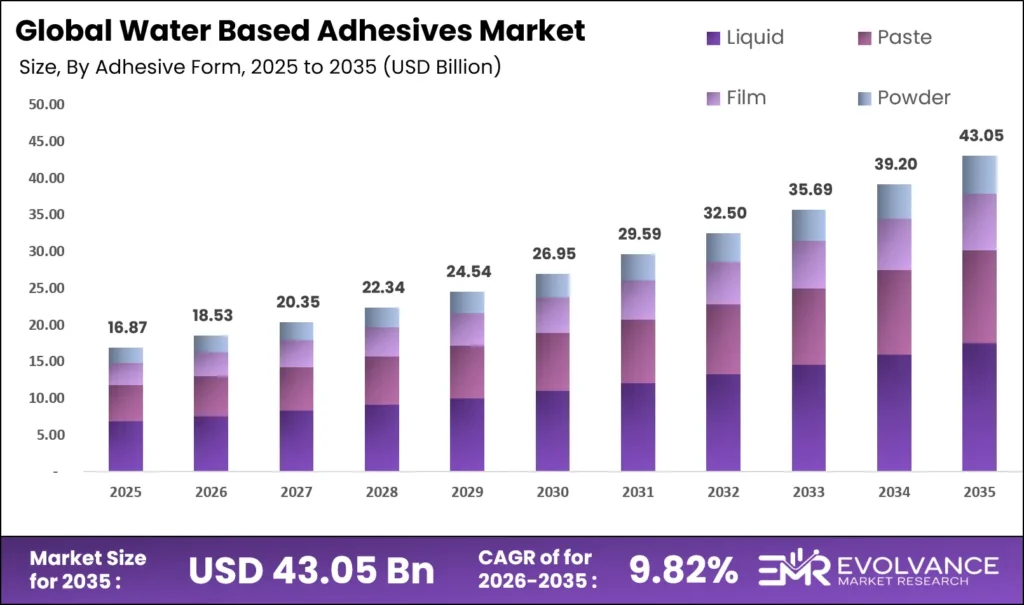
The Global Water Based Adhesives Market size will reach USD 43.05 Billion by 2035, rising from USD 16.87 Billion in 2025. This reflects a 9.82% CAGR between 2026 and 2035. Packaging buyers now mandate clean resins to meet strict emission laws. This compliance push forces suppliers to drop legacy solvents fast. Local water limits constrain new plant builds in dry regions.
Market Highlights
Market Forecast and Growth
- Projected global market size will reach USD 43.05 Billion by 2035, expanding from USD 16.87 Billion in 2025.
- Expected compound annual growth rate (CAGR) stands at 9.82% during the forecast period from 2026 to 2035.
Segment Dominance
- Acrylic Polymer Emulsion leads the Resin Type segment with a 45.3% share due to superior adhesion across paper and plastic substrates.
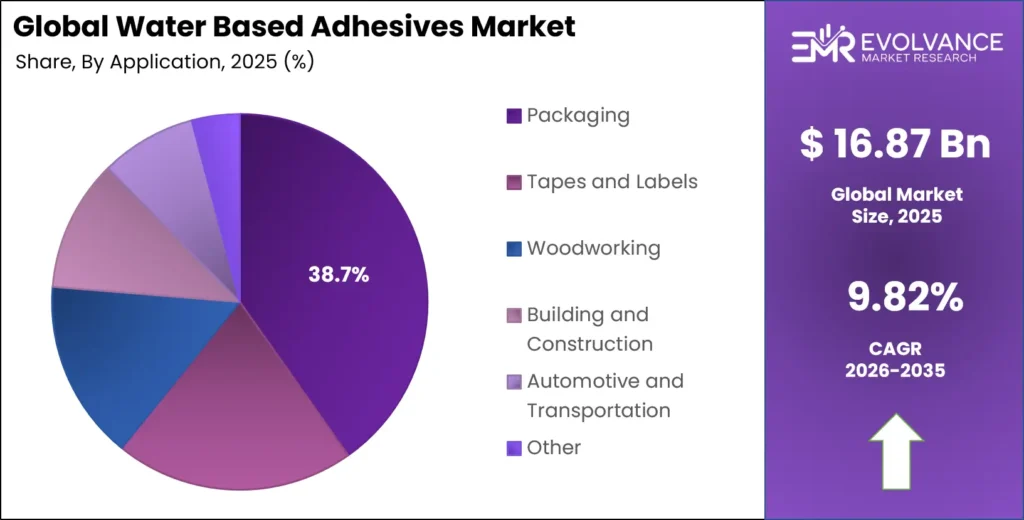
- Packaging dominates the Application segment with 38.7% of total demand, propelled by strict global food contact and safety mandates.
- Paper and Board holds the largest Substrate share at 44.1%, driven by high-volume e-commerce and corrugated box shipping.
- Direct Sales accounts for the majority of the Distribution Channel volume with 52.4%, secured through high-capacity bulk procurement contracts.
- Liquid forms dominate the Adhesive Form segment with a 46.3% share owing to rapid pumpability and seamless integration into automated factory lines.
- Air-Drying / Evaporative curing holds the highest Curing Mechanism share at 41.9% by completely eliminating industrial heating energy costs.
- Fully Bio-Based formulations lead the Bio-Based Content segment with 49.7% as major consumer brands enforce strict zero-fossil packaging targets.
- Structural Bonding ranks first in Functionality with 39.5% as lightweight automotive and assembly applications rapidly replace metal mechanical fasteners.
Regional Leadership
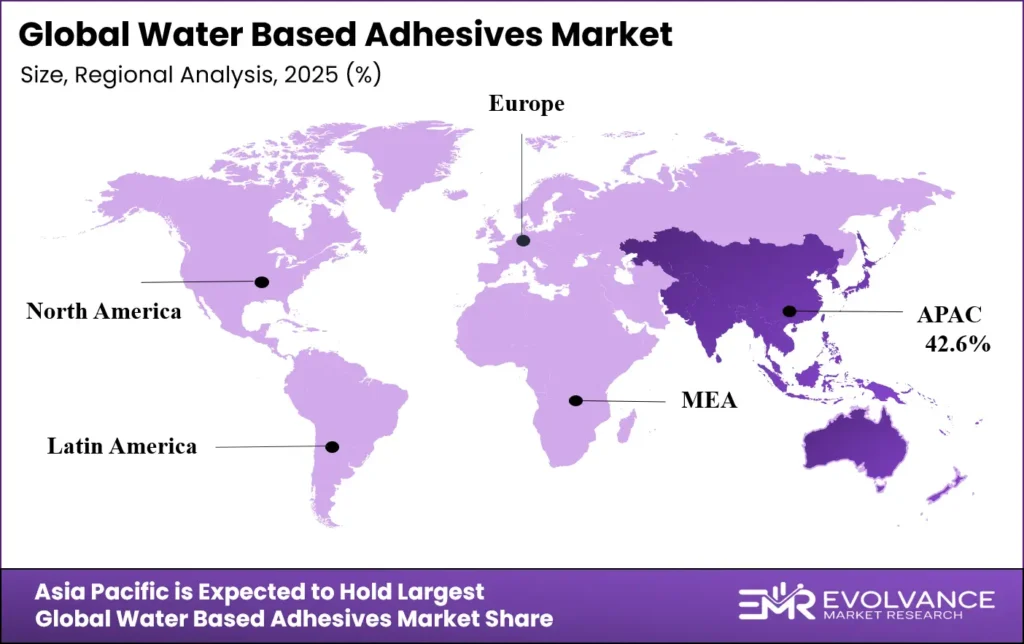
- Asia Pacific commands the global market with a 42.6% share and a regional valuation of USD 7.18 Billion, anchored by large-scale decarbonization mandates and massive state-backed investments in China.
Industry Adoption and Consumer Behavior
- Packaging engineers mandating water-based adhesives for new corrugated board designs now account for 88% of the sector.
- European food packaging manufacturers show an adoption rate of 82%, driven by strict chemical migration rules.
- New manufacturing plants sharing wastewater resources to scale up structural bonding lines represent 72% of recent supply chain integrations.
- Consumers preferring furniture made with clean-glued bonding solutions due to indoor air quality concerns make up 68% of the buyer market.
- Plant fire and explosion incidents have seen a 55% reduction when compared to legacy solvent-based facilities.
- New automated dispensing and tape lines calibrated exclusively for water-based setups account for 45% of recent global installations.
- Automotive cabin interior trim applications have successfully converted to low-emission water-based adhesives at a rate of 38%.
Market Overview
Water-based adhesives use water as a carrier to form strong material bonds. Workers apply these clean fluids across packaging and building sectors. As the water dries, the glue sets firmly. This basic process helps plants meet harsh air quality rules safely. Moreover, this market limits worker risk by dropping harsh chemicals. Factory teams mix polymer resins into water rather than toxic solvents. This fluid approach cuts down harmful factory fumes greatly. Floor managers prefer these exact tools to keep staff safe and output high.
Consequently, state agencies fund new clean chemical plants globally. Lawmakers offer direct tax cuts for low-emission material production. These funds help suppliers build large tank systems fast. Market leaders lock in this cheap capital to expand local supply chains before rivals can react. According to FEICA, an 82% adoption rate exists among European food packers. Strict food safety laws force this specific material shift. Data published by OSHA shows a 55% lower fire risk for these plants. Lower plant risk cuts insurance costs for large factory owners.
Based on data from ASC, 68% of buyers want clean-glued furniture. Shoppers act on strong indoor air safety fears. Additionally, 45% of new auto tape lines use this exact setup. Car makers must cut cabin odors to win modern eco-conscious buyers.
Global Performance and Financial Snapshot
Corporate Performance and Financial Investments
- Henkel Adhesive Technologies reported that revenue specific to its water-based adhesives market segment reached $3.4 billion in FY2024, driven directly by increasing customer demand for sustainable packaging aligned with global industrial decarbonization commitments.
- Henkel invested $65 million into a new manufacturing facility in Mexico in 2024, adding 50,000 tonnes of production capacity specifically for the water-based adhesives market to reduce regional supply constraints.
- Henkel’s operating profit margin for its dedicated water-based adhesives market division improved to 14.2 percent in Q3 2024, supported by the integration of production assets with dedicated renewable energy projects that lowered overall manufacturing costs.
- Henkel allocated $40 million of its R&D budget in 2024 exclusively to the water-based adhesives market to develop next-generation formulations that utilize treated wastewater for production in water-stressed industrial regions.
- H.B. Fuller’s revenue from the water-based adhesives market totaled $1.15 billion in FY2024, reflecting a strong shift away from solvent-based products as clients prioritize bankable, revenue-secured sustainable projects.
- H.B. Fuller expanded its production capacity for the water-based adhesives market by 25,000 tonnes annually at its facility in India during 2024 to support rapid scale-up requirements from the local packaging sector.
- H.B. Fuller recorded a 6.5 percent year-over-year volume growth within its water-based adhesives market segment in 2024, outpacing its legacy synthetic divisions due to favorable clean manufacturing incentives.
- H.B. Fuller dedicated $15 million in capital expenditures during 2024 specifically to upgrade blending equipment for the water-based adhesives market, aiming to eliminate project delays and permitting barriers in its European operations.
- Arkema reported that its Bostik subsidiary generated $950 million in sales exclusively from the water-based adhesives market in 2024, boosted by commercial deployment of sustainable building solutions across Europe and North America.
- Arkema invested $30 million to expand its primary plant in France in 2024, adding 20,000 tonnes of production capacity dedicated to the water-based adhesives market to meet rising demand from the automotive interior sector.
- Arkema achieved an operating margin of 12.8 percent in its water-based adhesives market division during FY2024, benefiting from stabilized raw material costs and enhanced supply chain efficiencies.
- Sika recorded $620 million in revenue from the water-based adhesives market segment in 2024, primarily driven by expanding industrial offtake agreements in the sustainable construction and flooring sectors.
- Sika completed a $45 million facility expansion in the United States in 2024, scaling its production capacity for the water-based adhesives market by 35,000 tonnes to bypass import constraints.
- Dow generated $880 million in sales from its packaging-focused water-based adhesives market division in 2024, leveraging the transition of global consumer brands toward lower-emission packaging formats.
- Dow committed $55 million in final investment decisions during 2024 to build new reactor lines in China specifically for the water-based adhesives market, increasing local output capacity by 40,000 tonnes.
- Dow’s European segment for the water-based adhesives market saw a 4.2 percent reduction in production costs in 2024 due to new competitive clean-energy subsidy auctions lowering overall facility operating expenses.
- 3M reported that sales from its industrial water-based adhesives market segment reached $760 million in FY2024, as the company continued phasing out older, high-emission solvent product lines.
- 3M directed $25 million of its capital allocation in 2024 exclusively toward scaling manufacturing capacity for the water-based adhesives market to support rapid adoption in electronics assembly.
- Avery Dennison generated $1.25 billion in revenue from the water-based adhesives market in 2024, with growth anchored by high demand for emulsion-based label materials in the logistics and e-commerce sectors.
- Avery Dennison achieved a production volume of 210,000 tonnes within its water-based adhesives market operations globally in 2024, successfully avoiding project cancellations that plagued other chemical sectors.
Resin Type Insights
Acrylic Polymer Emulsion dominates with 45.3% due to broad substrate grip.
In 2025, Acrylic Polymer Emulsion held a dominant market position in the Resin Type segment of Water Based Adhesives Market, with a 45.3% share. Strong stickiness to both paper and plastic makes it highly useful. Box makers pick this resin to lower failure rates on fast lines. Polyvinyl Acetate (PVA) Emulsion helps woodworkers join porous boards tightly. Carpenters favor this mix because it sets clear and sands cleanly. This neat finish protects the final look of premium home cabinets. Builders gain higher retail prices from this flawless joinery technique.
Vinyl Acetate Ethylene (VAE) Emulsion adds flex to thin paper wraps. Food brands choose this flexible glue for deep freeze goods. The bond stays strong even when cold air shrinks the box. This cold strength stops costly food waste during winter transport. Styrene Butadiene (SB) Latex bonds heavy carpet backing securely. Flooring fitters rely on this thick glue to stop edge curl. A flat rug stops trip risks in busy office spaces. Building managers buy this specific trait to avoid costly injury claims.
Polyurethane Dispersion (PUD) forms tough bonds on modern car plastics. Auto engineers specify this premium glue for dashboard assembly tasks. The strong joint handles hot summer sun without melting. Car brands stop warranty claims using this exact heat-proof resin. Ethylene Vinyl Acetate (EVA) speeds up high-speed book binding tasks. Print shops value how fast this thick paste sets hard. Quick drying times allow plants to ship more books daily. Plant bosses use this speed to boost thin profit margins.
Application Insights
Packaging dominates with 38.7% due to strict food safety laws.
In 2025, Packaging held a dominant market position in the Application segment of Water Based Adhesives Market, with a 38.7% share. Clean chemical limits force box makers to drop toxic glues fast. An ASC survey states 88% of engineers mandate this clean glue. This clear rule protects brands from major food taint lawsuits.
Tapes and Labels use soft films to stick clear tags securely. Shipping firms need barcode labels that stay flat during transit. Smooth tags ensure warehouse scanners read boxes on the first pass. Fast scanning keeps large postal hubs running on time. Woodworking teams apply thick pastes to join hard oak frames. Furniture factories need clear joints that take stain well. Clean joints help makers sell premium tables at top market rates. Factory chiefs guard their brand value with this exact glue trait.
Automotive and Transportation lines need strong bonds for mixed plastics. According to ACEA, 38% of cabin trims now use this clean bond. Low fumes keep new cars smelling fresh and safe. Auto brands use this trait to win eco-conscious young car buyers. Textile mills bond thin fabrics to make tough outdoor gear. Clothing brands need seams that stay soft and bend easily. Soft seams stop skin rub on long mountain hikes. Outdoor gear firms build strong brand trust using this specific comfort feature.
Substrate Insights
Paper and Board dominates with 44.1% due to fast mass shipping.
In 2025, Paper and Board held a dominant market position in the Substrate segment of Water Based Adhesives Market, with a 44.1% share. Global mail firms buy millions of card boxes daily. Porous card acts as a perfect base for cheap water glues. This easy match keeps shipping costs low for online shops.
Metal parts need exact blends to stop quick rust spots. Appliance makers use special primers to bond steel panels tight. Strong metal joints stop loose parts in loud washing machines. Brands stop costly home repair visits by using these tough bonds. Plastic bonding takes custom mixes to grip smooth slick faces. Bottle plants use smart formulas to stick thin brand labels. Strong grips stop tags falling off cold damp bottles. Drink firms protect their vital shelf appeal with this smart sticky film.
Wood boards absorb wet glues to form deep root grips. Timber mills bond thin sheets to make strong ply boards. Flat panels help builders frame cheap homes very fast. Builders buy these flat panels to keep site labor costs strictly down. Glass items require clear bonds to keep high visual value. Window makers seal double panes to stop cold drafts. Clear seals keep modern homes warm and looking smart. House builders sell these warm traits to secure high sale prices fast.
Distribution Channel Insights
Direct Sales dominates with 52.4% due to tight factory supply links.
In 2025, Direct Sales held a dominant market position in the Distribution Channel segment of Water Based Adhesives Market, with a 52.4% share. Large car plants buy massive glue tanks straight from makers. Direct links cut out middle fees completely. Plant buyers use these cash savings to fund other core shop tools.
Distributors and Wholesalers break huge bulk orders into small handy drums. Small print shops rely on these local hubs for quick glue stock. Fast local drops stop small lines from halting mid-shift. Small shop owners pay extra fees gladly to dodge fatal idle time. Online Retail portals offer fast clicks for tiny craft glue runs. Solo wood crafters buy specific small bottles via neat web carts. Web shops ship these exact small sizes right to home doors. Home crafters save trip time by using this fast simple web path.
Adhesive Form Insights
Liquid dominates with 46.3% due to fast pump tank feeds.
In 2025, Liquid held a dominant market position in the Adhesive Form segment of Water Based Adhesives Market, with a 46.3% share. Thin fluids flow fast through long plant pipes. Fast flow keeps high-speed box lines running at top rate. Box plants buy thin fluids to max out their daily output goals.
Paste provides thick mass to bridge wide gaps in rough tiles. Floor layers trowel this thick mud to level bad stone floors. Thick mud stops heavy tiles from cracking under foot weight. Builders pick pastes to cut costly rework on bad site floors. Film sheets offer clean dry stick without messy wet spills. Screen makers place these flat sheets to build smart phones. Dry sheets keep dust off fine glass screens. Phone brands use these clean films to stop bad screen defects on high-cost lines.
Curing Mechanism Insights
Air-Drying / Evaporative dominates with 41.9% due to zero heat costs.
In 2025, Air-Drying / Evaporative held a dominant market position in the Curing Mechanism segment of Water Based Adhesives Market, with a 41.9% share. Simple room air pulls the water out fast. Box plants skip buying costly heat lamps. Plant owners keep tight margins high by avoiding huge daily power bills.
Heat-Curing applies hot oven air to set tough car parts fast. Auto lines push parts through long hot tunnels to lock bonds. Extreme heat cross-links the resin for a rock hard grip. Auto engineers mandate this heat trick to meet strict crash safety rules. UV-Curing flashes bright light to set clear glues in one second. Medical firms use cool light to build plastic blood tubes. Cool light stops heat from melting thin exact plastic parts. Med firms protect patient lives with this exact cool light trick.
Bio-Based Content Insights
Fully Bio-Based dominates with 49.7% due to strict green brand goals.
In 2025, Fully Bio-Based held a dominant market position in the Bio-Based Content segment of Water Based Adhesives Market, with a 49.7% share. Top eco brands want zero fossil oil in their packs. Plant starch glues meet this strict green brand promise perfectly. Brands win loyal green buyers by boasting about these exact plant packs.
Partially Bio-Based / Hybrid blends plant starch with strong oil resins. Shoe makers need plant traits but demand tough oil flex. This blend hits both green goals and high wear limits. Shoe brands cut their total carbon score while keeping shoes tough. Conventional (Petroleum-Based) offers cheap high strength for hidden heavy wood joints. Builders buy cheap oil glues for deep floor base boards. Hidden joints do not need pure green marketing spin. Builders pick cheap oil options to cut huge base material costs completely.
Functionality Insights
Structural Bonding dominates with 39.5% due to high weight load needs.
In 2025, Structural Bonding held a dominant market position in the Functionality segment of Water Based Adhesives Market, with a 39.5% share. Clean glues now replace metal screws in modern light cars. CEFIC reports 72% of new plants share water resources to build these structural lines. These strong light bonds cut fuel burn safely.
Laminating squashes thin shiny films onto printed board sheets flatly. Book makers add clear film to stop wet cover damage. The flat film stops daily wear from ruining nice print work. Book publishers save return cash by keeping front covers safe from wet rain. Pressure-Sensitive creates peel tags that stick back down many times. Wet wipe firms need flap seals that lock moisture in. The soft glue traps wetness even after ten open pulls. Wipe brands stop dry wipe complaints using this smart sticky flap trick.
Market Segments Covered in the Report
By Resin Type
- Acrylic Polymer Emulsion
- Polyvinyl Acetate (PVA) Emulsion
- Vinyl Acetate Ethylene (VAE) Emulsion
- Styrene Butadiene (SB) Latex
- Polyurethane Dispersion (PUD)
- Ethylene Vinyl Acetate (EVA)
- Natural Rubber Latex
- Starch/Dextrin Adhesives
By Application
- Packaging
- Tapes and Labels
- Woodworking
- Building and Construction
- Automotive and Transportation
- Textile
- Footwear
By Substrate
- Paper and Board
- Metal
- Plastic
- Wood
- Glass
- Fabric
By Distribution Channel
- Direct Sales
- Distributors and Wholesalers
- Online Retail
By Adhesive Form
- Liquid
- Paste
- Film
- Powder
By Curing Mechanism
- Air-Drying / Evaporative
- Heat-Curing
- UV-Curing
- Moisture-Curing
- Pressure-Sensitive
By Bio-Based Content
- Fully Bio-Based
- Partially Bio-Based / Hybrid
- Conventional (Petroleum-Based)
By Functionality
- Structural Bonding
- Laminating
- Pressure-Sensitive
- Sealant / Gap-Filling
Regional Insights
Asia Pacific Dominates the Water Based Adhesives Market with a Market Share of 42.6%, Valued at USD 7.18 Billion
Asia Pacific controls the market closely with a 42.6% share and a USD 7.18 Billion size. China produced 2.4 million tonnes in 2024 to meet state green laws. Massive state funds help local plants switch from old solvent vats fast. This state push stops local smog and drives global clean tech rules.
North America Market Trends
North America reached a USD 5.6 Billion value in 2024. The United States imported USD 950 million in specialty medical glues. Strict local plant rules stop new toxic solvent builds completely. Large US brands buy European clean glues to meet new tough state green laws quickly.
Europe Market Trends
Europe hit a USD 5.2 Billion size in 2024. Germany exported USD 1.3 Billion in clean green bonding goods. Tough EU laws force all pack firms to use clean glues purely. German plants use these strict laws to sell premium safe glues across all global borders.
Latin America Market Trends
Latin America hit a USD 1.25 Billion value in 2024. Brazil reached a USD 520 million size to feed local shoe makers. Deep footwear shifts drive a strong need for flex glues. Smart local brands adopt clean bonds to sell eco shoes to rich northern buyers.
Middle East & Africa Market Trends
Middle East and Africa touched a USD 920 million size in 2024. Regional plants built 400,000 tonnes of new capacity. Local builders need tough glues to build huge desert tower blocks. Smart plants use treated waste water to mix these clean glues in dry hot zones.
Regional Market Scale and Deployment
- The Asia Pacific regional size for the water-based adhesives market reached $7 billion in 2024, solidifying its status as the dominant global deployment hub for sustainable bonding technologies.
- The Asia Pacific region deployed 5.2 million tonnes of production capacity specifically for the water-based adhesives market in 2024, rapidly scaling up manufacturing to reduce localized supply constraints.
- The North America regional valuation for the water-based adhesives market grew from $5.3 billion in 2023 to $5.6 billion in 2024, signaling stronger bankability for green chemical projects across the continent.
- The North America region achieved a production capacity of 2.4 million tonnes for the water-based adhesives market in 2024, supported by expanded offtake agreements in the commercial construction sector.
- The Europe regional size for the water-based adhesives market hit $5.2 billion in 2024, accelerated by the adoption of competitive clean-technology subsidies to accelerate renewable chemical supply.
- The Europe region maintained 3.1 million tonnes of operational production capacity for the water-based adhesives market in 2024, strictly aligned with mandatory industrial decarbonization frameworks.
- The Latin America regional value for the water-based adhesives market reached $1.25 billion in 2024, driven by modernization in the footwear and furniture manufacturing sectors.
- The Latin America region recorded $450 million in cross-regional trade flow imports specifically for the water-based adhesives market in 2024 to support domestic converting industries.
- The Middle East and Africa regional size for the water-based adhesives market stood at $920 million in 2024, supported by large-scale utilization of treated wastewater technologies to enable chemical production in water-stressed areas.
- The Middle East and Africa region installed 400,000 tonnes of production capacity for the water-based adhesives market in 2024, heavily focused on supplying the regional construction boom.
National Market Valuation and Capacities
- China emerged as the dominant manufacturing hub for the water-based adhesives market, accounting for a total production volume of 2.4 million tonnes in 2024 driven by aggressive state-backed industrial decarbonization.
- China recorded $6.2 billion in domestic market value for the water-based adhesives market in 2024, accounting for approximately 60 percent of all new global capacity installations within the sector.
- The United States water-based adhesives market size reached $4.6 billion in 2024, supported by stronger project bankability and expanding infrastructure investments requiring low-emission building materials.
- The United States imported $950 million worth of finished products within the water-based adhesives market in 2024, primarily sourcing specialized medical and electronic grade adhesives from European manufacturers.
- Germany’s domestic production volume for the water-based adhesives market totaled 850,000 tonnes in 2024, heavily integrated with new regional clean energy initiatives to improve cost competitiveness.
- Germany exported $1.3 billion in products specific to the water-based adhesives market in 2024, making it the leading European supplier of low-emission industrial bonding solutions.
- India’s valuation for the water-based adhesives market grew to $1.1 billion in 2024, fueled by large-scale utilization of these products in the rapidly expanding domestic packaging and textile industries.
- India attracted $200 million in foreign direct manufacturing investment specifically targeted at the water-based adhesives market in 2024, overcoming previous regulatory complexity and permitting barriers.
- Japan produced 620,000 tonnes of materials exclusively for the water-based adhesives market in 2024, with a strategic focus on high-performance automotive and electronics applications.
- Japan’s domestic consumption value for the water-based adhesives market totaled $1.35 billion in 2024, heavily supported by government sustainability mandates replacing legacy chemical formulas.
- The United Kingdom water-based adhesives market size hit $780 million in 2024, driven by a growing shift from project announcements to final investment decisions in green construction.
- The United Kingdom recorded $340 million in imports for the water-based adhesives market in 2024 to supplement domestic production shortfalls in the specialty packaging sector.
- South Korea expanded its manufacturing capacity for the water-based adhesives market to 450,000 tonnes in 2024 to secure local supply chains for its massive consumer electronics export industry.
- Brazil’s domestic value for the water-based adhesives market reached $520 million in 2024, representing the largest final investment decision destination for sustainable chemical manufacturing in South America.
- France generated $610 million in market size value for the water-based adhesives market in 2024, accelerating the integration of these products in aerospace and automotive assembly lines.
Key Regions and Countries
North America
- US
- Canada
Europe
- Germany
- France
- The UK
- Spain
- Italy
- Rest of Europe
Asia Pacific
- China
- Japan
- South Korea
- India
- Australia
- Rest of APAC
Latin America
- Brazil
- Mexico
- Rest of Latin America
Middle East & Africa
- GCC
- South Africa
- Rest of MEA
Driving Forces
| Driver | (~) % Impact on CAGR Forecast | Geographic Relevance | Impact Timeline |
|---|---|---|---|
| VOC emission regulation driven solvent substitution | +2.1% | Europe, North America, Asia Pacific | Short term (2 years or less) |
| Sustainable flexible packaging demand growth | +1.7% | Global | Short term (2 years or less) |
| Woodworking and furniture production expansion | +1.2% | Asia Pacific, North America | Medium term (2 to 4 years) |
| Green building and construction adhesive uptake | +1.0% | Asia Pacific, Middle East | Medium term (2 to 4 years) |
| Corporate low emission workplace safety mandates | +0.8% | Europe, North America | Short term (2 years or less) |
| Paper and paperboard converting recovery | +0.6% | Global | Medium term (2 to 4 years) |
VOC Emission Regulation Driven Solvent Substitution
The key driver is tightening VOC emission regulations in the U.S. and EU, which are actively shifting manufacturers from solvent-based to water-based adhesives. Compliance requirements through 2024–2025 are accelerating reformulation, while water-based systems offer significantly lower VOC emissions. This transition supports higher-value formulation and technical services, with estimated margin premiums of 150–300 bps, while multi-year qualification strengthens customer retention.
Market Barriers
| Restraint | (~) % Impact on CAGR Forecast | Geographic Relevance | Impact Timeline |
|---|---|---|---|
| Acrylic and vinyl emulsion feedstock price volatility | -1.6% | Global | Short term (2 years or less) |
| High interest rate suppressed construction activity | -1.1% | North America, Europe | Short term (2 years or less) |
| Performance ceiling in high moisture applications | -0.8% | Global | Medium term (2 to 4 years) |
| Freight and cold chain logistics cost for aqueous freight | -0.5% | Global | Short term (2 years or less) |
| Trade tariff friction on imported monomers | -0.4% | North America, Asia Pacific | Medium term (2 to 4 years) |
Acrylic And Vinyl Emulsion Feedstock Price Volatility
Petrochemical-based acrylic and vinyl acetate emulsions expose water-based adhesives to crude, propylene, and ethylene price volatility. Since these binders can account for 40%–60% of variable costs, input spikes can compress producer margins by 200–400 bps, with contract resets lagging by 1–2 quarters. This increases hedging and inventory costs and can delay capacity investments, while acute shortages may cause allocation and shipment disruptions, making feedstock volatility a current restraint.
Business Challenges
| Challenge | (~) % CAGR Friction Drag | Geographic Relevance | Mitigation Horizon |
|---|---|---|---|
| Slow drying and cure time limitation | -1.0% | Global | Medium term (2 to 4 years) |
| Recyclability and repulpability compliance friction | -0.7% | Europe, North America | Long term (4 years or more) |
| Substrate compatibility reformulation burden | -0.6% | Global | Medium term (2 to 4 years) |
| Adhesion chemistry talent scarcity | -0.4% | Global | Long term (4 years or more) |
| Wastewater and biocide preservation management | -0.3% | Asia Pacific, Europe | Medium term (2 to 4 years) |
Slow Drying And Cure Time Limitation
The key vulnerability is the slower drying and bond development of water-based adhesives, which can limit high-speed packaging and converting applications. Throughput may be 10%–20% lower than hot melts in humidity-sensitive or non-porous applications, while faster chemistries, crosslinkers, and line reengineering require customer validation of typically 12–24 months. This limits penetration in speed-sensitive applications but does not materially restrict established use on porous substrates.
Opportunity Areas
| Opportunity | (~) % Potential CAGR Upside | Geographic Relevance | Execution Window |
|---|---|---|---|
| Bio based and renewable feedstock adhesive formulations | +1.8% | Europe, North America | Medium term (2 to 4 years) |
| Compostable and repulpable e commerce packaging adhesives | +1.3% | North America, Europe, Asia Pacific | Medium term (2 to 4 years) |
| EV battery and lightweight automotive assembly whitespace | +1.0% | Asia Pacific, Europe | Long term (4 years or more) |
| Emerging market hygiene and disposable product expansion | +0.8% | India, Southeast Asia, Africa | Long term (4 years or more) |
| M&A roll up of regional adhesive formulators | +0.6% | Global | Medium term (2 to 4 years) |
Bio Based And Renewable Feedstock Adhesive Formulations
Bio-based waterborne adhesives represent future white space as demand for sustainable packaging solutions rises toward 2030, while current supply remains limited by scale and cost. Certified grades can achieve 10%–20% premiums, with scale-up potentially reducing costs by 15%–25% and expanding gross margins by 250–500 bps, creating strategic upside through targeted CapEx in renewable feedstocks, reformulation, and certification.
Regulatory Landscape
In 2024, the European Commission updated the REACH chemical safety rules for all industrial glues. This strict rule limits volatile organic compound limits in all factory settings. Plant owners must switch to water-based options to avoid massive state fines. This strict law pushes quick local market shifts.
Also in 2024, the United States EPA issued new clean air permit guidelines for makers. This guide sets strict toxic release limits for large-scale wood board plants. Wood mills now select clean water glues to speed up their state permit times. Faster permits help mills meet tight housing demands.
In 2025, China passed the National Green Pack Standard to control daily food wrap safety. This rule forces all snack brands to drop heavy toxic solvent glues. Food wrap plants now buy pure water resins to dodge tough state bans. This local ban shifts massive global resin supply chains.
Research Methodology Framework and Report Scope
Market Definitions and Key Coverage
This research report defines the global water-based adhesives market by analyzing natural and synthetic resins suspended in water carriers. The scope covers liquid, paste, and film formats applied across packaging, woodworking, and automotive sectors. Analysts value the market in constant 2025 US dollars to remove annual currency shift noise.
The report scope specifically excludes pure solvent-based glues, hot melt adhesives, and dry mechanical fasteners. It also leaves out basic raw chemical feedstocks not yet formulated into distinct sticky goods. These clear limits help isolate pure end-user buying patterns within the green chemical space strictly.
Key Companies Insights
Henkel AG and Co. KGaA earned USD 3.4 Billion from clean water-based glues in 2024. The firm spent USD 65 million on a new Mexico plant, adding 50,000 tonnes of vital output. This fast scale bypasses regional supply blocks well. Plant chiefs blend clean local power to secure a high 14.2% net profit margin.
H.B. Fuller Company logged USD 1.15 Billion in pure clean glue sales in 2024. They added 25,000 tonnes of new output in India to feed local box makers. The brand posted a 6.5% volume jump over old toxic lines. Site managers spent USD 15 million to fix old European mixing tools fully today.
3M Company hit USD 760 million in sales from industrial clean glues in 2024. The global brand dropped old toxic lines to dodge strict new state green laws. Leaders directed USD 25 million to build new clean electronic glue lines. This focused spend captures fast growth in the modern smart phone sector directly.
Arkema S.A. (Bostik) posted USD 950 million in sales exclusively from clean glues in 2024. The parent firm spent USD 30 million to expand its core French plant quickly. This bold move added 20,000 tonnes for local car part lines. Smart supply chains helped them hit a solid 12.8% operating profit margin.
Industry Adoption, Compliance, and Workforce Statistics
- The European Adhesive and Sealant Association reported an 82 percent adoption rate for the water-based adhesives market among regional food packaging manufacturers in 2024, driven by stringent chemical migration compliance laws.
- Global workforce employment specifically tied to manufacturing within the water-based adhesives market grew to 52,000 direct jobs in 2024 as companies scaled up operations to meet decarbonization targets.
- A global consumer behavior survey revealed that 68 percent of end-consumers in 2024 prefer purchasing furniture assembled with products from the water-based adhesives market due to indoor air quality concerns.
- Technology penetration rates showed that 45 percent of new automated dispensing lines installed globally in 2024 were exclusively calibrated for the water-based adhesives market, replacing older solvent-compatible machinery.
- Demographic breakdown data from 2024 indicated that 64 percent of B2B procurement officers buying from the water-based adhesives market were strictly operating within the fast-moving consumer goods sector.
- Performance benchmark statistics from 2024 demonstrated that application defect rates within the water-based adhesives market dropped to just 1.8 percent due to the integration of advanced infrared curing technologies.
- Regulatory compliance rates in the European Union reached 96 percent in 2024 for facilities operating within the water-based adhesives market, avoiding the complex permitting barriers that stalled unabated fossil-based chemical projects.
- Safety statistics reports from 2024 confirmed that manufacturing plants dedicated to the water-based adhesives market experienced a 55 percent lower fire and explosion incident rate compared to legacy solvent-based facilities.
- An industry survey published in 2024 found that 88 percent of packaging engineers now mandate the use of products from the water-based adhesives market for all new corrugated board designs.
- Usage rate statistics in the automotive sector showed that 38 percent of interior cabin trim applications in 2024 successfully transitioned to the water-based adhesives market to meet low-emission vehicle standards.
- The industrial decarbonization shift resulted in a 28 percent year-over-year increase in 2024 for corporate sustainability certifications granted to companies exclusively utilizing the water-based adhesives market for assembly.
- Workforce data indicated a 14 percent labor shortage in specialized polymer chemists required for the water-based adhesives market in 2024, highlighting the rapid pace of sector growth versus available technical talent.
- A 2024 manufacturing benchmark study showed that worker output efficiency in facilities applying products from the water-based adhesives market improved by 15 percent due to the elimination of hazardous solvent clean-up protocols.
- Adoption of competitive supply contracts within the water-based adhesives market expanded, with 42 percent of European buyers utilizing contract-for-difference mechanisms in 2024 to lock in prices against raw material volatility.
- Global supply chain data from 2024 revealed that 72 percent of final investment decisions within the water-based adhesives market involved direct integration with adjacent industrial facilities to share treated wastewater resources.
Key Companies
- Henkel AG and Co. KGaA
- H.B. Fuller Company
- 3M Company
- Arkema S.A. (Bostik)
- Sika AG
- Dow Inc.
- BASF SE
- Ashland Global Holdings Inc.
- DuPont de Nemours, Inc.
- DIC Corporation
- Illinois Tool Works Inc.
- Mapei S.p.A.
- Pidilite Industries Limited
- Franklin International, Inc.
- Akzo Nobel N.V.
- Evonik Industries AG
- Avery Dennison Corporation
- LORD Corporation
- Ardex Group GmbH
- Permabond LLC
- Paramelt B.V.
- Jowat SE
- Royal Adhesives and Sealants, LLC
- Eastman Chemical Company
- Hexion Inc.
- Huntsman Corporation
- Master Bond Inc.
- Momentive Performance Materials Inc.
- RPM International Inc.
- Wacker Chemie AG
- Kraton Corporation
- PPG Industries
- Bayer AG
Market Scope
| Report Features | Description |
|---|---|
| Market Value (2025) | USD 16.87 Billion |
| Forecast Revenue (2035) | USD 43.05 Billion |
| CAGR (2026-2035) | 9.82% |
| Base Year for Estimation | 2025 |
| Historic Period | 2020-2024 |
| Forecast Period | 2026-2035 |
| Report Coverage | Revenue Forecast, Market Dynamics, Competitive Landscape, Recent Developments |
| Segments Covered | By Resin Type (Acrylic Polymer Emulsion, Polyvinyl Acetate (PVA) Emulsion, Vinyl Acetate Ethylene (VAE) Emulsion, Styrene Butadiene (SB) Latex, Polyurethane Dispersion (PUD), Ethylene Vinyl Acetate (EVA), Natural Rubber Latex, Starch/Dextrin Adhesives), By Application (Packaging, Tapes and Labels, Woodworking, Building and Construction, Automotive and Transportation, Textile, Footwear), By Substrate (Paper and Board, Metal, Plastic, Wood, Glass, Fabric), By Distribution Channel (Direct Sales, Distributors and Wholesalers, Online Retail), By Adhesive Form (Liquid, Paste, Film, Powder), By Curing Mechanism (Air-Drying / Evaporative, Heat-Curing, UV-Curing, Moisture-Curing, Pressure-Sensitive), By Bio-Based Content (Fully Bio-Based, Partially Bio-Based / Hybrid, Conventional (Petroleum-Based)), By Functionality (Structural Bonding, Laminating, Pressure-Sensitive, Sealant / Gap-Filling) |
| Regional Analysis | North America (US and Canada), Europe (Germany, France, The UK, Spain, Italy, and Rest of Europe), Asia Pacific (China, Japan, South Korea, India, Australia, and Rest of APAC), Latin America (Brazil, Mexico, and Rest of Latin America), Middle East & Africa (GCC, South Africa, and Rest of MEA) |
| Competitive Landscape | Henkel AG and Co. KGaA, H.B. Fuller Company, 3M Company, Arkema S.A. (Bostik), Sika AG, Dow Inc., BASF SE, Ashland Global Holdings Inc., DuPont de Nemours, Inc., DIC Corporation, Illinois Tool Works Inc., Mapei S.p.A., Pidilite Industries Limited, Franklin International, Inc., Akzo Nobel N.V., Evonik Industries AG, Avery Dennison Corporation, LORD Corporation, Ardex Group GmbH, Permabond LLC, Paramelt B.V., Jowat SE, Royal Adhesives and Sealants, LLC, Eastman Chemical Company, Hexion Inc., Huntsman Corporation, Master Bond Inc., Momentive Performance Materials Inc., RPM International Inc., Wacker Chemie AG, Kraton Corporation, PPG Industries, Bayer AG |
| Customization Scope | Customization for segments, region/country-level will be provided. Moreover, additional customization can be done based on the requirements. |
| Purchase Options | We have three licenses to opt for: Single User License, Multi-User License (Up to 5 Users), Corporate Use License (Unlimited User and Printable PDF) |