
Introduction
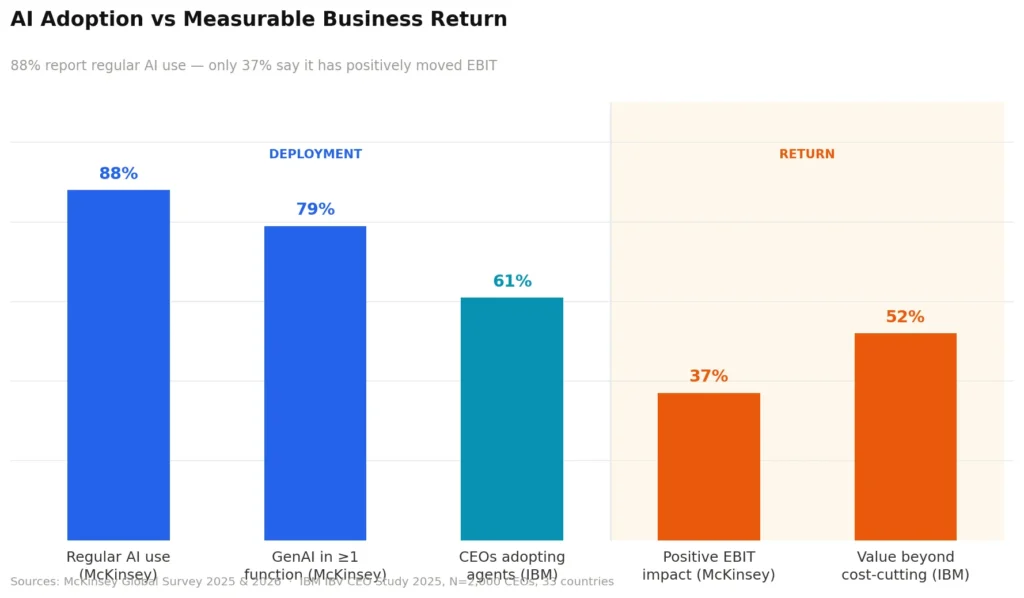
Stanford HAI reports that generative AI drew $33.9 billion in global private investment in 2024, up 18.7% year on year. McKinsey found only 37% of respondents say AI has improved their organization’s EBIT. That gap is the story: companies are buying capability much faster than they are converting it into accountable economic output.
This post uses 64 verified data points from Stanford HAI, McKinsey, IBM Institute for Business Value, OECD, and the European Commission, published from 2025 through August 2026. The conclusion is direct: Generative AI 2.0 means agentic, cheaper, more embedded systems, but enterprise control, trust, and value capture remain badly behind deployment.
Key Statistics at a Glance
- Stanford HAI: U.S. AI investment reached $109.1 billion in 2024. Capital concentration is becoming product concentration.
- McKinsey: 88% of organizations used AI regularly in 2025. Usage is not proof of scaled value.
- IBM: 61% of CEOs actively adopted AI agents in 2025. Autonomy is arriving before most controls.
- OECD: 20.2% of firms used AI in 2025. Most businesses still sit outside the market narrative.
- Stanford HAI: AI incidents hit 233 in 2024. Deployment is producing a visible liability trail.
- European Commission: GPAI obligations applied from August 2025. Compliance is now an operating requirement.
- McKinsey: only about 30% reached mature governance, strategy, or agentic-AI controls. Most firms remain structurally unprepared.
Adoption Outruns Value
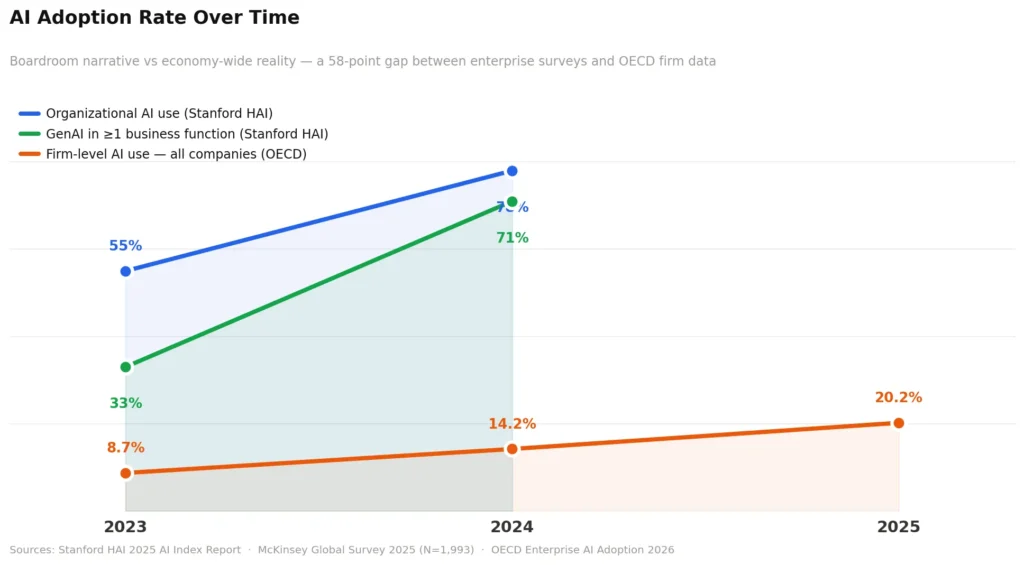
Stanford HAI found organizational AI use rose from 55% in 2023 to 78% in 2024, while generative-AI use in at least one business function climbed from 33% to 71%. Those are adoption figures, not value figures. The market has normalized experimentation before it has proved repeatable returns.
McKinsey reported 88% regular AI use in 2025, up 10 percentage points from 2024, while generative-AI use reached 79%. However, just 37% said AI contributed positively to EBIT in 2026. Most firms have crossed the software-purchase threshold and failed the operating-model threshold.
IBM’s survey of 2,000 CEOs across 33 countries found 52% realized generative-AI value beyond cost reduction. That leaves nearly half unable to point to expansion, new offerings, or better customer economics. Cutting labor time is easy to demonstrate; building durable revenue is where the claims start collapsing.
OECD reported that only 20.2% of firms used AI in 2025, despite a rise from 14.2% in 2024 and 8.7% in 2023. Large enterprises dominate public discussion because they dominate spending and vendor case studies. The wider economy has not adopted Generative AI 2.0 at anything close to the pace implied by boardroom rhetoric.
Investment Outruns Distribution
Stanford HAI recorded $252.3 billion in corporate AI investment during 2024, with private investment up 44.5% and AI mergers and acquisitions up 12.1%. The capital is real. However, it is flowing into a narrow set of platforms, models, chips, and buyers. hai.stanford
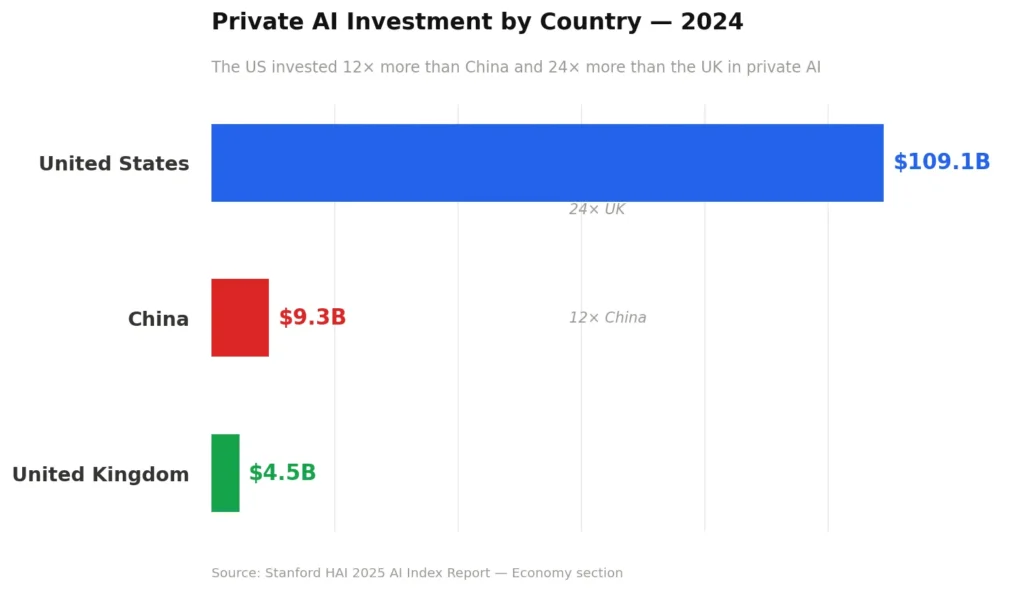
The United States put $109.1 billion into private AI in 2024, compared with China’s $9.3 billion and the United Kingdom’s $4.5 billion. That is roughly 12 times China’s total and 24 times the UK’s. Generative AI 2.0 is being built inside an investment geography that few countries can match.
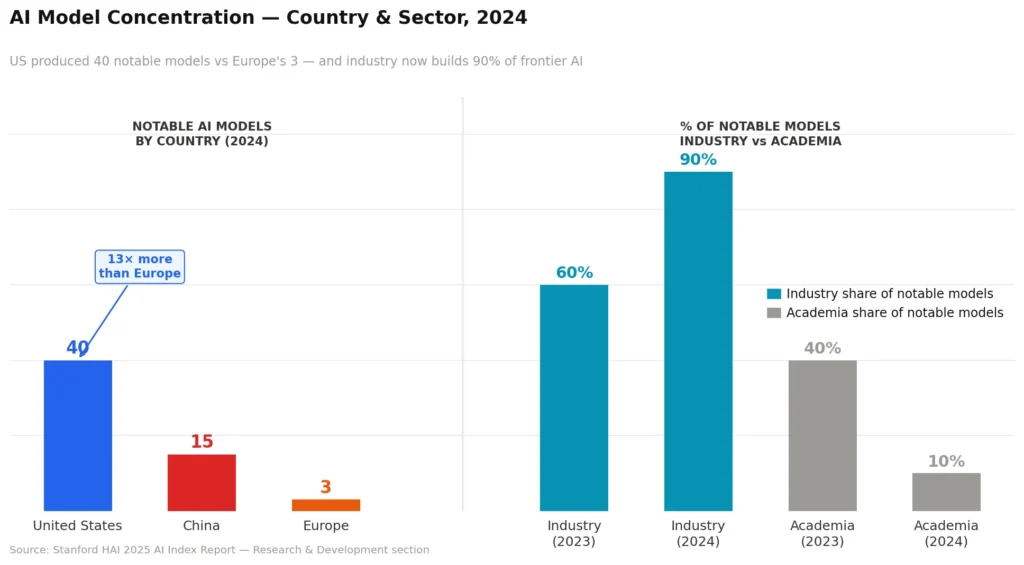
Stanford HAI counted 40 notable AI models from U.S.-based institutions in 2024, compared with 15 from China and 3 from Europe. Industry produced nearly 90% of notable models, up from 60% in 2023. Open models may widen access, but frontier development remains a corporate and national concentration problem.
IBM found executives expect AI investment as a share of revenue to rise about 150% between 2025 and 2030. That forecast says little about who receives the return. Spending projections are not business cases, and corporate finance teams should stop treating them as if they are.
Costs Fall While Control Lags
Stanford HAI found that the price of GPT-3.5-equivalent model querying fell from $20 per million tokens in November 2022 to $0.07 by October 2024. That is a decline of more than 280 times in about 18 months. Cheap inference removes the financial excuse for pilots, then exposes every operational weakness those pilots were hiding.
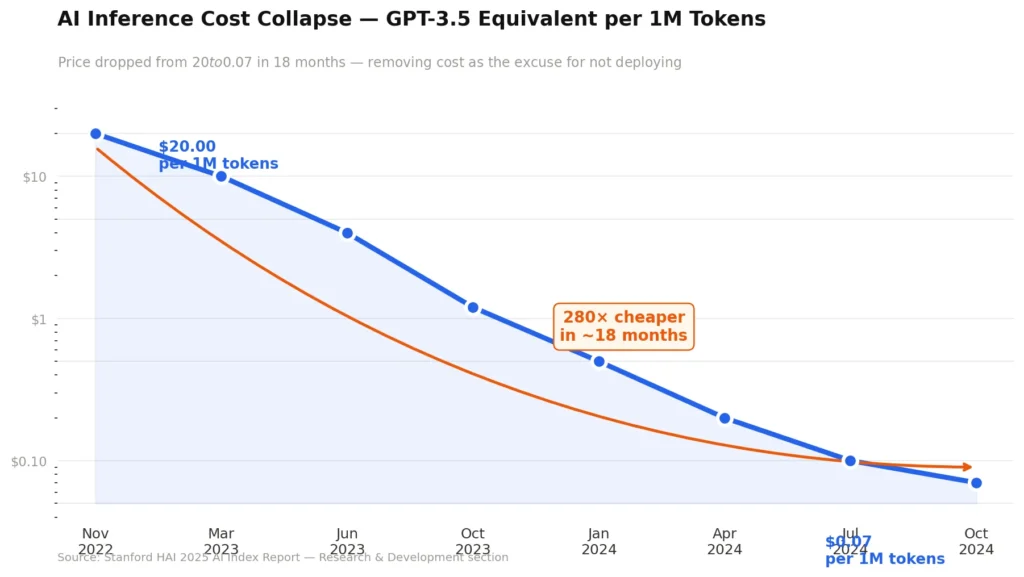
A model with 3.8 billion parameters matched the MMLU threshold once reached by PaLM with 540 billion parameters, a 142-fold reduction. Smaller models make local and domain-specific deployment easier. They also make unmanaged deployment easier, which is not the same thing as secure deployment.
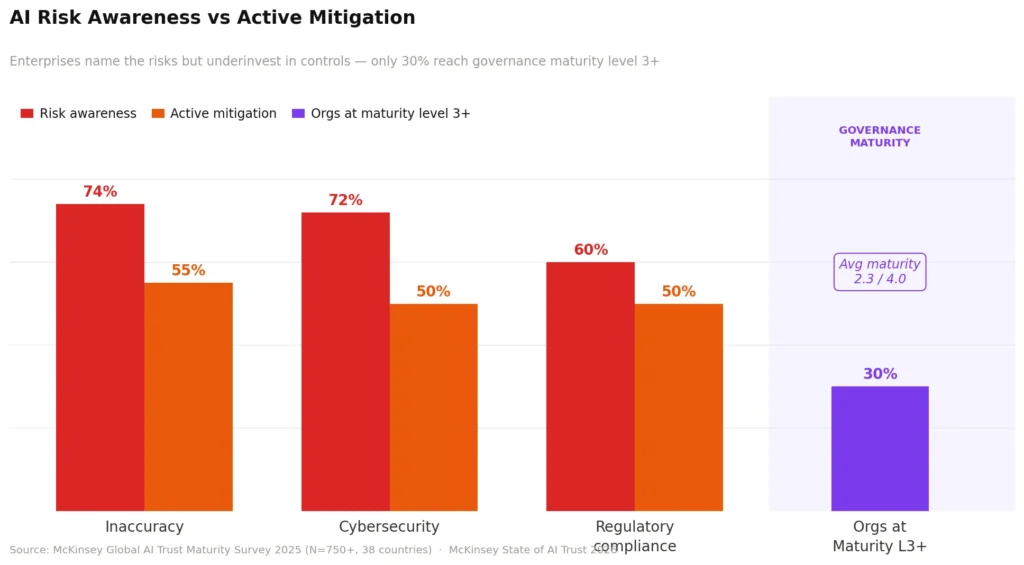
McKinsey found 74% of respondents viewed inaccuracy as a highly relevant AI risk and 72% said the same of cybersecurity. Yet active risk mitigation lagged awareness across almost every category. Enterprises understand the hazards well enough to name them, then underfund the controls needed to contain them.
Cheap models do not create cheap mistakes.
McKinsey’s 2026 survey put average responsible-AI maturity at 2.3 out of 4, up from 2.0 in 2025. Only about 30% of organizations scored at maturity level 3 or above for strategy, governance, and agentic-AI controls. Better averages disguise a much larger group that still cannot safely run autonomous systems.
Agents Advance Beyond Governance
IBM found 61% of CEOs were actively adopting AI agents or preparing to implement them at scale in 2025. By 2030, its executive survey expects 62% of AI spending to target innovation, compared with 47% then directed toward efficiency. Leaders want agents to change work, not merely accelerate existing tasks.
However, McKinsey’s responsible-AI study of more than 750 leaders across 38 countries placed average maturity at only 2.0 on a 0 to 4 scale. About 36% landed at level 2, meaning they were still assembling basic risk indicators, data rules, and incident-response practices. Agents are being assigned tasks before firms have proved they can supervise the results.
Knowledge and training gaps blocked 51% of organizations in McKinsey’s trust survey, while regulatory uncertainty blocked 40%. More than 55% were investing to reduce inaccuracy, and over 50% were investing in cybersecurity and regulatory compliance. Spending on safeguards is rising because the operational gap is no longer theoretical.
This is not automation maturity.
The European Commission set systemic-risk obligations for general-purpose AI models above 10^25 FLOP. Providers must conduct evaluations, manage systemic risks, report serious incidents, and secure model infrastructure. Firms treating agent deployment as a procurement project will discover that regulators treat it as a control system.
Regulation Speeds Up After Harm
Stanford HAI recorded 233 AI-related incidents in 2024, a 56.4% increase from 2023. The total is incomplete because reporting is uneven and many incidents stay internal. Even the visible number shows that real-world exposure is rising faster than corporate confidence in governance.
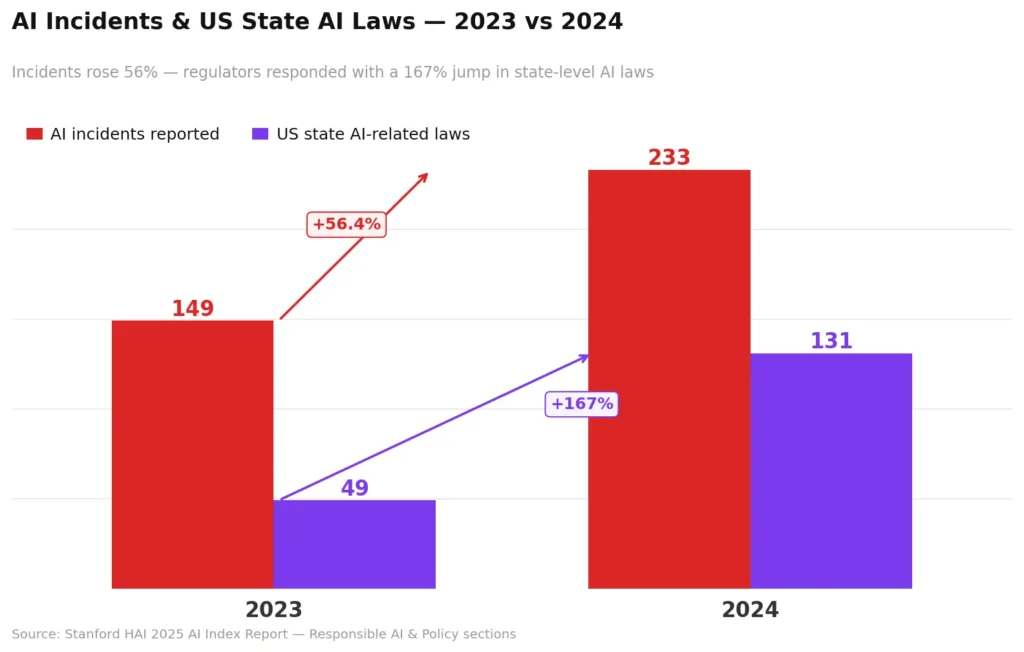
The same index found U.S. state-level AI-related laws rose from 49 in 2023 to 131 in the following year. Policymakers are not waiting for enterprise governance programs to mature. Companies now face a fast-moving compliance environment created by the gap between commercial rollout and public protection.
The European Commission began GPAI-model obligations on 2 August 2025, including transparency and copyright duties. Models already on the market before that date must comply by 2 August 2027. This creates no safe legacy category for businesses that assumed existing models could avoid new documentation requirements.
The rulebook is no longer hypothetical.
Article 50 transparency obligations for certain AI-generated content become applicable in August 2026, covering deepfakes and specified AI-generated public-interest text. The Commission’s approach covers 4 categories, including human interaction, synthetic content, emotion recognition, and biometric categorization. Content generation now carries disclosure obligations, not just brand-risk considerations.
Public Trust Falls as Use Spreads
Stanford HAI found global confidence that AI companies protect personal data fell from 50% in 2023 to 47% in 2024. At the same time, 80.4% supported stricter data privacy rules. Users want the tools but do not trust the firms collecting, training on, or processing their information.
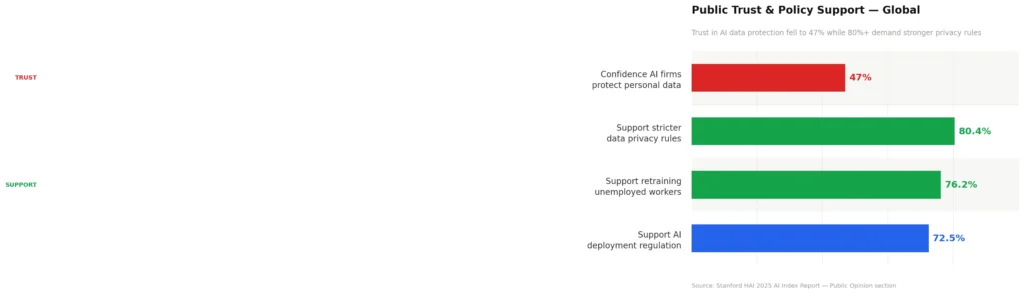
Support for retraining unemployed workers reached 76.2%, while support for AI deployment regulation reached 72.5%. This is not anti-technology sentiment. It is a demand for institutions to absorb costs that companies have been too willing to externalize. hai.stanford
OECD found generative AI in use among 31% of SMEs, ranging from 24% in Japan to 39% in Germany. The regional spread matters because adoption depends on skills, infrastructure, sector mix, and local business support. A global average conceals the countries and smaller firms being left behind.
Trust is becoming a market constraint.
IBM reported that nearly two-thirds of consumers had used or wanted to try AI applications. Retail and consumer-product leaders expect AI’s contribution to revenue growth to increase 133% from 2023 to 2027. Consumer willingness is real, but it will not compensate for opaque data practices or defective output at scale.
Capability Improves Faster Than Readiness
Stanford HAI reported that OpenAI’s o1 reached 96.0% on MedQA, a 5.8 percentage-point improvement over the best 2023 score. Medical AI devices authorized by the FDA rose from 288 in 2020 to 1,031 in 2024. Capability is entering regulated work where error costs are measured in patient outcomes, claims, and legal exposure.
Medical AI performance improved by 28.4 percentage points on one benchmark series, while formal approvals more than tripled over four years. That looks like a clean success story. It is not, because a benchmark score and a safe clinical workflow are different things.
Stanford HAI found less than half of U.S. high-school computer-science teachers felt equipped to teach AI, although 81% agreed AI learning should be foundational. Education systems recognize the skill need and still lack the people ready to teach it. Companies expecting a ready-made AI workforce are budgeting against fiction.
The labor pipeline is not keeping pace.
OECD’s survey spans G7 countries and Brazil and focuses on enterprise adoption barriers as well as usage. Its evidence base confirms that policy, skills, data access, and management capacity shape adoption outcomes. Generative AI 2.0 will reward firms that can redesign work and govern systems, not firms that buy the most subscriptions.
Methodology and Sources
This analysis used only approved primary or named institutional research sources published between January 2025 and August 27, 2026. It did not use Statista, Wikipedia, news coverage, blogs, market aggregators, or syndicated market-research publishers. Every figure cited comes from a specific live report, survey release, regulatory page, or official index page returned in the research record.
Stanford HAI supplied the 2025 AI Index Report, published April 2025, including its Economy, Research and Development, Technical Performance, Responsible AI, Policy and Governance, Public Opinion, Education, and Science and Medicine sections. Its figures cover global investment, models, performance, incidents, regulation, education, and public opinion.
McKinsey supplied the State of AI: Global Survey 2025, the State of AI: Global Survey 2026, and its Global AI Trust Maturity research. The 2025 AI-use survey cited 1,993 participants from June 25 through July 29, 2025. The 2026 trust survey covered approximately 500 organizations from December 2025 through January 2026, while the 2025 responsible-AI survey covered more than 750 leaders across 38 countries.
IBM Institute for Business Value supplied its 2025 CEO study with Oxford Economics, surveying 2,000 CEOs in 33 countries and 24 industries between February and April 2025, plus its 2026 enterprise study covering 2,007 senior executives across 33 geographies and 20 industries. OECD supplied enterprise and SME evidence, while the European Commission supplied binding-rule timelines and obligation details under the AI Act.
FAQ
What is Generative AI 2.0?
IBM found 61% of CEOs were already adopting AI agents or preparing to scale them in 2025. McKinsey found 79% of organizations used generative AI in 2025. Generative AI 2.0 refers less to another chatbot wave and more to systems that act across workflows, use tools, and create new governance exposure.
Is enterprise AI adoption really broad?
McKinsey reported 88% regular AI use among surveyed organizations in 2025. OECD found only 20.2% of firms reported AI use in 2025. Both figures can be true because survey populations differ, but they expose a basic fact: adoption is concentrated among organizations already equipped to invest and implement.
Are companies getting a return from generative AI?
McKinsey found 37% of respondents said AI had positively contributed to EBIT in 2026. IBM found 52% of CEOs saw generative-AI value beyond cost reduction in 2025. Return exists, but it is neither universal nor evidence that most deployments have reached a business-critical scale.
Why are AI agents riskier than chatbots?
McKinsey found 74% of respondents saw inaccuracy as a major risk and 72% cited cybersecurity. The European Commission applies extra rules to systemic-risk GPAI models above 10^25 FLOP. An agent can take actions, not merely produce text, which turns output quality into an operational-control problem.
What AI rules already apply in Europe?
The European Commission started GPAI transparency and copyright obligations on 2 August 2025. Existing GPAI models must comply by 2 August 2027, and certain synthetic-content transparency rules apply in August 2026. Firms selling or deploying relevant systems in Europe need documentation, disclosure, and copyright controls now.
Is AI becoming cheaper to deploy?
Stanford HAI found GPT-3.5-equivalent inference fell from $20 to $0.07 per million tokens in about 18 months. It also found a 3.8 billion parameter model matched a threshold previously met by a 540 billion parameter system. Cost barriers are collapsing, so governance failures will spread faster unless firms build controls first.