
Introduction
SEMI puts global installed wafer-fab capacity at nearly 42.7 million 300mm-equivalent wafers per quarter in Q1 2025, up from more than 42 million in Q4 2024. Yet advanced nodes of 7nm and below account for only 2.2 million wafers per month in 2025, even after a projected 16% increase. That gap is the industry’s real constraint: total capacity is expanding, but the capacity that matters for leading AI systems remains scarce.
This post uses 66 verified data points from SEMI, the U.S. Department of Commerce, the European Commission, and the International Energy Agency. All figures come from public releases published from January 2025 through August 2026. The conclusion is blunt: chip manufacturing is adding factories, tools, and public money faster than it is adding geographically diversified leading-edge output, trained people, and stable end-market demand.
Key Statistics at a Glance
- SEMI recorded $117.1 billion in 2024 equipment sales, up 10%. Tool spending is rising faster than supply-chain resilience.
- China spent $49.6 billion on equipment, up 35%. Concentration is being rebuilt, not reduced.
- Europe’s equipment spending fell 25% to $4.9 billion. Policy ambition does not buy production tools.
- SEMI expects 18 new fab projects to start in 2025. Construction announcements are not output.
- The EU says its Chips Act catalysed more than EUR 80 billion. Investment still does not equal global share.
- SEMI projects front-end fab equipment spending of $110 billion in 2025. Capital intensity keeps rising.
- Taiwan consumed $20.1 billion of semiconductor materials in 2024. The physical supply chain remains heavily concentrated.
- U.S. CHIPS awards exceeded $32 billion across 16 states. Funding disperses geographically; advanced know-how does not.
More Capacity, Less Flexibility
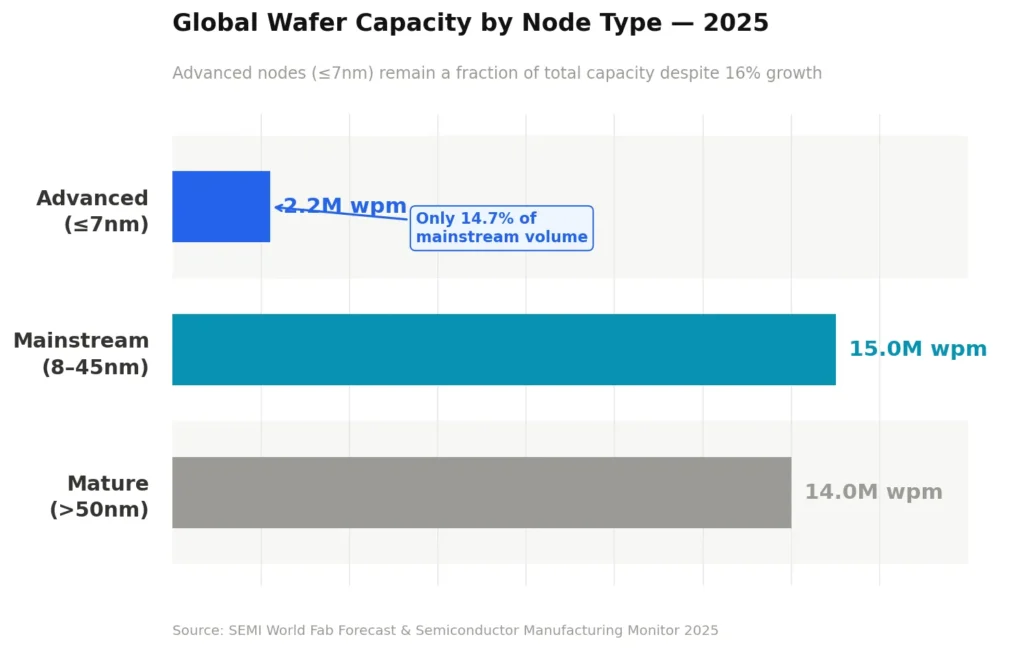
SEMI forecasts 33.6 million wafers per month of global capacity in 2025, a 6.6% annual increase. That sounds broad based. It is not. Mainstream nodes from 8nm to 45nm alone exceed 15 million wafers per month, while mature nodes reach 14 million. Most new capacity still serves automotive, industrial, power, and consumer markets rather than the few leading-edge products driving strategic concern.
The numbers on advanced capacity are stark.
SEMI expects advanced-node capacity to rise more than 300,000 wafers per month to 2.2 million in 2025. That is a 16% increase, versus 5% growth for mature nodes above 50nm. The industry is investing hardest where output is scarcest, but the base remains small. A percentage increase does not remove a structural bottleneck.
SEMI projects foundry capacity to rise from 11.3 million wafers per month in 2024 to 12.6 million in 2025, a 10.9% gain. Memory capacity, by contrast, grows only 2.9% in 2025 after 3.5% in 2024. AI demand is pulling investment toward selected logic and HBM supply chains, not lifting the entire manufacturing base evenly.
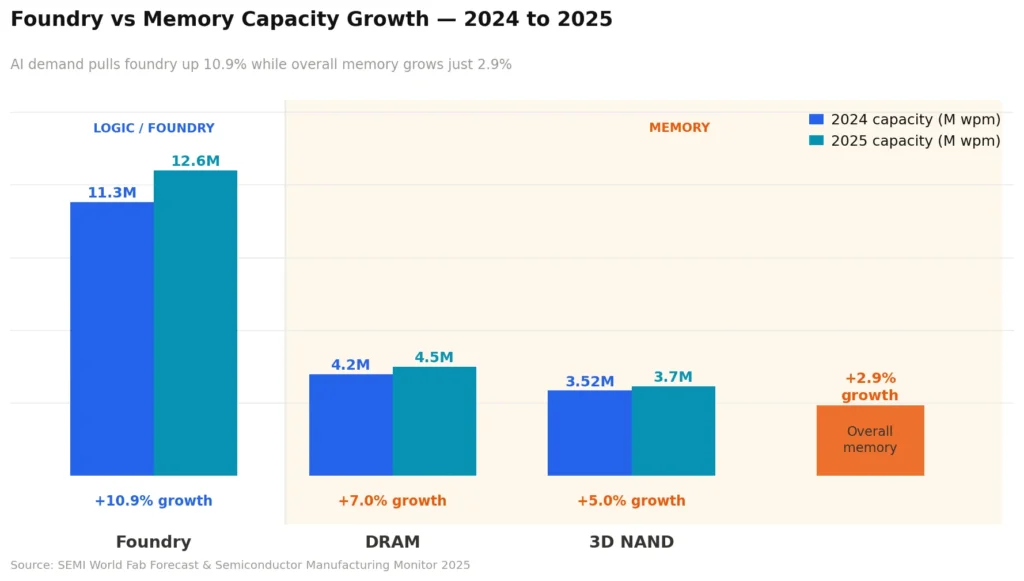
DRAM capacity is expected to increase about 7% to 4.5 million wafers per month in 2025. 3D NAND capacity rises 5% to 3.7 million. HBM demand makes memory look healthy, but it does not repair weak pricing and excess capacity in every memory category. The industry is not experiencing one cycle. It is operating several conflicting cycles at once.
Record Spending, Uneven Geography
SEMI reported worldwide manufacturing-equipment sales of $117.1 billion in 2024, against $106.3 billion in 2023. Wafer-processing equipment sales increased 9%, while other front-end equipment increased 5%. Capital spending is clearly back. However, higher tool orders tell you where money is being committed, not where commercially useful output will arrive on schedule.
China, Korea, and Taiwan represented 74% of global equipment spending in 2024. China alone spent $49.6 billion, up 35% year on year, while Korea spent $20.5 billion, up 3%. Those figures make one point unavoidable: the equipment base remains concentrated in Asia even as every major economy talks about diversification.
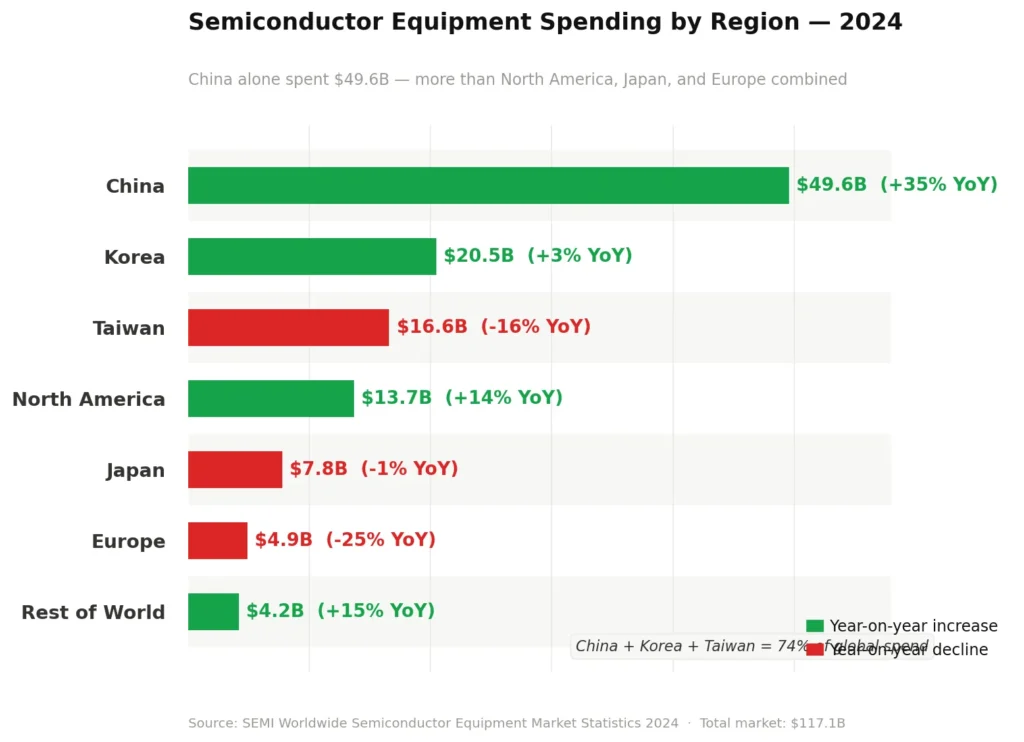
Taiwan’s equipment spending fell 16% to $16.6 billion in 2024. North American spending rose 14% to $13.7 billion. The headline suggests rebalancing. It does not. Taiwan’s decline followed years of heavy investment, while North America still spent less than China by $35.9 billion. A one-year growth rate cannot erase an installed-base advantage.
Europe spent $4.9 billion on semiconductor equipment in 2024, down 25%. Japan spent $7.8 billion, down 1%, while the rest of the world reached $4.2 billion, up 15%. Governments can announce fabs, but tool deployment exposes which regions actually have projects moving through procurement and construction. Europe’s problem is execution, not intent.
Factory Announcements, Delayed Output
SEMI expected 18 new fab construction projects to start in 2025. Of those, 15 use 300mm wafers and only 3 use 200mm wafers. The majority are expected to begin operations in 2026 or 2027. Announcing a fab is the easy part. Ramping yield, staffing shifts, qualifying materials, and winning customer volume takes years.
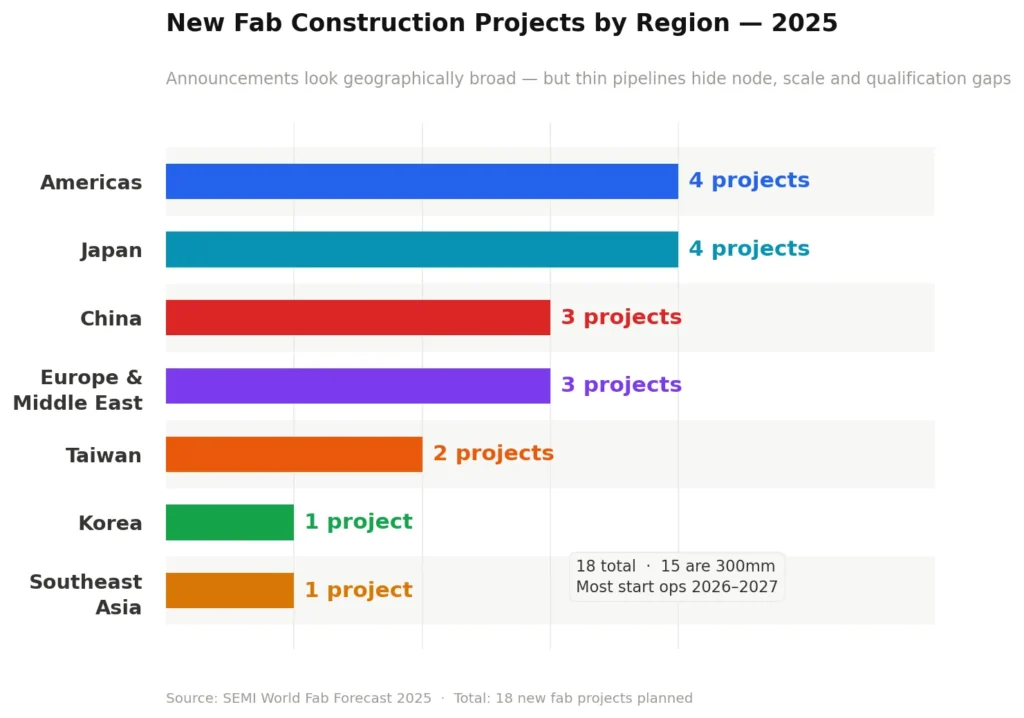
The Americas and Japan each planned 4 new fab projects in 2025. China and Europe and the Middle East each planned 3, Taiwan planned 2, and Korea and Southeast Asia planned 1 each. This looks geographically broad. It is still a thin pipeline relative to existing Asian manufacturing depth. Factory counts hide differences in node, scale, process maturity, and customer qualification.
SEMI tracked plans for 97 high-volume fabs to begin operating across 2023 through 2025. That total included 48 projects in 2024 and 32 in 2025. Its World Fab Forecast listed more than 1,500 facilities and lines globally, including 180 future volume facilities or lines. A long project list is not proof of balanced capacity. It is proof that the industry is spending into uncertainty.
SEMI projected global installed capacity above 42.5 million wafers per quarter in Q1 2025, a 2% quarterly and 7% annual increase. Yet the same monitor noted inventory problems for discrete, analog, and optoelectronic manufacturers. Capacity growth and demand health are separate questions. Adding wafer starts into weak utilization does not create value. It creates pressure on margins.
AI Investment, Broad Market Weakness
SEMI reported IC sales up 29% year on year in Q4 2024. Electronics sales rose only 4% in that quarter and just 2% for full-year 2024. AI-related chips are lifting the industry’s most visible metrics. They are not delivering a uniform recovery across the wider electronics production chain.
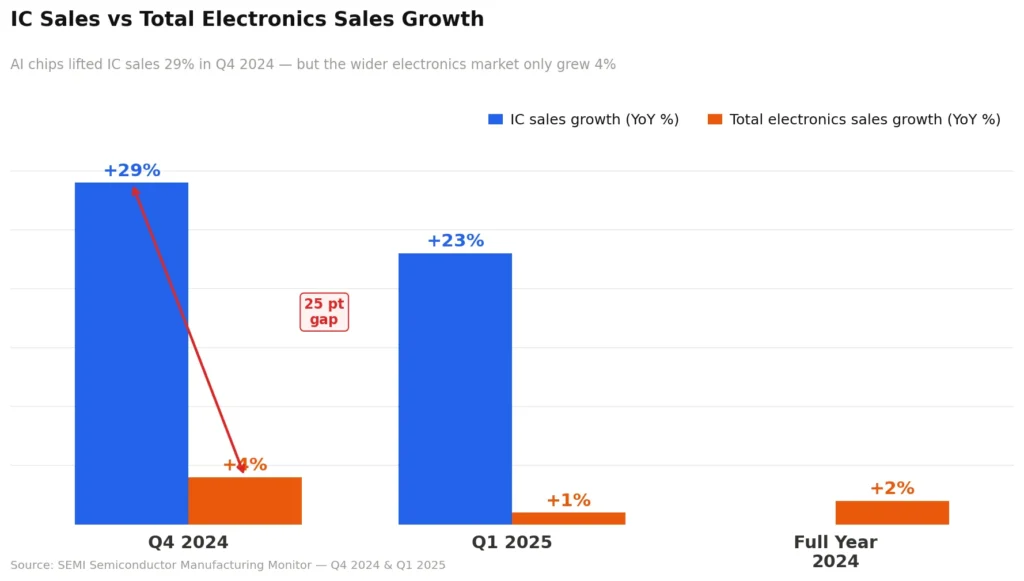
SEMI expected IC sales to rise 23% year on year in Q1 2025. It expected electronics sales to increase only 1%. That difference matters because fabs ultimately serve many end markets, not just data centers. AI can fill selected high-end lines while analog, power, automotive, and consumer suppliers still face weak orders and inventory cleanup.
Memory capital expenditure jumped 53% quarter on quarter and 56% year on year in Q4 2024. Non-memory capex also increased 19% quarter on quarter and 17% year on year. The industry is not short of money for AI-linked capacity. It is short of evidence that every downstream segment can absorb the capacity now being funded.
SEMI expected total semiconductor capex to grow 16% year on year in Q1 2025. Wafer-fab-equipment spending rose 14% year on year and 8% quarter on quarter in Q4 2024. Money is flooding into the most capital-heavy stages of production. Therefore, a demand slowdown outside AI hits a much larger fixed-cost base.
Packaging Recovers, Silicon Stays Weak
SEMI reported that global semiconductor materials revenue rose 3.8% to $67.5 billion in 2024. Wafer-fabrication materials reached $42.9 billion, up 3.3%, while packaging materials reached $24.6 billion, up 4.7%. The materials market recovered. However, the mix shows where recovery sits: advanced processing and packaging, not broad-based wafer demand.
CMP materials, photoresist, and photoresist ancillaries posted double-digit growth in 2024. Silicon revenue fell 7.1% because trailing-edge customers continued working through excess inventory. More complex leading-edge chips use more process steps and more specialty materials. That does not mean the lower-cost, high-volume manufacturing base has recovered.
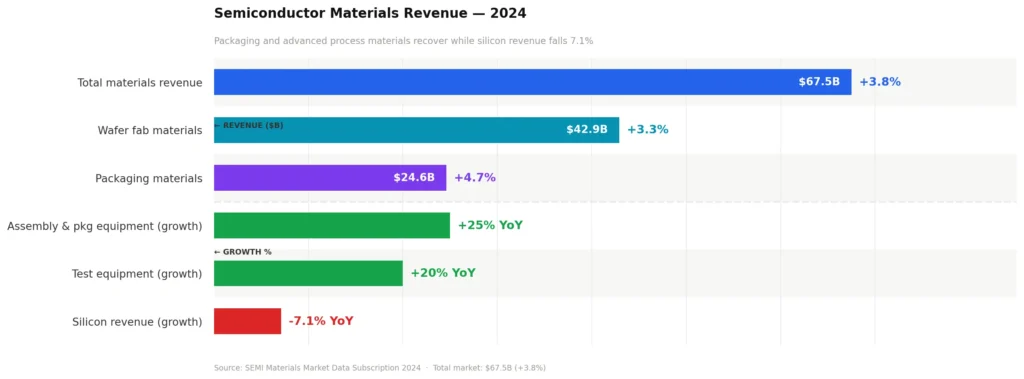
Assembly and packaging equipment sales increased 25% in 2024. Test-equipment billings increased 20% after back-end tools had fallen for two straight years. Advanced packaging has become a capacity constraint because AI systems need more than a leading chip. However, recovery after a two-year decline is not evidence of a permanently healthy back-end market.
Taiwan bought $20.1 billion in semiconductor materials in 2024, China bought $13.5 billion, and Korea bought $10.5 billion. Taiwan held the top position for the 15th consecutive year. Materials spending follows manufacturing concentration. A country cannot claim supply-chain resilience while its critical chemical, wafer, packaging, and process demand remains tied to a few production hubs.
Public Funding, Slow Rebalancing
The U.S. Department of Commerce said CHIPS for America had allocated more than $32 billion in proposed funding across 16 states by December 2025. That is real public commitment. It is not yet equivalent to a self-sufficient production base, because grants finance projects while supply chains depend on years of tool delivery, labor development, and customer qualification.
The Department of Commerce said TSMC’s planned U.S. investment reached $265 billion in July 2026. The plan covers 12 leading-edge semiconductor and packaging facilities, including 4 added facilities. This is the scale required to move advanced capacity. It also shows how expensive reshoring becomes when a handful of projects carry national strategy.
The European Commission said the Chips Act catalysed more than EUR 80 billion in manufacturing-capacity investment. It had approved 7 first-of-a-kind state-aid decisions totaling more than EUR 31.5 billion in public and private investment. Funding is moving. However, capital commitments do not reverse a regional production gap without sustained equipment deployment and operational scale.
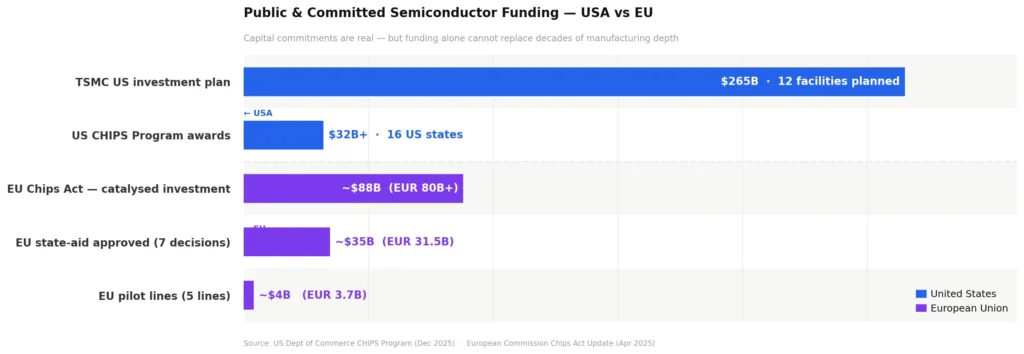
The EU also committed EUR 3.7 billion in European and national funding for 5 pilot lines. It selected 6 projects under a EUR 200 million quantum-chip investment. Research infrastructure matters, but pilot lines do not replace volume fabs. Europe is strengthening technology options while its manufacturing position remains exposed.
Energy Demand, Manufacturing Constraint
The International Energy Agency estimated that data centres used 415 TWh of electricity in 2024, around 1.5% of global consumption. It projects around 1,200 TWh by 2035. Semiconductor manufacturing sits inside that demand chain because AI data-center expansion drives the leading-edge logic and HBM investment cycle. The power system is becoming part of chip capacity planning.
The IEA projects data-center electricity demand to rise from 485 TWh in 2025 to 950 TWh in 2030. That is roughly a doubling in five years. Semiconductor fabs require stable, high-quality electricity and large water systems, not merely a construction site. Chip strategy without power and utility planning is industrial policy written on paper.
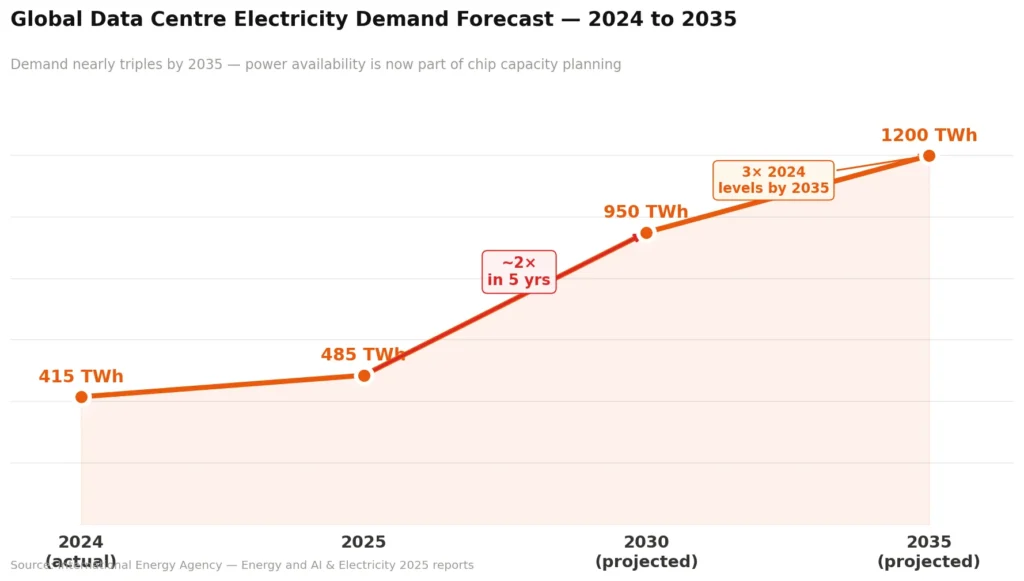
AI-focused data centers raised electricity consumption by 50% in 2025, according to the IEA. Total data-center electricity demand rose 17% that year. That demand strengthens the case for more advanced chips. It also creates a practical limit: fabs, data centers, and local communities now compete for power infrastructure in the same regions.
The IEA expects U.S. electricity demand to grow by an average 2% annually from 2025 through 2027. It identifies semiconductor manufacturing among major new loads. The number sounds manageable at the national level. Local grids do not operate at the national average. A fab can be viable on a corporate slide and unviable at the substation.
Methodology and Sources
This analysis uses public releases issued between January 2025 and August 2026. Every statistic comes from a live report page, official government release, regulatory publication, or intergovernmental analysis. No aggregator, syndicated research publisher, market-data reseller, blog-based estimate, or unattributed forecast was used.
SEMI supplied most production and equipment statistics through the World Fab Forecast, Semiconductor Manufacturing Monitor, Worldwide Semiconductor Equipment Market Statistics, and Materials Market Data Subscription. SEMI says its World Fab Forecast tracks more than 1,500 facilities and lines globally, including 180 future volume facilities or lines. Its equipment data is compiled from member submissions and the Semiconductor Equipment Association of Japan.
The U.S. Department of Commerce provided CHIPS program and investment figures through official releases covering awards, proposed funding, and company commitments in the United States. The European Commission provided figures from its April 2025 Chips Act milestone update, covering EU-wide public and private commitments, pilot lines, state-aid decisions, and research programs.
The International Energy Agency supplied energy figures from Key Questions on Energy and AI, Energy and AI, and Electricity 2025. Those reports cover global and national electricity demand rather than fab-level utility consumption. That distinction matters. The energy numbers show the infrastructure pressure surrounding chip production, not a direct meter reading from a single fab.
FAQ
How fast is semiconductor fab capacity expanding?
SEMI forecasts 33.6 million wafers per month of global capacity in 2025, up 6.6%. Yet advanced nodes reach only 2.2 million wafers per month even after 16% growth. The industry is expanding, but the most strategically valuable capacity remains a small portion of total output.
Which region spends the most on chipmaking equipment?
SEMI reports China spent $49.6 billion on semiconductor equipment in 2024, up 35% year on year. China, Korea, and Taiwan together represented 74% of worldwide equipment spending. Geographic diversification remains mostly a policy target, not a measured outcome.
Is U.S. chip manufacturing becoming self-sufficient?
The U.S. Department of Commerce says CHIPS funding exceeded $32 billion across 16 states. TSMC’s planned U.S. investment reached $265 billion for 12 facilities. That is a large buildout, but dependence cannot disappear before factories qualify products, hire staff, and establish domestic supplier networks.
Why is advanced packaging important now?
SEMI says assembly and packaging equipment sales rose 25% in 2024, while test equipment rose 20%. Materials revenue for packaging reached $24.6 billion, up 4.7%. AI systems increasingly depend on how chips are assembled together, so wafer fabrication alone no longer defines manufacturing strength.
Is the semiconductor recovery broad based?
SEMI reported IC sales rose 29% year on year in Q4 2024, while total electronics sales rose 4%. Silicon-material revenue fell 7.1% in 2024 as trailing-edge inventory remained high. AI is lifting selected categories while many mainstream chip markets still carry excess supply.
What is Europe’s main semiconductor problem?
The European Commission says the Chips Act catalysed over EUR 80 billion in capacity investment. SEMI reports European equipment spending fell 25% to $4.9 billion in 2024. Europe has money and policy tools, but manufacturing strength requires factories purchasing and installing equipment at scale.
Does energy limit semiconductor manufacturing growth?
The IEA projects global data-center electricity use will rise from 485 TWh in 2025 to 950 TWh in 2030. SEMI expects leading-edge node capacity to increase more than 300,000 wafers per month in 2025. AI demand supports fab investment, but power availability can delay or constrain where those fabs actually operate.