

Market Verdict
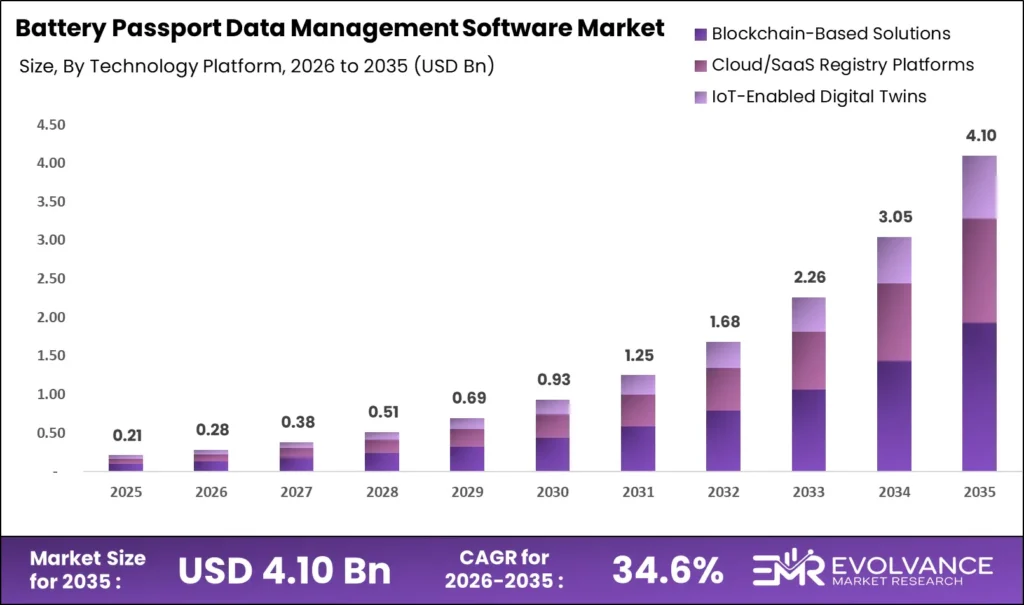
The battery passport data management software market is not an incremental software category. It is a compliance-driven infrastructure layer that batteries must use to enter the EU market beginning 18 February 2027. According to EMR, the market size stands at USD 0.21 billion in 2025, reaches a calculated USD 0.28 billion in 2026, and is forecast to hit USD 4.10 billion by 2035, expanding at a 34.6% CAGR across the decade.
The battery passport data management software market rewards early movers with deep integration advantages that late entrants cannot buy back. Europe’s regulatory deadline is not a risk to monitor. It is a revenue calendar that locks in vendor relationships now.
Key Takeaways
Market Size:
- Market size in 2025: USD 0.21 billion
- Market Size in 2026: USD 0.28 billion as of 2026
- Market Size in forecast year: USD 4.10 billion by 2035
- CAGR: 34.6% over 2025 to 2035
Dominant Segments:
- Solution Type: Digital Product Passport leading as of 2025
- Technology Platform: Blockchain-Based Solutions at 47.9% as of 2025
- Component: Software Platforms at 45.8% as of 2025
- Deployment Mode: Cloud-based dominant as of 2025
- Application: Electric Vehicles at 44.8% as of 2025
- Battery Type: Lithium-ion Batteries dominant as of 2025
- End User: Battery Manufacturers dominant as of 2025
Dominant Region:
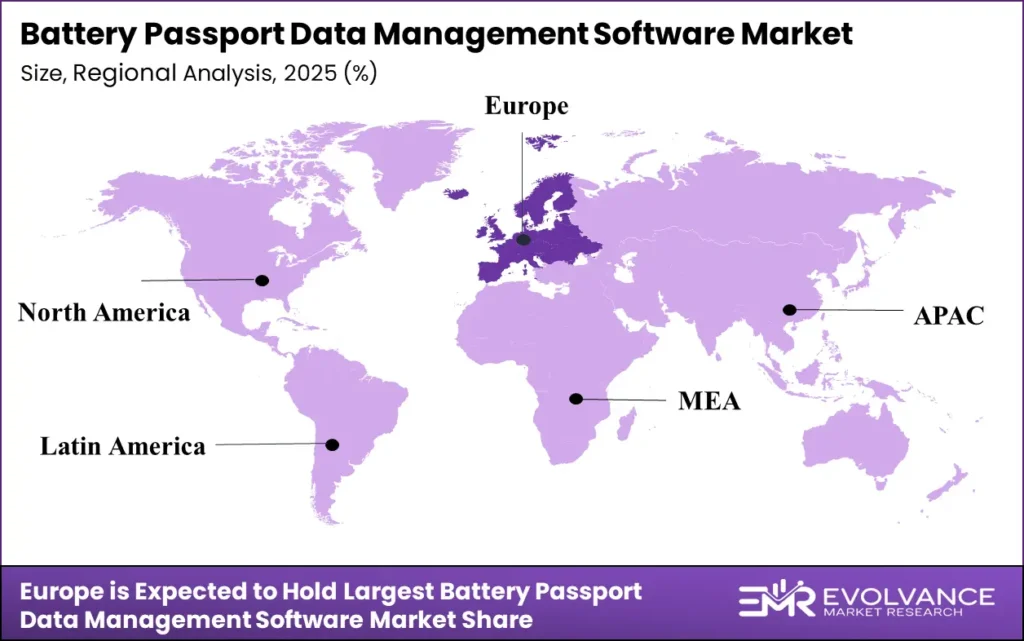
- Leading region: Europe at 48.6% as of 2025
Source: EMR
Market Overview
Battery passport data management software captures, stores, validates, and transmits lifecycle data across the full battery value chain, from raw material sourcing through manufacturing, deployment, and second-life processing. Automotive OEMs, battery manufacturers, energy companies, and recycling operators depend on this infrastructure to meet traceability, carbon-footprint, and due-diligence obligations that are now embedded in procurement contracts and regulatory frameworks simultaneously.
Our EMR research team built this analysis using primary interviews with battery manufacturers, automotive OEMs, compliance technology vendors, and regulatory affairs specialists across Europe, Asia-Pacific, and North America. The study covered the 2020 to 2025 historical window and extended projections to 2035. Data validation combined bottom-up demand modeling with cross-referencing against International Energy Agency published volumes and European Commission regulatory filings, covering more than 18 national markets and all major battery chemistries.
The purchase trigger in this market is not preference. Manufacturers who lack a certified battery passport platform face market exclusion in the EU from February 2027, per the European Commission’s Battery Regulation. Buyers are not optimizing compliance costs. They are eliminating existential supply-chain risk. A manufacturer that misses the certification window loses access to the single largest EV market by regulatory alignment, with no grace period built into the current framework.
Global EV battery deployment reached 1.2 TWh in 2025, nearly 30% higher than 2024 and more than seven times the 2020 level, per the International Energy Agency. Global lithium-ion battery nameplate manufacturing capacity exceeded 4 TWh by the end of 2025, approximately 30% above the 2024 level, per the IEA. Separately, demand for nickel, cobalt, graphite, and rare earths increased by 6 to 8% in 2024, per IEA data, deepening the traceability imperative across the supply chain. For operators, this volume trajectory means passport platforms must now handle industrial-scale data throughput, not pilot-program loads.
What Is Actually Driving This Market
The EU Battery Regulation creates a hard procurement requirement, not an adoption incentive. The European Commission has mandated battery passports from 18 February 2027 for EV batteries, light-means-of-transport batteries, and industrial batteries above 2 kWh. The causal mechanism runs from mandatory compliance to vendor certification to procurement necessity: manufacturers cannot substitute goodwill for a working digital product passport. For investors, this means demand is contractual rather than discretionary, which substantially de-risks revenue forecasting in the battery passport data management software market.
EV volume acceleration compresses the timeline for platform readiness. Global EV sales exceeded 17 million units in 2024, rising more than 25% year-on-year and accounting for over 20% of all cars sold worldwide, per the International Energy Agency. Sales were expected to surpass 20 million units in 2025, representing more than one-quarter of global car sales, per IEA. Each additional vehicle requires a traceable battery record. The causal mechanism is unit-volume driven: more EVs sold means more passport transactions processed, which scales platform revenue directly. For operators, this is not a secular trend to track. It is a load-planning problem to solve now.
Critical mineral supply-chain concentration amplifies the due-diligence demand signal. Global battery demand grew by more than 35% in 2025, exceeding 1.5 TWh, per IEA. Lithium demand increased by nearly 30% in 2024, per IEA, while energy applications accounted for 85% of growth in demand for lithium, nickel, cobalt, and graphite identified in the IEA’s 2025 outlook. Battery manufacturers sourcing from concentrated supply chains face audit trails that only digital traceability platforms can satisfy at scale. For investors, platforms with embedded due diligence tooling, not just lifecycle data storage, carry materially higher switching costs once integrated.
The single most important driver insight: regulatory non-compliance is a market exclusion event, not a fine.
- EU battery passport mandatory from 18 February 2027, per European Commission, covering EV, light-transport, and industrial batteries above 2 kWh
- Global EV sales exceeded 17 million units in 2024, up more than 25% year-on-year, per IEA
- Global battery demand exceeded 1.5 TWh in 2025, growing more than 35%, per IEA
- Lithium demand up nearly 30% in 2024, intensifying supply-chain traceability requirements, per IEA
Operators who have not selected and partially deployed a battery passport data management software vendor by mid-2026 are unlikely to meet the February 2027 certification window.
Where The Real Risk Is
Supply-chain concentration is a structural risk to data integrity, not a temporary bottleneck. China, Indonesia, and the Democratic Republic of the Congo contributed more than three-quarters of supply growth for key energy minerals during 2023 to 2025, per IEA. The average share controlled by the largest refined supplier across key energy minerals reached 70% in 2025, versus 68% in 2020, per IEA. If upstream data quality from concentrated jurisdictions is poor or manipulated, the passport record is worthless regardless of the platform quality downstream. For investors, platforms with upstream data verification capabilities, not just downstream aggregation, carry a defensible moat that pure-registry vendors cannot replicate.
Regulatory scope creep is correlational rather than causal as a risk factor, but it is directionally consistent. The EU’s recycling efficiency target of a minimum 65% by average weight for lithium-based batteries by 31 December 2025, per the European Commission, combined with material-recovery targets of 50% lithium recovery by 2027 and 80% by 2031, and 90% nickel, cobalt, and copper recovery by end-2027, signals that the scope of data an operator must passport will expand. Platforms architected narrowly for initial compliance will face costly re-engineering. For operators, the architecture selection now determines the retrofit cost later. This is not a solvable problem after the fact.
The risk most investors underestimate: upstream data quality failures invalidate the entire passport record at the point of regulatory audit.
- Largest refined supplier concentration reached 70% in 2025, per IEA, up from 68% in 2020
- China, Indonesia, and DRC contributed over 75% of mineral supply growth, 2023 to 2025, per IEA
- EU lithium recovery targets escalate from 50% in 2027 to 80% in 2031, per the European Commission, widening required data scope
Watch for EU enforcement actions against passports with unverifiable upstream mineral provenance records as the leading signal that platform data integrity standards will be tightened post-2027.
Segmentation: Where Value Is Concentrating
Solution Type Insights
Digital Product Passport Pulls Ahead: Dominant Share in 2025
Digital product passport solutions hold the leading position within the battery passport data management software market because they satisfy the literal requirement of the EU Battery Regulation, not as a feature but as the compliance artifact itself. Supply chain traceability platforms, compliance management systems, lifecycle management solutions, carbon footprint tracking tools, and due diligence tools each address downstream data needs. None replaces the passport record at the point of regulatory submission. For operators, digital product passport capability is the non-negotiable foundation; all other solution types are additive layers.
Technology Platform Insights
The 47.9% Story: How Blockchain-Based Solutions Took the Lead in 2025
Blockchain-based solutions held 47.9% of the technology platform segment as of 2025, according to EMR analysis. The structural advantage is immutability: a distributed ledger record cannot be retroactively edited without consensus, which satisfies the audit-trail requirements of EU Battery Regulation enforcement. Cloud and SaaS registry platforms offer lower deployment friction but cannot match the tamper-evidence profile of blockchain for cross-border provenance chains. IoT-enabled digital twins in automotive manufacturing complement blockchain but do not displace it at the regulatory record layer. For investors, blockchain-native vendors in the battery passport data management software market carry structural differentiation that cloud-only competitors cannot replicate without platform re-architecture.
| Sub-segment | Share % | Primary Driver | Outlook |
|---|---|---|---|
| Blockchain-Based Solutions | 47.9% | Regulatory audit-trail immutability requirement | Retains leadership as EU enforcement scales post-2027 |
| Cloud/SaaS Registry Platforms | Not specified | Lower deployment cost for mid-tier manufacturers | Growth constrained by tamper-evidence limitations |
| IoT-Enabled Digital Twins | Not specified | Real-time battery state monitoring | Additive layer; embedded analytics integration accelerating |
Component Insights
Software Platforms at 45.8%: What’s Behind the Numbers in 2025
Software platforms captured 45.8% of the component segment in 2025, per EMR research, spanning cloud-based platforms, mobile applications, data analytics dashboards, and ERP/PLM integration middleware. The ERP and PLM integration middleware sub-layer is the stickiest component: once a battery passport data management software platform is embedded in a manufacturer’s production ERP, replacement cost is prohibitive. Hardware and services round out the segment but represent lower-margin, more competitive positioning. For operators, integration depth into existing ERP infrastructure is the single variable that determines total cost of ownership over a ten-year deployment window.
| Sub-segment | Share % | Primary Driver | Outlook |
|---|---|---|---|
| Software Platforms | 45.8% | ERP/PLM integration and cloud deployment scalability | Share growth expected as platform complexity increases |
| Hardware | Not specified | IoT sensor integration at manufacturing nodes | Commoditizing; margin pressure increasing |
| Services | Not specified | Implementation and compliance consulting demand | Stable; bundled with platform contracts |
Deployment Mode Insights
Cloud-Based Deployment Captures Lead as 2025 Demand Shifts
Cloud-based deployment dominates the battery passport data management software market in 2025, per EMR analysis, driven by the multi-party data-sharing requirement that battery passports impose. A passport that only one entity can read satisfies no regulatory purpose. Cloud infrastructure enables the cross-organization data access that the European Commission’s framework demands. On-premise deployment persists for manufacturers with sovereignty requirements, but it introduces interoperability friction at the exact layer, cross-border data exchange, where the regulation demands fluency. For operators, on-premise architecture must be evaluated against cross-border audit access requirements before selection.
Application Insights
Electric Vehicles Holds the Largest Share at 44.8% in 2025
Electric vehicles accounted for 44.8% of the application segment in 2025, according to EMR, covering both passenger and commercial EV sub-segments. The EU Battery Regulation targets EV batteries specifically as the first mandatory passport category from February 2027, which concentrates near-term demand directly on this sub-segment. Energy storage systems, consumer electronics, and industrial applications follow, but none faces a comparable regulatory hard date. For investors, EV application-focused platform vendors carry the most immediate revenue visibility in the battery passport data management software market through the 2026 to 2028 compliance sprint.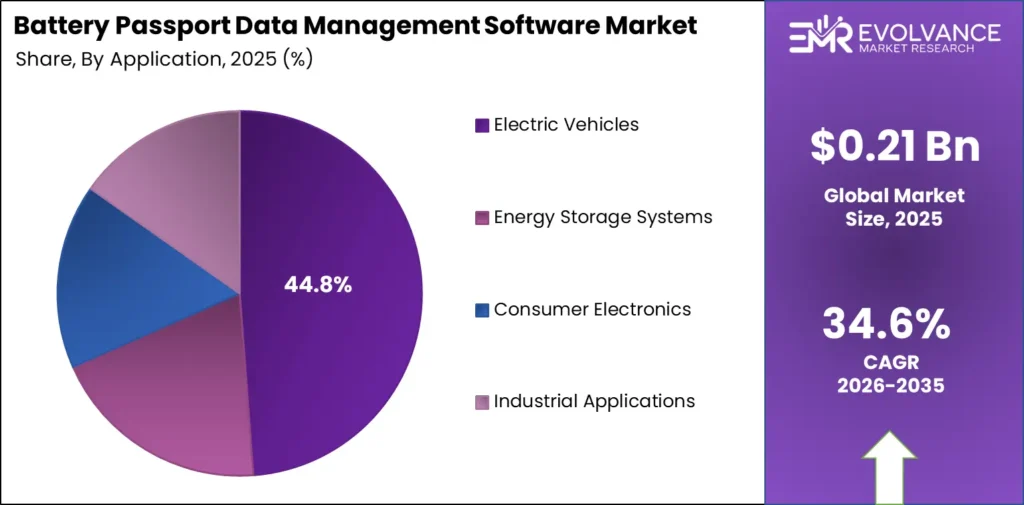
| Sub-segment | Share % | Primary Driver | Outlook |
|---|---|---|---|
| Electric Vehicles | 44.8% | EU mandatory passport deadline, February 2027 | Sustained leadership through 2028 compliance sprint |
| Energy Storage Systems | Not specified | Grid-scale battery deployment and utility compliance | Accelerating as storage mandates expand |
| Consumer Electronics | Not specified | Extended producer responsibility frameworks | Slower regulatory pressure; moderate growth |
| Industrial Applications | Not specified | Due diligence and lifecycle tracking mandates | Niche but growing; scope expansion likely post-2027 |
Battery Type Insights
Lithium-ion Batteries’ Dominant Edge in the Battery Type Race
Lithium-ion batteries dominate the battery type segment of the battery passport data management software market in 2025, per EMR analysis, consistent with their dominance of EV drivetrains and grid-scale energy storage globally. Solid-state batteries represent the next architecture in the pipeline, but commercial-scale deployment remains beyond the current forecast horizon for most OEMs. Lead-acid batteries carry legacy traceability requirements in industrial and utility contexts. For operators serving diversified battery chemistries, platform architecture must accommodate multiple data schemas without requiring a separate passport module per chemistry type.
End User Insights
Inside Battery Manufacturers’ Dominant Share Advantage
Battery manufacturers hold the dominant end-user position in 2025, per EMR research, because the passport obligation originates at the point of manufacture. The data that an automotive OEM, energy company, recycling operator, or regulatory body needs flows upstream from the manufacturer’s production records. Automotive OEMs follow as the second-largest end-user segment given the EU Battery Regulation’s EV-first scope. Recycling and second-life operators represent the fastest-evolving sub-segment given EU circular economy digital platforms mandates expanding through 2031. For operators in recycling and second-life, passport data access, not just passport data creation, is the commercial differentiator to negotiate into supply contracts now.
Segments Covered In This Report
Solution Type
- Digital Product Passport
- Supply Chain Traceability Platforms
- Compliance Management Systems
- Lifecycle Management Solutions
- Carbon Footprint Tracking
- Due Diligence Tools
Technology Platform
- Blockchain-Based Solutions
- Cloud/SaaS Registry Platforms
- IoT-Enabled Digital Twins
Component
- Software Platforms (Cloud-based, Mobile Applications, Data Analytics Dashboards, ERP/PLM Integration Middleware)
- Hardware
- Services
Deployment Mode
- Cloud-based
- On-premise
Application
- Electric Vehicles (Passenger EVs, Commercial EVs)
- Energy Storage Systems
- Consumer Electronics
- Industrial Applications
Battery Type
- Lithium-ion Batteries
- Solid-state Batteries
- Lead-acid Batteries
- Others
End User
- Battery Manufacturers
- Automotive OEMs
- Energy Companies & Utilities
- Recycling & Second-life Operators
- Regulatory Bodies/Certification Agencies
Value in the battery passport data management software market is concentrating at the intersection of blockchain-based technology platforms and EV application deployments, where regulatory deadlines and unit-volume growth align simultaneously. Fragmentation is occurring in services and hardware components, where commoditization is accelerating faster than platform consolidation. For investors, the highest-return positioning is in software platform vendors with EV-focused blockchain infrastructure and embedded analytics, not diversified compliance service providers.
Regional Analysis: Where Geography Creates Advantage
Europe held 48.6% of the battery passport data management software market in 2025, the leading regional position, according to EMR analysis. The structural driver is unambiguous: the European Commission’s Battery Regulation creates the world’s only hard-date mandatory passport requirement at scale, directly pulling vendor investment and customer procurement into the European market ahead of every other region. Europe’s EV sales reached 4.2 million units in 2025, equal to 28% of new-car sales in the region, per the IEA, underpinning the transaction volume that passport platforms must process. Europe added approximately 6.2 GW of battery storage capacity in 2025, with utility-scale additions exceeding 4.6 GW, more than double the prior year, per the IEA, expanding the non-EV passport addressable market simultaneously. For investors, Europe is not merely the largest region; it is the region where vendor contracts are legally compelled rather than commercially negotiated.
Asia-Pacific is the fastest-growing region in the battery passport data management software market, per EMR research, driven by the scale of battery manufacturing activity that will eventually need to passport-qualify for export to regulated markets. China accounted for more than 80% of worldwide battery manufacturing capacity in 2025, while the EU and the United States each accounted for approximately 6 to 7%, per the IEA. China added more than 63 GW of battery storage capacity in 2025, approximately one-third more than in 2024, per the IEA. Any Chinese battery cell or pack destined for the EU market from February 2027 must carry a compliant passport, creating inbound adoption pressure from European customers onto Asian suppliers. The Ministry of Industry and Information Technology in China has also initiated domestic traceability frameworks that may create an indigenous battery gigafactory compliance market separate from EU-driven demand. For operators sourcing from Asia-Pacific, passport data quality agreements must be embedded into supplier contracts before 2027, not after.
North America is a developing market in the battery passport data management software space, with the United States adding 19 GW of battery capacity in 2025, representing approximately 60% year-on-year growth, per the IEA. The U.S. lacks a federal battery passport mandate equivalent to the EU framework, but the Inflation Reduction Act’s battery sourcing and traceability requirements under the Department of Energy create a parallel compliance infrastructure demand. LG Energy Solution’s large-scale Arizona battery manufacturing complex signals that North American-produced batteries targeting both domestic and export markets will need multi-jurisdictional passport compatibility. For investors, North America represents the second wave of battery passport data management software market expansion, contingent on federal traceability rule finalization by the DOE.
| Region | Share % | USD Value | Key Driver | Strategic Signal |
|---|---|---|---|---|
| Europe | 48.6% | Largest region, 2025 | EU Battery Regulation mandatory passport from February 2027 | Vendor contracts legally compelled; highest near-term revenue certainty |
| Asia-Pacific | Fastest-growing | Largest manufacturing base | Export-driven compliance pressure from EU-bound battery manufacturers | Chinese suppliers must passport-qualify for EU market access post-2027 |
| North America | Developing | 19 GW battery capacity added in 2025 | DOE traceability requirements under Inflation Reduction Act | Second-wave expansion dependent on federal rule finalization |
Competitive Landscape: Who Is Pulling Ahead and Why
The battery passport data management software market is currently fragmented, with no single vendor holding dominant share across all deployment contexts, but consolidation signals are present. Circulor and Minespider GmbH hold early-mover advantages in supply-chain traceability specifically because they entered the space before the EU Battery Regulation created a mass-market mandate. Deep supply-chain data relationships established pre-mandate are operationally difficult for later entrants to replicate at comparable data depth. CATL invested RMB 22.1 billion in R&D in 2025, and CATL sold 661 GWh of lithium-ion batteries in 2025, a 39% increase year-on-year, per CATL’s March 2026 filings, positioning it as both a market participant and a platform development force in the embedded analytics space. For investors, vendors with validated supply-chain integrations and existing customer data histories are better positioned than pure-registry new entrants.
Enterprise software incumbents including SAP SE, IBM Corporation, Siemens AG, and Accenture plc bring ERP and PLM integration infrastructure that pure-play passport vendors cannot match in manufacturing environments where these systems already own the production data layer. The advantage is not the passport module. It is the pre-existing integration footprint that reduces deployment time for a customer that is already running SAP or Siemens systems. Bosch Connected Industry occupies a similar embedded position within industrial IoT environments. LG Energy Solution reported KRW 23.7 trillion in consolidated revenue and KRW 1.3 trillion in operating profit for full-year 2025, per January 2026 filings, reflecting the financial scale of battery manufacturers who can develop proprietary passport infrastructure rather than procure externally. For operators, the vendor selection question is whether an independent platform or an ERP-embedded module better aligns with existing system architecture.
The most aggressive challengers in the battery passport data management software market are specialist traceability platforms with blockchain-native architectures, including Circularise B.V., Kezzler AS, PSQR B.V. (Cirtrace), and Everledger, which are built specifically for immutable provenance tracking rather than adapted from adjacent software categories. Their barrier to scale is not technology. It is enterprise sales cycle length and ERP integration depth relative to incumbents. CATL’s RMB 72.2 billion net profit in 2025, up 42% year-on-year, and its RMB 423.7 billion in revenue, up 17%, per March 2026 filings, signals that large battery manufacturers may internalize passport infrastructure rather than purchase it, creating a market structure risk for independent vendors. For investors, platform vendors with defensible third-party certifications or regulatory body endorsements carry lower substitution risk than those relying solely on commercial relationships.
| Company | Market Position | Key Advantage | Recent Move |
|---|---|---|---|
| Circulor | Supply-chain traceability leader | Pre-mandate data relationships; utility-scale & EV deployments | Expanded to utility-scale energy storage systems via Powin partnership |
| Minespider GmbH | Blockchain traceability specialist | Open-standard mineral provenance tracking | Deepening EU regulatory alignment |
| Siemens AG | Enterprise integration incumbent | Industrial IoT and PLM ecosystem breadth | Battery-passport platform launch with Sunwoda for carbon footprint tracking |
| SAP SE | ERP-layer incumbent | Pre-existing production data ownership in OEM environments | Compliance module integration into core ERP |
| CATL | Battery manufacturer / platform developer | Internal data scale; 661 GWh sold in 2025 | R&D at RMB 22.1 billion in 2025 with platform development embedded |
| Circularise B.V. | Blockchain-native challenger | Zero-knowledge proof data sharing architecture | Expanding EU manufacturer customer base |
| IBM Corporation | Enterprise blockchain infrastructure | Hyperledger-based traceability at enterprise scale | Supply chain intelligence integration |
| LG Energy Solution | Battery manufacturer / internal platform | Manufacturing scale; KRW 23.7T revenue in 2025 | Arizona complex signals multi-jurisdictional passport requirements |
Key Players In This Report:
- Circulor
- Minespider GmbH
- Siemens AG
- AVL List GmbH
- OPTEL Group
- SAP SE
- IBM Corporation
- Circularise B.V.
- Kezzler AS
- PSQR B.V. (Cirtrace)
- Tata Elxsi Ltd.
- Infosys Limited
- Accenture plc
- Wipro Limited
- Bosch Connected Industry
- Everledger
- LG Energy Solution
- Panasonic Energy
- CATL
- Microsoft Corporation
Where This Market Goes Next
When the EU battery passport mandate takes effect in February 2027, the first compliance sprint will resolve into a consolidation wave. Vendors that won the initial certification race will hold data relationships, audit histories, and regulator familiarity that late entrants cannot establish retroactively. Lithium demand is projected to rise by 353% between 2024 and 2040, per UNCTAD’s June 2026 analysis, and clean technologies’ share of lithium demand is projected to increase from 62% in 2024 to 87% in 2040, per the same source. This trajectory sustains passport transaction volume well beyond the 2027 compliance sprint into a steady-state infrastructure phase. For operators, the selection decision made in 2025 and 2026 is a decade-long architectural commitment, not a procurement cycle.
Battery gigafactory expansion outside China represents the next geographic activation condition for the battery passport data management software market. As the IEA data points, the EU and US each held only approximately 6 to 7% of global manufacturing capacity in 2025. Government-backed manufacturing incentives in both regions are designed to shift that ratio. When European gigafactories reach operational scale, passport platform demand generated domestically within the EU becomes a different and larger market than the current import-compliance model. Operators building greenfield battery manufacturing facilities must architect passport data infrastructure into the plant design, not retrofit it post-commissioning. For operators, the gigafactory planning window is the passport integration window, and both are now open simultaneously.
Panasonic Energy’s announced JPY 350 billion investment to triple Japanese battery-cell production by FY2029 signals that passport requirements will propagate into new manufacturing geographies as production-scale mandates EU export volumes. The activation condition here is Japanese and Korean battery producers gaining sufficient EU market share to make EU Battery Regulation compliance mandatory for their business models, a threshold early data suggests is already being crossed. For operators, multi-jurisdictional passport compatibility, not single-market certification, is the architecture requirement to build toward now. The EU circular economy digital platforms framework will extend data scope requirements further, making platform extensibility a non-negotiable selection criterion.
| Condition | Timeline | Upside | Who Benefits |
|---|---|---|---|
| EU mandate enforcement begins | February 2027 | Mandatory vendor contracts; compliance sprint consolidation | Early-certified blockchain-native and ERP-embedded platform vendors |
| Lithium demand 353% growth trajectory materializes | 2024 to 2040 | Passport transaction volumes scale 7x+ from current base | High-throughput cloud platform vendors with embedded analytics |
| Ex-China gigafactory capacity scaling in EU and US | 2026 to 2030 | Domestically generated passport demand; higher data quality | Vendors with greenfield manufacturing integration playbooks |
Key Developments
- June 2026, CeLLife Technologies: The Finnish battery-software company raised EUR 4 million in post-seed financing to expand its battery-analytics, diagnostics, and traceability platform. This signals that specialist traceability software is attracting early-stage capital independently of hardware-adjacent battery technology, pointing toward a software-only investment category forming within the battery passport data management software market.
- June 2026, Panasonic Energy: Panasonic announced a planned JPY 350 billion investment to develop data-center battery manufacturing, targeting a tripling of Japanese battery-cell production by FY2029. This signals that battery production scale outside China is accelerating faster than passport platform coverage currently extends, creating a geographic expansion imperative for vendors.
- February 2026, TWAICE: TWAICE secured EUR 24 million in European Investment Bank venture-debt financing to expand predictive battery analytics and lifecycle-management capabilities, with total funding at USD 75 million at announcement. EIB backing signals institutional validation of battery lifecycle software as infrastructure-grade investment.
- December 2024, CATL and Stellantis: The companies agreed to invest up to EUR 4.1 billion to establish an LFP battery joint venture in Zaragoza, Spain, with up to 50 GWh of capacity and production targeted to begin by end of 2026. This signals that gigafactory-scale LFP production within the EU will require EU-compliant passport infrastructure from day one of operation.
- September 2025, CATL: CATL broke ground on a USD 5.9 billion battery plant in Karawang, Indonesia, designed for up to 15 GW of capacity with full operation expected by 2028. This signals that passport platform vendors must extend Asia-Pacific manufacturing coverage to remain relevant to the largest battery producers’ global supply chains.