

HomeFood And BeverageAlternative Protein Market

Alternative Protein Market

Global Alternative Protein Market Size, Share, Growth Analysis By Source (Plant-Based, Insect-Based, Microbial-Based, Others), By Form (Dry, Liquid, Powder, Ready To Eat, Liquid Concentrates), By Application (Food, Animal Feed, Petfood, Equine, Others), By Distribution Channel (Supermarkets, Online Retail, Specialty Stores), By Region and Companies – Industry Segment Outlook, Market Assessment, Competition Scenario, Statistics, Trends and Forecast 2026-2035

Key Statistics

Formats:
Formats:
Key Statistics

What is the Alternative Protein Market Size?

The Global Alternative Protein Market size will be worth around USD 553.69 Billion by 2035 from USD 107.6 Billion in 2025, growing at a CAGR of 17.8% during the forecast period 2026 to 2035. Food brands are swapping animal inputs for plant, microbial, and fermented sources to cut cost and carbon load. Retailers are widening private-label shelf space, pushing volume growth even where average prices soften. Feed millers face tighter margins as fermentation-derived proteins compete directly with soy meal on price and traceability.

Market Highlights

  • The Alternative Protein Market will grow from USD 107.6 billion in 2025 to USD 553.69 billion by 2035, at a CAGR of 17.8%.
  • North America leads the market with a 35.7% share, valued at USD 38.41 billion.
  • Plant-Based: Dominated the source segment with a 47.2% share in 2025.
  • Dry: Led the form segment with a 49.7% share in 2025.
  • Food: Accounted for the largest application share at 54.3% in 2025.
  • Supermarkets: Dominated distribution channels with a 63.2% share in 2025.
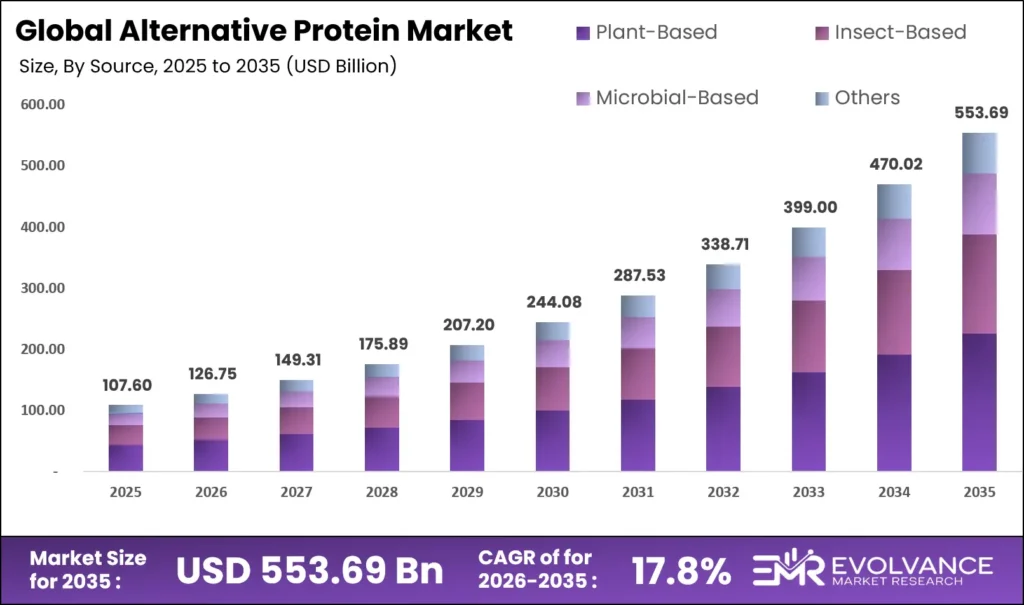
Alternative Protein Market

Market Overview

The alternative protein market covers plant, insect, and microbial protein sources used to replace animal-derived ingredients. It spans meat analogs, dairy alternatives, feed additives, and functional food inputs sold to manufacturers and retailers worldwide. Buyers choose these sources for cost control, supply security, and lower emissions per unit of protein produced. Food makers blend plant isolates with fermentation-derived proteins to match taste and texture targets that once needed animal inputs.

Governments now back this shift with direct funding. In 2025, precision fermentation reached a new milestone as an egg-white protein powder launched at Walmart, proving these ingredients can meet mainstream retail standards. This kind of shelf placement builds trust with buyers who once saw fermentation proteins as niche.

According to GFI data reported by the Food Institute, global plant-based retail sales reached USD 28.6 billion in 2024, led by 5% growth in dairy alternatives. This shows dairy substitutes now drive category growth more than meat analogs, redirecting where manufacturers should place new production capacity. As reported by the Good Food Institute, global sales of non-dairy alternative milk and beverages grew 5% to reach USD 22.4 billion in 2024. This steady climb signals that dairy substitution has moved past early adopters into routine household purchasing across major retail markets.

Source Insights

Plant-Based dominates with 47.2% due to broad ingredient availability and lower cost.

In 2025, Plant-Based held a dominant market position in the By Source segment of Alternative Protein Market, with a 47.2% share. Soy, pea, and wheat proteins offer manufacturers proven supply chains and predictable pricing, making plant sources the default choice for new product launches across food and feed categories alike.

Soy Protein Isolates anchor the plant-based group through their high purity and strong binding function in meat analogs and dairy substitutes. In 2024, at least 13 new partnerships formed in the plant-based sector, alongside 26 new facilities announced or built, extending isolate supply into more regional markets.

Soy Protein Concentrates serve cost-sensitive feed and bakery buyers who need functional protein without isolate-level purity. Millers favor concentrates because they blend easily into existing formulations, cutting reformulation time and lowering ingredient switching costs for mid-size producers.

Insect-Based protein serves feed buyers who value dense amino acid content and low land use per unit of output. A 2025 EASAC report highlighted the growing role of insects and microbial fermentation as efficient protein sources with minimal environmental impact when producers use sustainable feedstocks, a point that is pushing more feed formulators to trial insect meal in aquaculture and pet food lines.

Microbial-Based protein draws buyers who want production independent of weather and farmland, since fermentation tanks run year-round under controlled conditions. This consistency appeals most to buyers who cannot tolerate seasonal supply gaps in their formulations. Yeast protein benefits from decades of established fermentation infrastructure already used in brewing and baking, giving producers a faster, lower-cost route to commercial-scale output than newer microbial platforms.

Form Insights

Dry dominates with 49.7% due to lower shipping cost and longer shelf life.

In 2025, Dry held a dominant market position in the By Form segment of Alternative Protein Market, with a 49.7% share. Powdered and granulated formats cut freight weight and storage cost, letting manufacturers ship further without spoilage risk, a clear edge for exporters serving distant regional markets.

Liquid form suits beverage and dairy-alternative producers who need proteins pre-dissolved for direct blending, cutting processing steps on the manufacturing line and shortening batch turnaround time. Powder formats give food makers precise dosing control in bakery, snack, and supplement lines, supporting consistent nutrition labeling across large production runs.

Ready To Eat products meet rising demand from buyers who want convenience without home preparation, letting alternative protein brands compete directly with traditional prepared meat and dairy items on the shelf.

Application Insights

Food dominates with 54.3% due to consumer-facing demand across multiple categories.

In 2025, Food held a dominant market position in the By Application segment of Alternative Protein Market, with a 54.3% share. As reported by the Good Food Institute, global sales of plant-based meat analogues grew 4% to reach USD 6.1 billion in 2024, confirming that consumer food remains the category’s largest and steadiest revenue base despite slower analog growth than dairy substitutes.

Animal Feed applications give producers a lower-margin but high-volume outlet, especially where fermentation-derived proteins now compete with soy meal on delivered cost per protein unit. Swine feed buyers turn to alternative proteins, particularly fermented soy, to improve piglet digestion during the sensitive weaning period.

Dairy cattle diets use alternative proteins to support milk yield and quality without over-relying on single-crop feed sources. Aquaculture has become a fast-adopting segment, as insect and algae proteins replace fishmeal and ease pressure on wild fish stocks used in feed production.

Distribution Channel Insights

Supermarkets dominate with 63.2% due to established cold-chain and shelf access.

In 2025, Supermarkets held a dominant market position in the By Distribution Channel segment of Alternative Protein Market, with a 63.2% share. Their existing refrigeration networks and high foot traffic give alternative protein brands the fastest route to mainstream household purchasing.
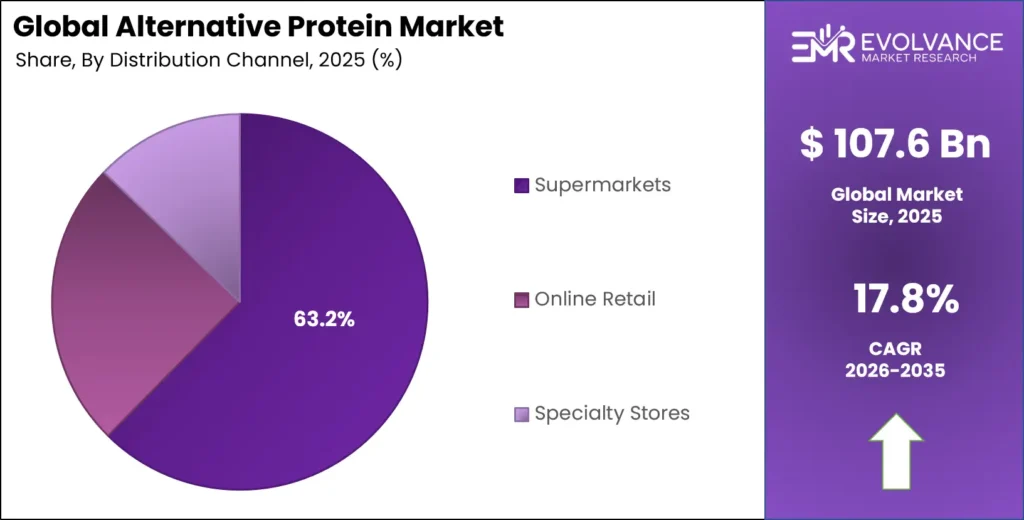
Alternative Protein Market Share

Online Retail channels are expanding as buyers seek wider product variety than local shelf space allows, particularly for niche microbial and insect-based brands not yet stocked in mainstream stores. Specialty Stores serve health-focused shoppers willing to pay a premium for curated alternative protein selections, giving smaller brands a testing ground before scaling into supermarket chains.

Market Segments Covered in the Report

By Source

  • Plant-Based
    • Soy Protein Isolates
    • Soy Protein Concentrates
    • Fermented Soy Protein
    • Duckweed Protein
    • Others
  • Insect-Based
  • Microbial-Based
    • Bacteria
    • Yeast
    • Algae
    • Fungi
  • Others

By Form

  • Dry
  • Liquid
  • Powder
  • Ready To Eat
  • Liquid Concentrates

By Application

  • Food
    • Meat analogs
    • Bakery
    • Dairy alternatives
    • Cereals & snacks
    • Beverages
    • Others
  • Animal Feed
    • Poultry
      • Broiler
      • Layer
      • Turkey
      • Others
    • Swine
      • Starter
      • Grower
      • Sow
    • Cattle
      • Dairy
      • Calf
      • Others
    • Aquaculture
      • Salmon
      • Trout’s
      • Shrimps
      • Carp
      • Others
    • Petfood
    • Equine
    • Others

By Distribution Channel

  • Supermarkets
  • Online Retail
  • Specialty Stores

Regional Insights

North America Dominates the Alternative Protein Market with a Market Share of 35.7%, Valued at USD 38.41 Million

North America leads through early manufacturer investment and strong retail infrastructure for chilled and shelf-stable alternative proteins. The region’s 35.7% share, worth USD 38.41 billion, reflects deep private and public backing, including federal funding for domestic fermentation capacity.
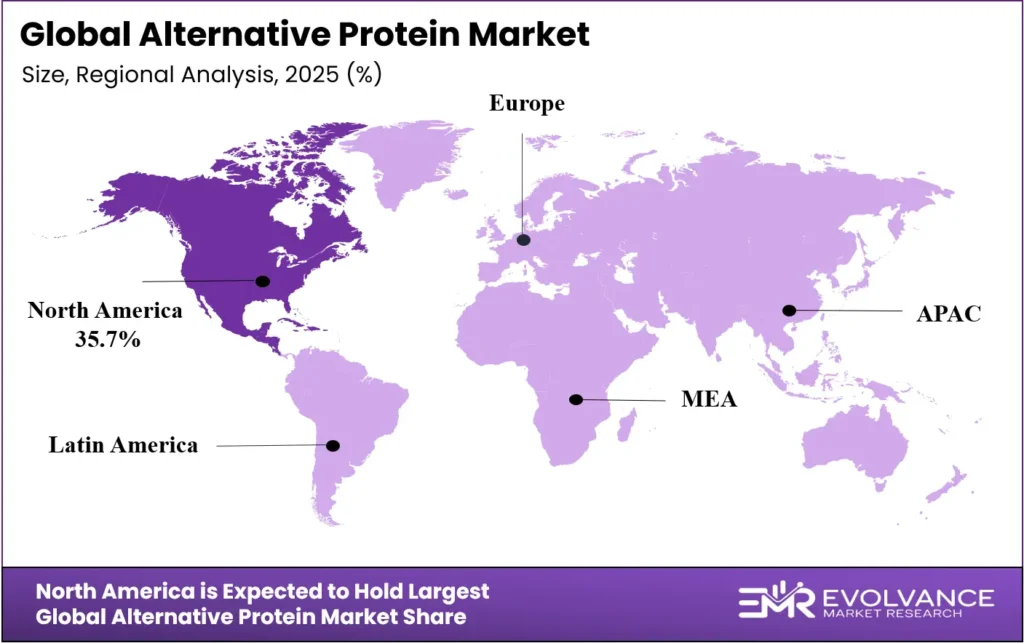
Alternative Protein Market Regional Analysis

Europe Market Trends

Europe’s plant-based retail sales across its six largest markets reached €4.75 billion in 2025, up 3.3% from the prior year. Germany and Italy post steady gains, while the UK market has contracted, showing uneven country-level demand within the region.

Asia Pacific Market Trends

China imported USD 1.72 billion in plant-based pulse ingredients in 2023, growing at a 21.1% compound annual rate since 2019. Japan added 46.1 thousand tonnes of protein ingredient volume in 2024, showing steady regional processing demand.

Latin America Market Trends

The Latin America plant-based dairy market generated an estimated USD 1.38 billion in 2024. Organic formats hold 65% of that category, while Mexico accounts for about 32% of regional share on rising domestic output.

Key Regions and Countries

North America

  • US
  • Canada

Europe

  • Germany
  • France
  • The UK
  • Spain
  • Italy
  • Rest of Europe

Asia Pacific

  • China
  • Japan
  • South Korea
  • India
  • Australia
  • Rest of APAC

Latin America

  • Brazil
  • Mexico
  • Rest of Latin America

Middle East & Africa

  • GCC
  • South Africa
  • Rest of MEA

Regulatory Landscape

Between 2024 and 2025, several U.S. states, including Florida, Alabama, Mississippi, Montana, Nebraska, and Indiana, passed laws banning the sale and distribution of cultivated meat products. These state-level bans create a fragmented compliance map for producers selling across state lines. Outside the United States, most markets regulate alternative proteins under standard novel-food and labeling frameworks rather than category-specific bans.

Producers must still prove nutritional equivalence and safety before national approval, adding time to market entry. Public funding has moved in the opposite direction from state bans, with federal programs backing domestic fermentation capacity. This split between state restriction and federal support means compliance strategy now varies sharply by jurisdiction within a single country.

Drivers

Public Funding and New Production Capacity Push Precision Fermentation Into the Mainstream

Government backing is turning precision fermentation from a lab-scale idea into a funded industry. The U.S. Department of Defense committed up to USD 100 million for domestic precision fermentation capacity through its Distributed Biomanufacturing Program, signaling that national supply security now factors into protein sourcing decisions.

In Q1 2025, Liberation Labs brought a 600,000-liter precision fermentation facility online in Indiana, one of North America’s largest dedicated plants for the sector. This scale gives food brands a domestic supplier able to meet retail-volume orders without relying on imported fermentation capacity.

As reported by the Good Food Institute, U.S. sales of whole-food plant-based options like tofu, tempeh, and seitan rose 7% in 2024, even as processed alternatives softened. This shift shows buyers now separate whole-food plant proteins from heavily processed analogs when making purchase decisions, a distinction manufacturers should build into product positioning.

Restraints

State-Level Bans and Falling Investment Slow Cultivated Meat Commercialization

Cultivated meat faces a fragmented regulatory map, with Florida, Alabama, Mississippi, Montana, Nebraska, and Indiana banning its sale between 2024 and 2025. Each ban forces producers to redesign distribution plans around state borders, raising legal and logistics costs before a single product reaches shelves.

Capital has pulled back sharply alongside this regulatory pressure. Investment in cultivated meat dropped from USD 922.3 million in 2022 to USD 225.9 million in 2023, a decline that reflects investor caution as pilot plants struggle to scale into commercial production. Together, these pressures push cultivated meat further behind plant and fermentation-based proteins in near-term commercial readiness. Producers now face a narrower funding window to prove unit economics before investor patience runs out entirely.

Growth Factors

Rising Research Output and Low-Reformulation Proteins Open New Revenue Paths

Academic and patent activity around alternative proteins is accelerating fast. Academic research on plant-based and hybrid alternatives rose to 825 articles in 2024, up from 649 in 2023, while cumulative patent families for meat and dairy analogs passed 1,200. This research pipeline is translating into commercial partnerships.

In 2024, at least 13 new partnerships formed within the plant-based sector, alongside 26 new facilities announced or under development, widening production capacity ahead of expected demand growth. Precision fermentation-derived dairy and egg proteins can integrate into existing food manufacturing lines with minimal reformulation, cutting emissions by more than 90% versus animal-derived equivalents. This low-friction adoption path lets established food makers add these proteins without rebuilding production infrastructure.

Emerging Trends

AI-Driven Protein Design Shortens the Path From Lab to Shelf

Artificial intelligence and machine learning are reshaping how new proteins get designed. These tools now predict structure-function relationships, sensory quality, and allergenicity before a product ever reaches physical testing, cutting development timelines significantly. This shift is most visible in cultivated meat, where cell-culture media costs have fallen by more than 99% over the past decade.

Open-access cell lines paired with AI tools are accelerating research and development, narrowing the cost gap with conventional meat production. A 2025 EASAC report reinforced this direction, highlighting the growing role of insects and microbial fermentation as efficient protein sources with minimal environmental impact when producers use sustainable feedstocks. Early movers combining AI design with these efficient source types stand to capture disproportionate share as the category matures.

Research Methodology Framework and Report Scope

Market Definitions and Key Coverage

This report defines the alternative protein market as the global supply of plant-derived, insect-derived, and microbial-derived protein ingredients used across food, animal feed, and specialty nutrition applications. Coverage includes protein isolates, concentrates, fermented proteins, and finished ingredient forms sold in dry, liquid, powder, ready-to-eat, and concentrate formats. Market values are stated in constant United States dollars using 2025 as the base year, a method chosen to remove the distorting effect of currency fluctuation on year-over-year comparisons across the ten-year forecast window.

The scope excludes finished consumer packaged goods sold under individual food and beverage brand names, animal-derived protein ingredients, and cultivated or lab-grown meat products regulated as novel foods rather than ingredient inputs. Software platforms, agricultural equipment, and unrelated nutraceutical categories outside direct protein ingredient supply also fall outside this report’s coverage.

Key Companies Insights

Hamlet Protein A/S focuses on fermented soy-based specialty ingredients for young animal nutrition, giving it a defensible niche in feed markets that prize digestibility over raw cost, though its narrow product range limits exposure to the faster-growing food-application side of the market.

E.I. Du Pont De Nemours and Company brings deep protein science and formulation expertise across both food and feed applications, positioning it to serve large multinational buyers, though its scale also ties performance closely to broad ingredient demand cycles. Archer Daniels Midland Company operates extensive soy processing infrastructure that supports high-volume plant protein output at competitive cost, giving it strong leverage in supermarket-channel supply contracts where price consistency matters most.

Ingredion reported full-year 2024 net sales of USD 7.4 billion, with adjusted operating income up 5% to USD 1.01 billion. The company also took a USD 65 million impairment charge after discontinuing its plant-based protein concentrates facility in Vanscoy, Canada, showing even established players are actively reshaping capacity around where demand is strongest.

Key Companies

  • Hamlet Protein A/S
  • E.I. Du Pont De Nemours and Company
  • Archer Daniels Midland Company
  • Nordic Soya Oy
  • Deep Branch Biotechnology
  • CHS Inc.
  • Agriprotein GmbH
  • Darling Ingredients
  • Innovafeed
  • Ynsect
  • Angel Yeast
  • Calysta Inc.
  • Lallemand, Inc.
  • AB Mauri
  • Ingredion
  • Beneo GmbH
  • Roquette Frères
  • Kerry Group
  • DuPont Nutrition Biosciences
  • Puris

Recent Industry Developments

  • In February 2025, Beyond Meat reported total net revenues of $326.5 million for the full year 2024, representing a 4.9% year-over-year decrease as the company focused on restructuring for sustainable operations.
  • In April 2025, it was reported that global venture capital investment dedicated to plant-based food startups globally totaled $309 million during the full year 2024, representing a 64% year-over-year decline.
  • In February 2025, Ingredion recognized a $65 million impairment charge for 2024 resulting from its decision to discontinue manufacturing operations and close its plant-based protein concentrates facility located in Vanscoy, Canada.

Market Scope

Report Features Description
Market Value (2025) USD 107.6 Billion
Forecast Revenue (2035) USD 553.69 Billion
CAGR (2026-2035) 17.8%
Base Year for Estimation 2025
Historic Period 2020-2024
Forecast Period 2026-2035
Report Coverage Revenue Forecast, Market Dynamics, Competitive Landscape, Recent Developments
Segments Covered By Source (Plant-Based, Insect-Based, Microbial-Based, Others), By Form (Dry, Liquid, Powder, Ready To Eat, Liquid Concentrates), By Application (Food, Animal Feed, Petfood, Equine, Others), By Distribution Channel (Supermarkets, Online Retail, Specialty Stores)
Regional Analysis North America (US and Canada), Europe (Germany, France, The UK, Spain, Italy, and Rest of Europe), Asia Pacific (China, Japan, South Korea, India, Australia, and Rest of APAC), Latin America (Brazil, Mexico, and Rest of Latin America), Middle East & Africa (GCC, South Africa, and Rest of MEA)
Competitive Landscape Hamlet Protein A/S, E.I. Du Pont De Nemours and Company, Archer Daniels Midland Company, Nordic Soya Oy, Deep Branch Biotechnology, CHS Inc., Agriprotein GmbH, Darling Ingredients, Innovafeed, Ynsect, Angel Yeast, Calysta Inc., Lallemand Inc., AB Mauri, Ingredion, Beneo GmbH, Roquette Frères, Kerry Group, DuPont Nutrition Biosciences, Puris
Customization Scope Customization for segments, region/country-level will be provided. Moreover, additional customization can be done based on the requirements.
Purchase Options We have three licenses to opt for: Single User License, Multi-User License (Up to 5 Users), Corporate Use License (Unlimited User and Printable PDF)

FAQ's

How big is the alternative protein market and how fast will it grow?+

Which segment leads the alternative protein market?+

Which region leads the alternative protein market?+

What key trends and drivers are shaping the market?+

Who are the major players in the alternative protein market?+

Tag:

  • 1. Executive Summary
    • Definition
    • Market Snapshot
    • Market Overview
    • Segment Overview
    • Regional Overview
    • Competitive Landscape
    • Taxonomy
  • 2. Global Market Overview
    • Global Market Insights and Industry Overview
    • Market Dynamics
      • Drivers
      • Restraints
      • Opportunities
      • Trends
      • Impact Analysis
    • Porter’s Analysis
      • Bargaining power of the suppliers
      • Bargaining power of the buyers
      • Threats of substitution
      • Threats of entrants
      • Competitive rivalry
    • PESTEL Analysis
      • Political landscape
      • Economic and Social landscape
      • Technological landscape
      • Environmental landscape
      • Legal landscape
    • Regulatory Framework
    • Winning Strategy Adopted by Leading Players
    • Promotional and Marketing Initiative
    • Macro and Micro Factors Impacting Market Growth
    • Key Unmet Need of KOL’s
    • Market Attractiveness by Country
    • Market attractive by Segment
    • Key Development
    • Value Chain Analysis
    • Pricing Analysis
    • Ecosystem Analysis
    • Key Stakeholder and Buying Criteria
      • Key Stakeholder in Buying Process
      • Buying Criteria
    • Investment and Funding Scenario
    • Key Conference and Events, 2025-2026
    • Case Study Analysis
  • 3. Global Alternative Protein Market Analysis, By Source
    • Introduction
      • Market Share Analysis
      • Y-O-Y Growth Analysis
      • Segment Trend
    • Plant-Based
      • Introduction
      • Market Size & forecast, and Y-o-Y Growth, 2020-2035 (US$ Bn)
    • Insect-Based
      • Introduction
      • Market Size & forecast, and Y-o-Y Growth, 2020-2035 (US$ Bn)
    • Microbial-Based
      • Introduction
      • Market Size & forecast, and Y-o-Y Growth, 2020-2035 (US$ Bn)
    • Others
      • Introduction
      • Market Size & forecast, and Y-o-Y Growth, 2020-2035 (US$ Bn)
  • 4. Global Alternative Protein Market Analysis, By Form
    • Introduction
      • Market Share Analysis
      • Y-O-Y Growth Analysis
      • Segment Trend
    • Dry
      • Introduction
      • Market Size & forecast, and Y-o-Y Growth, 2020-2035 (US$ Bn)
    • Liquid
      • Introduction
      • Market Size & forecast, and Y-o-Y Growth, 2020-2035 (US$ Bn)
    • Powder
      • Introduction
      • Market Size & forecast, and Y-o-Y Growth, 2020-2035 (US$ Bn)
    • Ready To Eat
      • Introduction
      • Market Size & forecast, and Y-o-Y Growth, 2020-2035 (US$ Bn)
    • Liquid Concentrates
      • Introduction
      • Market Size & forecast, and Y-o-Y Growth, 2020-2035 (US$ Bn)
  • 5. Global Alternative Protein Market Analysis, By Application
    • Introduction
      • Market Share Analysis
      • Y-O-Y Growth Analysis
      • Segment Trend
    • Food
      • Introduction
      • Market Size & forecast, and Y-o-Y Growth, 2020-2035 (US$ Bn)
    • Animal Feed
      • Introduction
      • Market Size & forecast, and Y-o-Y Growth, 2020-2035 (US$ Bn)
    • Poultry
      • Introduction
      • Market Size & forecast, and Y-o-Y Growth, 2020-2035 (US$ Bn)
    • Swine
      • Introduction
      • Market Size & forecast, and Y-o-Y Growth, 2020-2035 (US$ Bn)
    • Cattle
      • Introduction
      • Market Size & forecast, and Y-o-Y Growth, 2020-2035 (US$ Bn)
    • Aquaculture
      • Introduction
      • Market Size & forecast, and Y-o-Y Growth, 2020-2035 (US$ Bn)
    • Petfood
      • Introduction
      • Market Size & forecast, and Y-o-Y Growth, 2020-2035 (US$ Bn)
    • Equine
      • Introduction
      • Market Size & forecast, and Y-o-Y Growth, 2020-2035 (US$ Bn)
    • Others
      • Introduction
      • Market Size & forecast, and Y-o-Y Growth, 2020-2035 (US$ Bn)
  • 6. Global Alternative Protein Market Analysis, By Distribution Channel
    • Introduction
      • Market Share Analysis
      • Y-O-Y Growth Analysis
      • Segment Trend
    • Supermarkets
      • Introduction
      • Market Size & forecast, and Y-o-Y Growth, 2020-2035 (US$ Bn)
    • Online Retail
      • Introduction
      • Market Size & forecast, and Y-o-Y Growth, 2020-2035 (US$ Bn)
    • Specialty Stores
      • Introduction
      • Market Size & forecast, and Y-o-Y Growth, 2020-2035 (US$ Bn)
  • 7. Global Alternative Protein Market Analysis, By Region
    • Introduction
      • Market Share Analysis
      • Y-O-Y Growth Analysis
      • Segment Trend
    • North America
      • Introduction
      • Market Size & forecast, and Y-o-Y Growth, By Source, 2020-2035 (US$ Bn)
      • Market Size & forecast, and Y-o-Y Growth, By Form, 2020-2035 (US$ Bn)
      • Market Size & forecast, and Y-o-Y Growth, By Application, 2020-2035 (US$ Bn)
      • Market Size & forecast, and Y-o-Y Growth, By Distribution Channel, 2020-2035 (US$ Bn)
      • Market Size & forecast, and Y-o-Y Growth, By Country, 2020-2035 (US$ Bn)
        • U.S.
          • Market Size & forecast, and Y-o-Y Growth, By Source, 2020-2035 (US$ Bn)
          • Market Size & forecast, and Y-o-Y Growth, By Form, 2020-2035 (US$ Bn)
          • Market Size & forecast, and Y-o-Y Growth, By Application, 2020-2035 (US$ Bn)
          • Market Size & forecast, and Y-o-Y Growth, By Distribution Channel, 2020-2035 (US$ Bn)
        • Canada
          • Market Size & forecast, and Y-o-Y Growth, By Source, 2020-2035 (US$ Bn)
          • Market Size & forecast, and Y-o-Y Growth, By Form, 2020-2035 (US$ Bn)
          • Market Size & forecast, and Y-o-Y Growth, By Application, 2020-2035 (US$ Bn)
          • Market Size & forecast, and Y-o-Y Growth, By Distribution Channel, 2020-2035 (US$ Bn)
    • Europe
      • Introduction
      • Market Size & forecast, and Y-o-Y Growth, By Source, 2020-2035 (US$ Bn)
      • Market Size & forecast, and Y-o-Y Growth, By Form, 2020-2035 (US$ Bn)
      • Market Size & forecast, and Y-o-Y Growth, By Application, 2020-2035 (US$ Bn)
      • Market Size & forecast, and Y-o-Y Growth, By Distribution Channel, 2020-2035 (US$ Bn)
      • Market Size & forecast, and Y-o-Y Growth, By Country, 2020-2035 (US$ Bn)
        • Germany
          • Market Size & forecast, and Y-o-Y Growth, By Source, 2020-2035 (US$ Bn)
          • Market Size & forecast, and Y-o-Y Growth, By Form, 2020-2035 (US$ Bn)
          • Market Size & forecast, and Y-o-Y Growth, By Application, 2020-2035 (US$ Bn)
          • Market Size & forecast, and Y-o-Y Growth, By Distribution Channel, 2020-2035 (US$ Bn)
    • Asia Pacific
      • Introduction
      • Market Size & forecast, and Y-o-Y Growth, By Source, 2020-2035 (US$ Bn)
      • Market Size & forecast, and Y-o-Y Growth, By Form, 2020-2035 (US$ Bn)
      • Market Size & forecast, and Y-o-Y Growth, By Application, 2020-2035 (US$ Bn)
      • Market Size & forecast, and Y-o-Y Growth, By Distribution Channel, 2020-2035 (US$ Bn)
      • Market Size & forecast, and Y-o-Y Growth, By Country, 2020-2035 (US$ Bn)
        • China
          • Market Size & forecast, and Y-o-Y Growth, By Source, 2020-2035 (US$ Bn)
          • Market Size & forecast, and Y-o-Y Growth, By Form, 2020-2035 (US$ Bn)
          • Market Size & forecast, and Y-o-Y Growth, By Application, 2020-2035 (US$ Bn)
          • Market Size & forecast, and Y-o-Y Growth, By Distribution Channel, 2020-2035 (US$ Bn)
        • Japan
          • Market Size & forecast, and Y-o-Y Growth, By Source, 2020-2035 (US$ Bn)
          • Market Size & forecast, and Y-o-Y Growth, By Form, 2020-2035 (US$ Bn)
          • Market Size & forecast, and Y-o-Y Growth, By Application, 2020-2035 (US$ Bn)
          • Market Size & forecast, and Y-o-Y Growth, By Distribution Channel, 2020-2035 (US$ Bn)
        • South Korea
          • Market Size & forecast, and Y-o-Y Growth, By Source, 2020-2035 (US$ Bn)
          • Market Size & forecast, and Y-o-Y Growth, By Form, 2020-2035 (US$ Bn)
          • Market Size & forecast, and Y-o-Y Growth, By Application, 2020-2035 (US$ Bn)
          • Market Size & forecast, and Y-o-Y Growth, By Distribution Channel, 2020-2035 (US$ Bn)
        • India
          • Market Size & forecast, and Y-o-Y Growth, By Source, 2020-2035 (US$ Bn)
          • Market Size & forecast, and Y-o-Y Growth, By Form, 2020-2035 (US$ Bn)
          • Market Size & forecast, and Y-o-Y Growth, By Application, 2020-2035 (US$ Bn)
          • Market Size & forecast, and Y-o-Y Growth, By Distribution Channel, 2020-2035 (US$ Bn)
        • Australia
          • Market Size & forecast, and Y-o-Y Growth, By Source, 2020-2035 (US$ Bn)
          • Market Size & forecast, and Y-o-Y Growth, By Form, 2020-2035 (US$ Bn)
          • Market Size & forecast, and Y-o-Y Growth, By Application, 2020-2035 (US$ Bn)
          • Market Size & forecast, and Y-o-Y Growth, By Distribution Channel, 2020-2035 (US$ Bn)
        • Rest of APAC
          • Market Size & forecast, and Y-o-Y Growth, By Source, 2020-2035 (US$ Bn)
          • Market Size & forecast, and Y-o-Y Growth, By Form, 2020-2035 (US$ Bn)
          • Market Size & forecast, and Y-o-Y Growth, By Application, 2020-2035 (US$ Bn)
          • Market Size & forecast, and Y-o-Y Growth, By Distribution Channel, 2020-2035 (US$ Bn)
    • Latin America
      • Introduction
      • Market Size & forecast, and Y-o-Y Growth, By Source, 2020-2035 (US$ Bn)
      • Market Size & forecast, and Y-o-Y Growth, By Form, 2020-2035 (US$ Bn)
      • Market Size & forecast, and Y-o-Y Growth, By Application, 2020-2035 (US$ Bn)
      • Market Size & forecast, and Y-o-Y Growth, By Distribution Channel, 2020-2035 (US$ Bn)
      • Market Size & forecast, and Y-o-Y Growth, By Country, 2020-2035 (US$ Bn)
        • Brazil
          • Market Size & forecast, and Y-o-Y Growth, By Source, 2020-2035 (US$ Bn)
          • Market Size & forecast, and Y-o-Y Growth, By Form, 2020-2035 (US$ Bn)
          • Market Size & forecast, and Y-o-Y Growth, By Application, 2020-2035 (US$ Bn)
          • Market Size & forecast, and Y-o-Y Growth, By Distribution Channel, 2020-2035 (US$ Bn)
        • Mexico
          • Market Size & forecast, and Y-o-Y Growth, By Source, 2020-2035 (US$ Bn)
          • Market Size & forecast, and Y-o-Y Growth, By Form, 2020-2035 (US$ Bn)
          • Market Size & forecast, and Y-o-Y Growth, By Application, 2020-2035 (US$ Bn)
          • Market Size & forecast, and Y-o-Y Growth, By Distribution Channel, 2020-2035 (US$ Bn)
        • Rest of Latin America
          • Market Size & forecast, and Y-o-Y Growth, By Source, 2020-2035 (US$ Bn)
          • Market Size & forecast, and Y-o-Y Growth, By Form, 2020-2035 (US$ Bn)
          • Market Size & forecast, and Y-o-Y Growth, By Application, 2020-2035 (US$ Bn)
          • Market Size & forecast, and Y-o-Y Growth, By Distribution Channel, 2020-2035 (US$ Bn)
    • Middle East & Africa
      • Introduction
      • Market Size & forecast, and Y-o-Y Growth, By Source, 2020-2035 (US$ Bn)
      • Market Size & forecast, and Y-o-Y Growth, By Form, 2020-2035 (US$ Bn)
      • Market Size & forecast, and Y-o-Y Growth, By Application, 2020-2035 (US$ Bn)
      • Market Size & forecast, and Y-o-Y Growth, By Distribution Channel, 2020-2035 (US$ Bn)
      • Market Size & forecast, and Y-o-Y Growth, By Country, 2020-2035 (US$ Bn)
        • GCC
          • Market Size & forecast, and Y-o-Y Growth, By Source, 2020-2035 (US$ Bn)
          • Market Size & forecast, and Y-o-Y Growth, By Form, 2020-2035 (US$ Bn)
          • Market Size & forecast, and Y-o-Y Growth, By Application, 2020-2035 (US$ Bn)
          • Market Size & forecast, and Y-o-Y Growth, By Distribution Channel, 2020-2035 (US$ Bn)
        • South Africa
          • Market Size & forecast, and Y-o-Y Growth, By Source, 2020-2035 (US$ Bn)
          • Market Size & forecast, and Y-o-Y Growth, By Form, 2020-2035 (US$ Bn)
          • Market Size & forecast, and Y-o-Y Growth, By Application, 2020-2035 (US$ Bn)
          • Market Size & forecast, and Y-o-Y Growth, By Distribution Channel, 2020-2035 (US$ Bn)
        • Rest of MEA
          • Market Size & forecast, and Y-o-Y Growth, By Source, 2020-2035 (US$ Bn)
          • Market Size & forecast, and Y-o-Y Growth, By Form, 2020-2035 (US$ Bn)
          • Market Size & forecast, and Y-o-Y Growth, By Application, 2020-2035 (US$ Bn)
          • Market Size & forecast, and Y-o-Y Growth, By Distribution Channel, 2020-2035 (US$ Bn)
  • 8. Competitive Landscape
    • Competitive Dashboard
    • Company Market Positioning
    • Company Market Share Analysis
    • What Key Market Participants Are Saying
    • Company Heat Map Analysis
    • Company Profiles
      • Hamlet Protein A/S
        • Company Overview
        • Financial Highlights
        • Product Portfolio
        • SWOT Analysis
        • Key Strategies and Developments
      • E.I. Du Pont De Nemours and Company
        • Company Overview
        • Financial Highlights
        • Product Portfolio
        • SWOT Analysis
        • Key Strategies and Developments
      • Archer Daniels Midland Company
        • Company Overview
        • Financial Highlights
        • Product Portfolio
        • SWOT Analysis
        • Key Strategies and Developments
      • Nordic Soya Oy
        • Company Overview
        • Financial Highlights
        • Product Portfolio
        • SWOT Analysis
        • Key Strategies and Developments
      • Deep Branch Biotechnology
        • Company Overview
        • Financial Highlights
        • Product Portfolio
        • SWOT Analysis
        • Key Strategies and Developments
      • CHS Inc.
        • Company Overview
        • Financial Highlights
        • Product Portfolio
        • SWOT Analysis
        • Key Strategies and Developments
      • Agriprotein GmbH
        • Company Overview
        • Financial Highlights
        • Product Portfolio
        • SWOT Analysis
        • Key Strategies and Developments
      • Darling Ingredients
        • Company Overview
        • Financial Highlights
        • Product Portfolio
        • SWOT Analysis
        • Key Strategies and Developments
      • Innovafeed
        • Company Overview
        • Financial Highlights
        • Product Portfolio
        • SWOT Analysis
        • Key Strategies and Developments
      • Ynsect
        • Company Overview
        • Financial Highlights
        • Product Portfolio
        • SWOT Analysis
        • Key Strategies and Developments
      • Angel Yeast
        • Company Overview
        • Financial Highlights
        • Product Portfolio
        • SWOT Analysis
        • Key Strategies and Developments
      • Calysta Inc.
        • Company Overview
        • Financial Highlights
        • Product Portfolio
        • SWOT Analysis
        • Key Strategies and Developments
      • Lallemand, Inc.
        • Company Overview
        • Financial Highlights
        • Product Portfolio
        • SWOT Analysis
        • Key Strategies and Developments
      • AB Mauri
        • Company Overview
        • Financial Highlights
        • Product Portfolio
        • SWOT Analysis
        • Key Strategies and Developments
      • Ingredion
        • Company Overview
        • Financial Highlights
        • Product Portfolio
        • SWOT Analysis
        • Key Strategies and Developments
      • Beneo GmbH
        • Company Overview
        • Financial Highlights
        • Product Portfolio
        • SWOT Analysis
        • Key Strategies and Developments
      • Roquette Frères
        • Company Overview
        • Financial Highlights
        • Product Portfolio
        • SWOT Analysis
        • Key Strategies and Developments
      • Kerry Group
        • Company Overview
        • Financial Highlights
        • Product Portfolio
        • SWOT Analysis
        • Key Strategies and Developments
      • DuPont Nutrition Biosciences
        • Company Overview
        • Financial Highlights
        • Product Portfolio
        • SWOT Analysis
        • Key Strategies and Developments
  • 9. Research Methodology
    • Research Approach
    • Data Sources
    • Assumptions and Limitations
  • 10. Appendix
    • About Us
    • Glossary of Terms

By Source

  • Plant-Based
    • Soy Protein Isolates
    • Soy Protein Concentrates
    • Fermented Soy Protein
    • Duckweed Protein
    • Others
  • Insect-Based
  • Microbial-Based
    • Bacteria
    • Yeast
    • Algae
    • Fungi
  • Others

By Form

  • Dry
  • Liquid
  • Powder
  • Ready To Eat
  • Liquid Concentrates

By Application

  • Food
    • Meat analogs
    • Bakery
    • Dairy alternatives
    • Cereals & snacks
    • Beverages
    • Others
  • Animal Feed
    • Poultry
      • Broiler
      • Layer
      • Turkey
      • Others
    • Swine
      • Starter
      • Grower
      • Sow
    • Cattle
      • Dairy
      • Calf
      • Others
    • Aquaculture
      • Salmon
      • Trout’s
      • Shrimps
      • Carp
      • Others
    • Petfood
    • Equine
    • Others

By Distribution Channel

  • Supermarkets
  • Online Retail
  • Specialty Stores

Key Companies

  • Hamlet Protein A/S
  • E.I. Du Pont De Nemours and Company
  • Archer Daniels Midland Company
  • Nordic Soya Oy
  • Deep Branch Biotechnology
  • CHS Inc.
  • Agriprotein GmbH
  • Darling Ingredients
  • Innovafeed
  • Ynsect
  • Angel Yeast
  • Calysta Inc.
  • Lallemand, Inc.
  • AB Mauri
  • Ingredion
  • Beneo GmbH
  • Roquette Frères
  • Kerry Group
  • DuPont Nutrition Biosciences
  • Puris

our personal details are safe with us. Privacy Policy*

Ask For Sample

No cookie-cutter, only authentic analysis – take the 1st step to become a EMR client

Immediate Delivery Available

Immediate Delivery Available

Immediate Delivery Available

Meet Our Team

Yash Mule

Yash Mule

SEO Manager

Read More
Shewta Tiwari

Shewta Tiwari

Research Analyst

Read More

Recent Post

Goat Milk Infant Formula Market

The Global Goat Milk Infant Formula Market size will be worth around USD 42.85 Billion by 2035 from USD 14.30 Billion in 2025, growing at a CAGR of 11.6% during the forecast period 2026 to 2035.

View Post

Precision Fermentation Ingredients Market

The Global Precision Fermentation Ingredients Market size will be worth around USD 330.61 Billion by 2035 from USD 7.36 Billion in 2025, growing at a CAGR of 46.3% during the forecast period 2026 to 2035.

View Post

Protein Hydrolysate Market

The Global Protein Hydrolysate Market size will be worth around USD 15.47 Billion by 2035 from USD 6.40 Billion in 2025, growing at a CAGR of 9.23% during the forecast period 2026 to 2035.

View Post

How Can We Empower Your Path To Success And Transformation?

Our diverse team of experts is united by a single mission: to revolutionize email marketing through innovative technology.

Scroll to Top

Request A Free Sample Report