

What is the Precision Fermentation Ingredients Market Size?
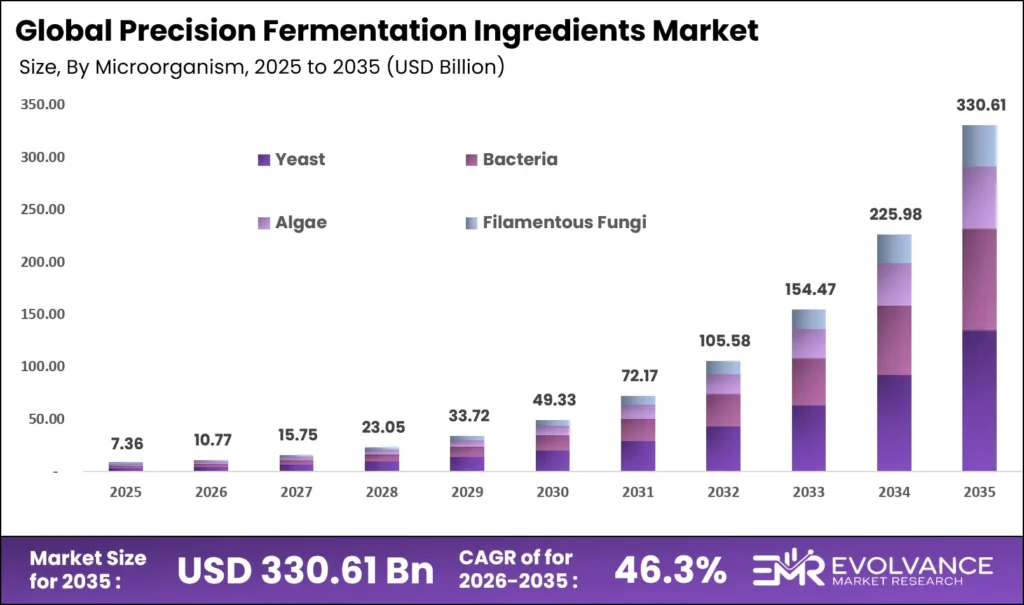
The Global Precision Fermentation Ingredients Market size will be worth around USD 330.61 Billion by 2035 from USD 7.36 Billion in 2025, growing at a CAGR of 46.3% during the forecast period 2026 to 2035. Major food brands actively source animal-free proteins to hit strict corporate carbon emission targets. Enterprise buyers shift core capital budgets from standard dairy lines to advanced bio-based ingredient alternatives to protect global supply chains. Extreme upfront biomanufacturing facility costs restrict fast volume scale-up capacity for many newly formed market players.
Market Highlights
- The global Precision Fermentation Ingredients Market is projected to grow from USD 7.36 Billion in 2025 to USD 330.61 Billion by 2035, registering a 46.3% CAGR.
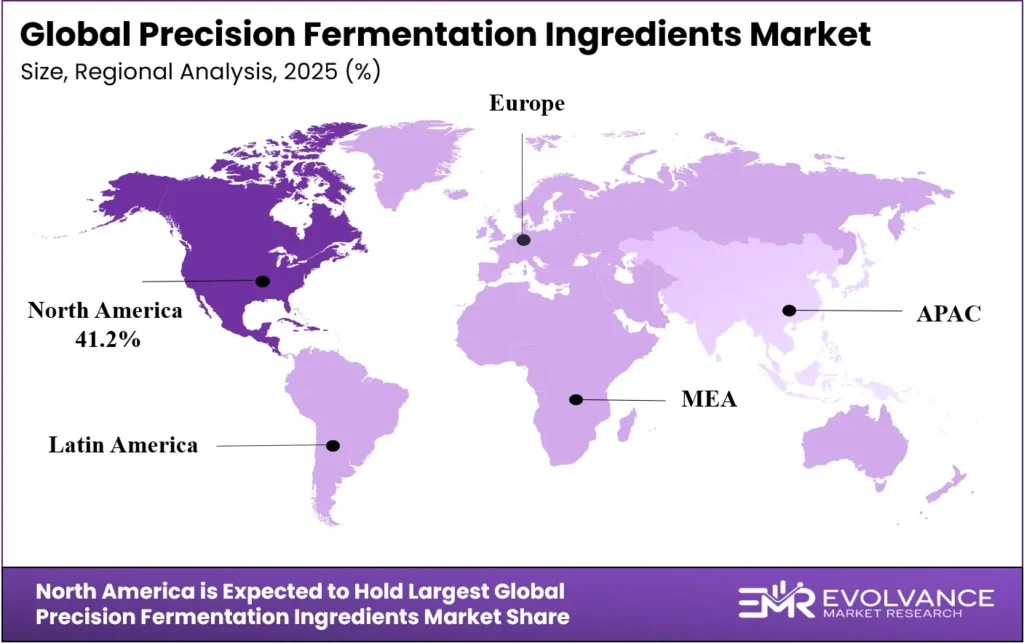
- North America dominated the global market with a 41.2% share, valued at USD 3.03 Billion in 2025.
- Whey and Casein Protein led the ingredient type segment with a 42.5% market share in 2025.
- Yeast dominated the microorganism segment, accounting for 42.1% of the market in 2025.
- Direct Sales emerged as the leading distribution channel with a 58.3% market share in 2025.
- Fed-Batch Fermentation held the largest share at 62.7% in the fermentation mode segment in 2025.
- Food and Beverage remained the largest application segment, capturing 65.3% of the market in 2025.
- Nutritional Supplements accounted for the highest functionality segment share at 43.8% in 2025.
- CRISPR/Cas9 dominated the genetic modification technique segment with a 49.7% share in 2025.
- Commercial-scale production led the production scale segment, representing 52.1% of the market in 2025.
Market Overview
Precision fermentation ingredients serve as core inputs for modern food systems. This sector creates pure proteins, fats, and enzymes without animal farming. Companies program specific microbes to build target molecules exactly matching natural versions. This model offers high purity and stable supply for global manufacturers.
These advanced components replace standard dairy and meat inputs in mass production. Brands use them to craft exact textures and flavors in premium retail products. A critical technological engine powering this shift is the Precision Fermentation Ingredients Market, which enables the production of bio-identical dairy, egg, and functional proteins without animal agriculture. This bioprocessing capability allows food developers to enhance the texture, stretch, and mouthfeel of alternative protein products while eliminating supply chain volatility.
Precision fermentation ingredients are actively revolutionizing early life and clinical nutrition. By utilizing engineered microorganisms, food scientists can cultivate exact molecular replicas of highly beneficial human milk oligosaccharides (HMOs) and proteins hydrolysate without animal agriculture. These pure, bio-engineered components deliver unprecedented immune and gut-microbiome support, effectively enhancing everything from medical diets to premium goat milk infant formula products.
Public funds now back heavy infrastructure to scale bio-based output. Early 2025 saw Vivici close a €32.5 million round to expand dairy protein lines. Further backing this shift, Trichoderma reesei boasts over 50 years of industrial safety history before entering food tech. Proven safe bugs lower federal risk for massive factory builds.
According to the Good Food Institute, 34% of American adults remain willing to try precision-fermented dairy. This high baseline proves mainstream buyers will accept lab-made foods fast. Companies can target mass retail channels rather than just narrow vegan niches. Broad appeal lowers the total risk for early product launches.
Findings from the same source show 29% of consumers expect these items to benefit the environment. Buyers link novel food tech directly to climate action and lower emissions. Brands can charge premium prices by marketing this specific eco-friendly angle. Green positioning speeds up retail shelf placement and drives fast trial sales.
Ingredient Type Insights
Whey and Casein Protein dominates with 42.5% due to strong dairy-replacement product fit.
In 2025, Whey and Casein Protein held a dominant market position in the By Ingredient Type segment of the Precision Fermentation Ingredients Market, with a 42.5% share. Food brands already stock recipes built around dairy protein functions, so a fermented match slots into existing production lines with little rework needed.
Lactoferrin targets infant nutrition and immune health formulas. The FDA reports the precision-fermented recombinant bovine lactoferrin isolate developed by All G meets a spec of over 90% total protein, with over 95% of that being target rbLf protein, giving formulators a purity baseline that supports premium infant nutrition claims.
Microorganism Insights
Yeast dominates with 42.1% due to decades of safe, well-understood industrial use.
In 2025, Yeast held a dominant market position in the By Microorganism segment of the Precision Fermentation Ingredients Market, with a 42.1% share. Brewers and bakers have run yeast strains at scale for generations, so regulators and plant engineers already trust its handling and safety record.
Filamentous Fungi such as Trichoderma reesei bring strong output economics to the category. Onego Bio reports that this organism has shown protein secretion titers exceeding 110 g/L, one of the highest levels among industrial microbial platforms, alongside more than 50 years of industrial safety history in enzyme production before its move into food protein. That track record shortens the regulatory review runway for new entrants using the same organism.
Distribution Channel Insights
Direct Sales dominates with 58.3% due to close technical ties between makers and food manufacturers.
In 2025, Direct Sales held a dominant market position in the By Distribution Channel segment of the Precision Fermentation Ingredients Market, with a 58.3% share. New ingredients need close technical support during product formulation, so producers build direct commercial teams instead of routing through generalist distributors.
Distributors help ingredient makers reach smaller regional food manufacturers that lack the volume to justify a dedicated account team. Online channels remain a small but growing path for smaller-batch buyers such as specialty bakeries and supplement brands testing new formulas.
Fermentation Mode Insights
Fed-Batch Fermentation dominates with 62.7% due to tighter control over yield and cost per batch.
In 2025, Fed-Batch Fermentation held a dominant market position in the By Fermentation Mode segment of the Precision Fermentation Ingredients Market, with a 62.7% share. This mode lets operators add nutrients through the run, pushing cell density and output higher than a single fixed batch allows.
Batch Fermentation remains common for smaller producers and pilot facilities that value simple, repeatable setup over maximum yield per run. Continuous Fermentation appeals to large-scale producers chasing lower per-unit cost through nonstop output, though it demands tighter process monitoring.
Application Insights
Food and Beverage dominates with 65.3% due to broad ingredient fit across dairy, egg, and protein products.
In 2025, Food and Beverage held a dominant market position in the By Application segment of the Precision Fermentation Ingredients Market, with a 65.3% share. This category covers the widest set of use cases, from ice cream to sports drinks, so producers scale here first to spread fixed plant costs across more product lines.
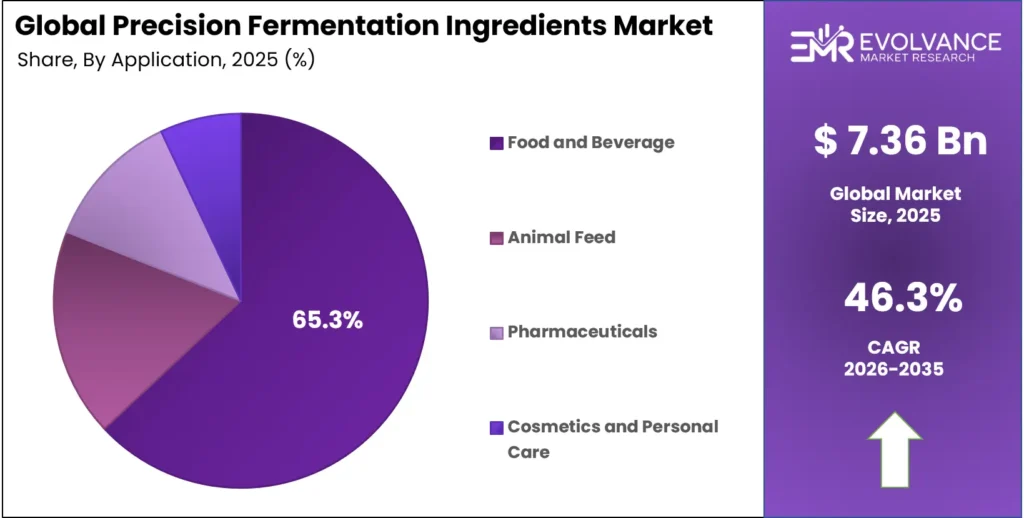
Animal Feed gives fermentation platforms a path to reduce methane output tied to livestock diets, a growing focus for large agriculture buyers. Pharmaceuticals use precision-fermented proteins for therapeutic and diagnostic applications where purity requirements exceed typical food-grade standards.
Functionality Insights
Nutritional Supplements dominates with 43.8% due to premium pricing power in health-focused categories.
In 2025, Nutritional Supplements held a dominant market position in the By Functionality segment of the Precision Fermentation Ingredients Market, with a 43.8% share. Health-conscious buyers pay a premium for clean-label protein sources, letting producers recover high early production costs faster than in commodity food categories.
Texturizing Agents help brands replicate the mouthfeel of animal fat and dairy solids in plant-forward recipes. Emulsifiers stabilize fat and water blends in packaged foods, an area where fermented proteins can replace synthetic or animal-derived options. Binders support structure in baked goods and meat alternatives that need to hold shape without animal collagen.
Genetic Modification Technique Insights
CRISPR/Cas9 dominates with 49.7% due to faster, more precise strain design.
In 2025, CRISPR/Cas9 held a dominant market position in the By Genetic Modification Technique segment of the Precision Fermentation Ingredients Market, with a 49.7% share. This gene-editing method lets scientists target exact genetic changes, cutting the guesswork and time older methods needed to reach a workable strain.
Traditional Mutagenesis still serves producers who want a track record of regulatory acceptance built over decades of industrial use. Synthetic Biology lets teams build entirely new genetic pathways rather than edit existing ones, opening the door to molecules no natural organism makes. Data published by CORDIS shows the ORIGIN pipeline targets production titers above 10 g/L with purity above 95% at pilot scales of 30L to 100L, a benchmark that CRISPR-edited strains are well placed to hit.
Production Scale Insights
Commercial-scale dominates with 52.1% due to lower per-unit cost at full plant capacity.
In 2025, Commercial-scale held a dominant market position in the By Production Scale segment of the Precision Fermentation Ingredients Market, with a 52.1% share. Producers who clear pilot testing move fast to full plants, since fixed costs per liter drop sharply once tanks run at industrial volume.
Pilot-scale facilities let newer entrants prove process reliability before committing capital to a full commercial build. Lab-scale work remains the entry point for early-stage strain development, where teams test genetic edits before any scale-up decision.
Market Segments Covered in the Report
By Ingredient Type
- Whey and Casein Protein
- Egg White
- Collagen
- Heme Protein
- Lactoferrin
- Fats and Oils
- Human Milk Oligosaccharides
- Enzymes
By Microorganism
- Yeast
- Bacteria
- Algae
- Filamentous Fungi
By Distribution Channel
- Direct Sales
- Distributors
- Online
By Fermentation Mode
- Fed-Batch Fermentation
- Batch Fermentation
- Continuous Fermentation
- Perfusion Fermentation
By Application
- Food and Beverage
- Animal Feed
- Pharmaceuticals
- Cosmetics and Personal Care
By Functionality
- Nutritional Supplements
- Texturizing Agents
- Emulsifiers
- Binders
- Flavor Enhancers
- Preservatives
By Genetic Modification Technique
- CRISPR/Cas9
- Traditional Mutagenesis
- Synthetic Biology
- Directed Evolution
By Production Scale
- Commercial-scale
- Pilot-scale
- Lab-scale
Regional Insights
North America Dominates the Precision Fermentation Ingredients Market with a Market Share of 41.2%, Valued at USD 3.03 Billion
North America leads the market with a 41.2% share, valued at USD 3.03 Billion. North America controls the sector due to fast FDA safety approvals and deep local capital grids. Silicon Valley tech money floods directly into bio-food start-ups here. Huge retail chains eagerly stock lab-made dairy to attract wealthy eco-shoppers. Fast legal paths help firms move rapidly from test labs to mass retail.
Europe Market Trends
Europe pushes harsh green laws that force heavy carbon cuts on big farm groups. Plant-based brands use strict local eco-rules to push fermented proteins into local diets. However, tough local food rules slow down fast market entry for novel items. Smart firms target the UK and Germany for quicker legal passes.
Asia Pacific Market Trends
Asia Pacific buys heavy volumes to feed massive, dense urban bases fast. Nations like Singapore create easy test zones to build secure local food nets. Deep state funds help bio-firms skip standard hard start-up pain points. Fast tech jumps allow the region to bypass old Western meat models completely.
Key Regions and Countries
North America
- US
- Canada
Europe
- Germany
- France
- The UK
- Spain
- Italy
- Rest of Europe
Asia Pacific
- China
- Japan
- South Korea
- India
- Australia
- Rest of APAC
Latin America
- Brazil
- Mexico
- Rest of Latin America
Middle East & Africa
- GCC
- South Africa
- Rest of MEA
Regulatory Landscape
Synthetic Biology Platform Innovation Reducing Development Timelines
Advanced lab tech radically cuts the time needed to map and build complex bug strains. Research by the EU-funded ORIGIN project shows these new tools slash product launch spans from 5-10 years down to just 2-3 years. Fast tools let young tech teams pitch fresh protein models to global food makers much faster.
State funds now heavily back these rapid scale models to boost local tech jobs. In 2025, the New South Wales Biosciences Fund gave $4.75 million to boost tech builds. Inside this pool, Number 8 Bio secured $1.18 million to scale methane-reducing feed. Public cash removes the lethal early risk for ambitious tech founders.
Drivers
Synthetic Biology Platform Innovation Reducing Development Timelines
Advanced lab tech radically cuts the time needed to map and build complex bug strains. Research by the EU-funded ORIGIN project shows these new tools slash product launch spans from 5-10 years down to just 2-3 years. Fast tools let young tech teams pitch fresh protein models to global food makers much faster.
These rapid design cycles destroy the old slow pace of standard food science. In June 2026, The EVERY Company signed a deal with Huvepharma to access a huge 9,000,000-liter plant in Bulgaria. Fast strain builds demand giant external tanks to meet sudden global volume spikes without breaking local supply links.
Restraints
High Capital Intensity of Industrial-Scale Biomanufacturing Facilities Limits Cost Competitiveness
Building massive steel brew plants burns extreme amounts of upfront start-up cash. The complex pipes, tight sensors, and massive power grids push total build costs deep into the millions. This harsh capital block keeps many smart lab teams trapped inside tiny test hubs, totally unable to hit mass market shelves.
Complex regulatory approval pathways add further delay before revenue starts flowing. The FDA review of All G’s rbLf ingredient found eaters-only dietary exposure levels of 220 mg per person per day at the mean, showing how much safety data producers must gather before market entry.
Firms try to bend the math by pushing basic bugs to their absolute limits. A 2025 CSIRO-linked study found that using precise 75°C pasteurization creates a 27.8% jump in pure biomass yields. Even with strict thermal tricks, heavy gear costs still break many weak balance sheets before full factory launch.
Growth Factors
Government Grants and Sustainability Mandates Unlock New Market Segments
Public funding is lowering the capital barrier for smaller fermentation firms. During the 2025/2026 cycle, the New South Wales Biosciences Fund allocated USD 4.75 Million across grants ranging from USD 200,000 to USD 2 Million, giving early-stage producers a nondilutive path to scale-up funding.
Individual grant recipients show where this money flows. Number 8 Bio secured USD 1,184,714 to scale a fermentation-based feed solution that cuts methane output from livestock, linking public funding directly to climate-driven demand for animal feed alternatives.
Land-use savings add a second growth lever tied to sustainability goals. Data from CORDIS shows the ORIGIN platform is projected to cut land use by more than 90% by moving away from wild-harvested natural ingredients. In early 2025, Vivici secured a EUR 32.5 Million Series A round led by APG and Invest-NL to scale precision fermentation dairy proteins for health and sports nutrition, showing investors back platforms that combine environmental savings with clear commercial demand.
Emerging Trends
AI-Driven Strain Engineering and Clean-Label Demand Shift Buyer Expectations
Big dairy giants quietly pivot away from cow limits by swapping in clean lab casein. They blend bio-whey into standard milk lines to drop total brand carbon scores quickly. This huge shift creates a massive hidden demand pipeline. Global farm groups now aggressively buy up tiny tech labs to stay alive.
Clean-label demand keeps pushing brands toward fermentation-derived proteins over synthetic additives. Onego Bio notes that Trichoderma reesei carries more than 50 years of industrial safety history in enzyme production, a track record that helps new food protein filings move faster through review.
Partnerships between food manufacturers and biotech firms are becoming the standard path to market. In September 2024, Formo raised USD 61 Million in a Series B round, including a media-for-equity investment from SevenVentures alongside REWE Group and EQT Ventures, to commercialize its koji protein-based vegan cheese, showing how retail and media partners now co-invest directly in ingredient makers.
Research Methodology Framework and Report Scope
Market Definitions and Key Coverage
This report defines the precision fermentation ingredients market as the set of proteins, fats, oils, and functional compounds produced through engineered microorganisms, including yeast, bacteria, algae, and filamentous fungi. Coverage spans whey and casein protein, egg white, collagen, heme protein, lactoferrin, fats and oils, human milk oligosaccharides, and enzymes sold into food and beverage, animal feed, pharmaceutical, and cosmetic end uses. Market values are presented in constant USD terms using 2025 as the base year, a method chosen to remove the effect of currency fluctuation on year-over-year comparisons.
The scope excludes plant-based protein products that do not involve microbial fermentation, cultivated or lab-grown animal cell meat products, and software or data platforms sold independently of a physical fermentation ingredient. Traditional fermented foods produced without genetic strain engineering, such as conventional yogurt or bread, also fall outside this report’s defined scope.
Key Companies Insights
Perfect Day leads the sector by locking down massive early FDA safety wins. In August 2024, the firm formed a bold 50:50 joint venture with Zydus Lifesciences to build massive animal-free protein plants. This smart global tie-up scales raw bulk volume fast. Aggressive foreign expansion starves slower local rivals of vital factory space.
The Every Company pairs egg protein production with large-scale manufacturing partnerships to close capacity gaps fast. In June 2026, it partnered with Huvepharma to use a 9,000,000-liter fermentation facility in Bulgaria, roughly quadrupling its production capacity for its OvoPro egg protein line.
Onego Bio built its strategy around the Trichoderma reesei organism, a platform with a long safety record that shortens regulatory review. In July 2024, it secured EUR 14 Million from the EIC Accelerator Program and Series A investors to expand its animal-free egg protein footprint across North America and the EU.
Remilk attacks global dairy carbon issues by pumping pure whey proteins from deep steel factory tanks. The firm actively targets strict European and Asian markets eager for fast climate fixes. High regulatory skills help them push novel food files much faster than clumsy peers. Rapid legal speed secures prime space in global mass cheese supply lines.
Key Companies
- Perfect Day
- The Every Company
- Geltor
- Remilk
- Imagindairy
- Change Foods
- New Culture
- Formo
- Better Dairy
- All G Foods
- Eden Brew
- Onego Bio
- C16 Biosciences
- MeltandMarble
- Nourish Ingredients
- Circe
- TurtleTree
- Helaina
- Impossible Foods
- DSM-Firmenich
- Novonesis
- BASF
- Mozza
- Pigmentum
Recent Industry Developments
- In November 2025, The EVERY Company closed a $55 million Series D financing round led by McWin Capital Partners to support the mass rollout of its precision-fermented functional proteins.
- In September 2024, Formo raised $61 million in a Series B funding round, which included a media-for-equity investment from SevenVentures alongside REWE Group and EQT Ventures, to support the commercialization of its koji protein-based vegan cheese.
- In July 2024, Onego Bio secured €14 million ($15.2 million) in new funding from the European Innovation Council (EIC) Accelerator Program and additional Series A investors to advance its animal-free egg protein production in North America and the EU.
- In early 2025, Vivici secured a €32.5 million Series A round led by APG and Invest-NL to fuel its commercial scale-up of precision fermentation dairy proteins, particularly targeting health and sports nutrition segments in the US.
- In January 2024, Perfect Day raised a Pre-Series E financing round of up to $90 million led by internal investors to focus on scaling the manufacturing of dairy protein from fermentation and driving a path to profitability.
- In August 2024, Zydus Lifesciences (through a wholly-owned subsidiary) completed the acquisition of a 50% equity stake in Sterling Biotech Limited from Perfect Day Inc., restructuring the entity into a 50:50 Joint Venture to establish a state-of-the-art facility for manufacturing fermented animal-free protein for global markets.
Market Scope
| Report Features | Description |
|---|---|
| Market Value (2025) | USD 7.36 Billion |
| Forecast Revenue (2035) | USD 330.61 Billion |
| CAGR (2026-2035) | 46.3% |
| Base Year for Estimation | 2025 |
| Historic Period | 2020-2024 |
| Forecast Period | 2026-2035 |
| Report Coverage | Revenue Forecast, Market Dynamics, Competitive Landscape, Recent Developments |
| Segments Covered | By Ingredient Type (Whey and Casein Protein, Egg White, Collagen, Heme Protein, Lactoferrin, Fats and Oils, Human Milk Oligosaccharides, Enzymes), By Microorganism (Yeast, Bacteria, Algae, Filamentous Fungi), By Distribution Channel (Direct Sales, Distributors, Online), By Fermentation Mode (Fed-Batch Fermentation, Batch Fermentation, Continuous Fermentation, Perfusion Fermentation), By Application (Food and Beverage, Animal Feed, Pharmaceuticals, Cosmetics and Personal Care), By Functionality (Nutritional Supplements, Texturizing Agents, Emulsifiers, Binders, Flavor Enhancers, Preservatives), By Genetic Modification Technique (CRISPR/Cas9, Traditional Mutagenesis, Synthetic Biology, Directed Evolution), By Production Scale (Commercial-scale, Pilot-scale, Lab-scale) |
| Regional Analysis | North America (US and Canada), Europe (Germany, France, The UK, Spain, Italy, and Rest of Europe), Asia Pacific (China, Japan, South Korea, India, Australia, and Rest of APAC), Latin America (Brazil, Mexico, and Rest of Latin America), Middle East & Africa (GCC, South Africa, and Rest of MEA) |
| Competitive Landscape | Perfect Day, The Every Company, Geltor, Remilk, Imagindairy, Change Foods, New Culture, Formo, Better Dairy, All G Foods, Eden Brew, Onego Bio, C16 Biosciences, MeltandMarble, Nourish Ingredients, Circe, TurtleTree, Helaina, Impossible Foods, DSM-Firmenich, Novonesis, BASF, Mozza, Pigmentum |
| Customization Scope | Customization for segments, region/country-level will be provided. Moreover, additional customization can be done based on the requirements. |
| Purchase Options | We have three licenses to opt for: Single User License, Multi-User License (Up to 5 Users), Corporate Use License (Unlimited User and Printable PDF) |