

What is the Lithium-ion Battery Market Size?
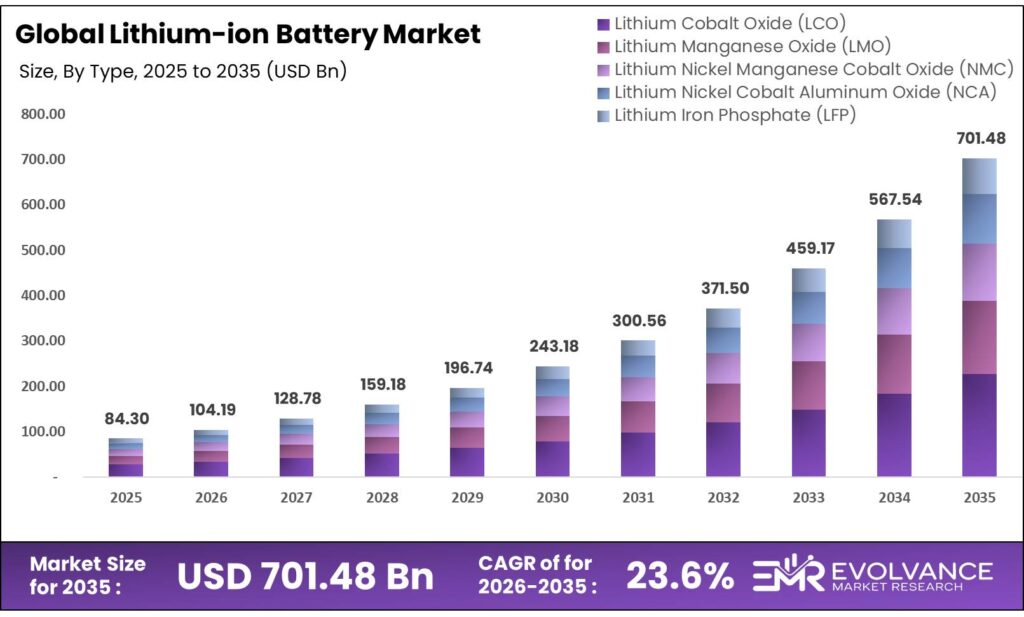
The Global Lithium-ion Battery Market size is expected to be worth around USD 701.48 Billion by 2035 from USD 84.30 Billion in 2025, growing at a CAGR of 23.6% during the forecast period 2026 to 2035. Rising electric vehicle adoption and grid-scale energy storage rollout drive this rapid growth. Falling battery pack costs and major capacity additions in Asia-Pacific further boost market expansion. An electrode binder in lithium-ion batteries is a crucial polymer material that holds the active particles (such as graphite in the anode or lithium metal oxides in the cathode) together and binds them to the current collector, ensuring structural integrity during repeated charge–discharge cycles.
Market Highlights
- The Global Lithium-ion Battery Market valued at USD 84.30 Billion in 2025, projected to reach USD 701.48 Billion by 2035, at a CAGR of 23.6% during the forecast period 2026-2035
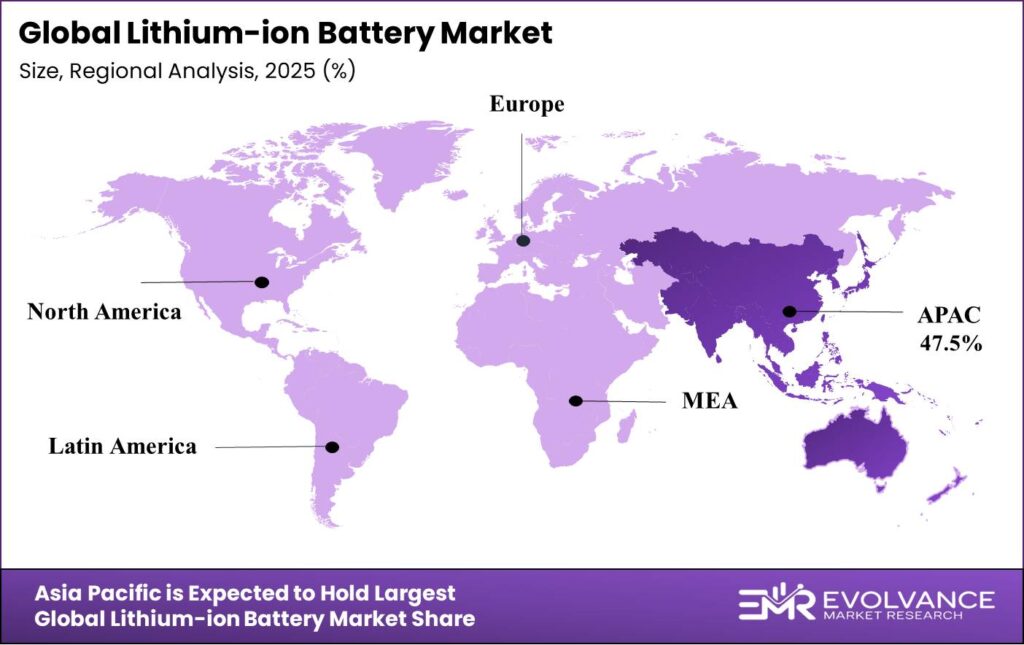
- Asia-Pacific dominates the market with 47.5% share, valued at USD 40.0 Billion in 2025
- Lithium Cobalt Oxide (LCO) segment dominates By Battery Type with 43.5% market share in 2025
- Automotive application leads with 47.2% share, driven by electric vehicle demand
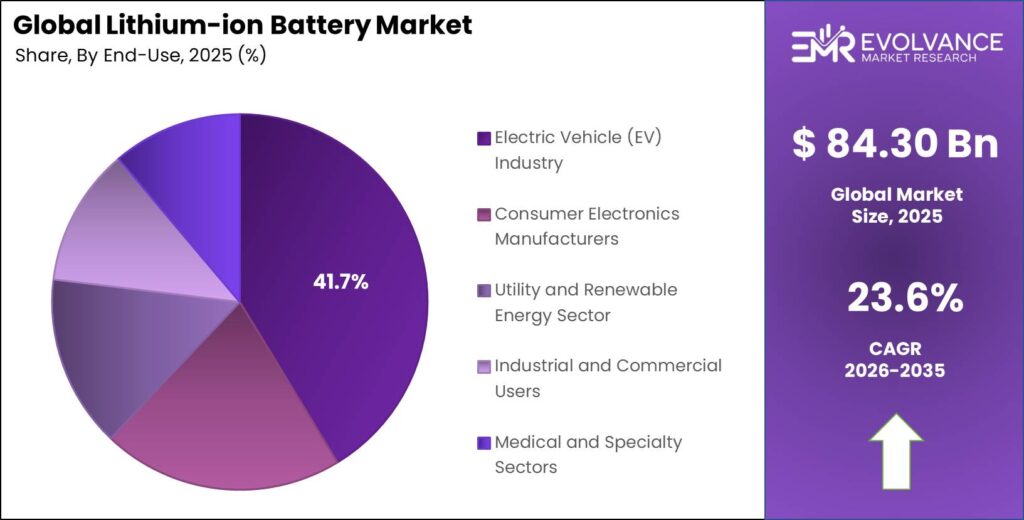
- Electric Vehicle (EV) Industry holds 41.7% share in By End User segment
- The 3,001 to 10,000 mAh capacity range captures 37.6% market share
Market Overview
Lithium-ion batteries power the global shift to clean energy and electric transport. These rechargeable energy storage devices use lithium ions moving between cathode and anode to store and release power. Their high energy density, long cycle life, and falling costs make them vital for cars, phones, and grid storage.
Electric vehicle growth drives market expansion as carmakers phase out gas engines. Grid operators install large battery systems to store solar and wind power. Consumer electronics brands rely on compact lithium cells for longer device runtime. Industrial users deploy backup power systems for critical facilities.
China’s total lithium-ion battery output hit 1,170 GWh in 2024, covering 823 GWh of power batteries, 94 GWh of small batteries, and 254 GWh of ESS batteries. This volume reflects the country’s dominant role in global battery making. China exported 3.914 billion battery units in 2024, up 8.1% year-on-year, though export value fell 5% to 434.874 billion yuan due to price declines.
The Neodymium (Nd-Fe-B) Magnet is closely linked to the Lithium-ion Battery, as both technologies are fundamental to electric vehicles and energy storage systems. Nd-Fe-B magnets are extensively used in high-efficiency electric traction motors, complementing lithium-ion batteries to enhance vehicle performance, energy efficiency, and driving range.
Global lithium-ion battery shipments reached 1,545.1 GWh in 2024. Electric vehicle uses consumed 898 GWh while energy storage systems took 307 GWh and IT plus consumer electronics used 115 GWh. These figures show transport and stationary storage now account for most demand, shifting the market away from small consumer devices.
Technology advances boost performance and cut prices. New cathode chemistries extend range and lower material costs. Fast-charging systems reduce vehicle downtime to under 20 minutes. Solid-state materials safer cells with higher energy density. Battery management software optimizes life and safety.
Contemporary Amperex Technology Co. Limited (CATL) reported total revenue of 362.0 billion yuan in 2024, with net profit at 50.745 billion yuan. The company produced 516 GWh of batteries and sold 475 GWh, split between 381 GWh power batteries and 93 GWh ESS batteries. CATL’s production capacity stood at 676 GWh per year by year-end, with another 219 GWh under construction.
Supply chain shifts reshape the industry landscape. Raw material mines expand in Asia, Latin America, and Australia. Refining plants process lithium, cobalt, and nickel closer to cell factories. Recycling facilities recover materials from end-of-life batteries. Trade policies and tariffs influence where companies build plants.
Battery Type Insights
Lithium Cobalt Oxide (LCO) dominates with 43.5% due to high energy density and established use in consumer electronics.
In 2025, Lithium Cobalt Oxide (LCO) held a dominant market position in the By Battery Type segment of Lithium-ion Battery Market, with a 43.5% share. LCO batteries deliver high energy density for phones, laptops, and tablets where space is limited. Stable supply chains and proven performance keep this chemistry popular despite higher cobalt costs. Consumer electronics brands prefer LCO for its reliable voltage output and compact cell design.
Lithium Nickel Manganese Cobalt Oxide (NMC) batteries serve electric vehicles needing balanced energy and power. Automakers select NMC for its strong energy density and decent thermal stability. The chemistry blends nickel for capacity, manganese for safety, and cobalt for cycle life. Many passenger EVs use NMC cells to achieve over 300 miles of range per charge.
Lithium Iron Phosphate (LFP) batteries gain share in EVs and stationary storage due to safety and cost benefits. LFP chemistry avoids cobalt and nickel, cutting material expenses and supply risks. Thermal stability prevents fires even under stress. Chinese EV makers and grid storage projects increasingly choose LFP despite slightly lower energy density than NMC.
Lithium Nickel Cobalt Aluminum Oxide (NCA) batteries power premium electric vehicles requiring maximum range. High nickel content boosts energy density but demands careful thermal management. Tesla and other performance-focused brands use NCA cells in long-range models. The chemistry supports fast charging while maintaining capacity over many cycles.
Lithium Manganese Oxide (LMO) batteries offer good power output for tools and medical devices. Manganese provides thermal stability and fast discharge rates. Lower energy density limits use in long-range EVs. Industrial equipment and backup power systems often deploy LMO cells where safety outweighs capacity needs.
Lithium Titanate Oxide (LTO) batteries deliver ultra-fast charging and long cycle life for buses and specialty uses. The titanate anode enables full charge in under 10 minutes without degradation. Public transit operators choose LTO for depot charging between short routes. Higher costs restrict widespread adoption outside niche applications requiring rapid turnaround.
Capacity Insights
3,001 to 10,000 mAh dominates with 37.6% due to wide use in smartphones, tablets, and power tools.
In 2025, 3,001 to 10,000 mAh held a dominant market position in the By Capacity segment of Lithium-ion Battery Market, with a 37.6% share. This capacity range fits most consumer electronics and portable devices sold globally. Smartphone batteries typically fall between 4,000 mAh and 6,000 mAh to balance size and runtime. Tablets, drones, and cordless tools also use cells in this mid-range bracket for optimal weight and performance.
Below 3,000 mAh batteries power compact wearables, wireless earbuds, and small IoT sensors. Miniature devices require cells under 500 mAh while fitness trackers use 200-300 mAh units. Growing wearable sales drive demand for ultra-compact batteries with thin form factors. Manufacturers focus on safety given limited space for thermal protection.
10,001 to 60,000 mAh batteries serve laptops, e-bikes, and light electric vehicles. Laptop batteries often combine multiple cells to reach 50,000-60,000 mAh total capacity. E-bikes use 10,000-20,000 mAh packs for 30-50 mile ranges. This segment grows as electric micromobility expands in urban areas worldwide.
Above 60,000 mAh batteries power electric cars, buses, and grid storage systems. Passenger EV packs range from 60 kWh to over 100 kWh using thousands of cells. Commercial trucks need even larger packs exceeding 200 kWh for long haul routes. Utility-scale storage projects deploy megawatt-hour systems with millions of individual cells working together.
Application Insights
Automotive dominates with 47.2% due to accelerating electric vehicle adoption globally.
In 2025, Automotive held a dominant market position in the By Application segment of Lithium-ion Battery Market, with a 47.2% share. Battery Electric Vehicles (BEVs) consume the most cells as carmakers launch dozens of new EV models. China, Europe, and North America see rising EV sales driven by emissions rules and gas price concerns. Plug-in Hybrid Electric Vehicles (PHEVs) use smaller packs blending electric and gas power for buyers wanting flexibility.
Energy Storage Systems (ESS) capture growing utility, commercial, and home installation budgets. Utility projects pair batteries with solar and wind farms to store excess power for evening peak demand. Commercial sites install batteries to cut electricity bills through peak shaving and demand response programs. Residential systems provide backup power during outages and enable solar self-consumption.
Consumer Electronics remain a steady market though growth slows versus EVs and storage. Smartphones drive high-volume cell demand with over 1 billion units sold yearly worldwide. Laptops, tablets, and wireless earbuds maintain consistent battery upgrades as users refresh devices every few years. Wearables and fitness trackers add incremental demand as health monitoring gains popularity.
End User Insights
Electric Vehicle (EV) Industry dominates with 41.7% due to global EV production surge.
In 2025, Electric Vehicle (EV) Industry held a dominant market position in the By End User segment of Lithium-ion Battery Market, with a 41.7% share. Automakers order massive battery volumes to hit emissions targets and meet consumer demand for electric cars. Major brands commit billions to EV platforms and secure long-term cell supply deals. Vehicle assembly plants integrate battery packs directly into chassis designs for optimal weight distribution and safety.
Consumer Electronics Manufacturers source billions of cells annually for phones, laptops, tablets, and accessories. Global electronics brands maintain diverse supplier networks to ensure stable pricing and supply. Design teams optimize battery integration for thinner devices and faster charging. Quality control focuses on cycle life and safety given high consumer expectations.
Utility and Renewable Energy Sector deploys large-scale battery systems for grid stability and clean energy storage. Power companies install batteries at substations to manage voltage and frequency fluctuations. Wind and solar developers add storage to sell power when generation stops. Grid operators test virtual power plant concepts linking distributed batteries for flexible capacity.
Industrial and Commercial Users install batteries for backup power, peak shaving, and microgrid applications. Data centers require uninterruptible power systems to prevent outages costing millions per minute. Factories use batteries to reduce demand charges and participate in grid services. Telecom towers in remote areas rely on solar-plus-battery systems for reliable off-grid operation.
Medical and Specialty Sectors depend on batteries for portable equipment, implants, and emergency systems. Hospitals use battery carts for portable X-ray, ultrasound, and life support devices. Medical implants like pacemakers need ultra-reliable long-life cells. Emergency services deploy battery packs in ambulances and rescue equipment for fieldwork requiring portable power.
Market Segments Covered in the Report
By Battery Type
- Lithium Cobalt Oxide (LCO)
- Lithium Manganese Oxide (LMO)
- Lithium Nickel Manganese Cobalt Oxide (NMC)
- Lithium Nickel Cobalt Aluminum Oxide (NCA)
- Lithium Iron Phosphate (LFP)
- Lithium Titanate Oxide (LTO)
By Capacity
- Below 3,000 mAh
- 3,001 to 10,000 mAh
- 10,001 to 60,000 mAh
- Above 60,000 mAh
By Application
- Automotive
- Battery Electric Vehicles (BEV)
- Plug-in Hybrid Electric Vehicles (PHEV)
- Hybrid Electric Vehicles (HEV))
- Energy Storage Systems (ESS)
- Utility
- Commercial and Industrial
- Residential
- Consumer Electronics
- Smartphones
- Laptops/Tablets
- Wearables
- UPS
- Others
By End User
- Electric Vehicle (EV) Industry
- Consumer Electronics Manufacturers
- Utility and Renewable Energy Sector
- Industrial and Commercial Users
- Medical and Specialty Sectors
Regional Insights
Asia-Pacific Dominates the Lithium-ion Battery Market with a Market Share of 47.5%, Valued at USD 40.0 Billion
Asia-Pacific commands the global lithium-ion battery market with a 47.5% share, valued at USD 40.0 Billion in 2025. China leads production with over 85% of global cell capacity and massive gigafactories from CATL, BYD, and other top makers. Japan and South Korea host major battery firms like Panasonic, LG Energy Solution, and Samsung SDI serving global automakers. India builds domestic capacity through policy incentives while Australia supplies key raw materials like lithium and nickel.
North America Market Trends
North America expands battery making through government support and automaker investments in local supply chains. The United States offers tax credits under the Inflation Reduction Act to encourage domestic cell and pack production. Canada develops mining and refining capacity for lithium, nickel, and cobalt to secure regional supply. Mexico attracts battery plants from Asian and European firms seeking low-cost North American manufacturing sites near car assembly lines.
Europe Market Trends
Europe builds battery capacity to support its large auto industry shift to electric vehicles. Germany hosts major cell plants from Asian suppliers and European startups backed by automaker partnerships. France, Spain, and Italy attract battery investments through state aid and green energy policies. The European Union funds research into next-generation chemistries and recycling systems to reduce import dependence on Asia.
Latin America Market Trends
Latin America leverages rich lithium reserves in Chile, Argentina, and Brazil to join the battery supply chain. Chile leads global lithium mining and seeks to add refining and cell making within its borders. Argentina expands production from salt flat deposits in the Andes region. Brazil develops mining for niobium and other battery materials while attracting downstream manufacturing for regional EV markets.
Middle East & Africa Market Trends
Middle East and Africa emerge as battery market participants through solar storage projects and mining investments. Saudi Arabia and UAE install large battery systems to store solar power for evening demand peaks. South Africa develops platinum group metal supply for battery catalysts and recycling processes. Morocco and Democratic Republic of Congo expand cobalt mining to feed global cell production while seeking to capture more value through local refining.
Key Regions and Countries
North America
- US
- Canada
Europe
- Germany
- France
- The UK
- Spain
- Italy
- Rest of Europe
Asia Pacific
- China
- Japan
- South Korea
- India
- Australia
- Rest of APAC
Latin America
- Brazil
- Mexico
- Rest of Latin America
Middle East & Africa
- GCC
- South Africa
- Rest of MEA
Regulatory Landscape
India’s 2025 Budget enhanced the Production Linked Incentive (PLI) scheme for advanced cell making with duty cuts on key battery inputs. The government reduced tariffs on lithium-ion cell imports and critical minerals to support domestic EV growth. These changes aim to help India meet 40% of national battery demand through local production by 2027.
The European Union enforced new battery rules in 2024 requiring carbon footprint labels and minimum recycled content for cells sold in member states. Manufacturers must disclose greenhouse gas emissions and meet collection targets for end-of-life batteries. The regulation pushes circular economy practices and aims to cut dependence on imported raw materials from outside Europe.
The United States implemented Inflation Reduction Act provisions in 2024 offering tax credits for batteries made with domestic or free-trade-agreement materials. Cell makers receive up to $45 per kilowatt-hour for qualifying production. These incentives drive billions in factory investments across multiple states to build North American battery supply chains.
China updated lithium-ion battery safety standards in 2024 with stricter thermal runaway and fire prevention requirements for EVs and storage systems. The rules mandate enhanced battery management systems and thermal barriers to prevent cell-to-cell failure spread. Automakers and battery firms must conduct more rigorous testing before product launches in the Chinese market.
Driving Forces
| Driver | (~) % Impact on CAGR Forecast | Geographic Relevance | Impact Timeline |
|---|---|---|---|
| EV platform electrification scale up | +3.20% | Global, led by China, Europe, North America, India | Short term (2 years or less) |
| Stationary storage grid integration | +2.10% | Global, strongest in China, United States, EU, Australia | Short term (2 years or less) |
| Battery pack cost decline | +1.85% | Global, strongest in mass market EV economies | Short term (2 years or less) |
| Policy backed local manufacturing | +1.55% | United States, EU, India, Japan, Korea | Medium term (2 to 4 years) |
| Consumer electronics refresh cycle | +0.90% | Global, led by Asia Pacific and North America | Short term (2 years or less) |
| Commercial fleet electrification | +1.25% | China, Europe, United States, urban Asia | Medium term (2 to 4 years) |
EV platform electrification scale up
The strongest active driver is the shift toward high-volume EV platforms, with rising EV deployment through 2024 and 2025 increasing demand for automotive batteries. Multi-year platform contracts, standardized cell formats, higher energy density, and gigawatt-hour procurement can contribute roughly +3.20% incremental CAGR support to the 21.45% baseline by improving cell-line utilization, fixed-cost absorption, and supplier scale economics.
Battery pack prices dropped about 20% year-on-year in 2024, marking the steepest decline since 2017 per IEA reports. Lower costs make EVs price-competitive with gas cars in key markets. Grid storage becomes economically viable for utility-scale projects without subsidies. Continued price reductions open new applications in commercial backup power and residential solar systems.
Global cell capacity exceeded 3 TWh in 2024 with roughly 30% growth that year driven by China and U.S. tax credits, IEA notes. Major battery makers announce gigafactory expansions in Asia, North America, and Europe. Government incentives fund domestic production to reduce import dependence. Rising capacity lowers costs through economies of scale and manufacturing learning curves.
Industry Constraints
| Restraint | (~) % Impact on CAGR Forecast | Geographic Relevance | Impact Timeline |
|---|---|---|---|
| Capital cost inflation | -2.15% | Global, strongest in Europe, United States, emerging Asia | Short term (2 years or less) |
| Permitting delays for upstream projects | -1.65% | Americas, Europe, Australia, selected Asian markets | Medium term (2 to 4 years) |
| Battery safety recall risk | -1.20% | Global, concentrated in EV and consumer electronics markets | Short term (2 years or less) |
| Grid connection queue constraints | -1.05% | United States, Europe, Australia, India | Medium term (2 to 4 years) |
| Trade compliance burden | -0.95% | EU, United States, China linked supply chains | Short term (2 years or less) |
| Insurance cost escalation | -0.70% | North America, Europe, industrial storage hubs | Short term (2 years or less) |
Capital cost inflation
Capital cost inflation is the key restraint, as battery projects require heavy upfront investment while elevated borrowing costs in 2024 and 2025 raise project hurdles. A 200–350 basis-point increase in debt costs can delay investment decisions, slow capacity expansion, and compress ramp-up margins, creating an estimated -2.15% drag on achievable CAGR.
Raw material price swings create uncertainty for battery makers and buyers planning long-term investments. China’s shutdown of a key lithium mine in 2025 triggered an 8% price surge within weeks. Supply disruptions reveal fragility in concentrated mining regions. Manufacturers struggle to pass volatile costs to customers while maintaining competitive pricing in fast-moving markets like EVs.
High upfront battery costs remain a barrier for buyers in price-sensitive markets despite recent declines. While pack prices fell 20% in 2024, EV sticker prices still exceed equivalent gas models in many regions. Energy storage systems require large capital outlays that extend payback periods for commercial users. Financing gaps limit adoption among smaller businesses and lower-income households seeking clean energy access.
Business Challenges
| Challenge | (~) % CAGR Friction Drag | Geographic Relevance | Mitigation Horizon |
|---|---|---|---|
| Critical mineral concentration | -1.90% | Global, acute for non Chinese supply chains | Long term (4 years or more) |
| Anode supply exposure | -1.45% | Global, strongest in United States, EU, India | Medium term (2 to 4 years) |
| Skilled workforce gaps | -1.10% | United States, EU, India, Southeast Asia | Medium term (2 to 4 years) |
| Yield ramp instability | -1.35% | Global new cell manufacturing hubs | Medium term (2 to 4 years) |
| Thermal management complexity | -0.85% | EV, aviation, storage, high power electronics markets | Long term (4 years or more) |
| End of life logistics | -0.75% | Europe, North America, Japan, Korea | Long term (4 years or more) |
Critical mineral concentration
Critical mineral concentration is a major challenge as battery production depends on limited supplies of lithium, nickel, cobalt, and graphite. Lithium demand could rise 353% from 2024 to 2040, while graphite export controls introduced in 2023 can increase supply-chain delays, sourcing costs, and inventory needs, creating an estimated -1.90% drag on market growth.
India’s first large-scale lithium-ion plant launched in Haryana with capacity to meet about 40% of national demand. Local production cuts import dependence and lowers costs through reduced logistics expenses. The facility supports India’s goal to become a major EV market. Similar localization efforts emerge in Southeast Asia, Latin America, and Africa.
Opportunity Areas
| Opportunity | (~) % Potential CAGR Upside | Geographic Relevance | Execution Window |
|---|---|---|---|
| Second life battery monetization | +2.00% | Europe, China, United States, Japan, Korea | Medium term (2 to 4 years) |
| Battery passport data services | +1.65% | EU first, global exporters thereafter | Medium term (2 to 4 years) |
| Sodium hybrid portfolio expansion | +1.40% | China, India, stationary storage markets | Long term (4 years or more) |
| Recycling feedstock integration | +1.75% | Europe, North America, China, Korea | Medium term (2 to 4 years) |
| Heavy duty off highway electrification | +1.30% | Mining, ports, construction, agriculture regions | Long term (4 years or more) |
| Localized module servicing networks | +1.05% | Europe, North America, India, Southeast Asia | Medium term (2 to 4 years) |
Second life battery monetization
Second-life battery monetization offers major white-space potential as retired EV packs with around 70–80% usable capacity can be redeployed into stationary storage. EU Battery Regulation requirements, including battery passports from 18 February 2027, can improve traceability and resale confidence, supporting an estimated +2.00% upside over the 21.45% baseline through lifecycle revenue and residual-value capture.
CATL launched its 9 GWh TENER Stack in May 2025, supporting large-scale storage with lower per-kWh system costs and modular deployment. Panasonic’s 32 GWh Kansas plant opened in 2025, strengthening regional EV battery supply and manufacturing efficiency. Meanwhile, energy storage exceeded 15% of lithium-ion deployment, with utilities increasingly adopting 4-hour systems for grid balancing, backup power, and renewable integration.
Key Companies Insights
Contemporary Amperex Technology Co., Ltd. (CATL) leads global battery production with output exceeding 516 GWh in 2024 and sales of 475 GWh split between power and storage cells. The company operates production capacity of 676 GWh per year with another 219 GWh under construction across China, Europe, and North America. CATL serves major automakers worldwide and expands into grid storage with ultra-large systems. The firm invests heavily in next-generation chemistries including sodium-ion and solid-state batteries.
BYD Co., Ltd. vertically integrates battery production with electric vehicle making, generating total revenue of 777.1 billion yuan in 2024. The company’s blade battery technology using LFP chemistry approaches 200 GWh of annual installations. BYD supplies cells for its own EV lineup while expanding third-party sales to other automakers. Strong domestic market position in China provides scale advantages as the firm targets international growth.
LG Energy Solution Ltd. reported consolidated revenue of KRW 25.6 trillion in 2024 serving global automotive and storage markets. The company operates joint venture plants with major automakers in North America, Europe, and Asia. LG Energy focuses on high-nickel NMC chemistries for premium EV applications requiring maximum range. Recent expansion includes grid storage products and next-generation cylindrical cells.
Panasonic Holdings Corporation supplies batteries for Tesla and other EV makers from facilities in Japan, North America, and China. The company opened a 32 GWh Kansas plant in 2025 to serve North American automotive demand. Panasonic develops larger cylindrical cells to reduce pack costs and improve energy density. The firm also serves energy storage and industrial markets with diverse cell formats and chemistries.
Key Companies
- BYD Co., Ltd.
- CALB (China Aviation Lithium Battery Co., Ltd.)
- Contemporary Amperex Technology Co., Ltd. (CATL)
- EVE Energy Co., Ltd.
- Ultralife Corporation
- Saft Groupe
- Gotion High Tech
- Farasis Energy
- LG Energy Solution Ltd.
- Panasonic Holdings Corporation
- Samsung SDI Co., Ltd.
- SK On Co., Ltd.
- Tesla, Inc.
- Toshiba Corporation
Recent Development
- December 2025 – South 8 Technologies secured $11 million in funding co-led by W. L. Gore & Associates and Lockheed Martin Ventures to scale its LiGas lithium-ion battery commercialization. The investment supports advanced battery tech with improved safety and performance for specialty applications in aerospace and defense sectors.
- December 2024 – Stellantis and CATL announced a joint venture with up to €4.1 billion investment to build a large LFP battery plant in Zaragoza, Spain. Production is expected by end-2026 to supply European EV manufacturing with cost-competitive cells and reduce import dependence from Asia.
- May 2025 – CATL launched its 9 MWh TENER Stack ultra-large energy storage system designed for grid-scale applications worldwide. The modular system targets utility and industrial users requiring high-capacity, long-duration storage to manage renewable energy intermittency and peak demand.
- May 2025 – Li-Cycle Holdings Corp. filed for bankruptcy protection in Canada and initiated a formal sale process while securing interim financing. The recycling firm faced financial challenges despite growing interest in battery material recovery to support circular supply chains.
- March 2025 – Glencore plc approached Li-Cycle regarding a potential acquisition as part of restructuring discussions. The mining giant’s interest reflects strategic focus on battery material supply chains and recycling infrastructure to capture value in growing EV markets.
- March 2024 – Li-Cycle closed a $75 million strategic investment from Glencore via senior secured convertible note to strengthen liquidity and operations. The funding aimed to support the company’s battery recycling capacity expansion amid rising end-of-life battery volumes.
Market Scope
| Report Features | Description |
|---|---|
| Market Value (2025) | USD 84.30 Billion |
| Forecast Revenue (2035) | USD 701.48 Billion |
| CAGR (2026-2035) | 23.6% |
| Base Year for Estimation | 2025 |
| Historic Period | 2020-2024 |
| Forecast Period | 2026-2035 |
| Report Coverage | Revenue Forecast, Market Dynamics, Competitive Landscape, Recent Developments |
| Segments Covered | By Battery Type (Lithium Cobalt Oxide (LCO), Lithium Manganese Oxide (LMO), Lithium Nickel Manganese Cobalt Oxide (NMC), Lithium Nickel Cobalt Aluminum Oxide (NCA), Lithium Iron Phosphate (LFP), Lithium Titanate Oxide (LTO)), By Capacity (Below 3,000 mAh, 3,001 to 10,000 mAh, 10,001 to 60,000 mAh, Above 60,000 mAh), By Application (Automotive, Energy Storage Systems (ESS), Consumer Electronics), By End User (Electric Vehicle (EV) Industry, Consumer Electronics Manufacturers, Utility and Renewable Energy Sector, Industrial and Commercial Users, Medical and Specialty Sectors) |
| Regional Analysis | North America (US and Canada), Europe (Germany, France, The UK, Spain, Italy, and Rest of Europe), Asia Pacific (China, Japan, South Korea, India, Australia, and Rest of APAC), Latin America (Brazil, Mexico, and Rest of Latin America), Middle East & Africa (GCC, South Africa, and Rest of MEA) |
| Competitive Landscape | BYD Co., Ltd., CALB (China Aviation Lithium Battery Co., Ltd.), Contemporary Amperex Technology Co., Ltd. (CATL), EVE Energy Co., Ltd., Ultralife Corporation, Saft Groupe, Gotion High Tech, Farasis Energy, LG Energy Solution Ltd., Panasonic Holdings Corporation, Samsung SDI Co., Ltd., SK On Co., Ltd., Tesla, Inc., Toshiba Corporation |
| Customization Scope | Customization for segments, region/country-level will be provided. Moreover, additional customization can be done based on the requirements. |
| Purchase Options | We have three licenses to opt for: Single User License, Multi-User License (Up to 5 Users), Corporate Use License (Unlimited User and Printable PDF) |