
Introduction
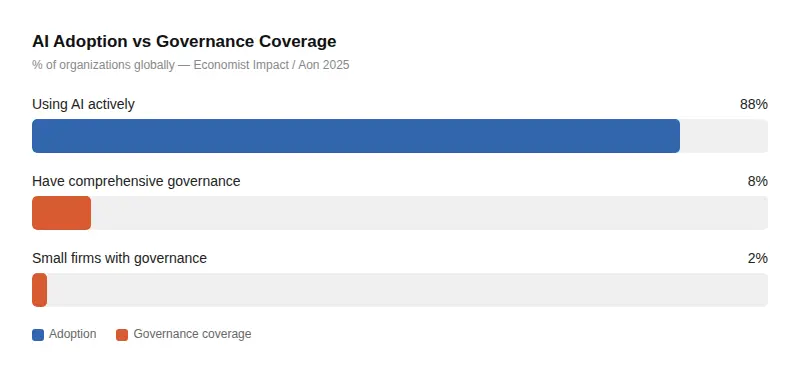
Enterprise AI adoption has reached a threshold that makes governance no longer optional. Aon data shows 88% of organizations used AI in at least one business function in 2025. However, Economist Impact research finds that only 8% of those organizations maintain a comprehensive AI governance framework. This gap between deployment and oversight defines the central challenge enterprises face in 2026.
The consequences of this gap are measurable and immediate. IBM data shows 87% of organizations claim they have clear AI governance frameworks. However, fewer than 25% have fully implemented the controls needed to manage bias, transparency, and security risks. Claiming governance and running governance are two entirely different things.
This report consolidates 60+ verified data points from PwC, Deloitte, IBM, Stanford HAI, Writer, Economist Impact, Aon, and other primary sources. It gives enterprise leaders a clear picture of where AI governance stands in 2026 — and what the data says about the cost of getting it wrong.
Key AI Governance Statistics at a Glance
Only 8% of organizations globally have a comprehensive AI governance framework, dropping to 2% among small firms. Meanwhile, 88% of organizations are actively using AI across business functions. The distance between these two numbers represents the core governance deficit enterprises must close in 2026.
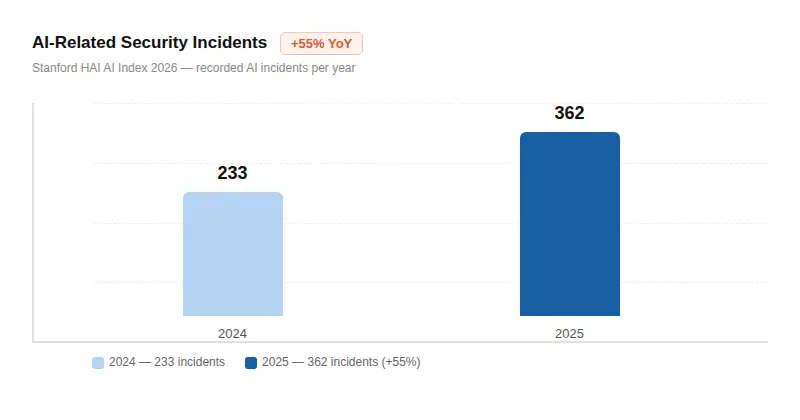
362 AI-related incidents were recorded in 2025, up from 233 in 2024 — a 55% year-on-year rise. At the same time, 74% of all AI-generated economic value flows to just 20% of organizations. Both figures point to the same conclusion: governance separates the organizations that benefit from AI from those that absorb its risks.
74% of organizations plan to adopt agentic AI within two years, but only 21% have a mature governance model for it. The EU AI Act now imposes penalties of up to €35 million or 7% of global turnover for prohibited AI practices. Enterprises that treat governance as a future priority rather than a current requirement face compounding regulatory and operational exposure.
The AI Governance Gap: Adoption vs. Implementation
Enterprise AI adoption has outpaced governance infrastructure at every level. Economist Impact research finds 88% of executives view AI as a competitive advantage. However, only 4% of organizations have achieved repeatable, scalable AI value. The gap between perception and performance exposes a structural weakness in how most enterprises approach AI deployment.
The numbers sharpen further at the small firm level. Figures from Economist Impact show comprehensive AI governance frameworks exist in only 2% of small organizations. Moreover, only 20% of teams across all organization sizes report proficiency in AI risk management, even though 96% rate cybersecurity as essential. Awareness without capability is not governance.
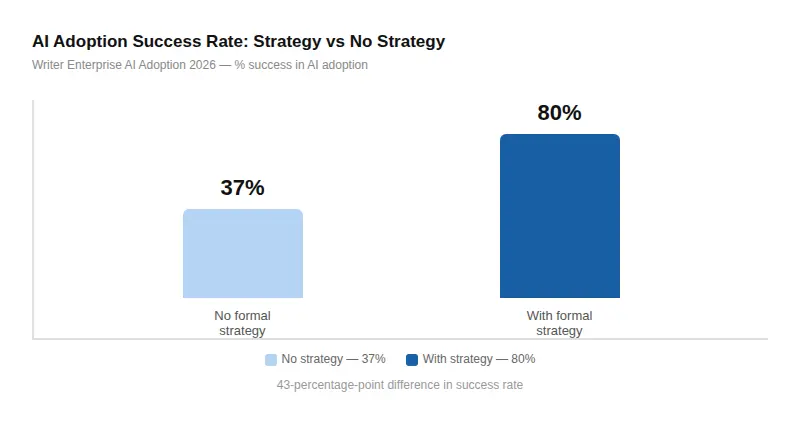
Strategy makes a measurable difference. Writer research finds organizations without a formal AI strategy report a 37% success rate in AI adoption. Consequently, those with a formal strategy achieve an 80% success rate. The 43-percentage-point gap confirms that governance and strategy are not administrative exercises. They are the primary determinants of whether AI investment delivers returns.
Budget confidence also lags behind ambition. Economist Impact data shows only 38% of executives believe their AI budgets are sufficient to deliver on their strategic goals. Therefore, most organizations are simultaneously underinvesting in governance and overestimating their current AI capabilities — a combination that raises operational and reputational risk.
AI Security Incidents and Data Breach Statistics 2026
AI-related security incidents are rising faster than governance responses. Stanford HAI records 362 AI incidents in 2025, up from 233 in 2024. This 55% year-on-year increase reflects a market where AI deployment has scaled but protective infrastructure has not kept pace. For enterprises, this trajectory means incident probability is rising with every new AI deployment.
Breaches are already occurring at significant scale. IBM confirms that 13% of organizations reported breaches of AI models or applications in 2025. Moreover, 97% of those breached organizations lacked proper AI access controls at the time of the incident. This near-universal absence of basic controls among breached organizations confirms that most AI security failures are preventable governance failures.
Policy gaps compound the access control problem. IBM research finds 63% of organizations that experienced AI breaches had no AI governance policies in place. Additionally, Writer data shows 67% of executives believe their organization has already suffered a data leak through unapproved AI tools. These figures together suggest the breach rate in the data significantly understates actual exposure.
Employee behavior represents a distinct and underestimated risk vector. Writer research finds 35% of employees have entered proprietary company information into public AI tools. Consequently, the risk is not only external attack but internal misuse — and most organizations lack the policies and controls to detect or prevent either. Aon puts the figure at more than 90% of insurance decision-makers now classifying AI incidents as a material risk factor.
Agentic AI Governance Statistics
Agentic AI systems that act autonomously on behalf of organizations — represents the next major enterprise deployment wave. Deloitte research finds 74% of organizations plan to adopt agentic AI within the next two years. However, only 21% of those organizations currently have a mature governance model for AI agents. The scale of this readiness gap makes agentic AI the most urgent governance challenge enterprises face in 2026.
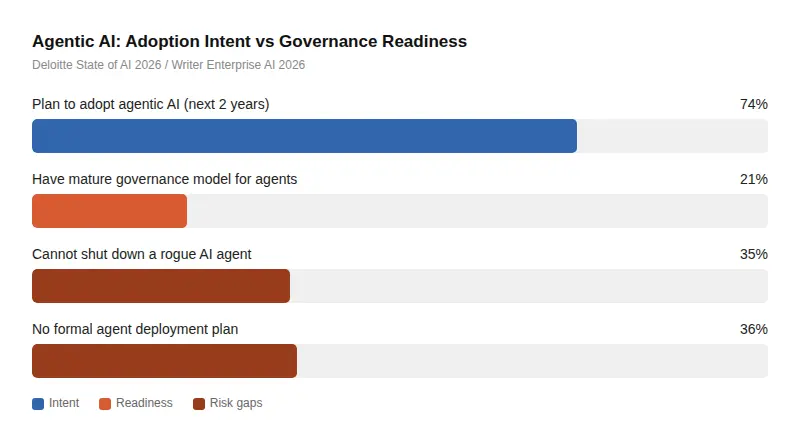
The planning deficit reinforces the readiness problem. Writer data shows 36% of organizations have no formal plan for deploying AI agents at all. Additionally, 35% of organizations admit they could not shut down a rogue AI agent if one emerged. Deploying autonomous systems without shutdown capability is not a theoretical risk — it is an operational liability that no enterprise risk framework currently treats as acceptable in any other technology context.
Deployment timelines are accelerating regardless of governance readiness. Deloitte confirms 25% of enterprises using generative AI were already deploying AI agents in 2025. Furthermore, this figure is forecast to reach 50% by 2027. Organizations that delay governance frameworks for agentic systems are not buying time they are accumulating unmanaged risk as deployment scales around them.
ROI of AI Governance: What the Data Says About Business Performance
AI governance is not a cost center. The data consistently shows it is a performance variable. PwC research finds 74% of all AI-generated economic value is captured by just 20% of organizations. These AI leaders share a common characteristic — they invest in governance infrastructure at rates significantly higher than the market average. Value concentration at this level is not coincidence; it is the commercial outcome of structured AI programs.
The governance multipliers from PwC are specific and consistent. AI leaders are 1.7x more likely to have a Responsible AI framework, 1.5x more likely to have a formal AI governance board, and 1.8x more likely to have implemented guardrails for AI use. Moreover, these leaders are 2x more likely to have earned employee trust in AI systems. Each multiplier represents an organizational capability that directly enables safer, faster, and more scalable AI deployment.
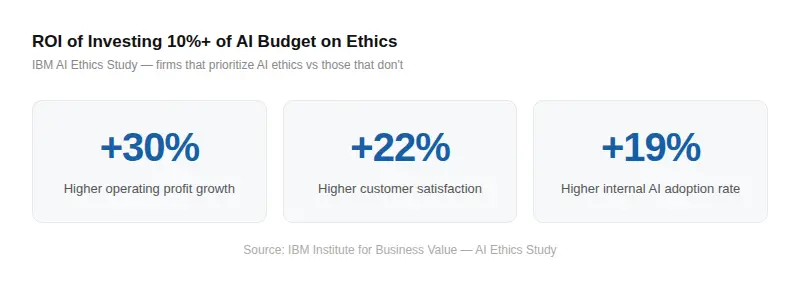
The profit impact of ethics investment is equally direct. IBM data shows firms that invest more than 10% of their AI budget on ethics report approximately 30% higher operating profit growth. Additionally, these firms achieve 22% higher customer satisfaction and 19% higher AI adoption rates internally. IBM research further confirms 59% of executives at these firms say AI ethics efforts have delivered measurable business results.
Maturity levels reflect where most organizations currently sit. PwC data shows 61% of organizations have reached either the strategic or embedded stage of Responsible AI maturity. However, reaching a maturity stage and extracting commercial value from it are separate achievements. The 4% that have achieved repeatable AI value represent the ceiling of what structured governance programs are currently producing at scale.
Board and C-Suite AI Governance Statistics
Board-level AI literacy remains one of the most significant structural weaknesses in enterprise governance. Deloitte data shows 66% of boards still have limited-to-no knowledge of AI an improvement from 79% in the previous survey, but still a majority. Boards that lack foundational AI knowledge cannot credibly challenge management on AI risk, evaluate governance frameworks, or set meaningful oversight standards.
Agenda presence is improving but remains incomplete. Deloitte research finds 31% of organizations report that AI is not on the board agenda at all, down from 45% previously. Therefore, while progress is real, nearly one in three enterprises is operating significant AI programs without board-level visibility. This creates accountability gaps that regulators and insurers are increasingly likely to scrutinize.
C-suite tension around AI is already a documented operational problem. Writer data shows 42% of C-suite executives say AI adoption is actively tearing their company apart. Additionally, 79% of organizations report significant challenges in scaling AI adoption. These figures reflect organizations where deployment pressure from leadership has outrun the internal infrastructure needed to govern what is being deployed.
Proficiency gaps at the team level compound board-level deficits. Economist Impact research finds only 20% of teams report proficiency in AI risk management, even though 96% rate cybersecurity as essential. Consequently, governance frameworks built without skilled practitioners to run them remain theoretical documents rather than operational controls. The combination of low board literacy and low team proficiency creates a governance vacuum that no policy document can fill.
AI Regulatory Landscape Statistics
AI regulation has moved from advisory to enforceable. The EU AI Act now imposes penalties of up to €35 million or 7% of worldwide annual turnover for violations of prohibited AI practices under Article 5. Non-compliance with high-risk AI system obligations carries penalties of up to €15 million or 3% of global turnover. Supplying incorrect or misleading information to regulators attracts fines of up to €7.5 million or 1% of turnover. For large enterprises, these figures convert governance failures into CFO-level financial exposures.
A second comprehensive AI regulatory regime became active in early 2026. South Korea’s Act on the Development of Artificial Intelligence and Establishment of Trust took effect on January 22, 2026. This makes South Korea the second jurisdiction after the EU to implement a broad AI regulatory framework with legal force. Multinationals operating across both markets now face dual compliance obligations with overlapping but distinct requirements.
Framework adoption rates lag behind regulatory expectations. Stanford HAI data shows 36% of organizations have adopted ISO/IEC 42001 and 33% have adopted the NIST AI Risk Management Framework. Additionally, 60% of organizations cite GDPR as an influence on their AI programs. However, 12% still report no regulatory influence on their AI programs at all — a figure that will become increasingly difficult to sustain as enforcement scales.
Vendor selection now carries a geopolitical dimension. Deloitte data shows 77% of organizations factor the country of origin into their AI vendor selection decisions. Therefore, regulatory compliance is no longer limited to what an organization does internally — it extends to who builds the tools the organization deploys. This shift adds a supply chain governance layer that most enterprise procurement frameworks have not yet formally incorporated.
Regional AI Governance Statistics
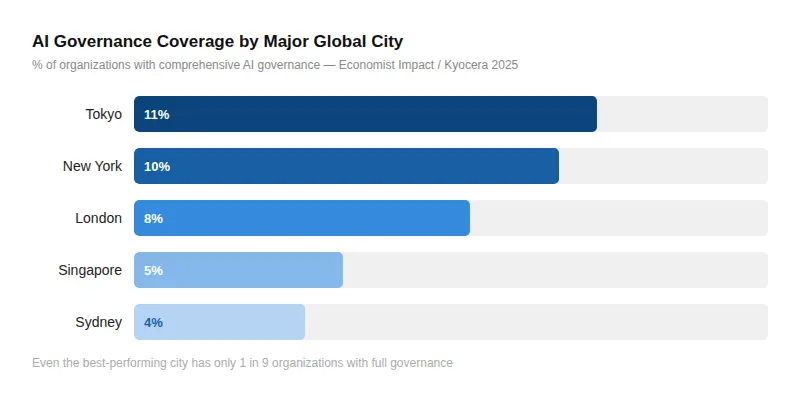
The governance gap is a global pattern, but its severity varies sharply by geography. Economist Impact city-level data shows Tokyo leading among major global cities with 11% of organizations maintaining comprehensive AI governance frameworks. New York follows at 10%, London at 8%, Singapore at 5%, and Sydney at 4%. Even in the best-performing city, nearly 9 in 10 organizations operate without complete governance infrastructure.
India presents the most extreme version of the global pattern. IBM research finds only 4% of Indian organizations have robust frameworks for managing AI-related risks and ensuring ethical AI practices. However, 83% of Indian organizations agree that effective AI governance is essential for successful AI infrastructure deployment. The distance between stated belief and actual implementation is wider in India than in almost any other measured market.
India’s infrastructure investment is accelerating regardless of governance readiness. IBM data shows 58% of Indian organizations report increased infrastructure investment due to AI demand, with budgets rising 19% in 2025. Consequently, capital is flowing into AI deployment faster than governance frameworks are being built — a pattern that historically increases incident probability before it decreases it.
Australia shows stronger governance intent but significant execution gaps. Diligent research finds 43% of Australian governance leaders have placed AI adoption at the top of their strategic agendas. Additionally, 61% of Australian organizations have restricted or formally defined AI use by employees — more than double the 30% regional average across Asia. However, only 37% of Australian boards have audited current AI usage, revealing a gap between policy intent and verification practice.
AI Pilot to Production Statistics: Deployment Rates and Spend Data
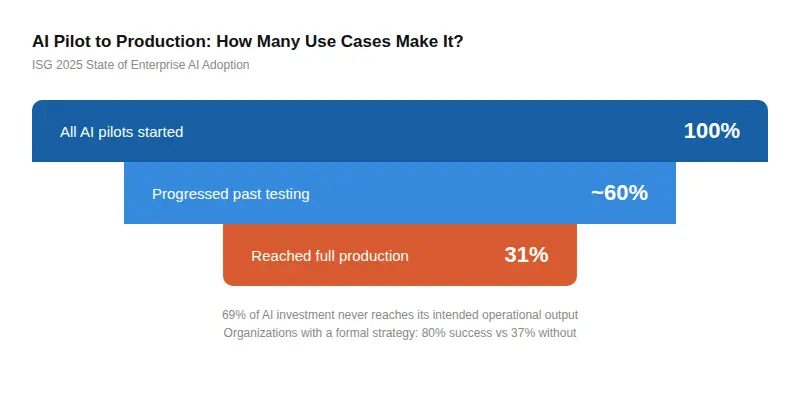
Enterprise AI is moving from experimentation to production, but the majority of use cases still do not complete the journey. ISG data shows 31% of AI use cases studied reached full production in 2025 — double the rate recorded in 2024. Progress is real, but a 69% non-completion rate means most AI investment still does not reach its intended operational output. The doubling of the production rate reflects improving organizational capability, not a resolved deployment challenge.
Spend levels confirm that AI has become a serious budget line. ISG research puts the average AI spend per organization at $1.3 million to date. Moreover, Deloitte data shows 25% of organizations have moved more than 40% of their AI pilots into production. These organizations represent the leading cohort — and their common characteristics include formal governance frameworks and defined deployment processes.
Transformation claims remain concentrated among a minority. Deloitte research finds 25% of organizations report a transformative effect from AI on their business, and 30% are actively redesigning key business processes around AI capabilities. Therefore, while a meaningful minority has reached genuine operational integration, the majority of enterprises are still in earlier phases of deployment where governance failures have the most acute impact on outcomes.
Strategy quality directly determines deployment success. Writer data shows organizations without a formal AI strategy achieve a 37% success rate in AI adoption. Additionally, those with a formal strategy achieve an 80% success rate. The 43-percentage-point difference is not explained by technology choice or budget size — it is explained by structured planning, which is governance by another name.
AI Governance Vendor and Market Statistics
Enterprise spending on AI governance tools has moved from discretionary to strategic. IBM’s full-year 2025 results show total revenue of $67.5 billion, up 6% at constant currency, with its generative AI book of business exceeding $12.5 billion. This figure — accumulated across consulting, software, and infrastructure — confirms that AI governance and implementation services have become a primary commercial category for the world’s largest enterprise technology providers.
Microsoft’s infrastructure dominance amplifies the market context. Microsoft reported total FY2025 revenue of $281.7 billion, up 15% year on year, with Azure surpassing $75 billion in annual revenue at 34% growth. Additionally, Microsoft Cloud revenue exceeded $168 billion, up 23%. The scale of cloud infrastructure underlying enterprise AI programs directly determines the surface area that AI governance tools must cover — and that surface area expanded substantially in 2025.
Specialist AI governance vendors are growing faster than the broader market. Dataiku surpassed $350 million in annual recurring revenue in October 2025, powering AI initiatives at more than 750 organizations globally including one in four of the Forbes Global 2000. Furthermore, Credo AI — a dedicated AI governance software vendor — reported 2x year-on-year revenue growth and 150% growth in enterprise customers during 2025. These growth rates reflect enterprises actively purchasing purpose-built governance tooling rather than relying solely on platform-native controls.
Broader data management and compliance vendors are also capturing governance spending. AvePoint reported $390 million in annual recurring revenue, up 26% year on year, with SaaS revenue of $84 million growing at 38%. Consequently, AI governance spending is distributing across platform giants, specialist vendors, and data management providers — creating a multi-vendor market where enterprises must evaluate not just individual tools but integrated governance architectures.
Data Sources and Research Methodology
This report compiles statistics exclusively from primary research sources. Every data point traces directly to the organization that conducted the original research or published the original financial result. No market research aggregators, secondary estimators, or third-party sizing firms were used as sources for any statistic in this report.
The primary sources used across this report are as follows. PwC’s 2026 AI Performance Study surveyed 1,217 senior executives across 25 sectors globally. Deloitte’s State of AI in the Enterprise 2026 surveyed 3,235 business and IT leaders across 24 countries. IBM’s Institute for Business Value studies cover retail, India, data breach, and AI ethics research across multiple geographies. Writer’s Enterprise AI Adoption 2026 survey covered 2,400 respondents including 1,200 executives and 1,200 employees.
Stanford HAI’s 2026 AI Index Report provides the incident tracking and framework adoption data cited in the regulatory and risk sections. The Economist Impact and Kyocera Future of Work Study surveyed 639 senior executives across London, New York, Singapore, Sydney, and Tokyo in late 2025. Aon’s AI Risk 2026 report and ISG’s 2025 State of Enterprise AI Adoption report provide additional market-level data points.
Regulatory statistics including EU AI Act penalty structures are sourced directly from the official EU legislative text published on EUR-Lex and the AI Act article reference. South Korea AI Basic Act data is sourced from Cooley LLP’s legal analysis and Kim and Chang law firm coverage. All company financial figures are sourced from official corporate earnings releases and investor relations newsrooms.
Frequently Asked Questions
1. What percentage of organizations have a comprehensive AI governance framework?
Economist Impact research finds only 8% of organizations globally maintain a comprehensive AI governance framework. This figure drops to 2% among small firms. Among major global cities, Tokyo leads at 11%, followed by New York at 10%, London at 8%, Singapore at 5%, and Sydney at 4%.
2. What are the EU AI Act penalties for non-compliance?
The EU AI Act imposes penalties of up to €35 million or 7% of worldwide annual turnover for violations of prohibited AI practices. Non-compliance with high-risk AI system obligations carries penalties of up to €15 million or 3% of global turnover. Supplying incorrect information to regulators attracts fines of up to €7.5 million or 1% of turnover.
3. What is the ROI of investing in AI governance?
IBM data shows firms that invest more than 10% of their AI budget on ethics report approximately 30% higher operating profit growth, 22% higher customer satisfaction, and 19% higher AI adoption rates. PwC research finds 74% of all AI-generated economic value is captured by the 20% of organizations that invest most heavily in governance and responsible AI infrastructure.
4. How many AI incidents were recorded in 2025?
Stanford HAI’s 2026 AI Index Report records 362 AI-related incidents in 2025. This represents a 55% increase from 233 incidents recorded in 2024. IBM data shows 13% of organizations reported breaches specifically of AI models or applications, with 97% of those breached organizations lacking proper AI access controls.
5. What is the state of agentic AI governance in enterprises?
Deloitte research finds 74% of organizations plan to adopt agentic AI within the next two years. However, only 21% currently have a mature governance model for AI agents. Writer data shows 35% of organizations admit they could not shut down a rogue AI agent if one emerged, and 36% have no formal plan for deploying AI agents at all.
6. What percentage of AI use cases reach full production?
ISG data shows 31% of AI use cases studied reached full production in 2025 — double the rate recorded in 2024. Writer research finds organizations with a formal AI strategy achieve an 80% success rate in AI adoption, compared with 37% for those without a formal strategy. ISG puts the average AI spend per organization at $1.3 million to date.
7. Which country has the weakest AI governance frameworks?
Among measured markets, India shows the widest gap between intent and implementation. IBM research finds only 4% of Indian organizations have robust frameworks for managing AI-related risks. However, 83% of Indian organizations agree that effective AI governance is essential. IBM data shows AI infrastructure budgets in India rose 19% in 2025, meaning deployment is scaling faster than governance frameworks are being built.
Primary Sources
PwC
- PwC 2025 Responsible AI Survey — https://www.pwc.com/us/en/tech-effect/ai-analytics/responsible-ai-survey.html
- PwC 2026 AI Performance Study — https://www.pwc.com/gx/en/news-room/press-releases/2026/pwc-2026-ai-performance-study.html
- PwC Australia AI Native Enterprise — https://www.pwc.com.au/services/artificial-intelligence/the-ai-native-enterprise.html
Deloitte
- Deloitte State of AI in the Enterprise 2026 — https://www.deloitte.com/cy/en/about/press-room/state-of-ai-in-the-enterprise.html
- Deloitte Governance of AI 2025 — https://www.deloitte.com/global/en/issues/trust/progress-on-ai-in-the-boardroom-but-room-to-accelerate.html
- Deloitte Global 2025 Predictions — https://www.deloitte.com/global/en/about/press-room/deloitte-globals-2025-predictions-report.html
IBM
- IBM IBV Retail Study January 2025 — https://newsroom.ibm.com/2025-01-07-ibm-study-ai-spending-expected-to-surge-52-beyond-it-budgets-as-retail-brands-embrace-enterprise-wide-innovation
- IBM Cost of a Data Breach Report 2025 — https://newsroom.ibm.com/2025-07-30-ibm-report-13-of-organizations-reported-breaches-of-ai-models-or-applications,-97-of-which-reported-lacking-proper-ai-access-controls
- IBM AI Ethics Study — https://www.ibm.com/think/news/why-investing-in-ai-ethics-makes-good-business-sense
- IBM India Study November 2025 — https://digitalterminal.in/enterprise/ibm-study-reveals-strong-ai-spend-but-weak-governance-across-indian-enterprises
- IBM APAC AI Outlook 2025 India — https://indiaai.gov.in/article/ibm-study-indian-enterprises-embrace-ai-for-long-term-growth-and-innovation
- IBM Full Year 2025 Financial Results — https://newsroom.ibm.com/2026-01-28-IBM-RELEASES-FOURTH-QUARTER-RESULTS
Writer
- Writer 2025 Enterprise AI Adoption Survey — https://writer.com/blog/enterprise-ai-adoption-survey/
- Writer Enterprise AI Adoption 2026 — https://writer.com/blog/enterprise-ai-adoption-2026/
Stanford HAI
- Stanford HAI AI Index 2026 Responsible AI Chapter — https://hai.stanford.edu/ai-index/2026-ai-index-report/responsible-ai
Economist Impact and Kyocera
- Economist Impact Kyocera Future of Work Study — https://www.kyoceradocumentsolutions.eu/en/smarter-workspaces/AI-report-Economist-Impact.html
- Additional Coverage — https://cfotech.co.uk/story/firms-pour-billions-into-ai-but-struggle-to-scale-value
- Economist Impact AI Value Realization — https://finance.yahoo.com/sectors/technology/articles/ai-irony-executives-champion-ai-140200015.html
Aon
- Aon AI Risk 2026 — https://www.aon.com/en/insights/articles/ai-risk-2026-practical-agenda
ISG
- ISG 2025 State of Enterprise AI Adoption — https://isg-one.com/state-of-enterprise-ai-adoption-report-2025
EU AI Act
- EU AI Act Article 99 Penalty Structure — https://artificialintelligenceact.eu/article/99/
- Official EU Legislative Text EUR-Lex — https://eur-lex.europa.eu/eli/reg/2024/1689/oj
South Korea AI Basic Act
- Cooley LLP Legal Analysis — https://www.cooley.com/news/insight/2026/2026-01-27-south-koreas-ai-basic-act-overview-and-key-takeaways
- Kim and Chang Law Firm — https://www.kimchang.com/en/insights/detail.kc?sch_section=4&idx=34018
Australia and Diligent
- Diligent Institute Governance Outlook Australia — https://www.diligent.com/company/newsroom/diligent-governance-outlook-australia
- IT Brief Australia Coverage — https://itbrief.com.au/story/australian-boards-push-ai-but-lag-in-oversight-expertise-gaps
Company Financial Results
- AvePoint Q3 FY2025 Financial Results — https://www.avepoint.com/news/avepoint-announces-third-quarter-2025-financial-results-251106
- Microsoft FY2025 Results — https://www.crn.com/news/ai/2025/microsoft-q4-2025-ceo-nadella-claims-title-of-ai-infrastructure-leader
- Microsoft Azure Revenue — https://dig.watch/updates/microsofts-cloud-and-ai-strategy-lifts-revenue-beyond-expectations
- Dataiku $350M ARR Milestone — https://www.globenewswire.com/news-release/2025/10/17/3168629/0/en/Dataiku-Breaks-350M-ARR-Barrier-as-Enterprises-Accelerate-the-Move-to-Trusted-AI-at-Scale.html
- Credo AI 2025 Year in Review — https://www.credo.ai/blog/credo-ai-2025-year-in-review