

What is the Netherlands Tactical Communication Market Size?
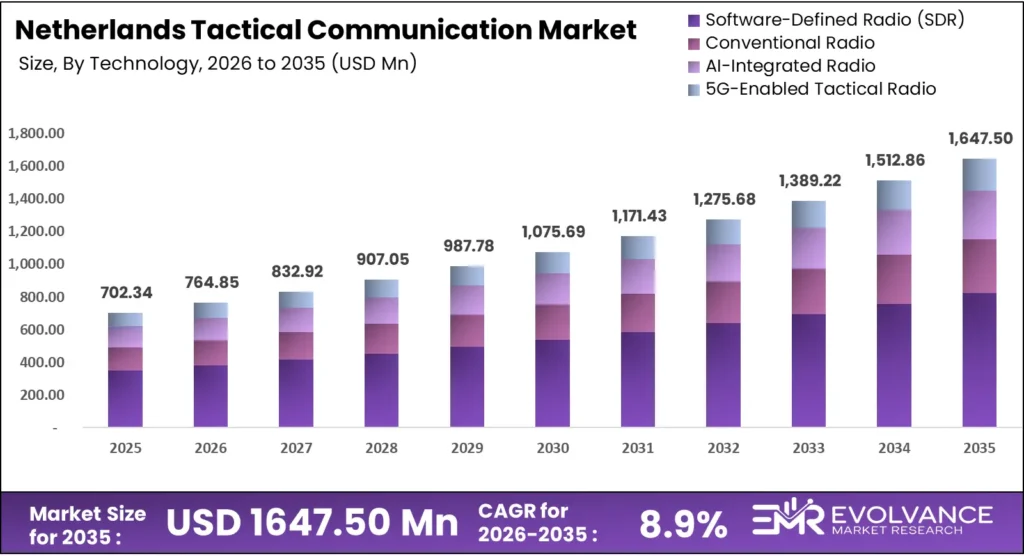
The Netherlands Tactical Communication market reaches USD 702.34 million in 2025, growing to USD 1647.50 million by 2035 at a CAGR of 8.9%. The FOXTROT tactical digitization programme, valued between €1 billion and €2.5 billion targeting ~8,000 vehicles, drives a sustained multi-year demand pull. 135 vessels and 170 aircraft are also covered, signalling that vendors with multi-domain capabilities hold a structural advantage over single-platform suppliers.
Market Highlights
- The Netherlands Tactical Communication market is valued at USAD 702.34 million in 2025, projected to reach USD 1647.50 million by 2035 at a CAGR of 8.9%.
- Software-Defined Radio (SDR) leads the By Technology segment, with the FOXTROT programme selecting Falcon IV SDR across all 5 Dutch military radio types.
- Vehicle-Mounted leads the By Installation Type segment, driven by FOXTROT’s target of approximately 8,000 military vehicles for SDR retrofitting.
- Encrypted/Cyber-Hardened leads the By Security Level segment, mandated across all 5 radio types in the USD 1.42 billion DSCA FMS package.
- VHF leads the By Frequency Band segment as the NATO STANAG-compliant baseline for all Dutch ground force procurement tenders.
- Foreign Military Sale (FMS) leads the By Procurement Pathway segment, representing the single largest Dutch tactical communication contract on record at USD 1.42 billion.
- Ground-Based leads the By Platform segment, anchored by FOXTROT’s ~8,000-vehicle modernization target — the largest platform group by unit count in Dutch tactical procurement.
- Army leads the By Application segment, driving the largest share of FOXTROT demand across ground vehicles, dismounted soldiers, and command post networks.
- Manpack Radio leads the By Type segment, serving 3,500 dismounted personnel under the FOXTROT procurement framework.
- Europe leads the regional market, with the Netherlands ranked 7th among 32 NATO members by total defence spending in 2024.
Market Overview
The Netherlands tactical communication market covers tactical radios, encrypted relay platforms, and soldier-worn devices across ground, naval, airborne, cyber, and command domains. This market serves the Royal Netherlands Army, Royal Netherlands Navy, Royal Netherlands Air Force, and Special Operations Forces.
This analysis draws on primary data across 3 platform domains, 8 segmentation dimensions, and contract-level records from the Netherlands Ministry of Defence, the U.S. DSCA, and NATO industry databases. EMR analysts found that the Dutch MoD’s simultaneous five-domain requirement structure distinguishes it from all comparable European NATO procurement programmes.
The Netherlands tactical communication market solves the problem of joint, NATO-interoperable field communication under contested and electronically hostile conditions. Netherlands defence procurement agencies, national systems integrators, and allied NATO contractor networks are the primary buyers. Multi-year framework agreements — not single-purchase contracts — define the buying model, giving incumbent vendors a durable structural advantage.
According to PwC/Strategy& (2025), the Netherlands’ cumulative defence equipment spend will reach about €62 billion over 2025–2030, with about €41 billion addressable by manufacturers. The COMMIT directorate held a 2024 budget of €864.08 million — 4% of total MoD. IT systems investment reached €1.23 billion, or 13% of the Defence Equipment Budget Fund (Army-Technology, 2024).
Type Analysis
Manpack Radio leads the By Type segment due to wide multi-terrain rollout and force portability requirements.
In 2025, Manpack Radio held a leading position in the Netherlands tactical communication market by type. FOXTROT covers 3,500 dismounted personnel alongside vehicle and platform installations — making manpack systems the primary radio form for this soldier cohort. Vendors offering lightweight, SDR-capable manpack units hold first-mover access to the personnel-carried procurement lane.
Handheld Radio serves squad-level and individual soldier communication. The Netherlands INVISIO framework — covering T30 headsets and intelligent control units — confirms handheld devices are an active, vehicle-separate procurement category. This separation of soldier and platform budgets creates two parallel bid opportunities for vendors in the same MoD funding cycle.
Vehicle-Mounted Radio anchors the largest platform count in the Dutch tactical procurement cycle. The FOXTROT programme’s stated target of ~8,000 military vehicles makes vehicle-mounted the largest single installation group across all platform types. Critically, SDR retrofitting of legacy vehicles creates recurring revenue — not just new-build installation — over the programme’s 2020–2034 horizon.
Base Station Radio supports fixed command post and headquarters communication. Static base station systems form the backbone of Netherlands Army command and control networks, particularly for the Royal Netherlands Army’s Combat Support Command. Vendors securing base station contracts gain access to integration roles across the broader Dutch tactical network, making this a strategic entry point.
| Sub-segment | Share % | Primary Driver |
|---|---|---|
| Manpack Radio | Leading | Dismounted personnel procurement under FOXTROT |
| Handheld Radio | Active | Soldier-worn systems framework procurement |
| Vehicle-Mounted Radio | Active | ~8,000 vehicle fleet SDR modernization |
| Base Station Radio | Active | Fixed C2 network systems investment |
| Airborne Radio | Active | H225M helicopter fleet and air platform upgrades |
| Naval Radio | Active | ASW frigate NAVICS multi-level secure install |
Platform Analysis
Ground-Based leads the By Platform segment due to the largest fleet modernization target in the FOXTROT programme.
In 2025, the Ground-Based platform held a leading position across Netherlands tactical communication procurement. FOXTROT’s ~8,000-vehicle target is the single largest platform group by unit count in the Dutch tactical modernisation plan. Simultaneous manpack, vehicle-mounted, and base station integration elevates contract value and favours prime contractors with cross-domain capability.
Naval platforms represent the most technically demanding communication environment in the Dutch force structure. Dutch Navy ASW frigates require multi-level secure systems at NATO SECRET and commercial classification — per the Rohde & Schwarz NAVICS contract at Euronaval 2024. This creates a premium-tier sub-market where vendors without military-grade cryptography integration cannot compete.
Airborne platforms form the smallest group by unit count but carry the highest per-unit integration cost. The Royal Netherlands Air Force’s 12 H225M helicopters — confirmed November 2024 — require airborne-qualified SDR and encrypted suites, driving high-margin aftermarket revenue. For communication vendors, airborne contracts build qualification records that unlock access to fighter and maritime patrol aircraft programmes.
| Sub-segment | Share % | Primary Driver |
|---|---|---|
| Ground-Based | Leading | ~8,000-vehicle FOXTROT SDR modernization |
| Naval | Active | ASW frigate multi-level secure comms upgrade |
| Airborne | Active | H225M helicopter fleet SDR integration |
Frequency Band Analysis
VHF leads the By Frequency Band segment due to its proven NATO interoperability and terrain-penetrating ground propagation.
In 2025, VHF held a leading position in the Netherlands tactical communication market by frequency band. NATO STANAG-compliant VHF radios underpin ground force communication across all allied armies in the European theatre, including Netherlands Army units deployed on NATO’s eastern flank. As a result, VHF capability is a non-negotiable baseline requirement in every Dutch tactical radio procurement tender.
HF frequencies enable beyond-line-of-sight communication critical for naval and strategic command roles. The Royal Netherlands Navy relies on HF for long-range maritime coordination, particularly on Atlantic patrol routes where satellite coverage is intermittent. Beyond this, HF survivability in GPS-denied environments makes it a priority resilience investment under the Netherlands’ cyber and electronic warfare hardening strategy.
UHF frequencies dominate satellite-linked and air-ground communication channels. UHF’s compatibility with MUOS satellite architecture means Netherlands Air Force and naval aviation units need UHF-capable radios for beyond-line-of-sight command link. This creates a procurement dependency on FMS-pathway suppliers — particularly U.S. firms — as MUOS is a U.S. DoD satellite system accessible to allied FMS customers.
Multi-Band systems address the interoperability gap between service branches. Netherlands joint operations require radios that bridge VHF ground networks, UHF air links, and HF maritime channels simultaneously. The Falcon IV SDR operates across all bands from one software-programmable unit. This is why multi-band SDR now defines the Dutch MoD procurement standard over single-band legacy radios.
| Sub-segment | Share % | Primary Driver |
|---|---|---|
| VHF | Leading | NATO STANAG ground force baseline interoperability |
| HF | Active | Naval beyond-line-of-sight and resilience mandate |
| UHF | Active | MUOS satellite link compatibility for air assets |
| Multi-Band | Active | Joint SDR platform replacing single-band legacy radios |
| SHF/EHF | Active | Anti-jam satellite and high-capacity data links |
Application Analysis
Army leads the By Application segment due to the largest unit footprint and multi-vehicle FOXTROT programme scope.
In 2025, Army applications held a leading position in the Netherlands tactical communication market. The Royal Netherlands Army drives the largest share of FOXTROT programme demand — covering ground vehicles, dismounted soldiers, and command post networks simultaneously. This multi-layer requirement means a single armoured brigade generates demand across manpack, vehicle-mounted, and base station product lines in a single procurement cycle.
Navy applications require the highest security certification among all Dutch service branches. Royal Netherlands Navy communication systems must operate at NATO SECRET classification, as confirmed by the NAVICS programme’s multi-level secure architecture. This means Navy contracts carry the longest qualification timelines — rewarding incumbents like Rohde & Schwarz and Thales while blocking new entrants.
Air Force applications prioritise lightweight, frequency-agile radios for fast-moving platform integration. Royal Netherlands Air Force communication requirements span fighter aircraft, maritime patrol, and the newly procured H225M helicopter fleet — each requiring distinct radio qualification protocols. Beyond this, Air Force SDR procurement ties into NATO LINK-16 datalink standards, creating a secondary software and waveform licensing market alongside hardware sales.
Special Operations Forces (SOF) demand the most compact, multi-mode, and cyber-hardened communication platforms available. Netherlands SOF operates within NATO Special Operations Headquarters at Mons and requires systems interoperable with allied SOF networks across multiple classification levels. This opens a distinct pathway outside the FMS track — accessible to specialists like Bittium without competing against prime contractors.
| Sub-segment | Share % | Primary Driver |
|---|---|---|
| Army | Leading | FOXTROT multi-vehicle and soldier programme |
| Navy | Active | NATO SECRET ASW frigate communication upgrade |
| Air Force | Active | H225M fleet and LINK-16 integration demand |
| Special Operations Forces | Active | Multi-mode cyber-hardened SOF radio procurement |
| Command & Control | Active | Joint C2 network digitalisation mandate |
Technology Analysis
Software-Defined Radio (SDR) leads the By Technology segment due to multi-band programmability enabling future waveform upgrades without hardware replacement.
In 2025, Software-Defined Radio held a leading position in the Netherlands tactical communication market by technology. Selection of the Falcon IV across all 5 Dutch radio types confirms SDR as the baseline — not a premium — for every FOXTROT lane. This locks non-SDR vendors out of the market’s primary growth cycle through 2034.
Conventional Radio remains active in legacy maintenance and upgrade contracts. Netherlands Armed Forces still operate older analogue and narrowband systems in reserve and civil defence roles — a managed-lifecycle stream for vendors with maintenance capabilities. However, FOXTROT’s scope explicitly replaces Conventional Radio systems, so this segment contracts over the forecast period rather than growing.
AI-Integrated Radio is entering the Netherlands procurement cycle through the Defence Strategy for Industry and Innovation 2025–2029. Intelligent systems is one of 5 priority areas in the Dutch EUR 1.15 billion fund — AI-enabled spectrum management is the clearest near-term radio application. This creates a funded innovation pathway — not just a procurement pipeline — for vendors with AI-capable radio platforms.
5G-Enabled Tactical Radio is a longer-horizon technology with active Dutch investment signalling. The NXTGEN High-Tech Programme secured €42 million for military laser satellite communication — signalling a national shift toward high-bandwidth, low-latency tactical links. This places 5G radio vendors who align with Dutch sovereign technology programmes ahead of pure FMS-pathway competitors in post-2030 tender evaluation.
| Sub-segment | Share % | Primary Driver |
|---|---|---|
| Software-Defined Radio (SDR) | Leading | FOXTROT standard platform across all 5 radio types |
| Conventional Radio | Declining | Legacy maintenance and reserve unit lifecycle |
| AI-Integrated Radio | Emerging | Dutch EUR 1.15B intelligent systems innovation fund |
| 5G-Enabled Tactical Radio | Emerging | NXTGEN laser comms and high-bandwidth network shift |
Installation Type Analysis
Vehicle-Mounted leads the By Installation Type segment due to the largest unit procurement target in the FOXTROT programme.
In 2025, Vehicle-Mounted installations held a leading position in the Netherlands tactical communication market. FOXTROT’s ~8,000-vehicle target exceeds the combined scope of 3,500 personnel, 135 vessels, and 170 aircraft — making vehicle integration the anchor contract type. This scale locks in vehicle-mounted as the reference standard for Dutch tactical network interoperability through 2034.
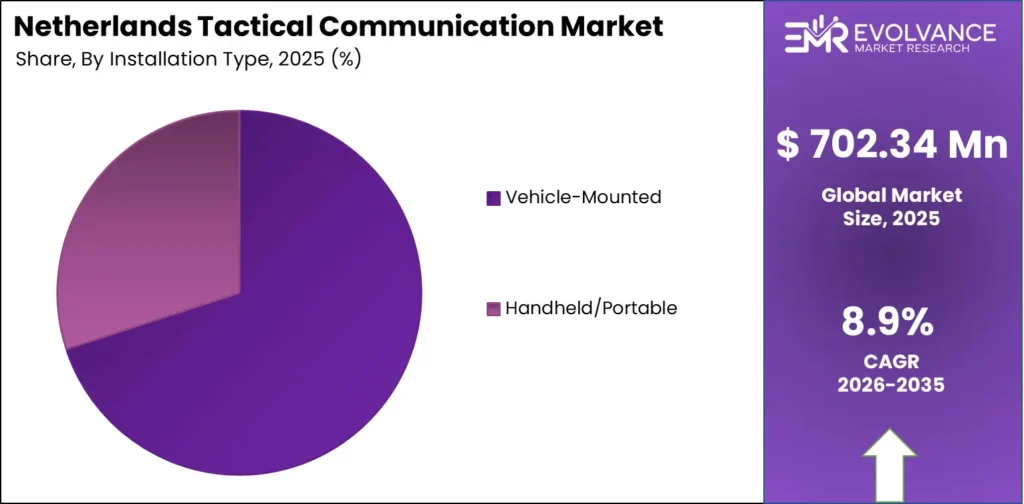
Handheld/Portable installations serve the dismounted soldier segment with actively funded procurement. The SEK 365 million INVISIO framework — T30 and X7 headsets plus control units — confirms handheld systems occupy a distinct budget line. This separation creates a parallel, accessible tender lane for specialist soldier-systems vendors outside the primary SDR prime contractor competition.
| Sub-segment | Share % | Primary Driver |
|---|---|---|
| Vehicle-Mounted | Leading | ~8,000-vehicle FOXTROT installation programme |
| Handheld/Portable | Active | SEK 365M dismounted soldier systems framework |
Security Level Analysis
Encrypted/Cyber-Hardened leads the By Security Level segment due to NATO interoperability mandates and DSCA tactical key loader requirements.
In 2025, Encrypted/Cyber-Hardened systems held a leading position in the Netherlands tactical communication market. DSCA’s October 2024 FMS approval included tactical key loaders and network encryptors alongside 5 radio types — confirming encryption is mandated, not optional. Vendors without NATO-certified end-to-end encryption capability are structurally excluded from the FOXTROT contract scope.
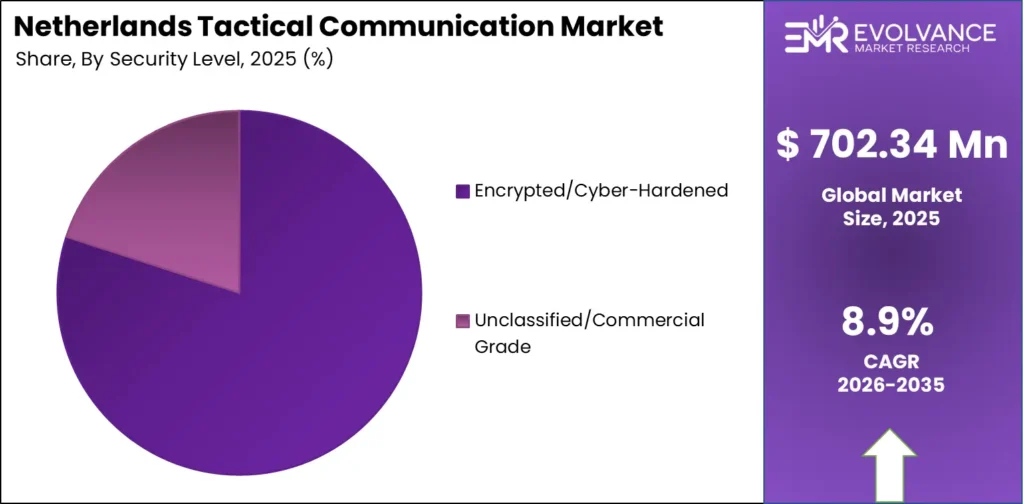
Unclassified/Commercial Grade systems serve civil defence, border security, and military training use cases. These fall below NATO SECRET requirements and occupy a shrinking share. The Dutch MoD’s shift toward secure communication-as-a-service — anchored by Sectra Tiger/S since 2004 — migrates even support roles to encrypted networks.
| Sub-segment | Share % | Primary Driver |
|---|---|---|
| Encrypted/Cyber-Hardened | Leading | Mandated DSCA FMS key loaders and encryptors |
| Unclassified/Commercial Grade | Declining | Civil defence and training legacy systems |
Procurement Pathway Analysis
Foreign Military Sale (FMS) leads the By Procurement Pathway segment due to the USD 1.42 billion DSCA-approved radio acquisition as the dominant active contract.
In 2025, Foreign Military Sale held a leading position in the Netherlands tactical communication market. The U.S. DSCA approved a USD 1.42 billion FMS package to the Netherlands in October 2024 — the single largest Dutch tactical communication procurement action on record. FMS transfers technology management risk to the U.S. government, making it contractually simpler than direct commercial negotiations at comparable scale.
Direct Commercial Sale (DCS) serves mid-tier vendors and specialist suppliers outside the FMS framework. DCS contracts — negotiated through the Netherlands MoD’s COMMIT directorate — cover European SDR suppliers, personal communication systems, and encrypted software licences. The Rohde & Schwarz NAVICS award for Dutch-Belgian ASW frigates followed the DCS pathway, confirming it as a viable and active route for non-U.S. prime vendors.
NATO/Government-to-Government (G2G) procurement grows in strategic importance for multi-national systems. The NCI Agency Blanket Order Agreement bypasses national timelines — Persistent Systems uses it for Wave Relay MANET — covering multiple NATO members at once. For vendors, a single NCI Agency qualification unlocks demand potential across all 32 NATO members, not just the Netherlands.
| Sub-segment | Share % | Primary Driver |
|---|---|---|
| Foreign Military Sale (FMS) | Leading | USD 1.42B DSCA radio package and FOXTROT LTA |
| Direct Commercial Sale (DCS) | Active | European SDR and encrypted software procurement |
| NATO/Government-to-Government (G2G) | Active | NCI Agency BOA enabling multi-nation qualification |
Market Segments Covered in the Report
By Type
- Manpack Radio
- Handheld Radio
- Vehicle-Mounted Radio
- Base Station Radio
- Airborne Radio
- Naval Radio
By Platform
- Ground-Based
- Naval
- Airborne
By Frequency Band
- VHF
- HF
- UHF
- Multi-Band
- SHF/EHF
By Application
- Army
- Navy
- Air Force
- Special Operations Forces
- Command & Control
By Technology
- Software-Defined Radio (SDR)
- Conventional Radio
- AI-Integrated Radio
- 5G-Enabled Tactical Radio
By Installation Type
- Vehicle-Mounted
- Handheld/Portable
By Security Level
- Encrypted/Cyber-Hardened
- Unclassified/Commercial Grade
By Procurement Pathway
- Foreign Military Sale (FMS)
- Direct Commercial Sale (DCS)
- NATO/Government-to-Government (G2G)
Netherlands Tactical Communication Market Regional Insights
Europe Leads Netherlands Tactical Communication Market
Europe anchors this market. The Netherlands ranked 7th among 32 NATO members in 2024 at €1,105 per capita spending (CBS, 2025). Thales Nederland operates across 7 locations with ~3,000 employees — confirming in-country industrial presence as a structural Dutch MoD qualification requirement.
NATO Alliance Drives Netherlands Defence Communication Spend
NATO European members collectively spent about $380 billion on defence in 2024 — the first time combined European NATO spending reached 2% of European GDP. Dutch procurement decisions carry outsized regional influence. The Rohde & Schwarz NAVICS contract covers both Dutch and Belgian navies — showing how Netherlands MoD awards shape allied procurement patterns.
Netherlands FMS Partnership Shapes North American Market Flows
The Netherlands has accumulated over $18 billion in Foreign Military Sales with U.S. defence firms, with about one-fifth of all Dutch contracts going to U.S. companies (U.S. ITA). This makes North America — via the DSCA FMS pipeline — the primary supply-side node for this market. The transatlantic procurement relationship is a structural condition, not a preference.
| Region | Role | Key Data Point |
|---|---|---|
| Europe (Netherlands) | Primary demand market | USD 702.34M total market (2025); 7th of 32 NATO members |
| North America | Primary supply market | ~$18B cumulative FMS to Netherlands |
| NATO Alliance (Europe-wide) | Demand amplifier | ~$380B combined European NATO spend (2024) |
Regulatory Landscape
The Netherlands tactical communication market is governed by NATO STANAG interoperability standards mandated for all systems under FOXTROT and Dutch MoD framework agreements. NATO STANAGs — STANAG 4204 for tactical radio and STANAG 4691 for SDR — serve as baseline technical specifications in all Dutch equipment tenders. Non-compliant platforms are excluded from evaluation regardless of commercial terms.
Foreign Military Sales to the Netherlands are regulated by the U.S. Arms Export Control Act and International Traffic in Arms Regulations, administered by DSCA. Export licences and end-use certificates are required for five AN/PRC radio types in the October 2024 package — adding compliance timelines to delivery schedules. Vendors must build these lead times into FOXTROT programme delivery commitments from contract signature.
Within the EU, Netherlands defence procurement is shaped by the European Defence Fund and PESCO, which prioritise joint capability development and domestic industrial participation. The Dutch Defence Strategy for Industry and Innovation (2025–2029) formalises sovereign technology capacity-building as a procurement evaluation criterion alongside technical performance. This means EU-based vendors with Dutch industrial footprint score higher under the new evaluation framework.
Drivers
Netherlands Defence Budget Surges to €19.9B in 2024
Netherlands defence spending reached €19.9 billion in 2024 — a 40% rise meeting NATO’s 2% GDP target for the first time since the 1990s (CBS, 2025). Rising eastern-flank threat perception drove this structural budget shift. In our view, this is a generational reset — creating a durable demand floor for tactical communication vendors.
The Netherlands targets a combined 5% defence GDP under the Hague Commitment, with 3.5% core by 2035 — already at 2.59% in 2025 (NLTimes, 2026). This trajectory locks in predictable procurement cycles across a decade. As a result, multi-year framework agreements — not spot contracts — define the dominant commercial structure in this market.
The Netherlands defence budget will rise to €26.8 billion in 2026 — an increase of €3.4 billion over 2025 (Netherlands MoD, 2025). Each annual increment opens new FOXTROT delivery tranches, funding tactical radio installation across Dutch vehicle, vessel, and aircraft fleets. Critically, this is the third straight year of double-digit growth — a clear entry signal for vendors.
Restraints
NATO Procurement Speed Trails 24-Month Technology Integration
NATO’s procurement cycle consistently lags technology development, prompting the Rapid Adoption Action Plan — committing to a 24-month integration target as formal remediation (NATO, 2025). Multinational approval processes slow SDR and AI-integrated system fielding regardless of budget availability. This creates a delivery-versus-award gap that compresses vendor cash flow even when Dutch MoD contract backlogs reach record levels.
Quantum computing poses a structural threat to existing Dutch military encryption standards. Netherlands defence networks face a 5-year post-quantum migration timeline before achieving full protection against quantum-enabled decryption attacks on NATO SECRET communications (Security Delta, 2025). Current encrypted systems — including FOXTROT hardware — will need a second replacement cycle before 2035, adding unplanned capital costs to Dutch MoD budgets.
Industrial supply chain constraints for defence-grade radio components — radiation-hardened semiconductors and military-qualified encryption chips — impose delivery risk on large-scale programmes like FOXTROT. The Netherlands’ dependence on a concentrated base of qualified component suppliers creates single-point vulnerabilities that budget increases alone cannot resolve. This restraint disproportionately affects smaller European vendors with less supplier leverage than U.S. prime contractors.
Growth Factors
€1.15B Dutch Defence Innovation Fund Opens Vendor Pathways
The Dutch government committed EUR 1.15 billion for defence innovation in April 2025. This deployed EUR 310 million across five areas — including intelligent systems and sensors (Netherlands MoD, 2025). These two areas directly address next-generation tactical communication hardware — and vendors aligned with Dutch sovereign technology priorities access innovation funding alongside procurement contracts.
The Netherlands invested €42 million in military laser satellite communication development via the NXTGEN High-Tech Programme, with Netherlands MoD integration confirmed (European Space Flight, 2025). Laser satellite communication addresses the high-bandwidth, low-intercept gap in current Dutch tactical networks. This signals a post-2030 procurement wave for satcom-capable terminals — not yet covered by existing FMS framework agreements.
Motorola Solutions completed the USD 4.4 billion acquisition of Silvus Technologies in August 2025, adding MANET tactical networking to its NATO-market portfolio (Motorola Solutions, 2025). MANET mesh networking addresses the denied-environment resilience gap driving Dutch SOF and dispersed ground force procurement. Beyond this, the deal backs MANET with Motorola’s NATO relationships — accelerating its path into Dutch MoD tenders.
Emerging Trends
Cyber-Resilient Tactical Networks Replace Legacy Dutch Systems
INVISIO secured a five-year framework worth up to SEK 365 million with the Netherlands MoD in October 2025, covering T30 and X7 headsets (INVISIO, 2025). This confirms soldier-worn systems now occupy a distinct, separately funded procurement lane in the Dutch tactical market. The separation from vehicle and platform budgets creates independent tender cycles and premium margin opportunities for specialist vendors.
The Netherlands 2025 defence equipment fund totals €9.78 billion — 44% of the total about €24 billion defence budget (Defence White Paper, 2024). This hardware-heavy budget composition directly accelerates the full-fleet transition from analogue legacy systems to SDR and encrypted IP-networked tactical platforms. Vendors positioned for volume production before 2027 capture the densest part of the FOXTROT delivery curve.
NLR and TNO signed a cooperation agreement in November 2025 to develop Dutch military space communication, pooling satellite, intelligence, and situational awareness expertise (NLR, 2025). Space-based tactical communication is emerging as a distinct fifth procurement category alongside ground, naval, airborne, and cyber domains. This builds domestic sovereign capability reducing Netherlands dependence on foreign satellite systems before 2035.
Tactical Communication Market Key Companies Insights
L3Harris Technologies leads via the FOXTROT long-term agreement — up to EUR 1 billion, signed March 2025 via a USD 1.42 billion FMS deal. The Falcon IV SDR platform covers all 5 Dutch military radio types, making L3Harris the network standard-setter through 2034. The 2025 formation of L3Harris Netherlands B.V. signals an in-country industrial commitment to support long-term programme retention.
Thales Nederland operates across 7 Dutch locations, with 100+ years of presence and 2024 Defence revenue of €10.969 billion — up 13.9%, book-to-bill 1.34 (Thales, 2025). The Thales–Kongsberg 50/50 JV formed in June 2025 targets combined revenues of NOK 3 billion by end of decade. Our forecast suggests this JV will expand Thales’ encrypted communications share in Dutch MoD tenders.
Rohde & Schwarz crossed €3 billion in FY2024/25 revenue, up 7.8%, with backlog exceeding €5 billion (Rohde & Schwarz, 2025). The NAVICS contract for Dutch and Belgian ASW frigates — awarded at Euronaval 2024 — delivers multi-level secure, cyber-protected naval communication. This naval footprint makes Rohde & Schwarz the leading DCS-pathway vendor in this market.
Elbit Systems posted 2024 revenues of $6.827 billion (+14%), Europe at 27%, C4I and Cyber at $62 million with 7.8% margin (Elbit, 2025). The VOSS programme delivers TORCH-X C2 and E-LynX SDR to the Royal Netherlands Army under a ~$50 million follow-on. This C4I-plus-SDR position gives Elbit a structural edge in Dutch joint tenders.
Key Companies
- L3Harris Technologies
- Thales Group
- Rohde & Schwarz
- INVISIO Communications
- Sectra
- Kongsberg Defence
- Rheinmetall AG
- Bittium
- Airbus Defence & Space
- Robin Radar Systems
- Elbit Systems
- Persistent Systems
Recent Development
- December 2025: Rheinmetall AG signed a contract for Skyranger 30 air defence systems for the Netherlands, valued at a high triple-digit million euros, with production confirmed at Rheinmetall Nederland’s facility in Ede (Army Recognition, 2025).
- December 2025: Robin Radar Systems received a Netherlands MoD contract for 100 IRIS C-UAS radars to protect Dutch airspace, with the first 50 units already delivered (Robin Radar Systems, 2025).
- December 2025: Kongsberg Defence & Aerospace won a C2 integration contract — valued in the high double-digit million euros — to integrate Skyranger 30 into NASAMS and NOMADS air defence systems for the Netherlands (Kongsberg, 2025).
- December 2025: Thales signed a framework agreement with the Dutch Armed Forces for tactical communication system modernization across Netherlands service branches (Militär Aktuell, 2025).
- November 2025: Embraer signed cooperation agreements with Dutch companies TNO, OPT/NET, and ILIAS Solutions under the Industrial Participation Agreement covering AI-driven decision support and real-time data solutions for defence communication and C2 (Embraer, 2025).
- October 2025: INVISIO signed a five-year framework agreement — up to SEK 365 million — with the Netherlands MoD covering T30 and X7 smart headsets and intelligent cables (INVISIO, 2025).
- June 2025: Bittium supplied Tough SDR radios to European Special Operations Forces, confirming the company’s growing role in NATO SOF communication procurement (Battle Updates, 2025).
- November 2024: Airbus Defence & Space confirmed a Netherlands MoD order for 12 H225M medium tactical helicopters, adding airborne communication platform demand to the Dutch procurement pipeline (Airbus, 2024).
- October 2024: Rohde & Schwarz received a contract from Dutch COMMIT to supply NAVICS integrated communications systems — featuring multi-level secure and cyber-protected capabilities — for Royal Netherlands Navy and Belgian Navy ASW frigates (Naval News, 2024).
- October 2024: The U.S. Defense Security Cooperation Agency (DSCA) approved a USD 1.42 billion Foreign Military Sale to the Netherlands covering five radio types plus tactical key loaders and network encryptors, with L3Harris Communications as principal contractor (Euro-SD, 2024).
Market Scope
| Market Size Value in 2025 | USD 702.34 Million |
| Revenue Forecast in 2035 | USD 1647.50 Million |
| Growth Rate | CAGR of 8.9% from 2026 to 2035 |
| Base Year | 2025 |
| Historic Period | 2020–2024 |
| Forecast Period | 2026–2035 |
| Segments Covered | By Type (Manpack Radio, Handheld Radio, Vehicle-Mounted Radio, Base Station Radio, Airborne Radio, Naval Radio); By Platform (Ground-Based, Naval, Airborne); By Frequency Band (VHF, HF, UHF, Multi-Band, SHF/EHF); By Application (Army, Navy, Air Force, Special Operations Forces, Command & Control); By Technology (Software-Defined Radio, Conventional Radio, AI-Integrated Radio, 5G-Enabled Tactical Radio); By Installation Type (Vehicle-Mounted, Handheld/Portable); By Security Level (Encrypted/Cyber-Hardened, Unclassified/Commercial Grade); By Procurement Pathway (Foreign Military Sale, Direct Commercial Sale, NATO/Government-to-Government) |
| Regions Covered | North America, Europe, Asia-Pacific, Latin America, Middle East & Africa |
| Countries Covered | United States, Canada, Mexico, Germany, United Kingdom, France, Italy, Spain, Russia, Netherlands, Switzerland, Belgium, China, India, Japan, South Korea, Australia, Thailand, Indonesia, Vietnam, Philippines, Taiwan, Brazil, Argentina, Colombia, Chile, Peru, Saudi Arabia, UAE, South Africa, Egypt, Israel, Turkey |
| Key Companies | L3Harris Technologies, Thales Group, Rohde & Schwarz, INVISIO Communications, Sectra, Kongsberg Defence, Rheinmetall AG, Bittium, Airbus Defence & Space, Robin Radar Systems, Elbit Systems, Persistent Systems |