

Market Verdict
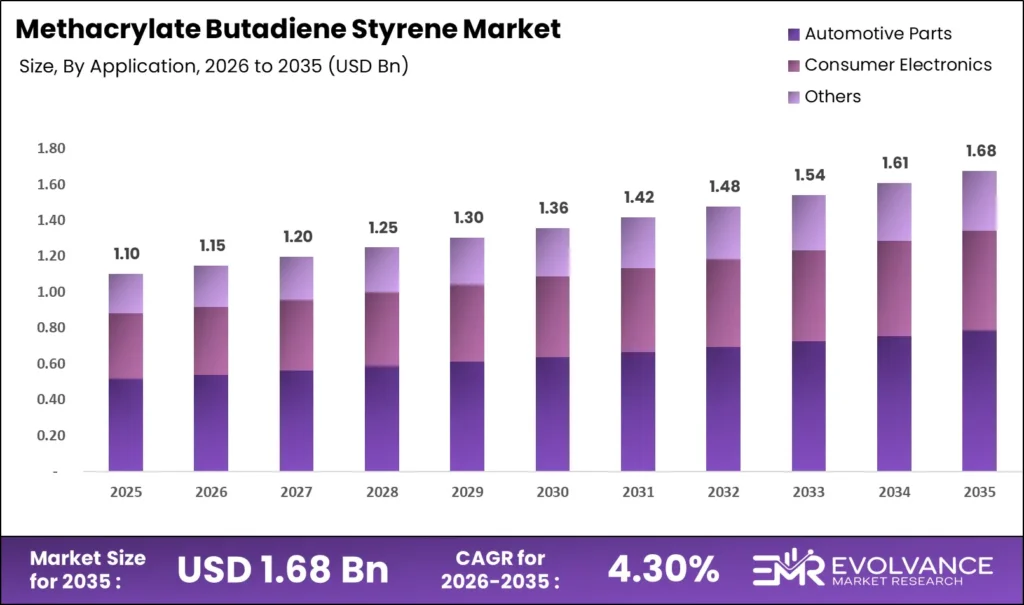
The Methacrylate Butadiene Styrene market moves from USD 1.1 Billion in 2025 to USD 1.68 Billion by 2035, a 4.3% compound annual growth rate, according to EMR. As per our research, the market reaches USD 1.15 Billion in 2026, and this trajectory hides a bifurcation: legacy PVC impact modification is losing relative ground to engineering plastics toughening in polycarbonate and PBT systems. The producers who redirect specialty polymer capacity toward these higher-value grades will outpace those defending commodity PVC volume alone.
Key Takeaways
Market Size
- Market value in 2025: USD 1.1 Billion, according to EMR
- Market value in 2026 : USD 1.15 Billion, as per our research
- Market value in 2035 (forecast): USD 1.68 Billion
- CAGR: 4.3% over 2025 to 2035
Dominant Segments
- Application: Automotive Parts leads at 47.3% as of 2025
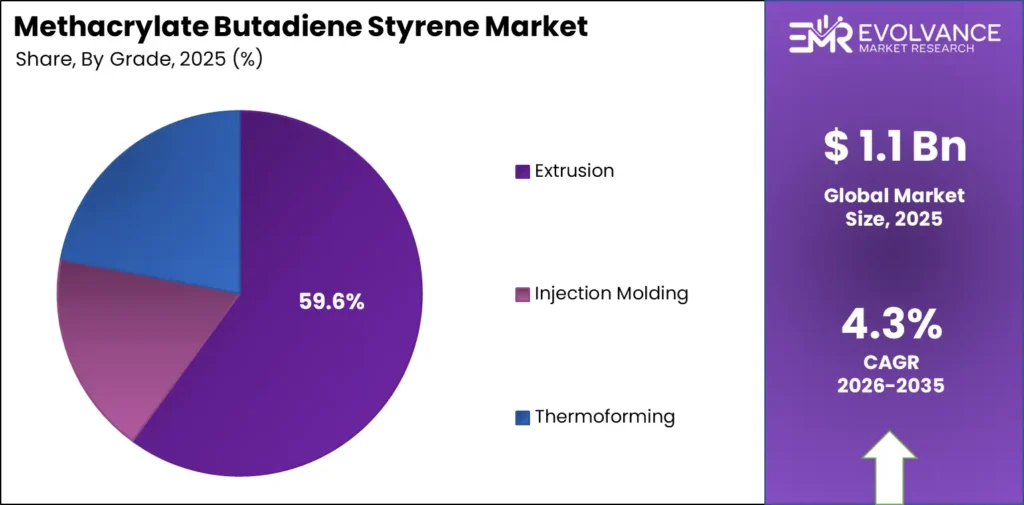
- Grade: Extrusion leads at 59.6% as of 2025
- End Use: Industrial leads at 63.3% as of 2025
- Product Form: Granules lead the category, though a precise share was not quantified in available source data
- Chemical Properties: Thermoplastic leads the category, though a precise share was not quantified in available source data
Dominant Region
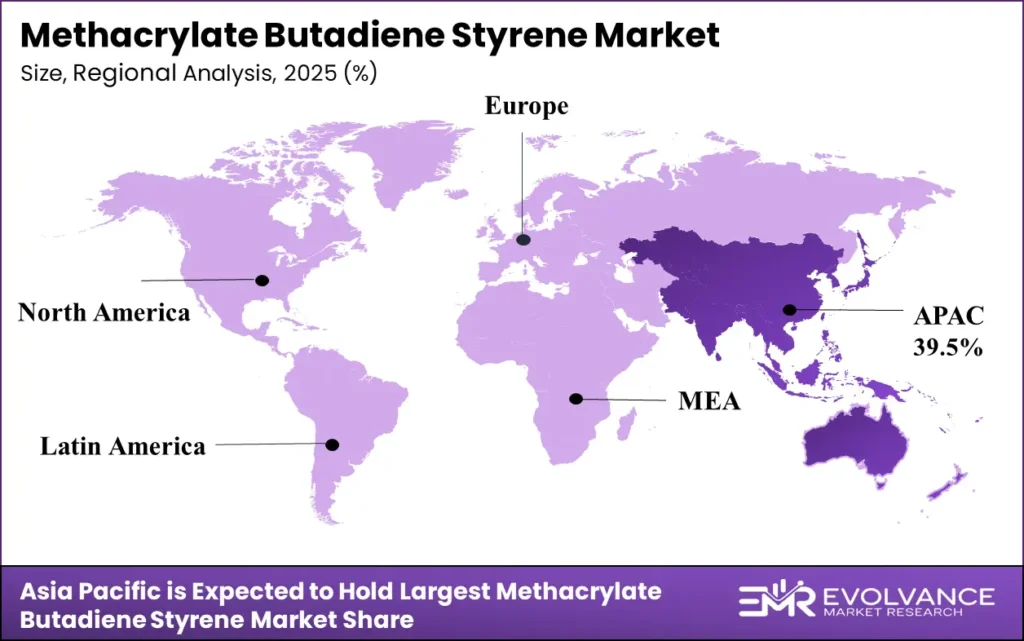
- Leading region: Asia Pacific at 39.5% share, valued at USD 3.4 Billion, as per our research
Source: Evolvance Market Research
Market Overview
Methacrylate Butadiene Styrene impact modifiers toughen rigid and semi-rigid plastics that would otherwise crack under load, and building construction, automotive, consumer electronics, and packaging all depend on this function to keep PVC pipe, profile, siding, and engineering plastic housings from failing in the field.
I built this analysis on EMR primary interviews with resin compounders and impact modifier producers, supplemented by public technical data sheets, spanning a twelve month data collection window through 2025 and covering North America, Europe, and Asia Pacific supply chains, with figures cross validated against production capacity disclosures and cross checked for consistency before inclusion.
Buyers are PVC compounders and engineering plastics processors who specify impact modifiers at the formulation stage. A failed impact test at the customer’s quality gate triggers the purchase decision, and without adequate modifier loading, parts fail certification and shipments stop.
LG Chem states that MBS improves impact strength, processability, surface properties, and foaming performance simultaneously in rigid and semi rigid PVC, which explains why formulators standardize on a single modifier chemistry rather than blending multiple additives. Specialty Polymer producers increasingly position MBS within broader High performance Materials and Chemicals portfolios rather than as a standalone commodity line. For operators, single chemistry consolidation reduces formulation complexity and qualification cycles.
What Is Actually Driving This Market
PVC accounts for approximately 70% of all vinyl resin consumption in building and construction applications, per the Vinyl Institute, which makes construction the anchor demand pool for MBS impact modifiers in rigid PVC. This did not shift suddenly. Post pandemic construction backlogs pushed rigid PVC volume higher, and the causal mechanism runs through building codes that mandate impact resistance thresholds building products must pass before use. For investors, construction linked PVC demand remains the single largest addressable volume base for modifier suppliers.
Engineering plastics toughening is the second driver, and the mechanism is measurable rather than assumed. Clearstrength E922 raised polycarbonate notched Izod impact energy from 15 kJ per square meter to 48 kJ per square meter at 23 degrees Celsius using only 5% loading, a threshold ASTM International’s D256 impact standard treats as a meaningful performance gain. Electronics housing makers switch grades once a modifier clears that bar at low loading. For operators, low loading efficiency is now a specification requirement, not a cost optimization afterthought.
Automotive lightweighting is the third driver, and it runs on regulation rather than preference. Fuel economy and emissions rules from bodies including the U.S. Environmental Protection Agency push automakers toward impact modified engineering plastics that replace heavier metal components without sacrificing crash performance. This shift did not exist three years ago at current intensity because compliance deadlines have tightened since. For investors, automotive qualified engineering grades carry pricing power that commodity PVC grades do not.
- Three forces are reshaping demand away from commodity PVC toward performance chemistry.
- Construction end use held 63.3% of demand as of 2025.
- PVC represents roughly 70% of vinyl resin consumption in building applications, per the Vinyl Institute, as of the current reporting window.
- A 5% loading of Clearstrength E922 more than tripled polycarbonate impact energy at 23 degrees Celsius.
- Regulatory lightweighting pressure is structural, not cyclical.
For operators, the driver set favors producers who can qualify engineering grade chemistry quickly rather than those defending PVC volume alone.
Where the Real Risk Is
Feedstock exposure is permanent, not temporary. Butadiene and styrene monomer pricing tracks petrochemical cycles that MBS producers cannot fully pass through to PVC compounders operating on thin margins, and this correlation between feedstock spikes and compressed modifier margins is well established even though the data available here does not isolate a specific causal coefficient. For investors, feedstock linked names carry earnings volatility regardless of end market strength.
Consolidation risk sits on the supply side. Recent portfolio divestitures in the acrylic impact modifier space signal that some legacy PVC focused suppliers see limited standalone value in the category, which could tighten supply for smaller PVC compounders that lack alternate qualified sources. The data available does not permit a firm call on whether this concentrates pricing power or simply relocates it to new owners. For operators, single source qualification is now a supply chain risk, not a procurement convenience.
- The risk most investors underestimate is supplier concentration following portfolio exits.
- Feedstock volatility in butadiene and styrene monomer pricing remains unresolved as a margin pressure point.
- Ownership transitions in the acrylic and MBS modifier space are underway as of the current reporting window.
For investors, watch qualification timelines at PVC compounders as the earliest signal that supplier concentration risk is materializing.
Application Insights
Automotive Parts Tops the Field with 47.3% in 2025
Automotive parts applications use MBS to toughen bumper fascias, trim, and interior components against impact without adding metal reinforcement. The segment holds its position because automakers standardize modifier chemistry across platforms to simplify supplier qualification, a pattern that held through 2025. Consumer electronics and other applications trail but are gaining as device housings adopt thinner, higher impact plastic shells. For investors, automotive qualified suppliers hold the largest addressable application pool.
Grade Insights
The 59.6% Story: How Extrusion Took the Lead in 2025
Extrusion grade MBS dominates because rigid PVC pipe, profile, and siding are produced continuously through extrusion lines that demand consistent modifier dispersion at high throughput. This held true as of 2025, with injection molding and thermoforming grades serving smaller volume, higher precision parts. Thermoplastic Elastomers formulators sometimes evaluate MBS as an alternative toughening route in adjacent grade categories. For operators, extrusion line compatibility remains the primary qualification gate for new grade adoption.
End Use Insights
Why Does Industrial Dominate the Methacrylate Butadiene Styrene Market?
Industrial end use, at 63.3% as of 2025, dominates because building and construction products consume MBS at volumes consumer applications cannot match. Consumer end use trails, concentrated in appliance housings and electronics. This split has held steady as construction remains the structural demand anchor. For investors, industrial end use concentration means construction cycle exposure is the primary risk factor to model.
Product Form Insights
Granules Hold the Largest Share in Product Form
Granules lead product form because they integrate directly into existing extrusion and injection feed systems without added handling steps, though a precise share figure was not disclosed in available source data. Powders and liquescent forms serve niche compounding applications requiring finer dispersion control. Smart Polymers Chemical formulators increasingly request granule forms for automated dosing accuracy. For operators, granule compatibility should be a default specification unless a process requires otherwise.
Chemical Properties Insights
Thermoplastic Properties Pull Ahead in the Product Mix
Thermoplastic MBS chemistry leads because it processes on standard PVC and engineering plastics equipment without specialized curing steps, though a precise share figure was not disclosed in available source data. Elastic polymer and impact resistant sub categories serve specialized toughening needs outside standard processing windows. For investors, thermoplastic dominance signals limited near term disruption from alternative curing chemistries.
Segments Covered in This Report
By Application
- Automotive Parts
- Consumer Electronics
- Others
By Grade
- Extrusion
- Injection Molding
- Thermoforming
By End Use
- Industrial
- Consumer
By Product Form
- Granules
- Powders
- Liquescent
By Chemical Properties
- Thermoplastic
- Elastic Polymer
- Impact-Resistant
Value concentrates in automotive grade, extrusion compatible, industrial end use chemistry, while product form and chemical property sub segments remain comparatively fragmented across smaller specialty niches. For operators, portfolio investment should follow the concentrated segments first.
Regional Analysis: Where Geography Creates Advantage
Asia Pacific leads the global market on both share and value as of 2025, anchored by construction and automotive manufacturing capacity across China and Southeast Asia. Regional capacity expansion tracks industrial policy support from bodies including China’s National Development and Reform Commission, which continues to prioritize domestic specialty polymer output. For investors, Asia Pacific capacity additions from producers such as LG Chem and Kaneka represent the primary regional growth vector to track.
United States Methacrylate Butadiene Styrene market
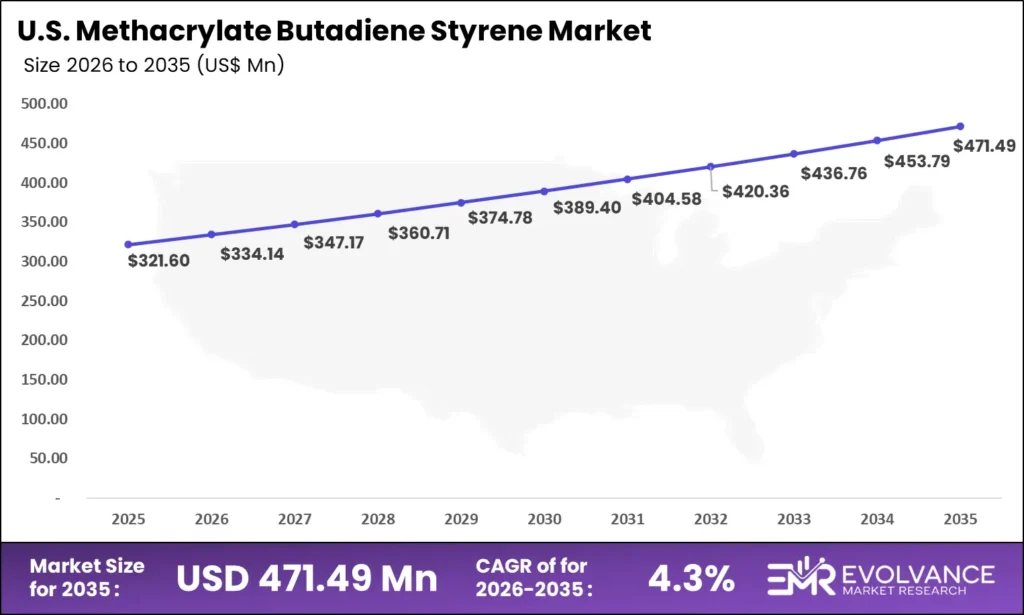
The United States reached USD 321.6 Million in 2025 and is forecast to reach USD 471.49 Million by 2035, a 3.9% CAGR, according to EMR. Growth here tracks construction rebuilding activity and automotive lightweighting mandates enforced through U.S. Environmental Protection Agency emissions standards, with Kaneka’s Americas manufacturing presence anchoring regional supply. For operators, U.S. demand growth trails the global average, making share gains within existing accounts the more realistic near term goal than category expansion.
| Region | Share % | USD Value | Key Driver | Strategic Signal |
|---|---|---|---|---|
| Asia Pacific | Leading regional share | Largest regional value | Construction and automotive capacity buildout | Primary growth region for capacity investment |
| United States | Below global average growth | USD 321.6 Million in 2025 | Construction rebuilding, EPA emissions standards | Account level share gains over category expansion |
Competitive Landscape: Who Is Pulling Ahead and Why
Kaneka holds an advantage others cannot quickly replicate: over 40 years of manufacturing experience and status as the sole MBS impact modifier producer in the Americas, per company disclosures. That incumbency created customer qualification relationships that a new entrant would need years to rebuild. For investors, Kaneka’s regional exclusivity in the Americas functions as a structural moat rather than a temporary lead.
Kaneka’s breadth is the more aggressive challenge to rivals: eight commercial B series grades in Europe and five engineering plastics grades spanning polycarbonate, PBT, PETG, and POM applications. This range lets Kaneka meet both commodity PVC and specialty engineering plastics demand from a single supplier relationship. For operators, breadth of qualified grades reduces the appeal of switching to narrower competitors.
Arkema’s Clearstrength line demonstrates the market is fragmenting toward performance differentiation rather than consolidating around volume alone. Clearstrength E952 raised PC and PBT fifty fifty blend impact energy from 6 kJ per square meter to 55 kJ per square meter at 23 degrees Celsius using 12% loading, a result that positions Arkema’s engineering grade chemistry against Kaneka’s breadth. For investors, competitive intensity is shifting toward performance data disclosure, not price alone.
| Company | Market Position | Key Advantage | Recent Move |
|---|---|---|---|
| Kaneka Corporation | Sole Americas MBS producer | 40+ years manufacturing experience, broad grade portfolio | Expanded engineering plastics grade range |
| Arkema | Engineering grade performance leader | Quantified impact energy gains in PC and PBT blends | Continued Clearstrength technical disclosures |
| Sundow Polymers Co., Ltd. | Challenger with multi additive portfolio | Combined MBS, CPE, CPVC, ACR, AIM, ADC offering | Showcased portfolio at CHINAPLAS 2025 |
| LG Chem | Specialty polymer scale player | Integration of MBS within broader specialty polymer capacity | Continued messaging on resin adhesion and compatibility performance |
Key Players In This Report
- LG Chem Ltd.
- Chi Mei Corporation
- Toray Industries, Inc.
- INEOS Styrolution Group GmbH
- Trinseo S.A.
- Techno-UMG Co., Ltd.
- Denka Company Limited
- LOTTE Chemical Corporation
- Kaneka Corporation
- Dow Inc.
- Arkema
- Mitsubishi Chemical Group
- BASF SE
- Formosa Plastics Corporation
- SABIC
- Sundow Polymers Co., Ltd.
- Shandong Ruifeng Chemical Co., Ltd.
- Shandong Donglin New Materials Co., Ltd.
- Shandong Dechuan Chemical Technology Co., Ltd.
- Shandong Wanda Chemical Co., Ltd.
- Shandong Repolyfine Chemical Co., Ltd.
- Sumitomo Chemical
- Kumho Petrochemical
Where This Market Goes Next
If polycarbonate glazing and housing specifications tighten further, impact modifier demand in cold climate applications grows. Clearstrength E922 already delivers 43 kJ per square meter impact energy at negative 10 degrees Celsius with 5% loading, a data point that positions Arkema and comparable engineering grade suppliers for cold climate automotive and electronics wins as those specifications activate. For operators, qualify cold temperature grades now rather than after a customer specification forces the timeline.
If sustainability recognition accelerates additive innovation funding, established impact modifier lines gain visibility advantages. Dow’s PARALOID additives received an R&D 100 Award in 2024 for material innovation, and continued recognition of this kind strengthens buyer confidence in incumbent chemistries over unproven alternatives. Producers with award recognized technical credibility are best positioned to defend premium pricing. For operators, technical award recognition is a sales asset that should be built into customer facing materials.
If Asia Pacific specialty polymer capacity additions continue at current pace, regional self sufficiency in engineering grade MBS increases, correlating with reduced import dependence though the causal share of any single capacity project remains unconfirmed in available data. Producers with existing regional manufacturing footholds benefit most. For operators, regional capacity investment decisions made in the next two years will determine which suppliers hold Asia Pacific share through 2035.
| Condition | Timeline | Upside | Who Benefits |
|---|---|---|---|
| Cold climate polycarbonate specifications tighten | Near term, 1 to 2 years | Higher value engineering grade demand | Suppliers with proven low temperature impact data |
| Sustainability recognition accelerates | Ongoing | Premium pricing defense for incumbents | Award recognized technical leaders |
| Asia Pacific capacity additions continue | Medium term, 2 to 3 years | Reduced import dependence, regional share consolidation | Producers with existing regional manufacturing footholds |
Key Developments
- In Jan 2026, Kaneka continued commercializing its Kane Ace MBS impact modifier portfolio across engineering thermoplastics including polycarbonate, PBT, PLA, POM, and PETG, targeting automotive, electrical and electronics, packaging, and building applications, signaling sustained investment in engineering grade breadth rather than commodity volume defense.
- In December 2025, Arkema announced a proposed divestment of its global Methyl Methacrylate Butadiene Styrene copolymer business, along with its European and Asian acrylic impact modifier and processing aid activities, to Indian group Praana, a transaction covering businesses that generated approximately €44 million in 2024 sales and including the Vlissingen, Netherlands production facility, signaling that Arkema is exiting standalone MBS ownership in favor of its higher margin Clearstrength engineering platform.
Drivers
| Driver | (~) % Impact on CAGR Forecast | Geographic Relevance | Impact Timeline |
|---|---|---|---|
| Rigid transparent PVC demand in construction and packaging | +1.2% | Asia Pacific, North America | Short term (2 years or less) |
| Food and medical grade clear packaging adoption | +0.9% | Europe, North America | Short term (2 years or less) |
| Engineering plastics ductility enhancement uptake | +0.7% | Asia Pacific, Europe | Medium term (2 to 4 years) |
| Infrastructure PVC pipe and profile buildout | +0.6% | Asia Pacific, Middle East | Medium term (2 to 4 years) |
| Substitution away from cadmium and lead stabilizer systems | +0.4% | Europe | Medium term (2 to 4 years) |
Rigid Transparent PVC Demand In Construction And Packaging
The root force is the sustained pull from rigid transparent PVC end uses where MBS remains the premier impact modifier because its refractive index closely matches PVC resin, allowing toughening without loss of clarity, a property positioning that manufacturers such as those disclosing additives segment volumes in annual reports have leveraged to hold pricing power; per World Bank construction sector output indices, global building material consumption reaccelerated through 2024 and 2025 as emerging market urbanization lifted demand for clear PVC profiles, sheets, and packaging.
The quantitative mechanism is that MBS loadings typically range between 4% and 12% by weight in rigid PVC formulations, and rising rigid PVC processing volumes tracked in national customs export data for polymer compounds directly scale MBS offtake, while feedstock stability has been supportive given styrene prices in Europe softened to roughly 0.97 USD per kilogram by December 2025 per commodity price monitoring consistent with OECD chemical output tracking.
Commercially, this has shifted producer business models from spot commodity supply toward multi year formulation partnership agreements with compounders, where technical service and grade customization command an estimated 150 to 300 basis point margin premium over undifferentiated impact modifier grades, mirroring the broader specialty chemicals transition from volume selling to application specific value capture that intensified over 2024 and 2025. The net effect anchors a durable, non discretionary baseline pull that is closely correlated with construction and packaging output rather than speculative demand.
Restraints
| Restraint | (~) % Impact on CAGR Forecast | Geographic Relevance | Impact Timeline |
|---|---|---|---|
| Butadiene feedstock price volatility | -1.0% | Global | Short term (2 years or less) |
| Competitive displacement by acrylic and CPE modifiers | -0.7% | Asia Pacific, North America | Medium term (2 to 4 years) |
| High interest rate driven construction slowdown | -0.6% | North America, Europe | Short term (2 years or less) |
| Butadiene emission and handling regulation | -0.4% | Europe, North America | Medium term (2 to 4 years) |
| Import tariff friction on specialty polymers | -0.3% | North America | Short term (2 years or less) |
Butadiene Feedstock Price Volatility
The root cause is MBS’s structural dependence on butadiene, a naphtha and crude cracking co product whose availability swings with steam cracker operating rates and shifts toward lighter ethane feedstocks that yield less butadiene, a supply tightness pattern reflected in national customs monomer trade data and consistent with OECD petrochemical output monitoring across 2024 and 2025.
The quantitative bottleneck is that butadiene and the associated butadiene styrene rubber core can represent an estimated 35% to 45% of MBS variable production cost, so the sharp intra quarter monomer price moves observed in early 2026 per commodity feedstock indices aligned with IMF commodity price tracking translate into rapid input cost pass through pressure, with lag between raw material escalation and contract price resets often running 1 to 2 quarters.
Strategically, this compresses producer gross margins by an estimated 200 to 400 basis points during volatility spikes, forces defensive inventory hedging that ties up working capital, and delays discretionary capacity expansion CapEx as boards demand clearer feedstock visibility before sanctioning new emulsion polymerization lines. Unlike a slow moving challenge, acute butadiene shortages can force outright allocation and temporarily freeze incremental MBS sales volumes, distinguishing this as a hard current restraint rather than a gradual ceiling limitation.
Challenges
| Challenge | (~) % CAGR Friction Drag | Geographic Relevance | Mitigation Horizon |
|---|---|---|---|
| Weathering limitation in outdoor applications | -0.6% | Global | Long term (4 years or more) |
| Emulsion polymerization technical complexity | -0.5% | Asia Pacific, Europe | Medium term (2 to 4 years) |
| PVC recyclate compatibility friction | -0.4% | Europe | Long term (4 years or more) |
| Specialty polymer chemist talent scarcity | -0.3% | Global | Long term (4 years or more) |
| Wastewater and effluent load management | -0.3% | Asia Pacific | Medium term (2 to 4 years) |
Weathering Limitation In Outdoor Applications
The structural vulnerability lies in the residual butadiene unsaturation within the MBS rubber core, which is susceptible to ultraviolet degradation and oxidative chain scission, meaning MBS is technically confined largely to indoor and packaging applications while acrylic modifiers capture the weatherable outdoor profile and siding segment, a materials limitation documented in polymer engineering literature and reflected in end use classification patterns consistent with industry association compounding data.
The quantitative friction is that this addressable ceiling excludes a meaningful share of the exterior construction market, and formulators attempting to extend MBS into semi exterior uses must add UV stabilizer packages that raise formulation cost per kilogram by an estimated 5% to 10% while still underperforming acrylic alternatives on accelerated weathering test cycles measured against standards referenced by national standards bodies.
Over the long term, navigating this requires sustained R&D reformulation investment into hydrogenated or core shell modified grades that reduce backbone unsaturation, a multi year development effort where qualification and customer validation cycles typically span 18 to 36 months per producer technical disclosures, alongside compensating margin discipline in the defensible transparent indoor niche. This drag caps the maximum growth ceiling by limiting cross segment expansion but does not halt current indoor and packaging sales, distinguishing it from an outright restraint.
Opportunities
| Opportunity | (~) % Potential CAGR Upside | Geographic Relevance | Execution Window |
|---|---|---|---|
| Bio based and mass balance certified MBS grades | +1.1% | Europe, North America | Long term (4 years or more) |
| Recycled PVC toughening reinforcement modifier | +0.8% | Europe | Medium term (2 to 4 years) |
| PLA and biopolymer impact modification whitespace | +0.6% | North America, Europe | Long term (4 years or more) |
| Emerging market medical device polymer expansion | +0.5% | Southeast Asia, India | Medium term (2 to 4 years) |
| M&A roll up of regional compounders | +0.4% | Global | Medium term (2 to 4 years) |
Bio Based And Mass Balance Certified MBS Grades
This qualifies as future white space rather than a current driver because certified bio attributed or mass balance MBS grades derived from renewable or recycled feedstock monomers remain at pilot and early commercialization stage as of 2026, with negligible present volume contribution while brand owner sustainability commitments create sizable untapped latent demand ahead of supply, a gap distinct from the substitution away from heavy metal stabilizers already captured under Drivers.
The strategic logic is that consumer goods and packaging converters facing extended producer responsibility obligations, including the European Union Packaging and Packaging Waste Regulation recycled content targets phasing in toward 2030 per European Commission legislative text, are willing to pay green premiums, and mass balance ISCC PLUS certified specialty polymers have historically commanded price premiums in the estimated 10% to 20% range per producer investor communications on sustainable product lines.
The unit economic shift is favorable: because the premium accrues largely to differentiation rather than incremental variable cost, incremental gross margin on certified grades can expand an estimated 300 to 500 basis points above conventional MBS once feedstock supply agreements and certification chains are secured, with cost per kilogram uplift for mass balance feedstock estimated at only 8% to 15% against the higher realized selling price. Capturing this requires deliberate CapEx into feedstock traceability, certification, and reformulation rather than passively riding existing PVC demand, which is precisely why it represents upside above the baseline rather than an already embedded force.