

What is the Hybrid Vehicle Market Size?
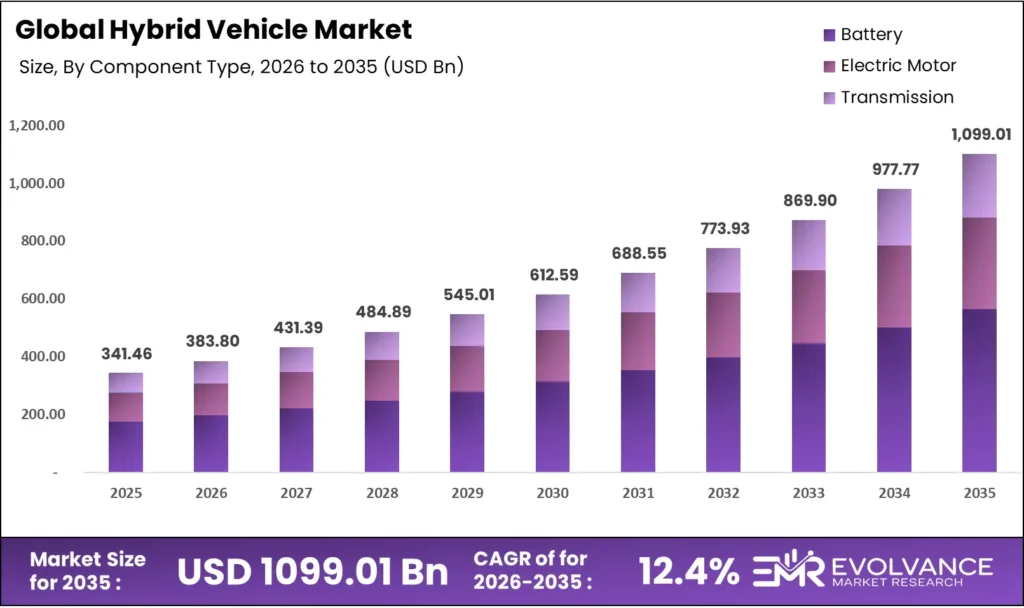
Global Hybrid Vehicle Market size is expected to be worth around USD 1099.01 Billion by 2035 from USD 341.46 Billion in 2025, growing at a CAGR of 12.4% during the forecast period 2026 to 2035. Rising fuel costs and strict emission rules push buyers toward hybrid cars that cut both fuel bills and carbon output. Urban growth and middle-class expansion across Asia drive demand for efficient and cost-smart transport options.
Key Takeaways
- Global Hybrid Vehicle Market size to reach USD 1099.01 Billion by 2035 at 12.4% CAGR
- Parallel Hybrid segment dominates with 70.3% market share in electric powertrain type
- Passenger Car segment leads vehicle type category with 89.2% share
- Asia Pacific region commands 45.6% market share valued at USD 155.67 Billion
- HEV propulsion type holds 79.5% share in hybrid propulsion segment
- Battery component captures 51.3% of component type segment
Market Overview
Hybrid vehicles combine internal combustion engines with electric motors to deliver better fuel economy and lower emissions than standard cars. These cars switch between power sources or use both at once to boost efficiency. Buyers now seek lower running costs amid rising urban fuel prices and tighter emission laws worldwide.
The market grows as cities expand and middle-class families buy more cars in Asia and Latin America. Governments offer tax breaks and rebates to make hybrids more attractive than pure gas models. Automakers respond by launching new hybrid SUVs and sedans that meet both city driving needs and highway range requirements.
Technology advances in battery life and energy recovery systems make hybrids more practical for daily use. Modern hybrid systems capture brake energy and store it for later use, cutting overall fuel consumption. This appeals to cost-conscious buyers who want green credentials without the range anxiety of pure electric cars.
Commercial fleets now adopt hybrids to cut operating costs while meeting corporate sustainability goals. Ride-hailing services particularly favor hybrids because they run all day and need good fuel economy. Fleet managers report lower maintenance costs compared to diesel vehicles over the same period.
Plug-in hybrid models gain traction among buyers who want electric-only range for short trips but need gas backup for longer journeys. These PHEVs bridge the gap between conventional hybrids and pure battery cars. Charging infrastructure growth in urban areas makes PHEVs more viable for apartment dwellers and office workers.
As reported by ACEA, hybrid-electric vehicles captured 34.5% of new car registrations in the European Union in 2025, making them the most popular powertrain type ahead of petrol and full BEVs. This marks a major shift in European buyer preferences toward electrified powertrains. Market leaders now prioritize hybrid models in their product portfolios to meet this surging demand.
According to S&P Global, the share of new vehicle registrations for hybrid vehicles in the United States increased from 3.1% in Q2 2020 to 16.3% in Q2 2025, showing nearly fivefold growth over five years. This rapid growth reflects changing American attitudes toward fuel efficiency and green technology. Dealers report strong hybrid inventory turnover compared to slower-moving conventional models.
Based on data from Deloitte, in the U.S., intention to purchase a hybrid vehicle rose to 26% of consumers, up 5 percentage points from the previous year, while EV purchase intent remained low at 5%. Buyers cite charging concerns and upfront costs as barriers to pure EVs but see hybrids as practical alternatives. Survey data confirms hybrids appeal to mainstream buyers who want gradual tech adoption without lifestyle disruption.
Electric Powertrain Type Analysis
Parallel Hybrid dominates with 70.3% due to simpler architecture and lower production costs.
In 2025, Parallel Hybrid held a dominant market position in the By Electric Powertrain Type segment of Hybrid Vehicle Market, with a 70.3% share. This setup allows both the engine and motor to drive wheels together or separately, giving flexible power delivery. Automakers prefer this design because it adapts easily to existing car platforms without major retooling. Buyers benefit from smooth power transitions and familiar driving feel compared to conventional cars.
Series Hybrid systems use the engine only to generate power for the electric motor that drives the wheels. This design suits city buses and delivery vans where stop-and-go driving benefits from instant electric torque. Commercial fleet operators choose series hybrids for predictable maintenance schedules and lower brake wear. The setup costs more upfront but delivers fuel savings in urban routes with frequent stops.
Component Type Analysis
Battery dominates with 51.3% due to critical role in energy storage and vehicle performance.
In 2025, Battery held a dominant market position in the By Component Type segment of Hybrid Vehicle Market, with a 51.3% share. Lithium-ion batteries store energy from regenerative braking and provide power for electric-only driving modes. Battery technology improvements directly impact hybrid range and efficiency, making it the most valuable component. Automakers invest heavily in better battery chemistry to extend life and reduce weight across model lineups.
Electric Motor converts stored battery power into mechanical energy to drive wheels or assist the combustion engine. Modern motors deliver instant torque for quick acceleration while maintaining compact size and light weight. Advances in permanent magnet motors improve efficiency and reduce rare earth material usage. Integration with transmission systems determines overall powertrain smoothness and driver satisfaction.
Transmission manages power flow between the engine, motor, and wheels to optimize fuel economy and performance. Hybrid transmissions use planetary gear sets or dual-clutch designs to blend power sources seamlessly. Sophisticated control software adjusts gear ratios based on driving conditions and battery charge levels. Quality transmission design separates premium hybrids from budget models in buyer perception and reliability.
Propulsion Analysis
HEV dominates with 79.5% due to no charging requirement and lower purchase price.
In 2025, HEV held a dominant market position in the By Propulsion segment of Hybrid Vehicle Market, with a 79.5% share. Standard hybrids charge their batteries only through regenerative braking and engine power, needing no external charging infrastructure. This convenience appeals to buyers who lack home charging or live in apartments without dedicated parking. HEVs cost less than plug-in models while still delivering significant fuel savings over conventional cars.
PHEV models add larger batteries and external charging capability for extended electric-only range up to 50 miles in most models. Buyers who can charge at home or work maximize fuel savings by running electric for daily commutes. Government incentives often favor PHEVs with tax credits and HOV lane access in congested urban areas. However, higher prices and charging needs limit adoption compared to standard hybrids in mass market segments.
NGV systems use natural gas as fuel combined with hybrid electric components for commercial applications. Transit agencies and waste management fleets adopt these for clean-burning fuel and lower emissions. Natural gas hybrids reduce urban air pollution while maintaining the range and refueling speed of conventional trucks. Limited fueling infrastructure restricts this propulsion type mainly to fleet applications with central refueling stations.
Degree of Hybridization Analysis
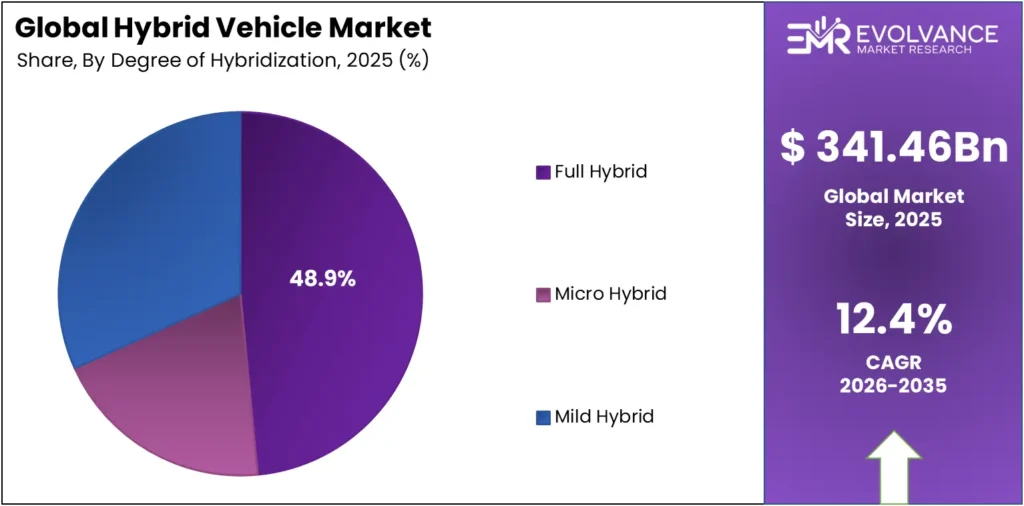
Full Hybrid dominates with 48.9% due to complete electric-only driving capability.
In 2025, Full Hybrid held a dominant market position in the By Degree of Hybridization segment of Hybrid Vehicle Market, with a 48.9% share. Full hybrids can run on engine alone, electric motor alone, or both together, giving maximum flexibility. This capability delivers the best fuel economy in mixed city and highway driving compared to other hybrid types. Buyers value the seamless power switching and electric-only mode for quiet neighborhood driving and parking lot crawling.
Micro Hybrid systems use simple start-stop technology to shut off the engine at traffic lights and restart instantly when needed. This basic setup costs less and adds minimal weight while cutting fuel use by roughly 5-10 percent in city driving. Budget-conscious automakers offer micro hybrids as entry-level efficiency upgrades across their compact car ranges. However, buyers seeking real hybrid performance typically skip this category for mild or full hybrid options.
Mild Hybrid adds a larger battery and motor-generator than micro systems but cannot drive on electric power alone. The electric motor assists the engine during acceleration and enables coasting with the engine off at highway speeds. Mild hybrids cost less than full hybrids while delivering about 70 percent of the fuel savings. European automakers favor this approach for diesel and gasoline models across midsize sedan and SUV segments.
Vehicle Type Analysis
Passenger Car dominates with 89.2% due to high consumer adoption and diverse model availability.
In 2025, Passenger Car held a dominant market position in the By Vehicle Type segment of Hybrid Vehicle Market, with an 89.2% share. Sedans, hatchbacks, and SUVs for personal use make up the vast majority of hybrid sales worldwide. Family buyers choose hybrid cars for daily commuting, school runs, and weekend trips with lower fuel costs. Automakers offer hybrid versions across their car lineups from compact to luxury segments to capture different buyer needs.
Commercial Vehicle hybrids include delivery vans, trucks, and buses that run in urban areas with frequent stops. Fleet operators adopt hybrids to cut diesel costs and meet city emissions rules that ban older trucks. Findings from S&P Global confirm hybrid commercial vehicle registrations soared from 13,000 to 163,000 units in the U.S. from 2019 to 2024, outpacing pure electric commercial registrations growth in the same period. Logistics companies report quick payback periods from fuel savings on high-mileage delivery routes.
Market Segments Covered in the Report
By Electric Powertrain Type
- Parallel Hybrid
- Series Hybrid
By Component Type
- Battery
- Electric Motor
- Transmission
By Propulsion
- HEV
- PHEV
- NGV
By Degree of Hybridization
- Full Hybrid
- Micro Hybrid
- Mild Hybrid
By Vehicle Type
- Passenger Car
- Commercial Vehicle
Hybrid Vehicle Market Regional Insights
Asia Pacific Dominates the Hybrid Vehicle Market with a Market Share of 45.6%, Valued at USD 155.67 Billion
Asia Pacific commands the hybrid vehicle market with a 45.6% share valued at USD 155.67 billion, driven by massive vehicle demand in China, Japan, and India. Japan pioneered hybrid technology and continues to lead in domestic hybrid adoption across all vehicle segments. China promotes hybrids as a bridge technology while building EV infrastructure, with local automakers launching competitive hybrid models. Rising middle-class income and urban congestion in India and Southeast Asia push buyers toward fuel-efficient hybrid options.
North America Hybrid Vehicle Market Trends
North America shows strong hybrid growth as American buyers shift toward fuel efficiency amid volatile gas prices. The United States leads regional sales with hybrid SUVs and trucks gaining traction among traditional pickup buyers. Canada follows similar patterns with cold-weather hybrid adoption increasing as battery technology improves winter performance. Automakers expand hybrid truck offerings to meet consumer demand for practical efficiency without compromising towing and payload capacity.
Europe Hybrid Vehicle Market Trends
Europe maintains the highest hybrid market penetration globally as strict CO2 regulations push automakers toward electrified powertrains. Germany, France, and the UK lead hybrid sales with strong government incentives and urban emission zones. Southern European markets favor smaller hybrid hatchbacks for city driving while northern countries prefer hybrid SUVs and crossovers. Brexit and regulatory changes create uncertainty but overall hybrid momentum continues upward across the continent.
Latin America Hybrid Vehicle Market Trends
Latin America experiences gradual hybrid adoption led by Brazil and Mexico where fuel price volatility drives efficiency concerns. Import duties and limited local production keep hybrid prices high compared to conventional cars in most markets. Brazil’s flex-fuel hybrid models gain interest by combining ethanol capability with electric assist for unique efficiency. Mexican production bases serve North American hybrid demand while slowly building domestic market awareness and charging infrastructure.
Middle East & Africa Hybrid Vehicle Market Trends
Middle East & Africa shows emerging hybrid interest primarily in Gulf nations and South Africa where affluent buyers seek premium models. Low fuel prices in oil-producing countries reduce hybrid economic appeal but environmental awareness slowly grows among younger buyers. South Africa leads the region with hybrid imports and some local assembly of global hybrid models. Infrastructure challenges and spare parts availability limit hybrid expansion beyond major urban centers across the region.
Key Regions and Countries
North America
- US
- Canada
Europe
- Germany
- France
- The UK
- Spain
- Italy
- Rest of Europe
Asia Pacific
- China
- Japan
- South Korea
- India
- Australia
- Rest of APAC
Latin America
- Brazil
- Mexico
- Rest of Latin America
Middle East & Africa
- GCC
- South Africa
- Rest of MEA
Regulatory Landscape
Global emission standards tighten across major markets between 2024 and 2026, pushing automakers toward hybrid and electric portfolios. The European Union enforces stricter CO2 targets requiring automakers to cut fleet emissions or face heavy fines starting in 2025. This regulation directly accelerates hybrid model launches across European markets as manufacturers seek compliance without full BEV transitions. Similar standards roll out in California and China, creating global momentum toward electrified powertrains.
Government incentive programs in key markets provide tax credits and rebates for hybrid vehicle purchases through 2026. The United States extends federal tax credits for plug-in hybrids while several states add their own purchase rebates and HOV lane access. Japan maintains hybrid subsidies as part of its green vehicle promotion strategy to support domestic automakers. These financial incentives reduce the price gap between hybrids and conventional cars, making them more accessible to mainstream buyers.
Hybrid Vehicle Market Dynamics
Drivers
Escalating Urban Fuel Costs Accelerating Consumer Shift Toward Fuel-Efficient Powertrains
Rising fuel prices in major cities worldwide push buyers toward hybrids that cut daily commuting costs by 30-50 percent. Urban drivers face stop-and-go traffic where hybrid systems capture brake energy and reduce fuel waste significantly. Middle-class families calculate total ownership costs and choose hybrids over conventional cars despite higher purchase prices. Fuel savings compound over vehicle lifetime, making hybrids attractive for high-mileage drivers and fleet operators.
Stringent emission rules across Europe, China, and North America force automakers to expand hybrid offerings or face regulatory penalties. Manufacturers invest billions in hybrid technology to meet fleet-wide CO2 targets set by government agencies. Cities implement low-emission zones that restrict conventional vehicles but allow hybrids, creating practical buying incentives. Automakers now position hybrids as core products rather than niche offerings to satisfy both regulators and consumers.
Government subsidies, tax credits, and purchase rebates reduce the upfront cost barrier that previously limited hybrid adoption. Federal and state programs in the U.S. offer up to several thousand dollars in combined incentives for hybrid buyers. Asian governments provide reduced registration fees and parking privileges for hybrid owners in congested urban areas. These financial benefits narrow the price gap between hybrids and conventional models, accelerating mainstream market penetration.
Restraints
Higher Upfront Purchase Prices Compared to Conventional Internal Combustion Vehicles
Hybrid vehicles typically cost $3,000 to $8,000 more than equivalent conventional models, creating a barrier for budget-conscious buyers. Complex powertrain components including batteries, motors, and control systems add to production costs that manufacturers pass to consumers. Many buyers focus on sticker price rather than long-term fuel savings, choosing cheaper conventional alternatives. This price sensitivity particularly affects emerging markets where disposable income remains limited despite growing middle classes.
Limited consumer awareness in developing markets about hybrid technology benefits and total ownership costs slows adoption rates. Many buyers lack understanding of how hybrid systems work and question reliability compared to proven conventional engines. Dealer staff often receive inadequate training to explain hybrid advantages and address customer concerns effectively. Media coverage in emerging markets focuses more on pure electric vehicles, leaving hybrids poorly understood by potential buyers.
Service network gaps in smaller cities and rural areas create perceived risk about hybrid maintenance and repair capabilities. Buyers worry about finding qualified technicians and affordable replacement parts for complex hybrid components outside major urban centers. Battery replacement costs, though rare, receive outsized attention and create hesitation among first-time hybrid buyers. These concerns persist despite improving hybrid reliability and longer warranty coverage from major automakers.
Growth Factors
Technological Advancements Accelerate Market Expansion
Battery technology improvements deliver longer life, better cold-weather performance, and reduced costs that make hybrids more practical. New lithium-ion chemistries extend battery durability beyond 10 years while cutting replacement costs by roughly 40 percent. Energy density gains allow automakers to increase electric-only range without adding vehicle weight or reducing cargo space. These advances address earlier buyer concerns about hybrid longevity and total ownership costs over extended periods.
Commercial fleet operators and ride-hailing services increasingly adopt hybrids to cut operating costs while meeting sustainability commitments. Taxi and rideshare drivers report fuel cost reductions of 40-60 percent compared to conventional cars on similar routes. Corporate fleets purchase hybrid SUVs and sedans to lower carbon footprints without sacrificing employee comfort or vehicle capability. Fleet managers value predictable maintenance costs and strong resale values that hybrids now demonstrate in secondary markets.
Growing demand for hybrid SUVs and crossovers matches consumer preferences for higher driving positions and cargo versatility. Automakers launch hybrid versions of popular SUV nameplates to capture buyers who want efficiency without sedan compromises. Urban and suburban families choose hybrid crossovers for school runs, shopping, and weekend trips with excellent fuel economy. This segment growth expands the hybrid market beyond traditional sedan buyers into mainstream family vehicle categories.
Emerging Trends
Digital Transformation Reshapes Market Landscape
Integration of AI-based energy management systems optimizes hybrid powertrain efficiency by predicting driving patterns and route conditions. Advanced software analyzes GPS data, traffic patterns, and driving history to decide optimal power source switching points. These smart systems learn individual driver habits and adjust energy usage to maximize fuel economy automatically. Premium hybrid models showcase this technology as a key differentiator from conventional and budget hybrid alternatives.
Shift toward plug-in hybrid electric vehicles accelerates as buyers seek extended electric-only range for daily commutes. PHEVs offer 30-50 miles of zero-emission driving that covers most urban trips while retaining gas backup for longer journeys. Charging infrastructure expansion in residential areas and workplaces makes PHEVs practical for apartment dwellers and office workers. Automakers position PHEVs as the optimal bridge between conventional hybrids and pure battery electric vehicles for hesitant buyers.
Lightweight material adoption including aluminum, carbon fiber, and advanced high-strength steel improves hybrid efficiency and performance. Reducing vehicle weight by 100-200 pounds directly enhances both electric range and overall fuel economy across all driving conditions. Engineers focus on structural optimization to maintain crash safety while cutting mass from body panels and chassis components. Material advances allow hybrids to achieve better efficiency without downsizing engines or compromising interior space and comfort features.
Hybrid Vehicle Market Key Companies Insights
Toyota Motor Corporation leads the global hybrid market with decades of experience and the best-selling Prius and RAV4 Hybrid models. The company pioneered mass-market hybrid technology and continues innovating with new battery chemistry and motor designs. Toyota’s global production network delivers hybrids across all major markets with strong brand recognition and reliability reputation. In May 2025, Toyota unveiled its all-new sixth-generation RAV4 with hybrid and plug-in hybrid drivetrain options globally.
Honda Motor Co., Ltd. expands its hybrid portfolio across sedan, SUV, and crossover segments with advanced two-motor hybrid systems. The company announced in December 2024 a major strategic shift to double annual global hybrid sales to 1.3 million units by 2030. Honda’s i-MMD hybrid technology delivers strong performance and efficiency without the complexity of planetary gear systems. The brand targets mainstream buyers seeking reliable hybrid options with competitive pricing and dealer network support.
Hyundai Motor Group rapidly grows its hybrid lineup with models spanning budget to luxury segments under Hyundai, Kia, and Genesis brands. The group invests heavily in dedicated hybrid platforms and battery technology to compete with established Japanese hybrid leaders. Kia announced in March 2025 it will begin producing hybrid cars at Hyundai’s U.S. Georgia factory starting mid-2026. Strong warranty coverage and aggressive pricing help the group gain hybrid market share in North America and Europe.
Ford Motor Company pivots toward hybrid trucks and SUVs after reassessing its electric vehicle strategy in late 2025. The company discontinued the all-electric F-150 Lightning in December 2025 while focusing resources on hybrid powertrain development. Ford’s hybrid F-150 and Explorer models appeal to American buyers seeking familiar vehicles with better fuel economy. The automaker leverages its truck expertise and dealer network to position hybrids as practical upgrades from conventional models.
Key Companies
- Toyota Motor Corporation
- Honda Motor Co., Ltd.
- Hyundai Motor Group
- Ford Motor Company
- General Motors
- Volkswagen Group
- BMW Group
- Mercedes-Benz Group AG
- Stellantis N.V.
- Nissan Motor Corporation
- Kia Corporation
- BYD Company Limited
- Renault Group
- Mazda Motor Corporation
- Subaru Corporation
Recent Development
- December 2025 – Toyota officially launched the new RAV4 in Japan with hybrid and plug-in hybrid options, reinforcing its commitment to hybrid electrification as part of its core SUV lineup strategy and global market leadership position.
- August 2025 – Dongfeng Motor’s sub-brand M-Hero launched the M817 plug-in hybrid electric off-road SUV, marking a notable new hybrid model entry in the premium SUV segment targeting Chinese luxury buyers.
- March 2025 – Kia Corp announced it will begin producing hybrid cars at Hyundai Motor’s U.S. Georgia factory starting mid-2026 to meet rising U.S. hybrid demand and broaden its electrified powertrain offerings across North America.
- January 2026 – China’s BYD and ExxonMobil expanded their hybrid technology partnership via a long-term Memorandum of Understanding for joint R&D and new material applications to advance battery and powertrain efficiency globally.
- December 2025 – Ford confirmed a major strategic shift focusing more on hybrid trucks while discontinuing the all-electric F-150 Lightning, signaling significant investment realignment toward hybrid powertrain development for commercial and consumer markets.
Market Scope
| Report Features | Description |
|---|---|
| Market Value (2025) | USD 341.46 Billion |
| Forecast Revenue (2035) | USD 1099.01 Billion |
| CAGR (2026-2035) | 12.4% |
| Base Year for Estimation | 2025 |
| Historic Period | 2020-2024 |
| Forecast Period | 2026-2035 |
| Report Coverage | Revenue Forecast, Market Dynamics, Competitive Landscape, Recent Developments |
| Segments Covered | By Electric Powertrain Type (Parallel Hybrid, Series Hybrid), By Component Type (Battery, Electric Motor, Transmission), By Propulsion (HEV, PHEV, NGV), By Degree of Hybridization (Full Hybrid, Micro Hybrid, Mild Hybrid), By Vehicle Type (Passenger Car, Commercial Vehicle) |
| Regional Analysis | North America (US and Canada), Europe (Germany, France, The UK, Spain, Italy, and Rest of Europe), Asia Pacific (China, Japan, South Korea, India, Australia, and Rest of APAC), Latin America (Brazil, Mexico, and Rest of Latin America), Middle East & Africa (GCC, South Africa, and Rest of MEA) |
| Competitive Landscape | Toyota Motor Corporation, Honda Motor Co., Ltd., Hyundai Motor Group, Ford Motor Company, General Motors, Volkswagen Group, BMW Group, Mercedes-Benz Group AG, Stellantis N.V., Nissan Motor Corporation, Kia Corporation, BYD Company Limited, Renault Group, Mazda Motor Corporation, Subaru Corporation |
| Customization Scope | Customization for segments, region/country-level will be provided. Moreover, additional customization can be done based on the requirements. |
| Purchase Options | We have three licenses to opt for: Single User License, Multi-User License (Up to 5 Users), Corporate Use License (Unlimited User and Printable PDF) |