
What is Creator Economy Market Size?
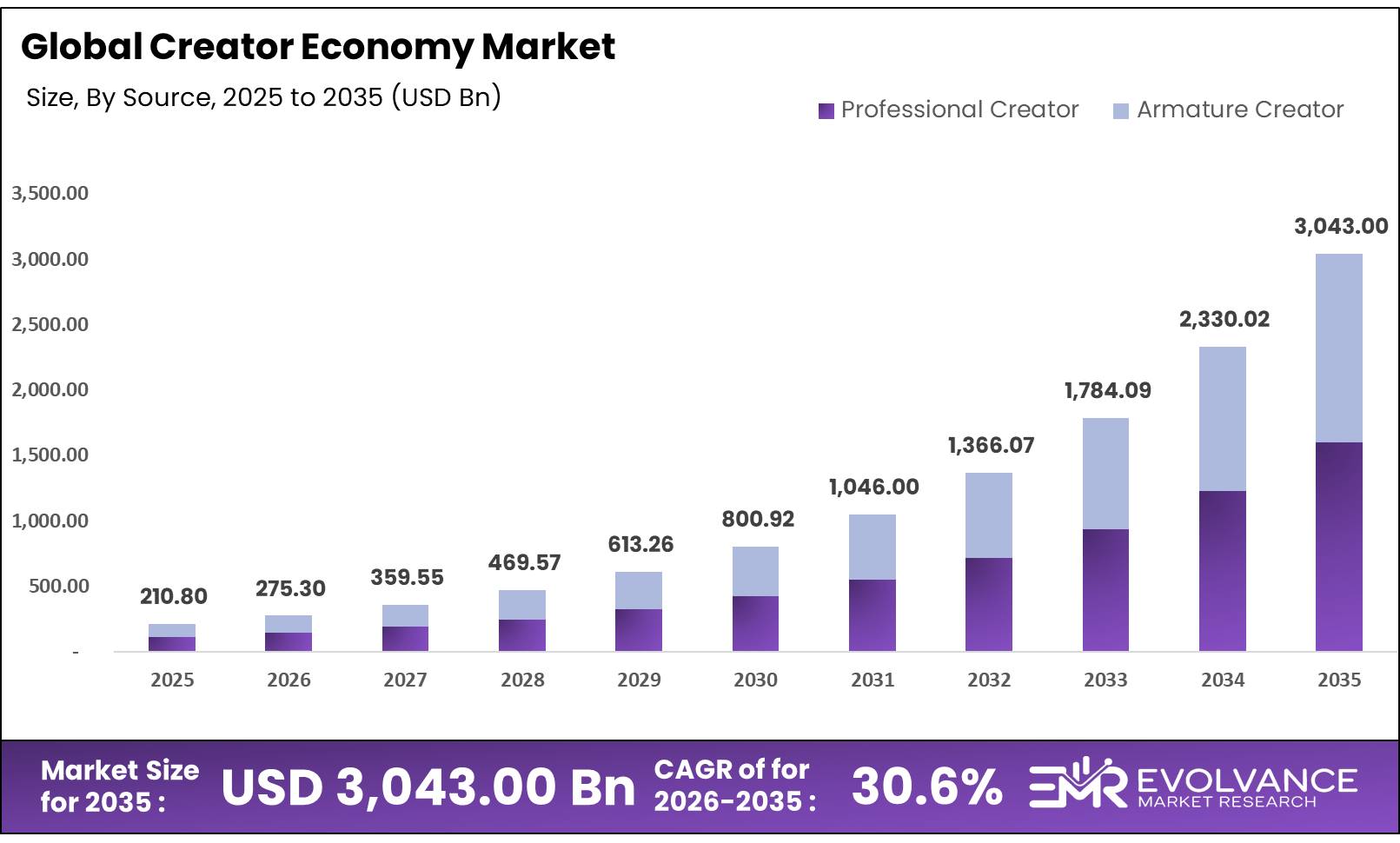
The Global Creator Economy Market size is calculated at USD 210.80 billion in 2025 and is predicted to increase from USD 275.30 billion in 2026 to approximately USD 3,043.00 billion by 2035, expanding at a CAGR of 30.6% from 2026 to 2035. The Creator Economy has become one of the fastest-growing business ecosystems in the digital world. It includes everyone who builds an audience online — influencers, digital entrepreneurs, streamers, educators, and independent creatives — along with the platforms and tools that help them earn revenue.
The Creator Economy Market is growing rapidly as individuals leverage digital platforms to produce and monetize content across multiple channels. The expansion of subscription-based models and community-driven platforms is strengthening revenue opportunities. This market is closely linked with the Content Creator Economy, as well as enabling technologies in the AI Podcast Creation Platforms and Digital Comics. Additionally, the use of automation tools from the Agentic AI for Customer Support Automation is supporting scalable creator engagement.
Market Highlights
- By region, North America dominated the market, holding largest share of 38.5% in the market during 2025.
- By region, Asia Pacific is expected to expand at the fastest CAGR of 36.8% between 2026 and 2035.
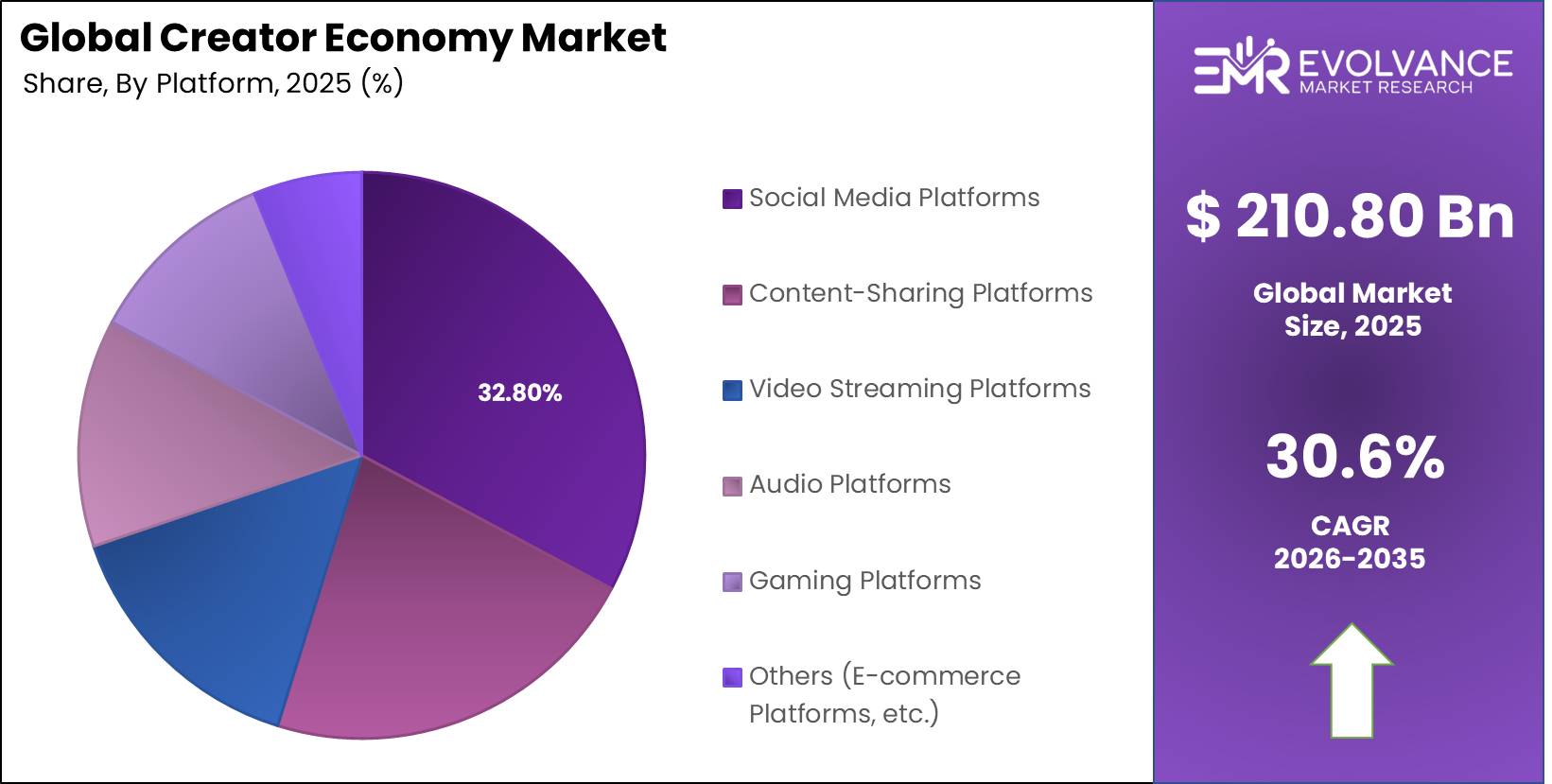
- By Platform, the Social Media Platforms segment contributed the biggest market share of 32.8% in 2025.
- By Platform, Video Streaming Platforms is expected to grow at a remarkable CAGR of 34.5% between 2025 and 2035.
- By Content Type, Video content segment held the major market share of 28.5% in 2025.
- By Content Type, Music content is projected to grow at a remarkable CAGR of 32.2% between 2025 and 2035.
- By Monetization Method, the Advertising Revenue segment captured the highest market share of 25.6% in 2025.
- By Monetization Method, the Brand Collaborations segment is growing at a remarkable CAGR of 35.4% between 2025 and 2035.
- By End User, the Armature Creator segment held the largest market share of 66.7% in 2025.
- By End User, Professional Creator segment is expanding at a strong of 34.6% CAGR between 2025 and 2035.
Statistical Data of Creator Economy
1. Social Media Giants and Core Video Platforms
- Alphabet’s YouTube segment generated 31.51 billion dollars in 2023, reflecting the direct monetization capacity of video producers within the Creator Economy market.
- Alphabet reported that its YouTube Partner Program paid out 70 billion dollars to content producers over 3 years up to early 2024, demonstrating the massive financial scale of revenue sharing in the Creator Economy market.
- Alphabet’s YouTube Shorts achieved an average of 70 billion daily views in 2024, driving significant engagement and new monetization pathways for short-form video participants in the Creator Economy market.
- Alphabet announced that YouTube Premium and Music surpassed 100 million subscribers in 2024, providing a stable secondary income stream for channel operators in the Creator Economy market outside of traditional ads.
- Meta Platforms announced that Instagram reached 2 million active creator subscriptions globally in 2024, showing a shift toward direct fan support mechanisms within the Creator Economy market.
- Meta Platforms reported that its Reels product reached a 10 billion dollar annualized revenue run rate in 2023, heavily driven by influencer content consumption in the Creator Economy market.
- Meta Platforms distributed over 2 billion dollars to digital producers through its various bonus programs between 2021 and 2023, an initiative designed to retain top talent within the competitive Creator Economy market.
- Meta Platforms disclosed that Threads reached 150 million monthly active users in 2024, opening a rapidly growing text-based engagement channel for influencers expanding their presence in the Creator Economy market.
- ByteDance reported that TikTok Shop reached a gross merchandise value of 20 billion dollars in Southeast Asia in 2023, largely fueled by affiliate marketing commissions within the regional Creator Economy market.
- ByteDance generated over 3.8 billion dollars in consumer spending through tips and digital coins on TikTok in 2023, highlighting micro-transaction growth in the mobile Creator Economy market.
- ByteDance’s Creator Rewards Program increased average ad revenue share by 250 percent for eligible video producers during its beta testing phase in 2024, improving monetization equity in the Creator Economy market.
- ByteDance reported that its TikTok platform reached 1.5 billion monthly active users in 2024, providing a massive global audience base for short-form video professionals in the Creator Economy market.
2. Specialized Content, Audio, and Gaming Platforms
- Patreon reported that its independent creators have earned over 3.5 billion dollars collectively since the platform’s inception up to 2023, proving the viability of the membership model in the Creator Economy market.
- Patreon hosts over 250,000 active creators earning monthly recurring revenue as of 2024, underscoring the platform’s role as a primary income stabilizer in the Creator Economy market.
- Patreon’s company valuation was adjusted to 1.5 billion dollars in secondary markets in 2023, reflecting investor recalibration of specialized tech platforms operating within the Creator Economy market.
- Roblox Corporation paid out over 741 million dollars to its community of game developers and asset designers in 2023, highlighting the expanding definition of interactive digital goods in the Creator Economy market.
- Roblox Corporation supports over 5 million active creators who develop virtual experiences and digital items as of 2024, representing a major labor segment within the metaverse-oriented Creator Economy market.
- Spotify paid out 9 billion dollars to the music industry and independent audio creators in 2023, representing a significant revenue distribution mechanism within the audio segment of the Creator Economy market.
- Spotify reported that over 250,000 video podcasts were published on its platform by 2024, indicating a major behavioral shift toward multi-format content distribution in the audio Creator Economy market.
- Amazon’s Twitch division paid out over 1 billion dollars to live-streaming creators in 2023, serving as the primary financial engine for the gaming and real-time broadcast sector of the Creator Economy market.
- Amazon reported that Twitch has over 1.3 million active affiliate creators earning revenue from subscriptions and bits as of 2024, showcasing broad monetization access in the live-streaming Creator Economy market.
- Substack writers generated over 300 million dollars in cumulative subscription revenue by the end of 2023, demonstrating the strong demand for premium written content in the newsletter Creator Economy market.
3. North American and European Market Dynamics
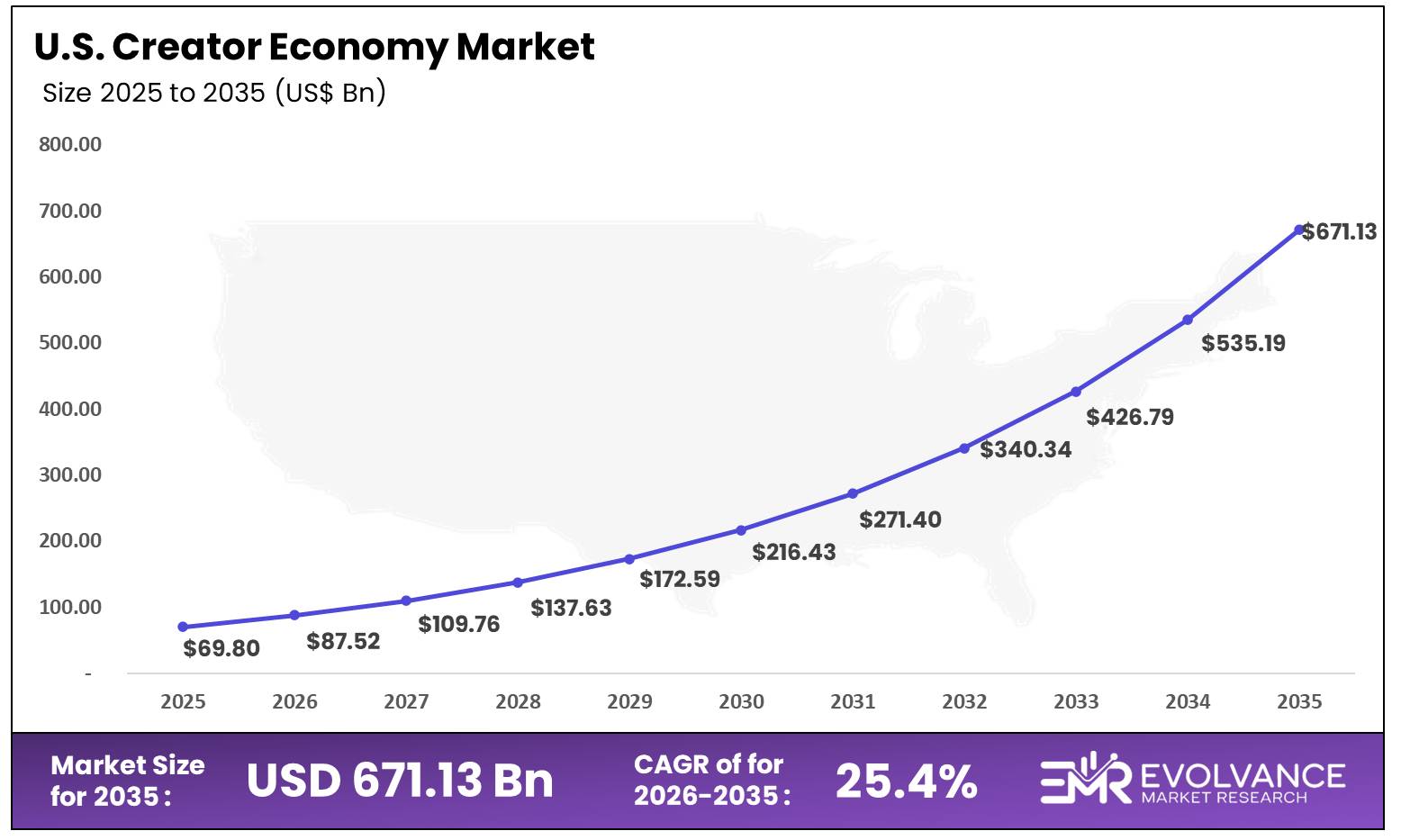
- The United States domestic Creator Economy market size was valued at 69.80 billion dollars in 2025, representing the largest single-country concentration of digital monetization platforms and influencer marketing spend.
- Over 8 million Americans earned direct income from digital platform monetization and brand deals in 2024, forming a significant independent labor force within the United States Creator Economy market.
- Canadian digital creators utilizing the YouTube platform generated over 1.2 billion Canadian dollars in gross economic activity in 2023, underscoring the cross-border revenue potential of the Creator Economy market.
- The North American regional Creator Economy market size reached an estimated 45 billion dollars in 2023, making it the most mature and highly monetized geographic zone globally for independent digital producers.
- Creator brand sponsorships in the North American region totaled 6.2 billion dollars in 2023, serving as the primary commercial engine supporting full-time professionals in the Creator Economy market.
- The United Kingdom Creator Economy market size reached 3.1 billion pounds in 2023, driven by a surge in digital advertising spend allocated specifically to domestic social media influencers.
- United Kingdom independent podcast creators generated 45 million pounds in dedicated audio advertising revenue in 2023, showcasing the rapid professionalization of niche audio channels in the Creator Economy market.
- The French domestic influencer marketing sector reached a valuation of 400 million euros in 2023, spurred by luxury and fashion brands increasing their budget allocation toward the Creator Economy market.
- Germany’s digital creator advertising share accounted for 850 million euros of total national marketing budgets in 2023, reflecting growing corporate trust in the German Creator Economy market.
- The European regional Creator Economy generated 14 billion euros in total platform and sponsorship revenue in 2023, despite strict new data privacy and advertising compliance regulations across member states.
- European influencer agencies formally represented over 150,000 professional creators as of 2024, indicating the rapid institutionalization and structured talent management occurring within the regional Creator Economy market.
4. APAC, Latin American, and Emerging Market Growth
- The Asia-Pacific regional Creator Economy was valued at 22 billion dollars in 2023, driven primarily by mobile-first digital adoption and the massive scale of domestic creator platforms in China and India.
- Live commerce events hosted by digital creators across the Asia-Pacific region reached 400 billion dollars in gross merchandise value in 2023, proving that influencer-led sales are the dominant retail trend in the APAC Creator Economy market.
- The Indian Creator Economy market is projected to reach a value of 1.2 billion dollars in 2024, fueled by high smartphone penetration and rapidly expanding regional language content consumption.
- India supports over 80 million content creators and digital knowledge professionals active on social platforms as of 2023, making it the largest volume driver of new participants in the global Creator Economy market.
- Japan’s virtual creator and VTuber sector reached a market size of 80 billion yen in 2023, establishing a highly lucrative and unique technological segment within the broader Asian Creator Economy market.
- Japanese independent anime and manga digital creators generated 2.1 billion dollars in global direct-to-consumer sales in 2023, utilizing international fan funding platforms to bypass traditional publishers in the Creator Economy market.
- South Korea’s Creator Economy generated 2.5 trillion won in platform and sponsorship revenue in 2023, driven heavily by exportable beauty, gaming, and lifestyle content formats.
- South Korean independent webtoon creators generated over 1.2 billion dollars in platform revenue sharing in 2023, cementing digital comics as a cornerstone export of the regional Creator Economy market.
- The Australian Creator Economy contributed 700 million Australian dollars to the local economy in 2023, supported by government grants for digital arts and increased local brand sponsorships.
- The Latin American regional Creator Economy reached a market value of 7 billion dollars in 2023, characterized by extremely high daily social media engagement rates that favor independent video producers.
- Social commerce adoption driven specifically by influencers in Latin America grew by 35 percent to reach 3.5 billion dollars in 2023, showcasing the conversion power of trust-based marketing in the Creator Economy market.
- Brazil’s domestic influencer marketing spend reached 4.5 billion dollars in 2023, reflecting the cultural dominance of social media personalities driving consumer purchases in the Latin American Creator Economy market.
- Over 500,000 citizens in Brazil consider digital content creation their primary, full-time source of income in 2024, highlighting the structural shift toward independent digital labor in the Creator Economy market.
- The Middle East and Africa regional Creator Economy market size reached 2.5 billion dollars in 2023, fueled by a young demographic profile and rapid smartphone penetration in emerging urban centers.
- Dedicated influencer marketing spend in the Middle East and North Africa region surpassed 1 billion dollars in 2023, as localized brands shifted budgets away from traditional television toward the Creator Economy market.
5. Creator Demographics, Labor Economics, and Wellbeing
- Over 50 million people globally identified themselves as active content creators who publish monetizable digital goods as of 2023, establishing the baseline participation rate of the global Creator Economy market.
- Only 4 percent of the global creator workforce considers content production their full-time profession in 2024, highlighting the severe income concentration and part-time nature of labor in the Creator Economy market.
- Approximately 4 percent of monetized global creators earn more than 100,000 dollars annually as of 2023, demonstrating the steep power-law curve regarding financial success within the Creator Economy market.
- A workforce survey indicated that 68 percent of video professionals cite YouTube as their primary, most reliable source of monetization in 2024, solidifying its infrastructure dominance in the Creator Economy market.
- Demographic analysis shows that 58 percent of full-time digital creators globally are between the ages of 18 and 34 as of 2024, confirming the millennial and Gen Z skew of the labor force in the Creator Economy market.
- Female content creators accounted for 65 percent of total brand sponsorship and influencer marketing revenue globally in 2023, highlighting the distinct gender economics at play within the Creator Economy market.
- A mental health survey found that 65 percent of full-time digital producers reported experiencing severe professional burnout in 2023 due to unpredictable platform algorithm changes inherent to the Creator Economy market.
6. Consumer Behavior, Technology, and Industry Maturation
- A consumer behavior survey found that 44 percent of Gen Z shoppers purchased a specific product because it was recommended by a digital creator in 2023, proving the immense retail influence of the Creator Economy market.
- 61 percent of global consumers reported trusting creator recommendations over traditional celebrity endorsements in a 2023 survey, reflecting a massive shift in marketing psychology that fuels the Creator Economy market.
- Short-form video creators experienced a 2.5 times higher average user engagement rate compared to those posting static image content in 2023, dictating production behavior shifts across the Creator Economy market.
- The average digital media user spent 2.5 hours daily consuming creator-led content on social platforms in 2023, providing the massive attention inventory required to sustain advertising in the Creator Economy market.
- 70 percent of YouTube viewers stated in a 2024 survey that they feel a stronger parasocial connection to micro-creators with under 100,000 subscribers than to macro-influencers, driving niche community value in the Creator Economy market.
- 55 percent of digital content creators reported adopting generative AI tools for scriptwriting, editing, or ideation in 2024, marking a rapid technological penetration rate that is increasing production efficiency in the Creator Economy market.
- Regulatory compliance data showed that 72 percent of sponsored posts globally successfully included required #ad or sponsored tags in 2024, reflecting increasing legal maturity and safety standards within the Creator Economy market.
- 35 percent of all venture capital funding deployed in the consumer media sector in 2023 was directed specifically toward startups building tools for the Creator Economy market, despite broader macroeconomic tightening.
U.S. Creator Economy Market Size and Growth 2025 to 2035
The U.S. Creator Economy Market size is exhibited at USD 69.80 billion in 2025 and is projected to be worth around USD 671.13 billion by 2035, growing at a CAGR of 25.4% from 2026 to 2035. U.S. creator economy growth is driven by social media reach, short video demand, brand shift to influencer marketing, easy monetization tools, mobile-first audiences, data-driven ads, niche communities, and trust in authentic voices.
Market Size and Forecast
- Market Size in 2025: USD 190.26 Billion
- Market Size in 2026: USD 248.48 Billion
- Forecasted Market Size by 2034: USD 2,102.98 Billion
- CAGR (2026-2035): 30.6%
- Largest Market in 2025: North America
- Fastest Growing Market: Asia Pacific
What Is the Creator Economy?
The creator economy is a fast-growing digital ecosystem where individuals build brands, share content, and earn money directly from their audience. Unlike the traditional media model—where only large companies-controlled production and distribution—today creators can use platforms like YouTube, Instagram, TikTok, LinkedIn, and podcasts to reach millions without needing big studios or agencies.
At its core, the creator economy is powered by people who use their skills, personality, or expertise to attract a community. These creators then monetize through several channels such as advertising, brand deals, digital products, subscription content, affiliate marketing, and even their own businesses.
What makes this economy unique is that trust and authenticity are its main currencies. Audiences increasingly prefer real-world voices over scripted, celebrity-driven content. As a result, creators are becoming powerful partners for brands and a major influence on consumer decision-making. The creator economy also involves a wide network of +3 agencies, editing tools, and marketplaces for digital products. Together, they help creators scale their work into sustainable careers.
In simple terms, the creator economy transforms everyday people into entrepreneurs by giving them the tools and platforms to create, connect, and earn. It is reshaping how content is produced, how brands communicate, and how audiences consume Information.
Platform Insights
Why Social Media Platforms Is Dominating the Creator Economy Market?
The Social Media Platforms is dominating the Creator Economy market by holding a share of 32.8%, as they act as the primary discovery engine, audience hub, and monetization gateway for creators worldwide. Platforms like Instagram, YouTube, TikTok, and Facebook form the digital infrastructure where creators build communities, distribute content instantly, and interact directly with followers. Their dominance comes from massive user bases, easy-to-use tools, and algorithm-driven visibility that enable creators to scale quickly.
The sector’s leadership is not just due to its large audience volume but its strategic role in shaping creator visibility and engagement. Social platforms serve as the first touchpoint where creators establish identity, credibility, and audience trust. Features such as short videos, reels, live streaming, branded content tags, and integrated shopping tools turn these platforms into high-conversion ecosystems. As user-generated content consumption grows, platforms continue investing in AI-driven feeds, creator funds, and monetization pathways. This positions social media as the operational backbone of the creator economy — accessible, scalable, and indispensable.
The Video streaming platforms is the fastest-growing in the Creator Economy market and are expected to grow at a 34.5% CAGR. This growth is driven by rising demand for long-form content, premium video quality, audience loyalty, and subscription-led revenue models. Unlike short social videos, streaming platforms offer creators deeper engagement, higher watch time, and diversified income streams like paid memberships, ads, tipping, and exclusive content.
The segment’s rapid expansion comes from the shift toward immersive, community-driven, and monetizable video experiences. With improvements in broadband, 5G penetration, and low-latency streaming, creators can now host live shows, gaming streams, webinars, and long-format storytelling without technological barriers. Video-first consumption is becoming a global norm, and streaming platforms are evolving into digital studios empowering creators with advanced analytics, editing suites, and monetization dashboards.
Content Type Insights
Why the Video Content Is Dominating the Creator Economy Market?
The Video Content is dominating the Creator Economy market by holding a share of 28.5%, driven by its unmatched ability to deliver high-impact engagement, visual storytelling, and audience retention. Short-form videos, livestreams, product demos, vlogs, and educational content have become the backbone of creator monetization across YouTube, TikTok, Instagram Reels, and streaming platforms. As platforms aggressively invest in video-first algorithms, creators benefit from higher visibility, stronger audience emotionally connection, and better monetization opportunities. The dominance of video stems from its ability to convert casual viewers into loyal followers faster than any other format, making it the centrepiece of the digital content ecosystem.
The segment’s leadership is not just due to its popularity but its strategic value. Brands prioritize video for influencer campaigns, performance marketing, and storytelling because it communicates authenticity and drives measurable business outcomes. Features such as shoppable videos, live commerce, Super Chats, paid subscriptions, and ad-based revenue models have strengthened video’s position as the most profitable content category. With rising smartphone penetration, 5G expansion, and on-the-go consumption trends, video remains the core engine powering creator engagement, audience expansion, and revenue streams. Its dominance reflects a long-term structural shift toward immersive, visual-first digital experiences.
The Music Content is are fastest growing in the Creator Economy market with an expected CAGR of 32.2%. This surge is fuelled by the rapid integration of music into short-form video apps, gaming platforms, digital concerts, virtual events, and creator-led music remixes. Independent artists, DJs, and music creators now leverage platforms like Spotify, YouTube Music, TikTok, and SoundCloud to distribute music globally without traditional record label dependency. AI-assisted music creation tools, royalty-free sound libraries, and creator-friendly licensing frameworks are accelerating adoption across sectors.
The segment’s rapid growth is driven by rising demand for micro-music formats — hooks, beats, samples, and background scores — that power millions of daily videos online. Music has evolved into an asset class that enables creators to monetize across streaming royalties, brand partnerships, sync licensing, live performances, and fan-funded platforms. As virtual reality concerts, AI-generated soundtracks, and interactive music experiences become mainstream, music content is set to outpace other segments in innovation and revenue potential. The next decade will see music transform from a supporting element to a standalone creator ecosystem fuelled by creativity, technology, and global digital distribution.
Monetization Method Insights
Why Advertising Revenue Is Dominating the Creator Economy Market?
Advertising Revenue is dominating the Creator Economy market by holding a share of 25.6%, driven by the massive dependence of creators and platforms on ad-based monetization. Most digital platforms—including YouTube, Instagram, Facebook, TikTok, and Snapchat—operate on advertising-first models where brands fund creator payouts through video ads, sponsored placements, and in-feed promotions.
The explosive rise of short-form content has accelerated ad inventory expansion, enabling platforms to scale monetization rapidly. With billions of users consuming content daily, advertisers view creator-driven content as a high-ROI channel due to its superior engagement and precision targeting.
The dominance of advertising revenue is not simply due to its scale but its structural advantage. Advertising acts as the default monetization layer for creators, especially those in early and mid-growth stages, enabling earnings without subscription barriers. As platform algorithms evolve, ad formats—such as shoppable ads, performance ads, and contextual video ads—are becoming smarter, increasing both impressions and conversion rates.
Brands are diverting budgets away from traditional media and allocating higher spends to creator-led campaigns that deliver authenticity, traceability, and audience trust. With rising digital video consumption and increasing platform investments in AI-driven ad optimization, advertising revenue remains the powerhouse of the creator economy—predictable, scalable, and continually expanding.
The Brand Collaborations are the fastest growing in the Creator Economy market with an expected growth rate of 35.4%. The surge is driven by brands increasingly preferring creators over traditional celebrity endorsements due to better relatability, niche audience targeting, and measurable ROI. Sponsored content, brand ambassadorships, product placements, and affiliate partnerships have evolved into strategic, long-term collaborations where creators shape consumer perception more authentically than traditional ads.
The segment’s rapid growth is fuelled by the shift toward performance-based influencer marketing, where brands reward creators based on engagement, clicks, conversions, and sales impact. Additionally, micro and nano creators—known for their high trust communities—are attracting significant brand budgets, widening the scope of collaborations across industries such as beauty, fintech, gaming, fitness, and consumer electronics. As brands adopt data-driven creator selection tools and AI-powered influencer analytics, partnerships are becoming more customized, transparent, and outcome-focused.
The coming years will witness a transition from one-time sponsorships to structured creator-brand ecosystems, where creators co-develop products, participate in marketing strategy, and even act as long-term strategic partners. This evolution positions brand collaborations as the fastest-growing monetization method, reflecting a market shift toward value-driven, measurable, and high-impact content partnerships.
End User Insights
Why Are Armature Creator Dominating the Creator Economy Market?
The Armature Creator is dominating the Creator Economy market by holding a share of 66.7%, driven by the explosive rise of accessible creation tools, low entry barriers, and platform-led monetization programs. These creators—everyday individuals producing content from smartphones, basic editing apps, and social platforms—form the widest base of the ecosystem. Their dominance stems from volume, diversity, and authentic engagement. Social media algorithms increasingly reward relatable content over high-budget production, allowing millions of aspiring creators to participate without technical expertise.
This leadership is rooted not in professional sophistication but in community-led influence, where creators build micro-niche audiences through storytelling, lifestyle content, tutorials, and opinion-led videos. Platforms like TikTok, Instagram Reels, and YouTube Shorts have democratized creation, enabling anyone to gain traction overnight.
Brands recognize the trust consumers place in relatable creators, sparking demand for micro-influencer collaborations that deliver higher ROI than celebrity endorsements. Thus, amateur creators remain the backbone of the creator economy—agile, relatable, and rapidly scalable.
The professional creator segment is projected to record the highest CAGR of nearly 18% within the creator economy market. With increasing expectations for premium content, structured monetization, and brand-grade storytelling, professional creators are rapidly scaling the commercial potential of the ecosystem. High-quality production, consistency, and data-driven content strategies are enabling these creators to convert audiences into paying communities across subscriptions, merchandise, online courses, and digital products.
Their accelerated growth is supported by the formalization of the creator business model. Professionals invest in advanced tools—studio equipment, editing software, analytics dashboards, and CRM solutions—to maximize reach and revenue. Brands now allocate significant portions of marketing budgets to top-tier creators who guarantee performance-based campaigns, professional deliverables, and multi-platform presence. As creators transition from hobbyists to entrepreneurs, they evolve into small businesses with teams managing scripting, editing, sponsorships, and community engagement.
Segments Covered in the Report
By Platform
- Social Media Platforms
- Content-Sharing Platforms
- Video Streaming Platforms
- Audio Platforms
- Gaming Platforms
- Others (E-commerce Platforms, etc.)
By Content Type
- Video
- Written
- Gaming
- Music
- Photography, Art, and Memes
- Audio
- Others (Educational, etc.)
By Monetization Method
- Advertising Revenue
- Subscriptions
- Donations and Tips
- Affiliate Marketing
- Brand Collaborations
- Merchandise
- Others
By End User
- Professional Creator
- Armature Creator
Creator Economy Market Outlook
- Industry Growth Overview: The creator economy is moving through a decisive expansion phase, driven by the global shift toward digital-first lifestyles and the growing preference for personalized, community-driven content. As audiences’ fragment across platforms, brands are increasingly relying on independent creators to bridge the gap between consumer expectations and authentic engagement.
- Sustainability Trends: Sustainability within the creator economy extends far beyond environmental concerns—it’s about long-term career viability, responsible content production, and the ethical use of emerging technologies. Creators are increasingly prioritizing diversified income models such as memberships, digital products, co-created merchandise, and brand retainers to reduce dependence on volatile algorithm-based earnings.
- Major Investors: The creator economy has evolved into a high-priority investment landscape for venture capital firms, media conglomerates, and technology platforms. Investors are increasingly drawn to creator-focused SaaS tools, monetization platforms, virtual production studios, and AI-driven creator enablement technologies.
- Startup Economy: The startup ecosystem surrounding the creator economy is thriving with innovation and experimentation. New ventures are emerging across niches such as AI-based content production, fan engagement analytics, micro-learning platforms, multi-platform publishing engines, and virtual storefronts designed specifically for creators.
Key Market Trends
- Expansion of 5G-enabled live and low-latency formats that increase high-quality livestream commerce and interactive shows.
- Rapid adoption of AI-assisted content tooling (script assistants, video editing, audio clean-up) that compress production time and raise output quality.
- Creator commerce maturation — embedded storefronts, direct drops, and white-label merch + fulfilment reduce friction from content → purchase.
- Subscription & community monetization replaces one-off creator income with predictable recurring revenue (tiered memberships, private communities).
- Platform revenue-share & policy evolution — creators negotiate for better splits and transparent policies; alternative models (cooperatives, creator-owned platforms) emerge.
- Regionalization of influencer markets — local creators capture culturally relevant audiences; brands invest regionally rather than only global stars.
- Professionalization & talent infrastructure — specialized agencies, creator accounting, legal support and brand strategy become standard offerings.
- Attention to creator welfare & rights — mental health, contract fairness, and IP ownership create new service opportunities and regulatory scrutiny.
Market Value Chain Analysis in Creator Economy
- Raw Material Sources: The creator economy relies on a rich flow of digital assets—videos, images, audio, livestreams, and written content—produced through everyday devices like smartphones and affordable software tools. This low barrier to creation fuels massive content output and continuous market expansion.
- Technology Used: AI editing tools, recommendation engines, cloud storage, live-streaming systems, and secure digital payment platforms form the technology backbone of the creator ecosystem. These tools enhance content quality, expand reach, and unlock multiple monetization channels.
- Investment by Investors: Global investors are rapidly funding creator platforms, influencer marketing start-ups, social commerce tools, and creator-centric SaaS solutions. Continuous investments from tech giants and venture firms are accelerating innovation, making the market one of the fastest-growing digital segments.
- AI Advancements: AI is reshaping creator workflows with automated video editing, smart captions, performance analytics, and hyper-personalized recommendations. These advancements boost creator productivity, increase viewer engagement, and strengthen monetization—making AI the biggest growth catalyst in the market.
Regional Insights
Why Is North America Leading the Creator Economy Market?
North America dominates the Global Creator Economy Market with a 38.6% share, because it combines strong digital spending, advanced platforms, and a mature ecosystem that supports creator monetization.
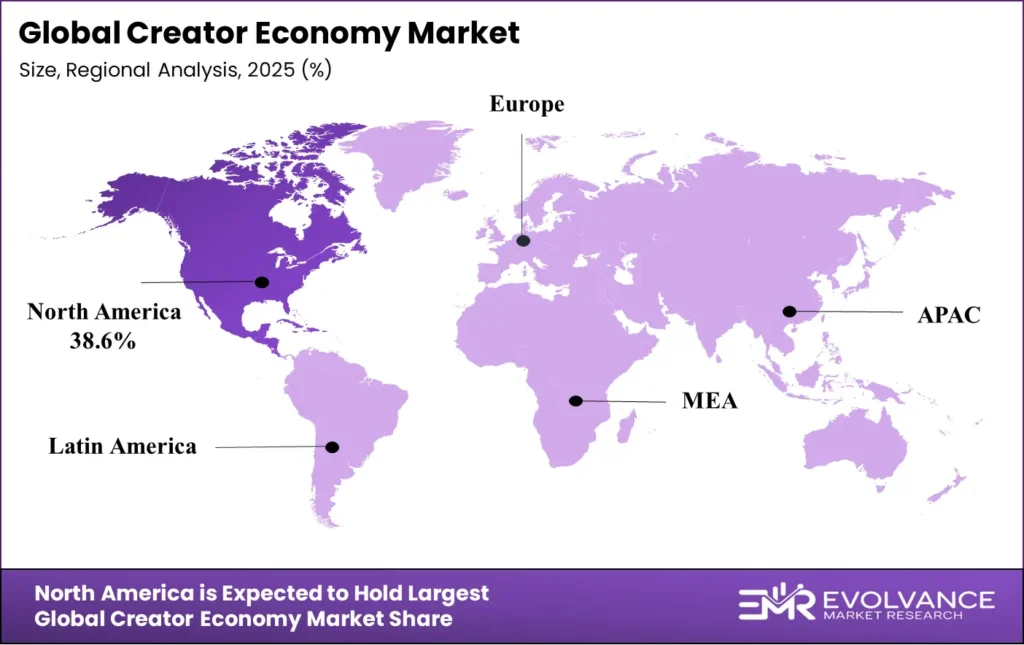
The region has the highest advertising and consumer spending on digital content, which directly increases creator earnings through ads, brand collaborations, and paid subscriptions. Most major creator platforms—such as YouTube, Instagram, TikTok, and Patreon—operate large parts of their product, monetization, and innovation teams in North America, giving creators early access to new tools and better revenue opportunities. Consumers in the region also show a higher willingness to pay for exclusive content, memberships, and tipping, which boosts direct income for creators.
Along with this, the market benefits from a developed financial and payment infrastructure, strong e-commerce integration, and easy-to-use creator tools that make content monetization simple and reliable.
North America also attracts significant venture capital investments in creator-focused startups, agencies, and technology solutions, further strengthening its competitive position. The region’s cultural influence and global reach of English-language content help creators tap into worldwide audiences, increasing scale and revenue. Altogether, these advantages make North America the most mature and commercially attractive region in the global creator economy.
Canadian Model in the Creator Economy Market
The Canadian model in the creator economy is built on a balanced ecosystem of strong digital infrastructure, government support, and a fast-growing community of creators who produce high-quality content for both domestic and global audiences. Canada has positioned itself as a creator-friendly market by combining large-scale platform usage (YouTube, TikTok, Instagram) with policies that encourage digital entrepreneurship.
Government programs such as the Canada Media Fund (CMF), Creative Canada Policy Framework, and provincial tax incentives help independent creators, production studios, and digital storytellers access funding, training, and resources. This gives Canadian creators a financial and professional advantage compared to many other regions.
Why Is the Asia Pacific Leading the Charge in the Creator Economy Market?
Asia Pacific stands as the fastest-growing region in the Creator Economy market, with an expected CAGR of 36.8%, due to the region combines the world’s largest internet user base with rapid digital adoption and a strong mobile-first culture. Countries such as India, China, Indonesia, Japan, and South Korea have millions of young, highly engaged users who spend a significant amount of time on short-form video, live streaming, gaming, and social commerce platforms. This large audience gives creators faster growth and higher engagement compared to most global markets.
Asia Pacific also benefits from local tech giants—like TikTok, YouTube, Kuaishou, Bilibili, and India’s homegrown apps—that continuously launch new monetization tools such as live gifting, virtual goods, in-app tipping, and commerce integrations. These features help creators earn money quickly, even without traditional brand deals.
The region’s strong e-commerce ecosystem makes influencer-led shopping extremely successful, allowing creators to drive direct sales for brands. Additionally, affordable smartphones, low-cost data plans, and expanding digital payment systems make it easy for people to create and consume content anywhere. With governments and businesses increasingly supporting digital entrepreneurship, Asia Pacific has become a fast-moving, high-growth hub where creators can scale quickly and build large communities—making it the most dynamic and rapidly expanding region in the global creator economy.
Key Regions and Countries
North America
- US
- Canada
Europe
- Germany
- France
- The UK
- Spain
- Italy
- Russia
- Rest of Europe
Asia Pacific
- China
- Japan
- South Korea
- India
- Australia
- ASEAN Countries
- Rest of Asia Pacific
Latin America
- Brazil
- Mexico
- Rest of Latin America
Middle East & Africa
- GCC Countries
- South Africa
- Rest of MEA
Top Creator Economy Market Companies
- Alphabet: Alphabet drives creator growth through YouTube’s global dominance, offering advanced ad monetization, analytics, and creator tools. Its expanding Shorts ecosystem, AI-powered recommendations, and strong advertiser base make it a core revenue engine in the creator economy.
- Amazon: Amazon strengthens the creator ecosystem through Twitch, Amazon Live, and affiliate programs. Its commerce-driven model, Prime integration, and livestream shopping capabilities enable creators to monetize audiences through subscriptions, product promotions, and real-time engagement.
- Meta Platforms: Meta leads through Instagram and Facebook, offering global reach, Reels expansion, and diversified creator monetization. Strong ad infrastructure, brand partnerships, and AI-driven discovery empower creators to scale audiences and earnings across multiple formats.
- ByteDance: ByteDance fuels the creator economy with TikTok’s viral algorithm, short-form innovation, and strong creator marketplace. Its commerce-integrated features, global engagement, and rapid content circulation make it a critical growth platform for creators worldwide.
Top Key Players in the Market
- Alphabet Inc.
- Company Overview
- Product Portfolio
- Financial Performance
- Recent Developments/Updates
- Strategic Overview
- Key Customers
- SWOT Analysis
Note (*): Similar analysis will be provided for other companies as well.
- com, Inc.
- ByteDance
- Meta Platforms
- Spotify AB
- Netflix Inc.
- Snap Inc.
- Pinterest, Inc.
- X Corp.
- Canva
- Roblox Corporation
- Etsy, Inc.
- Patreon, Inc.
- Discord Inc.
- Substack Inc.
- Other Major Players
Recent Developments
- In July 22, 2026 – Passionfroot raised $15 million in Series A funding led by Insight Partners to expand its B2B creator marketplace into the U.S. The Berlin-based company is also opening offices in New York and São Paulo; existing investors Creandum, Supernode Global, and s16vc participated.
- In March 2, 2026 – Devotion launched with $4 million in funding to build an AI-powered influencer marketing platform for brands. Founded by Parade’s Cami Tellez and former TikTok executive Jon Kroopf, Devotion uses AI for creator discovery, management and content workflows while retaining human review.
- In March 23, 2026 – YouTube introduced YouTube Creator Partnerships, replacing BrandConnect with a centralized creator-marketing platform integrated into YouTube Studio, Google Ads and Display & Video 360. Gemini is being used to help advertisers discover suitable creators from the more than 3 million creators in the YouTube Partner Program.
- In November 18, 2025 – Agentio raised $40 million in Series B funding led by Forerunner, bringing total funding to $56 million and valuation to $340 million. The company planned to use the funding to expand its creator-advertising infrastructure beyond YouTube to Meta Partnership Ads and additional platforms.
- In May 20, 2025 – Creator Ventures launched its second fund with $45 million, more than double its previous $20 million fund, to invest in consumer-internet companies. The fund is co-founded by creator Caspar Lee and investor Sasha Kaletsky and has increased its focus on AI-enabled consumer businesses.
- In February 2025 – Slow Ventures launched a $60 million Creator Fund dedicated to backing creators building businesses around their audiences and expertise. The fund targets creator-founders rather than traditional influencer campaigns and is designed to provide capital for businesses developed from creator communities.
- In Nov 2025, Visa is announced a program with Karat Financial, a fintech startup that provides credit cards and banking tailored to content creators. They target emerging creators, offering advice and automated payment solutions. The effort also includes an AI agent that can assist in evaluating brand deal offers.
- In October 2024, Webfluential, the pioneering influencer marketing platform, announced the launch of an additional stable of products and services to empower content creators and reshape the digital marketing landscape. The expanded Webfluential platform introduces a suite of innovative products and services that cater to the evolving needs of content creators and brands alike Enhanced content creation and collaboration, Direct-to-audience sales, Stock content marketplace, Lead generation tools, and others.
Market Scope
| Report Coverage | Details |
|---|---|
| Market Size in 2025 | US$ 210.80 Billion |
| Market Size in 2026 | US$ 275.30 Billion |
| Market Size by 2035 | US$ 3,043.00 Billion |
| Market Growth Rate from 2025 to 2035 | CAGR of 30.6% |
| Base Year for Estimation | 2025 |
| Historic Period | 2020-2025 |
| Forecast Period | 2026-2035 |
| Report Coverage | Revenue Forecast, Market Dynamics, COVID-19 Impact, Competitive Landscape, Recent Developments |
| Segments Covered | By Platform Type (Video streaming, Live Streaming, Blogging Platform, e-Commerce Platform, Pod-casting Platform, Others), By Creative Service (Arts & Crafts, Digital Content, Written Content, Video Production, Photography, Music Production, Others), By Revenue Channel (Advertising, Subscription, Tips/Donations, Affiliate Marketing, Selling Products/Merchandise, Brand Partnerships, Others), By End User (Armature Creator, Professional Creator) |
| Regional Analysis | North America – US, Canada; Europe – Germany, France, The UK, Spain, Italy, Russia, Netherlands, Rest of Europe; Asia Pacific – China, Japan, South Korea, India, New Zealand, Singapore, Thailand, Vietnam, Rest of APAC; Latin America – Brazil, Mexico, Rest of Latin America; Middle East & Africa – GCC Countries, South Africa, North Africa, and Rest of MEA |