

Market Verdict
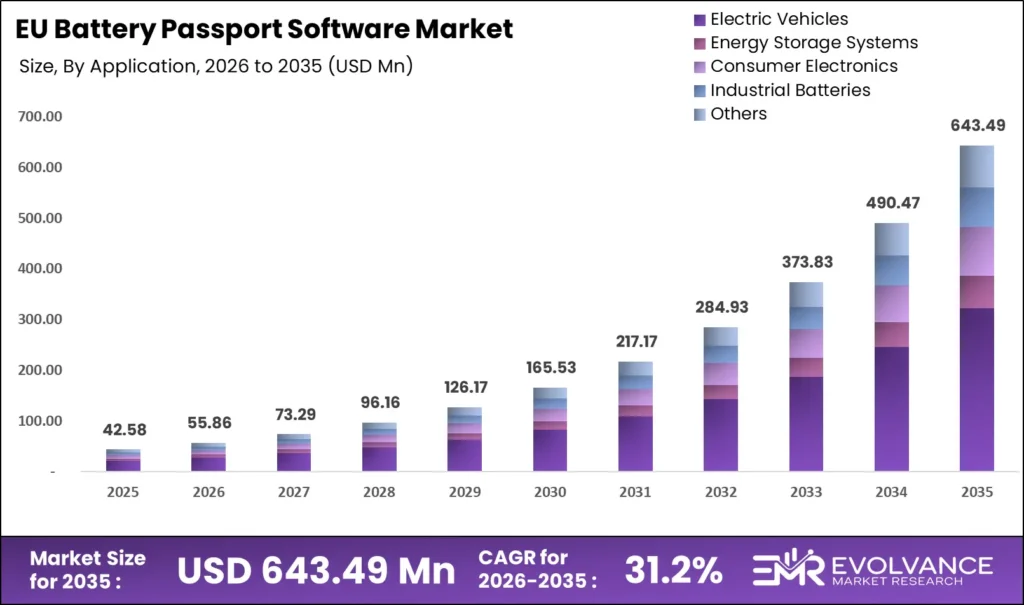
Battery passport software is not a compliance cost center; it is the data infrastructure layer that determines which battery manufacturers, automotive OEMs, and energy storage operators retain access to the EU market after 18 February 2027. The EU Battery Passport Software Market was valued at USD 42.58 million in 2025 and is projected to reach USD 55.87 million in 2026. The market is projected to reach USD 643.49 million by 2035, compounding at a 31.2% CAGR across the forecast period, per EMR analysis. The winners are not the largest vendors but those who solve multi-party data interoperability first.
Key Takeaways
Market Size:
- EU Battery Passport Software Market value in 2025: USD 42.58 million (2025), as per our research
- Market size in 2026: USD 55.87 million
- Market size in 2035: USD 643.49 million
- CAGR: 31.2% over 2026 to 2035
Dominant Segments:
- Component: Software at 62.0% as of 2025
- Application: Electric Vehicles at 55.0% as of 2025
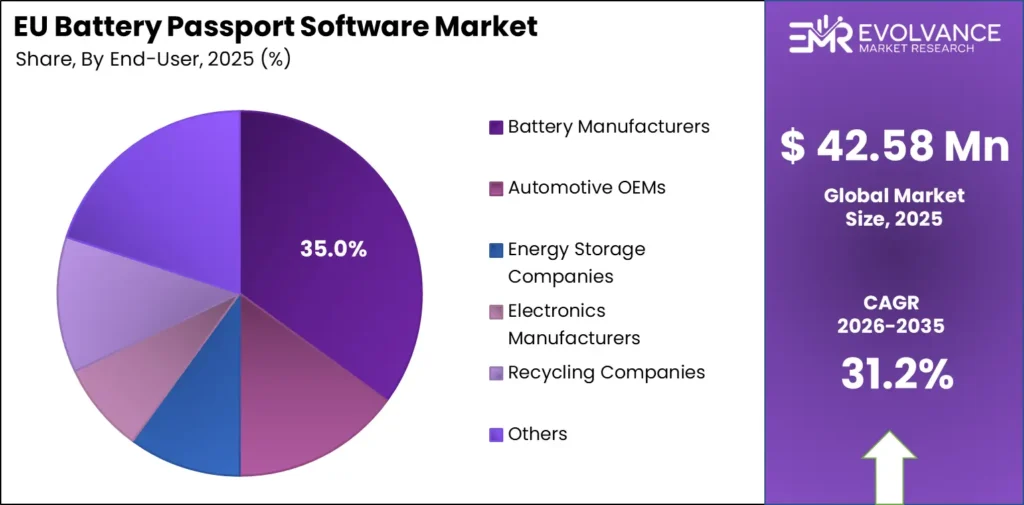
- End User: Battery Manufacturers at 35.0% as of 2025
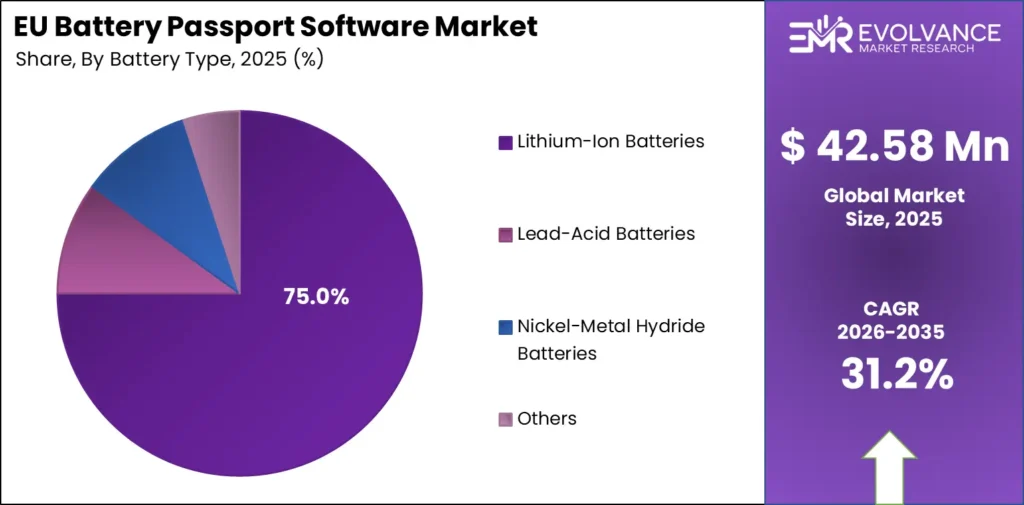
- Battery Type: Lithium-Ion Batteries at 75.0% as of 2025
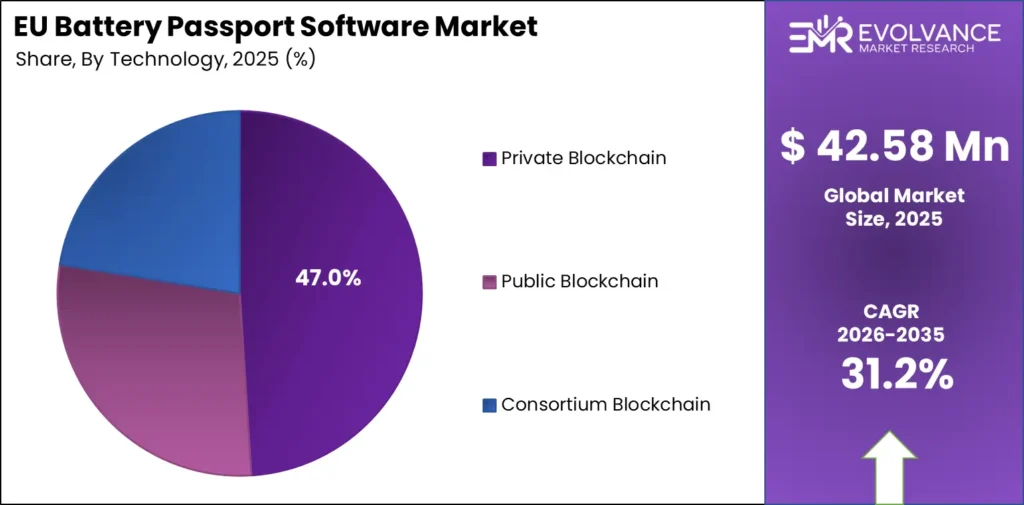
- Technology: Private Blockchain at 47.0% as of 2025
Dominant Region:
- Leading region: Europe, driven by Regulation (EU) 2023/1542 mandate effective 2027
Source: EMR
Market Overview
The EU Battery Passport Software Market captures, structures, and transmits lifecycle data across battery supply chains, from cell manufacturing through end-of-life recycling. Electric vehicle producers, grid energy storage operators, industrial battery assemblers, and consumer electronics manufacturers all depend on this infrastructure to meet traceability and circularity obligations under EU law. Without it, batteries cannot legally enter the EU market from 18 February 2027.
We conducted this research using a combination of primary interviews with battery manufacturers, automotive OEMs, and compliance software vendors, supplemented by secondary analysis of regulatory filings, Global Battery Alliance pilot documentation, and European Commission Joint Research Centre publications. EMR validated findings across a time window of 2020 to 2035, covering EU, North American, and Asia-Pacific geographies, with cross-referencing against Eurostat trade data and IEA deployment figures.
The core purchase trigger is regulatory non-compliance risk. Battery manufacturers and importers that lack a certified electronic passport system face de facto exclusion from the EU single market. The European Commission’s Digital Product Passport registry became operational on 20 July 2026, compressing vendor evaluation timelines. Companies that deferred procurement decisions now face accelerated onboarding under live registry conditions.
Global battery deployment reached 953 GWh in EVs and 205 GWh in battery energy storage systems in 2024, per the European Commission Joint Research Centre, establishing the volume base that passport systems must cover. The EU registered 1.89 million new battery-electric passenger cars in 2025, a 29.7% year-on-year increase, per Eurostat, each unit requiring passport-compliant documentation. EU countries also placed 231,000 tonnes of portable batteries on the market in 2023, per Eurostat, widening addressable scope beyond the EV segment. For investors, volume growth in battery deployment directly correlates with passport issuance demand, making this a volume-linked recurring software revenue story.
What Is Actually Driving This Market
Regulation (EU) 2023/1542 converts battery passport compliance from voluntary to mandatory, creating a hard purchase trigger that did not exist before 2023. The causal mechanism runs through market-access denial: any in-scope battery without an active electronic passport is barred from EU sale or service, per the European Commission. This is not a procurement preference; it is a binary gate. For operators, the compliance deadline makes software procurement a supply-chain continuity decision, not an IT budget line.
QR-code-linked unique identification requirements, also under Regulation (EU) 2023/1542, create enterprise demand for scalable passport issuance platforms that can handle individual battery serialization at manufacturing volumes. Three years ago, no operational registry existed to receive this data. The DPP Registry going live in July 2026 changed that architecture permanently. Global EV battery deployment reaching 1.2 TWh in 2025, almost 30% above 2024, per the IEA, directly scales the issuance volume these platforms must process. For investors, platforms with registry-native integration hold a structural onboarding advantage over late movers.
Multi-party supply-chain reporting obligations for carbon footprint, material composition, due diligence, and circularity data require secure interoperability across battery manufacturers, OEMs, and value-chain partners. Global battery investment reached USD 150 billion in 2023, including approximately USD 115 billion for EV batteries, per the IEA, funding the manufacturing networks that must now feed passport data upstream. Only 22.3% of global e-waste generated in 2022 was formally collected and recycled, per the International Telecommunication Union, underscoring why circularity data capture is treated as a structural gap, not an incremental improvement. For operators, multi-party data obligations make vendor interoperability the selection criterion that outweighs feature lists.
The single most important driver insight: regulatory non-compliance risk converts software from a discretionary budget item to a market-access prerequisite.
- Mandatory battery passport from 18 February 2027 for all LMT, industrial over 2 kWh, and EV batteries placed on the EU market (European Commission, 2026)
- EU portable-battery collection reached 117,000 tonnes in 2023 against 231,000 tonnes sold, exposing the circularity data gap passport systems must close (Eurostat, 2025)
- A record 62 billion kg of e-waste generated globally in 2022 (International Telecommunication Union, 2024), quantifying the lifecycle tracking problem battery passport software is built to address
- Siemens Digital Industries Software joined the Global Battery Alliance in August 2024 to accelerate battery passport ecosystem development, signaling tier-one industrial software vendors entering the compliance stack
For investors, the European Commission’s phased regulation timeline creates predictable demand windows through 2027 and beyond, with the July 2025 Innovation Fund awarding €852 million to six EV-battery cell manufacturing projects confirming sustained supply-side investment that generates downstream passport issuance demand.
Where The Real Risk Is
Fragmented upstream data capture across mining, refining, cell manufacturing, and pack assembly is the EU Battery Passport Software Market‘s structural constraint, not a temporary onboarding problem. Lithium recovery relative to theoretically available recycling feedstock reached only 20% in 2023, per the IEA, illustrating how thin the data infrastructure is at the source end of the supply chain. Passport software that cannot ingest verified upstream evidence produces compliant-looking documents with unverifiable content. For investors, this is a platform differentiation risk: vendors without supplier data ingestion pipelines face audit exposure on behalf of their clients.
China manufactured well over 80% of global batteries in 2025, per the IEA, and produced over 98% of global LFP cathode material and LFP battery cells, per the IEA. Commercial-confidentiality and cybersecurity risks around sharing proprietary battery chemistry data across jurisdictions are not correlational concerns but active contract blockers in cross-border passport deployments. This risk is not temporary; it is structurally embedded in geopolitical supply-chain architecture. For operators, passport platforms that offer granular role-based access control and jurisdictional data-residency options reduce legal exposure during supplier onboarding.
The risk most investors underestimate: upstream data immaturity invalidates passport content integrity before any compliance deadline is tested.
- Lithium recovery at 20% of theoretically available feedstock in 2023 (IEA, 2024), signaling that source-level data is missing for the majority of battery material
- China’s over 98% LFP cathode and cell production share (IEA, 2026) creates single-jurisdiction data-sharing risk for any EU-bound passport system
- Recovered-metal rates exceeded 40% for nickel and cobalt in 2023 (IEA, 2024), indicating selective material tracking maturity that passport platforms must integrate unevenly across chemistry types
Watch for EU enforcement actions against passports flagged for unverifiable upstream claims as the signal that supplier-side data quality risk is materializing into commercial liability.
Component Insights
Software Pulls Ahead: 62.0% Share in 2025
Software commands 62.0% of the component segment as of 2025, per EMR research, because the passport mandate is fundamentally a data architecture problem, not a hardware procurement. Platforms managing identity, carbon footprint, circularity, and durability attributes across 80-plus lifecycle fields require continuous SaaS updates as regulatory attribute requirements evolve. Hardware and services play supporting roles. For investors, software’s recurring revenue model within a compliance-driven purchase cycle creates durable retention economics.
Application Insights
Electric Vehicles at 55.0%: What’s Behind the Numbers in 2025
Electric vehicles account for 55.0% of EU Battery Passport Software Market demand by application as of 2025, per EMR analysis, reflecting both the regulatory priority given to EV batteries under Regulation (EU) 2023/1542 and the volume concentration in that segment. Energy storage systems, consumer electronics, and industrial batteries each represent addressable expansion vectors as phased regulation broadens scope. For operators, EV-first platform design is not optional; it is table stakes for any vendor seeking enterprise contracts with automotive OEMs.
End User Insights
Battery Manufacturers Tops the Field with 35.0% in 2025
Battery manufacturers hold 35.0% end-user share as of 2025, according to our research, because they sit at the passport issuance origin point and carry the heaviest compliance burden under EU law. Automotive OEMs, energy storage companies, and recycling firms are secondary adopters whose passport data requirements flow upstream. Lithium-ion battery production dominates the chemistry mix here, per EMR findings. For operators, battery manufacturers that standardize passport data models early establish data interoperability advantages with downstream OEM partners.
Battery Type Insights
Inside Lithium-Ion’s 75.0% Share Advantage
Lithium-ion batteries represent 75.0% of the battery type segment as of 2025, per EMR analysis, aligning with the finding that lithium-ion batteries represented approximately 77% of all global battery installations in 2024, per the European Commission Joint Research Centre. This chemistry dominance shapes the attribute requirements within passport data models, particularly around state-of-health monitoring and second-life valuation fields. Advanced and intelligent manufacturing integration at the cell level is the next frontier for real-time passport data capture. For operators, platforms built natively for lithium-ion data structures hold integration advantages over chemistry-agnostic approaches.
Technology Insights
The Case for Private Blockchain: 47.0% Share and Counting
Private blockchain holds 47.0% of the technology segment as of 2025, per EMR research, because multi-party data architecture requires permissioned access control that public chains cannot provide at enterprise confidentiality standards. Regulation (EU) 2023/1542’s role-based information layer requirements, separating public QR-code disclosure from restricted regulatory and authorized-operator data access, are structurally aligned with private blockchain’s access model. In 2025, 52.7% of EU enterprises purchased paid cloud-computing services, per Eurostat, and 40.89% purchased at least one sophisticated cloud service, per Eurostat, creating the cloud-native enterprise infrastructure on which blockchain-integrated passport platforms depend. For investors, private blockchain vendors with pre-built regulatory role-separation modules face lower enterprise sales friction than those requiring custom access control builds.
In 2023, 78% of large EU businesses purchased cloud services, per Eurostat, confirming that the enterprise adoption foundation for cloud-deployed passport platforms is well established rather than emergent.
Deployment Mode Insights
Where Deployment Mode Spending Goes: On-Premises and Hybrid Lead Structured Adoption
Cloud-based deployment data was not available in the source data for this segment; on-premises and hybrid modes are confirmed deployment options, per EMR analysis. Hybrid deployment is gaining traction among large battery manufacturers and automotive OEMs managing cross-jurisdictional data-residency requirements. Internet security architecture governs deployment mode selection as much as cost does, given the commercially sensitive nature of battery chemistry data. For operators, hybrid deployment models that separate public-facing passport data from restricted chemistry records offer the most defensible compliance posture.
| Sub-segment | Share % | Primary Driver | Outlook |
|---|---|---|---|
| Software | 62.0% | Regulatory data architecture mandate | Dominant; SaaS model locks in recurring revenue |
| Electric Vehicles | 55.0% | EU Regulation 2023/1542 EV-battery priority | Expanding as phased scope broadens |
| Battery Manufacturers | 35.0% | Passport issuance obligation at origin | Stable lead; OEM adoption accelerating |
| Lithium-Ion Batteries | 75.0% | Chemistry dominance in EV and storage | Dominant; second-life data fields expanding |
| Private Blockchain | 47.0% | Role-based access control requirements | Growing; open-standard interoperability pressure mounting |
Segments Covered In This Report
Component
- Software
- Hardware
- Services
Application
- Electric Vehicles
- Energy Storage Systems
- Consumer Electronics
- Industrial Batteries
- Others
End User
- Battery Manufacturers
- Automotive OEMs
- Energy Storage Companies
- Electronics Manufacturers
- Recycling Companies
- Others
Battery Type
- Lithium-Ion Batteries
- Lead-Acid Batteries
- Nickel-Metal Hydride Batteries
- Others
Technology
- Private Blockchain
- Public Blockchain
- Consortium Blockchain
Deployment Mode
- On-Premises
- Hybrid
Value is concentrating at the intersection of software, EV applications, and private blockchain technology, while hardware and services fragment across bespoke integration contracts. Battery manufacturers hold the procurement anchor position, but automotive OEMs are the fastest-growing secondary adopter group as fleet electrification scales. For investors, platform vendors that span software, blockchain infrastructure, and API-level OEM integration hold the highest switching-cost positions in the stack.
Regional Analysis: Where Geography Creates Advantage
Europe is the defining region for the EU Battery Passport Software Market. Every in-scope battery sold into the EU single market after 18 February 2027 requires a compliant electronic passport, making European regulatory architecture the primary demand engine globally. The EU’s total battery capacity in newly registered vehicles reached 107 GWh in 2024, per the European Commission Joint Research Centre, quantifying the passport issuance volume that EU-domiciled and EU-exporting manufacturers must cover. Germany, the Netherlands, Belgium, and France accounted for 62% of EU battery-electric vehicle registrations in 2025, per ACEA, concentrating demand among established automotive manufacturing economies. For investors, Europe is not a regional opportunity; it is the market’s originating demand structure, and early vendor positioning here determines global reference architecture.
Within Europe, Germany, Italy, and Austria accounted for 33%, 32%, and 6% respectively of new EU battery energy storage capacity in 2024, per the European Commission Joint Research Centre. EU battery factories produced 58 GWh in 2024, an 11% year-on-year increase, per the European Commission Joint Research Centre, establishing the domestic manufacturing base that passport software must serve directly. Europe added approximately 6.2 GW of battery storage in 2025, including about 4.6 GW of utility-scale systems, per the IEA, expanding passport scope beyond EVs into grid energy storage applications. Siemens Mobility broke ground on a battery-system factory in Bavaria in September 2025 with a €22 million investment targeting an annual capacity of 120 MWh, demonstrating tier-one industrial commitment to EU-based battery manufacturing that generates direct passport software demand. For operators, EU-based manufacturing investment by named industrial players signals a durable domestic customer pipeline rather than import-dependent demand.
Europe generated 17.6 kg of e-waste per capita in 2022, the highest regional rate worldwide, per the International Telecommunication Union, and the EU installed 19 GWh of new battery energy storage systems in 2024, per the European Commission Joint Research Centre. German recycler cylib secured a €63.4 million grant in December 2025 to build a 30,000-tonne LFP recycling line, bringing its total site capacity to 60,000 tonnes, illustrating how recycling infrastructure investment directly creates end-of-life passport data demand. Asia-Pacific, led by South Korea and Japan, represents the primary non-EU adoption market, driven by battery export dependency on EU market access. Minespider and Thingspire expanded their partnership in November 2024 to develop battery passport solutions for South Korean and East Asian markets, confirming that Asia-Pacific adoption is compliance-pull rather than domestic-regulation-push. For investors, Asia-Pacific represents a derivative demand market: its growth timeline is tethered to EU enforcement credibility.
| Region | Share % | USD Value | Key Driver | Strategic Signal |
|---|---|---|---|---|
| Europe | Dominant | Largest share, 2025 | Regulation (EU) 2023/1542 mandatory passport from 2027 | Reference architecture for all global deployments |
| Asia-Pacific | Secondary | Growing, 2025 | EU export-compliance pull; South Korea and Japan battery OEM exposure | Compliance-pull adoption; tethered to EU enforcement |
| North America | Emerging | Early-stage, 2025 | EV battery investment and potential regulatory alignment | Watch for domestic passport regulation as a secondary trigger |
Competitive Landscape: Who Is Pulling Ahead And Why
The leaders in the EU Battery Passport Software Market share one structural advantage: registry-native integration with the EU’s DPP Registry, operational since July 2026. Circulor has built sustained positioning through strategic verification partnerships, combining digital traceability with third-party assurance capabilities that mid-market competitors cannot replicate without equivalent alliance infrastructure. SAP, with total revenue of €36.800 billion in 2025 per its Integrated Report, brings enterprise ERP integration depth that positions it as the default passport data backbone for large battery manufacturers already running SAP supply-chain systems. For investors, the moat is not the passport module itself but the depth of upstream supplier data connectivity each vendor has already established.
Minespider is the most aggressive challenger in the upstream data segment, having built a multi-partner traceability network spanning mining, refining, and cell manufacturing. The January 2025 MOBIUS+ platform launch by Tata Elxsi and Minespider integrates blockchain-based battery passports with analytics, monitoring, and compliance capabilities, demonstrating vertically integrated lifecycle coverage that pure-play passport vendors lack. Circularise’s participation in both BatteryPass-Ready and a NEDO-selected battery traceability project as of early 2026 signals a dual-track interoperability strategy spanning EU and Japanese regulatory frameworks. For operators, challenger vendors with multi-jurisdictional pilot experience reduce the risk of regulatory divergence stranding a single-market platform investment.
The market is fragmenting at the vendor level but consolidating around a small number of technical standards, particularly open-standard data-exchange frameworks endorsed by the Global Battery Alliance. New entrants face a timing problem: the DPP Registry is live, early movers have active pilot relationships with manufacturers representing the majority of global EV battery capacity, and enterprise procurement cycles for compliance-critical software are multi-year. Industrial circular economy digital platforms built on interoperable data architectures hold the strongest defensibility, because switching costs compound as passport data accumulates across battery lifecycles. For investors, back platforms with existing GBA pilot relationships and registry-native architecture; those are the two non-replicable position elements at this stage.
| Company | Market Position | Key Advantage | Recent Move |
|---|---|---|---|
| Circulor | Leader | Verification partnership depth; BESS passport capability | Bureau Veritas partnership for assurance integration |
| Minespider GmbH | Challenger | Upstream mineral traceability network; multi-market reach | Recircle.market launch; MineHub partnership |
| SAP | Enterprise incumbent | ERP integration depth with battery manufacturer base | GBA ecosystem participation |
| Siemens | Industrial incumbent | Path.Era ecosystem; manufacturing R&D infrastructure | AI battery R&D centre; Bavarian factory |
| Circularise | Interoperability specialist | Dual EU-Japan regulatory framework coverage | BatteryPass-Ready; NEDO project participation |
| Tata Elxsi | Challenger | MOBIUS+ lifecycle platform with analytics layer | MOBIUS+ launch with Minespider |
| AVL | Testing and validation specialist | Battery state-of-health data depth | Expanding into passport data integration |
| OPTEL Group | Traceability specialist | Supply-chain serialization infrastructure | Passport module development |
| iPoint-systems GmbH | Compliance software specialist | Product compliance data management heritage | Battery passport attribute mapping |
| Glassdome | Emerging player | Decentralized data architecture | EU pilot participation |
| Everledger | Blockchain traceability specialist | Provenance verification infrastructure | Battery supply-chain expansion |
| DENSO Corporation | Automotive incumbent | OEM-side passport integration; manufacturing scale | Zenmyo plant investment for fiscal 2028 |
| RCS Global | Due diligence specialist | Responsible sourcing audit infrastructure | Passport due-diligence data integration |
| ChargeZone | Emerging EV infrastructure player | Charging network data linkage to passport lifecycle | Expanding passport data scope |
Key Players In This Report:
- Circulor
- Minespider GmbH
- SAP
- Siemens
- AVL
- OPTEL Group
- Tata Elxsi
- iPoint-systems GmbH
- Glassdome
- Everledger
- Circularise
- DENSO Corporation
- RCS Global
- ChargeZone
Where This Market Goes Next
The compliance-as-a-service opportunity within the EU Battery Passport Software Market for mid-market cell producers, battery importers, and industrial battery assemblers activates as the February 2027 deadline compresses procurement timelines for organizations without internal digital product passport capabilities. The EU battery market reaching 810 GWh by 2030 and 1.9 TWh by 2040, per the European Commission Joint Research Centre, establishes the long-run volume base that makes SaaS pricing viable at scale. Vendors positioned with modular onboarding architecture capture this segment before larger incumbents adapt enterprise-grade platforms downmarket. For operators, mid-market CaaS offering is the fastest growth vector in the near term and the customer base most likely to generate reference deployments across battery gigafactory and industrial circular economy digital platform contexts.
Battery state-of-health data products enabling second-life valuation, warranty underwriting, and residual-value analytics represent the market’s first post-compliance revenue layer. Lead-acid battery recycling can reach almost 100% under effective regulation, per the IEA, demonstrating that near-complete material recovery is achievable when data infrastructure supports it. The causal link here is correlational at present: state-of-health data improves second-life economics, but the financial product infrastructure to monetize that data is nascent. The EU and India’s joint €15.2 million initiative under the Trade and Technology Council, launched in May 2026 to collaborate on EV-battery recycling technologies, signals that state-level investment is beginning to formalize the institutional framework. For operators, vendors that build state-of-health data export APIs now, before the second-life market formalizes, establish the data standard others must conform to.
End-of-life recycler portals converting passport material and dismantling records into higher-yield recovery operations become commercially viable as passport data density increases past the 2027 mandatory adoption threshold. Jälle Technologies raising €2 million in pre-seed funding in July 2025 to scale lithium-ion battery recycling and upcycling technology illustrates early-stage capital forming around the recycler-portal opportunity. Minespider’s Recircle.market launch in February 2026, connecting battery reuse, repair, refurbishment, and recycling operators, points to marketplace-model competition emerging alongside SaaS licensing. The growth scenario with the highest upside is the one where passport data becomes the pricing input for secondary battery markets, not just a compliance artifact. For operators, the transition from compliance output to market-data asset is the strategic inflection that separates long-term platform value from one-cycle compliance revenue.
| Condition | Timeline | Upside | Who Benefits |
|---|---|---|---|
| Mandatory passport enforcement from February 2027 | 2026 to 2027 | Mid-market CaaS demand surge | Modular SaaS vendors; compliance specialists |
| Second-life battery market formalization | 2027 to 2030 | State-of-health data product revenue | AVL, platform vendors with SoH API infrastructure |
| EU battery market reaching 810 GWh by 2030 | 2028 to 2030 | Passport issuance volume at scale | Registry-native platforms; recycler portal operators |
| Passport data adopted as secondary-market pricing input | 2030 to 2035 | Platform monetization beyond compliance | Data product vendors; industrial circular economy platform operators |
Key Developments
- June 2026: Circulor partnered with Bureau Veritas to support battery passport and supply-chain traceability compliance, combining digital traceability with third-party assurance and verification expertise. This signals that passport credibility now requires independent verification, not just data capture.
- June 2026: Circulor completed a BESS battery passport pilot, expanding digital passport technology beyond electric vehicles. This confirms energy storage systems as the next mandatory compliance frontier.
- June 2026: The European Commission launched the €1.5 billion Battery Booster Facility, offering interest-free loans up to €500 million per project for battery cell manufacturing. Manufacturing investment at this scale directly expands the passport software addressable base.
- March 2026: Minespider partnered with MineHub to deliver critical mineral transparency through Digital Product Passports and Battery Passports across battery material supply chains. This extends upstream traceability reach to the mining origin point.