

Key Takeaways
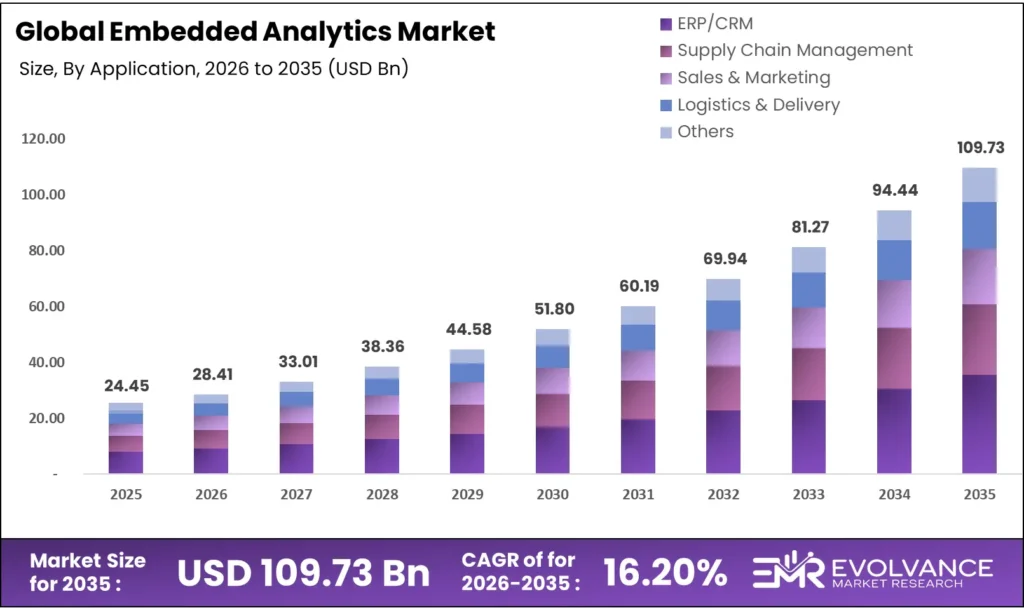
The global Embedded Analytics Market was valued at USD 24.45 billion in 2025 and is projected to reach USD 109.73 billion by 2035, growing at a CAGR of 16.20%. North America leads with a 35.18% revenue share, while Asia Pacific is the fastest-growing region. The cloud segment dominates with 64.20% market share, and large enterprises hold 58.06% of total revenue.
Supply chain management is the largest application segment (36.2% share), with IT & Telecommunications the leading end-user vertical at 29.79%. Key growth drivers include rising demand for real-time decision-making, AI integration, cloud migration, self-service analytics adoption, and data monetization strategies across industries worldwide.
What Is the Embedded Analytics Market Size?
The global Embedded Analytics Market was valued at approximately USD 24.45 billion in 2025 and is projected to grow from USD 28.41 billion in 2026 to nearly USD 109.73 billion by 2035, registering a compound annual growth rate (CAGR) of around 16.20% during 2026–2035. The year 2026 represents a strategic acceleration phase as enterprises transition toward AI-native embedded platforms, cloud-first architectures, and SaaS-driven monetization models.
Embedded analytics integrates analytical capabilities directly into business applications and workflows, enabling contextual, real-time insights without switching tools. Market expansion is supported by growing demand for real-time decision intelligence, rapid cloud adoption, increased AI/ML integration, and enterprise-wide data democratization across IT, BFSI, healthcare, retail, and manufacturing sectors.
Market Highlights
- North America dominated the market, holding the largest share of 35.18% in 2025.
- Asia Pacific is expected to expand at the fastest CAGR of 18.4% during 2026–2035.
- By deployment, the cloud segment accounted for the biggest market share of 64.20% in 2025.
- By deployment, the on-premise segment is expected to grow at the fastest CAGR of 15.6% during 2026–2035.
- By enterprise size, the large enterprises segment held the major market share of 58.06% in 2025.
- By enterprise size, the SMEs segment is expected to expand at the fastest CAGR of 18.1% during 2026–2035.
- By application, the supply chain management segment contributed the highest market share of 36.2% in 2025.
- By application, the ERP/CRM segment is expected to expand at the fastest CAGR of 17.2% during 2026–2035.
- By end-user, the IT & telecommunications segment captured the highest market share of 29.79% in 2025.
- By end-user, the retail and consumer goods segment is expected to expand at the fastest CAGR of 16.8% during 2026–2035.
U.S. Embedded Analytics Market Size and Growth 2026 to 2035
The U.S. Embedded Analytics Market size is estimated at USD 6.25 billion in 2025 and is projected to reach approximately USD 7.25 billion in 2026, reflecting steady enterprise adoption of integrated analytics solutions. The market is expected to grow at a strong CAGR of 16.03% from 2026 to 2035, driven by rising demand for real-time data visualization within business applications. Increasing integration of AI-driven insights, cloud-native analytics platforms, and self-service BI tools across industries such as BFSI, healthcare, retail, manufacturing, and IT is accelerating expansion.
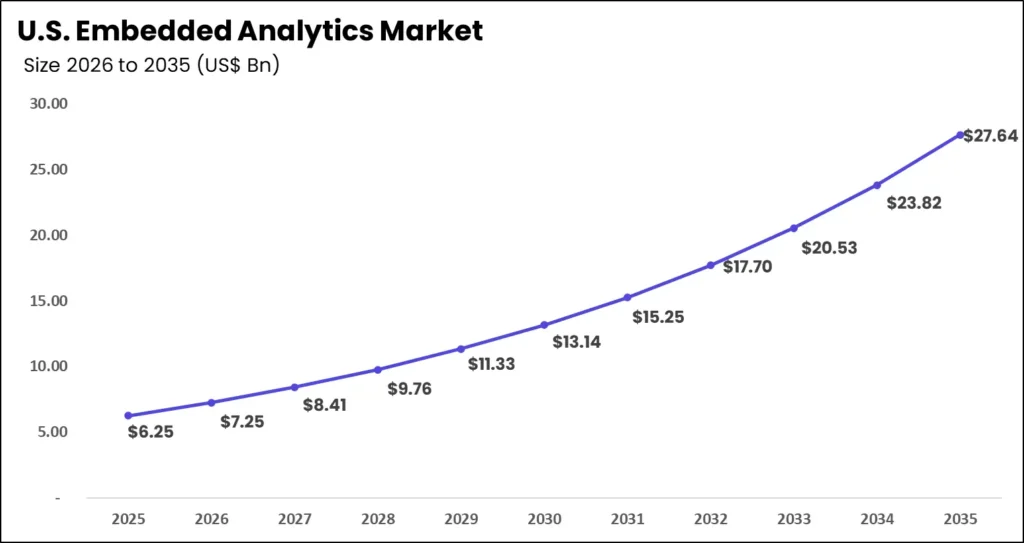
Organizations in the United States are embedding analytics directly into ERP, CRM, and operational systems to enhance productivity, improve decision-making accuracy, and gain competitive advantage. Growing investments in digital transformation initiatives and data governance frameworks further support long-term market growth.
What Is Embedded Analytics?
Embedded Analytics refers to the integration of analytical tools, dashboards, reports, and data visualizations directly within existing business applications, SaaS platforms, and operational software. Unlike traditional standalone business intelligence systems, embedded analytics enables end users to access real-time insights, interactive reports, and predictive models within the context of their daily workflows without needing to switch to separate analytical environments.
By leveraging technologies such as artificial intelligence, machine learning, natural language processing, and cloud computing, embedded analytics transforms raw operational data into actionable intelligence, empowering organizations to improve decision-making speed, enhance user engagement, optimize operational efficiency, and create new revenue streams through data monetization.
Embedded Analytics Market Outlook
Rising Demand for Real-Time Decision-Making
Organizations across industries are increasingly demanding real-time, data-driven insights embedded directly within their operational applications. The proliferation of IoT devices, connected systems, and digital workflows generates massive volumes of data that require immediate processing and contextual analysis. Enterprises are investing in embedded analytics platforms that deliver interactive dashboards, automated alerts, and predictive insights within CRM, ERP, and supply chain management systems, eliminating the latency associated with traditional reporting and enabling faster, more informed business decisions.
Rapid Cloud Adoption and Digital Transformation
The accelerating migration to cloud infrastructure and SaaS-based business models is driving substantial growth in cloud-native embedded analytics solutions. Cloud-based deployments offer scalability, cost efficiency, automatic updates, and seamless integration with distributed enterprise systems, making them particularly attractive to small and mid-sized enterprises. Digital transformation initiatives across BFSI, healthcare, retail, and manufacturing sectors are further expanding the addressable market, as organizations seek unified platforms that combine operational workflows with intelligent data analysis capabilities.
Integration of AI and Machine Learning
Artificial intelligence and machine learning are transforming embedded analytics by enabling predictive modeling, natural language querying, automated anomaly detection, and personalized dashboard experiences. AI-powered embedded analytics platforms learn user behavior to deliver relevant insights proactively, reducing dashboard fatigue and improving engagement. Organizations are leveraging AI-driven analytics for demand forecasting, customer churn prediction, fraud detection, and process optimization, driving sustained investment in intelligent embedded solutions across enterprise applications.
Self-Service Analytics and Data Democratization
The shift toward self-service analytics and low-code/no-code tools is empowering non-technical business users to generate reports, build custom dashboards, and explore data independently without relying on IT teams. Approximately 80% of organizations are expected to adopt self-service analytics by 2026, significantly expanding the user base for embedded analytics platforms. This trend is accelerating deployment across departments including sales, marketing, finance, and operations, driving broader organizational adoption and increasing platform revenue for software vendors.
Key Market Trends
- AI-Powered Conversational Analytics: Growing integration of natural language processing and AI assistants enabling users to query data conversationally within platforms like Slack, Microsoft Teams, and enterprise CRM systems.
- Cloud-Native BI Platforms: Rising deployment of cloud-based analytics solutions offering scalability, centralized governance, and real-time monitoring capabilities across distributed enterprise environments.
- Data Monetization Strategies: Increasing adoption of embedded analytics by SaaS companies to monetize data insights as premium features, creating tiered pricing models and new revenue streams.
- Edge Analytics Integration: Expansion of edge computing capabilities combined with embedded analytics to enable real-time processing at the point of data generation for IoT and manufacturing use cases.
- Low-Code Dashboard Builders: Growing demand for low-code and no-code analytics tools enabling business users to create custom dashboards and reports without developer intervention.
- Industry-Specific Solutions: Development of vertical-specific embedded analytics platforms tailored for healthcare, BFSI, manufacturing, and retail sectors to address unique compliance and operational requirements.
Market Scope
| Report Coverage | Details |
|---|---|
| Market Size in 2025 | USD 24.45 Billion |
| Market Size in 2026 | USD 28.41 Billion |
| Forecasted Market Size by 2035 | USD 109.73 Billion |
| Market Growth Rate (2026–2035) | CAGR of 16.20% |
| Base Year | 2025 |
| Historic Period | 2020–2025 |
| Forecast Period | 2026–2035 |
| Largest Market | North America |
| Fastest Growing Market | Asia Pacific |
| Segments Covered | Deployment, Enterprise Size, Application, End-User, Region |
| Regional Coverage | North America, Europe, Asia-Pacific, Latin America, Middle East & Africa |
Segment Insights
Deployment Insights
The cloud segment dominated the Embedded Analytics Market with the largest share of 64.20% in 2025, driven by its cost-effectiveness, scalability, and seamless integration with SaaS applications, ERP systems, and CRM platforms. Cloud-based embedded analytics eliminates the need for expensive on-premises infrastructure and enables organizations to deploy analytics capabilities rapidly across distributed teams. Automatic updates, lower total cost of ownership, and flexible subscription-based pricing make cloud deployments particularly attractive to small and medium-sized enterprises seeking affordable data intelligence solutions.
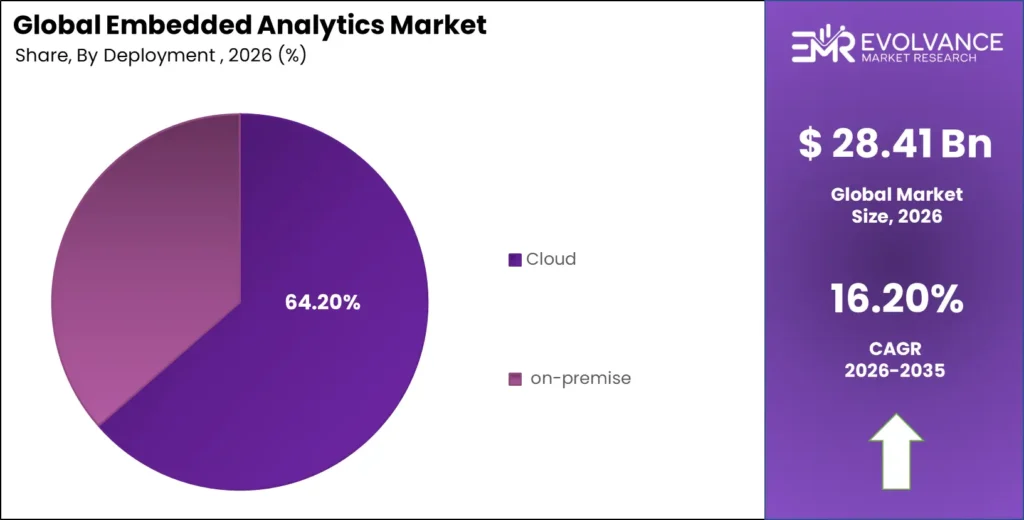
The on-premise segment is expected to grow at the fastest CAGR of 15.6% during 2026–2035. Growth in on-premise deployments is supported by stringent data security requirements, regulatory compliance mandates, and the need for complete control over sensitive data in heavily regulated industries such as banking, healthcare, and government. Organizations with complex legacy infrastructure often prefer on-premise solutions for greater customization, reduced latency, and enhanced data governance capabilities.
Enterprise Size Insights
The large enterprises segment held the major market share of 58.06% in 2025, driven by their extensive data volumes, complex operational workflows, and greater budgets for advanced analytics integration. Large organizations invest in embedded analytics to optimize cross-departmental decision-making, enhance customer engagement, and gain competitive advantages through AI-driven predictive insights. The SMEs segment is expected to expand at the fastest CAGR of 18.1% during 2026–2035, as affordable cloud-based analytics platforms and self-service tools enable smaller businesses to access sophisticated data intelligence previously available only to larger organizations.
Application Insights
The supply chain management segment contributed the highest market share of 36.2% in 2025. Embedded analytics enables supply chain managers to gain unified, real-time visibility across procurement, inventory, logistics, and distribution operations. The growing adoption of AI, IoT, and machine learning for demand forecasting, inventory optimization, and route planning has further accelerated embedded analytics adoption within supply chain applications. The ERP/CRM segment is expected to expand at the fastest CAGR of 17.2% during 2026–2035, driven by the urgent demand for unified, real-time intelligence directly within core business applications.
End-User Insights
The IT & Telecommunications segment captured the highest market share of 29.79% in 2025, as these industries generate massive volumes of data from networks, customer interactions, and service operations requiring real-time analysis. Embedded analytics enables telecom companies to monitor system performance, predict outages, optimize network usage, and enhance customer experience directly within their operational platforms. The retail and consumer goods segment is expected to expand at the fastest CAGR of 16.8% during 2026–2035, driven by the intense focus on improving customer engagement, optimizing supply chains, and leveraging real-time sales data within e-commerce and omnichannel platforms.
Regional Insights
North America — Leading the Market
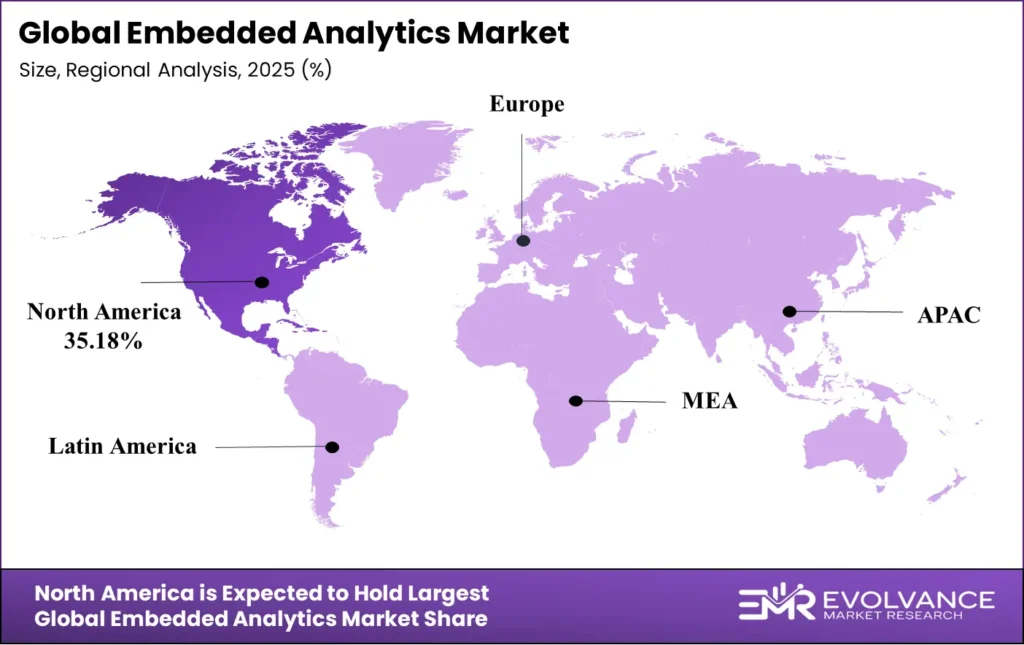
North America dominated the embedded analytics market with the largest share of 35.18% in 2025. The region’s leadership is supported by advanced digital infrastructure, strong enterprise technology investments, rapid adoption of AI-driven analytics solutions, and a well-established cloud ecosystem. Additionally, the presence of leading embedded analytics providers and continuous innovation in data-driven business intelligence solutions further strengthens North America’s competitive position in the global market.
Asia Pacific — Fastest Growing Region
Asia Pacific is expected to expand at the fastest CAGR of 18.4% during 2026–2035, driven by rapid digitalization, increasing cloud adoption, and a rising number of SMEs and startups leveraging data-driven insights. Growing investments in IT infrastructure, expanding SaaS usage, and a strong focus on operational efficiency and customer experience are accelerating adoption across the region. Emerging economies such as China, India, Japan, and Southeast Asian nations present significant opportunities for embedded analytics integration across retail, manufacturing, logistics, and financial services sectors.
Europe — Significant Market Position
Europe holds a significant position in the embedded analytics market, driven by growing demand for real-time automation, integrated data governance, and sustainable business operations. The region’s strong regulatory environment, including GDPR compliance requirements, is encouraging enterprises to implement analytics solutions with robust data protection capabilities. Companies across Germany, the United Kingdom, France, and the Nordics are increasingly adopting customized, sector-specific embedded analytics solutions.
Latin America — Emerging Opportunities
Latin America’s embedded analytics market is growing steadily, driven by increasing digital transformation across banking, retail, and telecommunications sectors. Brazil and Mexico represent the largest markets in the region, with organizations investing in cloud-based analytics platforms to improve operational efficiency and customer engagement. The rapid expansion of fintech ecosystems, growing e-commerce adoption, and new data protection regulations are compelling enterprises to strengthen their analytics capabilities.
Middle East & Africa — Growing Demand
The Middle East and Africa region presents expanding opportunities for embedded analytics, driven by government-led digital transformation initiatives, rapid cloud computing adoption, and increasing investment in smart city infrastructure. Countries including the UAE, Saudi Arabia, and South Africa lead regional market development, supported by national digitization strategies such as Saudi Vision 2030. Key sectors including BFSI, telecommunications, energy, and government agencies are prioritizing data-driven decision-making and real-time analytics integration.
Embedded Analytics vs Traditional Business Intelligence
Embedded analytics integrates analytical capabilities directly within business applications such as ERP, CRM, or SaaS platforms, enabling users to access real-time insights without leaving their workflow. It enhances operational efficiency by delivering contextual dashboards, reports, and predictive insights inside the tools employees already use. This approach improves decision speed, user adoption, and productivity, especially for non-technical users who require seamless access to data.
Traditional business intelligence (BI), on the other hand, operates as a standalone platform where users must log into separate BI tools to analyze data and generate reports. While traditional BI offers deep data exploration, advanced visualization, and centralized reporting, it often requires trained analysts and additional data integration processes.
The key difference lies in accessibility and workflow integration. Embedded analytics focuses on in-app, real-time decision-making, whereas traditional BI emphasizes centralized, comprehensive data analysis. Organizations increasingly prefer embedded analytics for agile, user-centric, and operational decision support.
Market Value Chain Analysis
- Technology Providers and Infrastructure Vendors: Cloud providers, data infrastructure vendors, and AI technology developers supplying compute resources, storage systems, machine learning engines, and API frameworks that form the foundational layer of embedded analytics platforms.
- Embedded Analytics Solution Developers: Software companies design and integrate self-service dashboards, interactive visualizations, natural language querying, and AI-based analytics engines, transforming raw operational data into actionable insights embedded directly within business applications.
- System Integrators and Managed Service Providers: Implementation partners and managed service providers deploy, customize, and manage embedded analytics solutions, ensuring seamless integration with existing enterprise applications, CRM systems, ERP platforms, and industry-specific workflows.
- End-Use Industries and Enterprises: Organizations across IT, BFSI, healthcare, retail, manufacturing, and government sectors utilize embedded analytics solutions to enhance decision-making, improve operational efficiency, strengthen customer engagement, and create competitive advantages through data-driven insights.
Top Embedded Analytics Market Companies
Tableau Software (Salesforce)
Tableau offers industry-leading embedded analytics solutions with powerful data visualization, interactive dashboards, and AI-driven insights. Acquired by Salesforce, Tableau integrates seamlessly into CRM workflows, enabling organizations to embed analytics directly within customer-facing and operational applications.
Microsoft (Power BI Embedded)
Microsoft Power BI Embedded provides scalable, cloud-native analytics capabilities that integrate with Azure services and enterprise applications. Power BI’s AI-powered features, natural language querying, and extensive data connectivity enable organizations to deliver interactive reports and dashboards within their SaaS products and customer-facing applications at scale.
Qlik
Qlik delivers embedded analytics through its associative analytics engine, enabling users to explore data relationships and uncover hidden insights. Qlik’s platform supports real-time data integration, AI-powered suggestions, and customizable embedded visualizations, making it a preferred choice for enterprises requiring flexible, white-labeled analytics.
Oracle
Oracle provides embedded analytics capabilities integrated with its cloud ERP, HCM, and CX applications. Oracle Analytics Cloud leverages machine learning and AI to deliver automated insights, predictive modeling, and intelligent data preparation directly within enterprise workflows.
Other key players include SAP, IBM, MicroStrategy, Looker (Google Cloud), Reveal, Toucan, Sisense, ThoughtSpot, Domo, and TIBCO Software.
Recent Developments
- April 2025 — Qrvey launched a suite of Embedded Services to help SaaS companies quickly deliver customer-facing analytics, integrating with in-house teams to streamline roadmap planning, implementation, and deployment.
- April 2025 — Microsoft announced major expansions to the Embedded Analytics Solution Accelerators Partner Program at FabCon 2025, expanding accelerator offerings for enterprise partners.
- January 2026 — Leading embedded analytics vendors enhanced AI-driven natural language querying capabilities, enabling business users to interact with complex datasets conversationally within enterprise CRM and ERP applications.
- February 2026 — Several SaaS platforms began embedding predictive analytics as premium tiered features, creating new monetization models for data-driven customer insights and operational intelligence.
Segments Covered in the Report
By Deployment
- Cloud
- On-premise
By Enterprise Size
- SMEs
- Large Enterprises
By Application
- ERP/CRM
- Supply Chain Management
- Sales and Marketing
- Logistics and Delivery
- Others
By End-User
- IT & Telecommunications
- Retail and Consumer Goods
- BFSI
- Manufacturing
- Healthcare
- Others
Key Regions and Countries
North America
- US
- Canada
Europe
- Germany
- France
- The UK
- Spain
- Italy
- Russia
- Rest of Europe
Asia Pacific
- China
- Japan
- South Korea
- India
- Australia
- ASEAN Countries
- Rest of Asia Pacific
Latin America
- Brazil
- Mexico
- Rest of Latin America
Middle East & Africa
- GCC Countries
- South Africa
- Rest of MEA
Future Outlook 2030–2035
Between 2030 and 2035, embedded analytics is expected to evolve into AI-augmented decision intelligence platforms. As enterprises prioritize automation, predictive operations, and digital ecosystem integration, embedded analytics will become a foundational component of enterprise software architecture, supporting the projected expansion to USD 109.73 billion by 2035.