

Key Takeaways
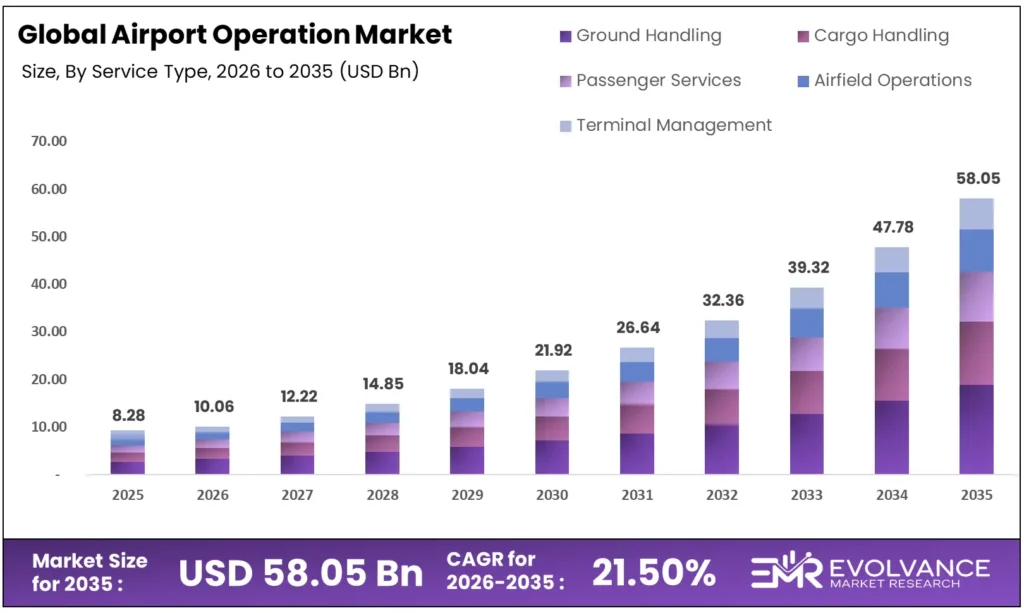
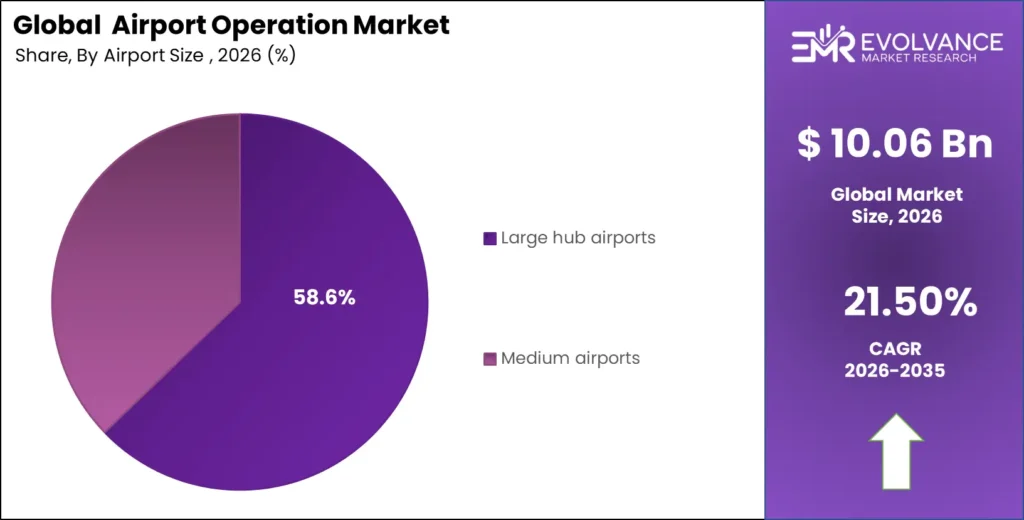
The global Airport Operation Market was valued at USD 8.28 billion in 2025 and is projected to reach USD 58.05 billion by 2035, growing at a CAGR of 21.50%. North America leads with a 36.8% revenue share, while Asia Pacific is the fastest-growing region. The ground handling segment dominates with 34.2% market share, and large hub airports hold 58.6% of total revenue.
Airside operations represent the largest operation segment (54.3% share), with commercial aviation the leading end-user vertical at 72.8%. Key growth drivers include increasing global passenger traffic surpassing 5.2 billion annually, rapid adoption of AI-powered airport management systems, growing investment in smart airport infrastructure, expanding cargo logistics and e-commerce fulfillment demand, and stringent aviation safety and regulatory compliance mandates worldwide.
What Is the Airport Operation Market Size?
The global Airport Operation Market was valued at approximately USD 8.28 billion in 2025 and is projected to grow from USD 10.06 billion in 2026 to nearly USD 58.05 billion by 2035, registering a compound annual growth rate (CAGR) of around 21.50% during 2026–2035. The year 2026 represents a critical acceleration phase as airports worldwide invest aggressively in operational modernization, digital transformation, and capacity expansion to accommodate post-pandemic traffic recovery and long-term passenger growth trajectories.
Airport operations encompass all ground-based activities essential for the safe, efficient, and commercial functioning of airports including ground handling, cargo management, passenger processing, airfield maintenance, terminal management, security operations, and air traffic flow coordination. Market expansion is supported by rising global air passenger traffic projected to exceed 5.8 billion by 2030, growing cargo volumes driven by e-commerce expansion, accelerating smart airport technology adoption, expanding airport privatization and public-private partnerships, and evolving regulatory frameworks including ICAO standards, IATA operational guidelines, and regional aviation safety mandates across commercial, military, and general aviation sectors.
Market Highlights
- North America dominated the market, holding the largest share of 36.8% in 2025.
- Asia Pacific is expected to expand at the fastest CAGR of 11.2% during 2026–2035.
- By service type, the ground handling segment dominated with the largest share of 34.2% in 2025.
- By service type, the cargo handling segment is expected to expand at the fastest CAGR of 10.8% during 2026–2035.
- By operation, the airside segment accounted for the biggest market share of 54.3% in 2025.
- By operation, the landside segment is expected to grow at a CAGR of 9.1% during 2026–2035.
- By airport size, large hub airports contributed the highest market share of 58.6% in 2025.
- By airport size, the medium airports segment is expected to expand at the fastest CAGR of 10.3% during 2026–2035.
- By technology, the AI & ML segment is expected to expand at the fastest CAGR of 14.5% during 2026–2035.
- By end-user, the commercial aviation segment captured the highest market share of 72.8% in 2025.
- By end-user, the general aviation segment is expected to expand at the fastest CAGR of 9.8% during 2026–2035.
U.S. Airport Operation Market Size and Growth 2026 to 2035
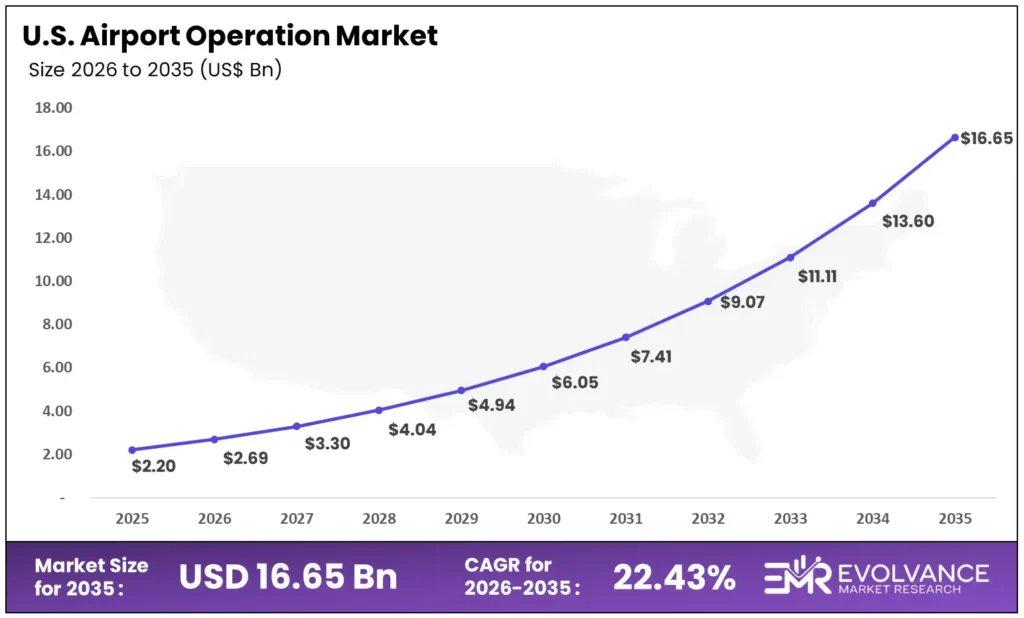
The U.S. Airport Operation Market size is estimated at USD 2.20 billion in 2025 and is projected to reach approximately USD 2.69 billion in 2026, reflecting robust federal and private investment in airport modernization and capacity expansion. The market is expected to grow at a strong CAGR of 22.43% from 2026 to 2035, driven by the FAA Reauthorization Act funding allocations, Airport Infrastructure Grants, and accelerating deployment of biometric passenger processing, autonomous ground support equipment, and AI-driven air traffic management systems.
The United States operates over 19,600 airports and airfields, with the FAA’s Airport Improvement Program (AIP) allocating billions annually for infrastructure upgrades. Major hub airports including Hartsfield-Jackson Atlanta, Dallas/Fort Worth, Denver International, and Los Angeles International are investing heavily in terminal modernization, automated baggage handling systems, smart security screening, and sustainable aviation fuel infrastructure to enhance operational efficiency and passenger experience.
What Is Airport Operation?
Airport Operation refers to the comprehensive set of activities, services, systems, and management processes required to ensure the safe, efficient, and commercially viable functioning of airport facilities. Unlike traditional facility management, modern airport operations integrate advanced technologies including artificial intelligence, IoT sensor networks, robotics, biometric processing, and predictive analytics to optimize every aspect of airport functionality from airside runway management and ground handling to landside passenger processing and commercial revenue generation.
Airport operations encompass ground handling services, cargo logistics, passenger terminal management, airfield maintenance, safety and security operations, air traffic coordination, environmental compliance, and commercial concession management, serving as the operational backbone that connects airlines, passengers, regulatory authorities, and ground service providers within the aviation ecosystem.
Airport Operation Market Outlook
Rising Global Passenger Traffic and Airport Capacity Expansion
Global air passenger traffic continues to surge, surpassing 4.7 billion passengers in 2025 with projections exceeding 5.8 billion by 2030. This sustained growth is compelling airports worldwide to invest in terminal expansions, runway additions, and operational capacity enhancements. Over USD 2.4 trillion in airport construction and modernization projects are planned globally through 2035, creating substantial demand for advanced airport operation solutions spanning automated check-in systems, biometric boarding gates, intelligent baggage handling, and real-time operational command centers.
Smart Airport Technology Adoption
The rapid adoption of smart airport technologies is fundamentally transforming airport operations worldwide. IoT sensor networks, digital twin platforms, AI-powered predictive maintenance, and autonomous ground vehicles are enabling airports to optimize resource allocation, reduce turnaround times, minimize delays, and enhance passenger experience. Over 65% of major international airports are expected to implement comprehensive smart airport platforms by 2028, driving demand for integrated operational technology solutions and real-time data analytics platforms.
AI and Automation in Ground Operations
Artificial intelligence and automation are revolutionizing airport ground operations by enabling predictive resource scheduling, automated baggage sorting, robotic aircraft inspection, and autonomous airfield operations. AI-powered ground handling platforms can optimize gate assignments, coordinate ground support equipment deployment, and predict operational disruptions before they cascade across airport networks. However, the aviation industry faces challenges including workforce transition, regulatory certification of autonomous systems, and cybersecurity risks associated with increasingly connected airport infrastructure.
Sustainability and Green Airport Operations
The shift toward sustainable aviation is driving adoption of electric ground support equipment, solar-powered terminal operations, sustainable aviation fuel infrastructure, and carbon-neutral airport management practices. ICAO’s Carbon Offsetting and Reduction Scheme for International Aviation (CORSIA) and Airport Carbon Accreditation programs are compelling airports to integrate environmental management into core operational strategies.
Key Market Trends
- Biometric Passenger Processing: Growing deployment of facial recognition, iris scanning, and touchless biometric systems for seamless passenger identification across check-in, security, border control, and boarding touchpoints at major international airports.
- Digital Twin Airport Platforms: Rising adoption of digital twin technologies creating real-time virtual replicas of airport infrastructure, enabling predictive maintenance, scenario simulation, and operational optimization across terminal and airfield operations.
- Autonomous Ground Support Equipment: Increasing deployment of self-driving baggage tractors, autonomous pushback tugs, and robotic cargo loaders to improve ground handling efficiency, reduce turnaround times, and address airport labor shortages.
- Airport-as-a-Service Models: Emergence of cloud-based airport management platforms offering modular operational capabilities including passenger flow analytics, revenue management, and resource optimization as subscription-based services.
- Drone-Based Airport Inspection: Growing investment in drone technologies for runway surface inspection, perimeter security monitoring, wildlife hazard management, and infrastructure condition assessment at airports worldwide.
- Integrated Airport Operations Centers: Expanding demand for centralized APOC platforms that consolidate real-time data from airlines, ground handlers, ATC, and security into unified decision-support dashboards for collaborative airport management.
Market Scope
| Report Coverage | Details |
|---|---|
| Market Size in 2025 | USD 8.28 Billion |
| Market Size in 2026 | USD 10.06 Billion |
| Forecasted Market Size by 2035 | USD 58.05 Billion |
| Market Growth Rate (2026–2035) | CAGR of 21.50% |
| Base Year | 2025 |
| Historic Period | 2020–2025 |
| Forecast Period | 2026–2035 |
| Largest Market | North America |
| Fastest Growing Market | Asia Pacific |
| Segments Covered | Service Type, Operation, Airport Size, Technology, End-User, Region |
Segment Insights
Service Type Insights
The ground handling segment dominated the Airport Operation Market with the largest share of 34.2% in 2025, driven by growing airline demand for efficient aircraft turnaround services including baggage handling, fueling, de-icing, pushback, and ramp operations. Airlines are increasingly outsourcing ground handling to specialized service providers to reduce operational costs and improve on-time performance metrics. The cargo handling segment is expected to expand at the fastest CAGR of 10.8% during 2026–2035, driven by explosive e-commerce growth, pharmaceutical cold-chain logistics demand, and expanding cross-border air freight volumes requiring advanced automated cargo processing facilities and real-time shipment tracking platforms.
Operation Insights
The airside operations segment accounted for the biggest market share of 54.3% in 2025, driven by critical investments in runway maintenance, taxiway management, apron operations, and air traffic flow optimization. Airside operations directly impact airport capacity utilization and safety metrics, compelling continuous investment in advanced surface movement guidance systems, runway incursion prevention technologies, and automated foreign object debris detection. The landside segment is expected to grow at a CAGR of 9.1% during 2026–2035, supported by passenger terminal modernization, biometric processing deployment, smart parking systems, and commercial revenue optimization initiatives.
Airport Size Insights
The large hub airports segment held the major market share of 58.6% in 2025, driven by higher operational complexity, massive passenger volumes exceeding 40 million annually, and substantial capital expenditure budgets for technology modernization. Large hubs including Dubai International, Singapore Changi, London Heathrow, and Tokyo Haneda are pioneering autonomous operations, AI-driven passenger flow management, and integrated digital platforms. Meanwhile, the medium airports segment is expected to expand at the fastest CAGR of 10.3% during 2026–2035, supported by regional traffic growth, low-cost carrier expansion, and government investment in secondary airport infrastructure development.
End-User Insights
The commercial aviation segment captured the highest market share of 72.8% in 2025, as airlines and airport authorities invest heavily in operational efficiency to manage growing passenger volumes, reduce delays, and improve customer satisfaction. Regulatory compliance requirements including ICAO Annex 14 standards, EASA aerodrome regulations, and FAA Part 139 certification mandates drive continuous investment in operational safety infrastructure. The general aviation segment is expected to expand at the fastest CAGR of 9.8% during 2026–2035, driven by growing business aviation demand, urban air mobility development, and advanced air mobility infrastructure preparation.
Regional Insights
North America — Leading the Market
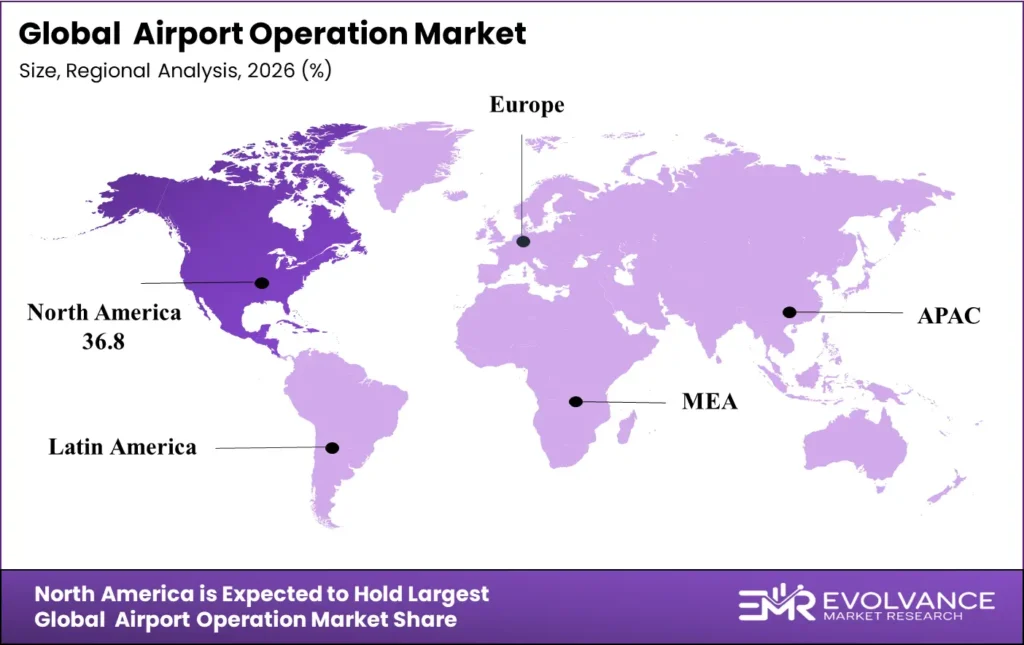
North America dominated the airport operation market with the largest share of 36.8% in 2025. The region’s leadership is supported by the world’s most extensive airport network with over 19,600 facilities, the FAA’s multi-billion dollar Airport Improvement Program, and advanced technology adoption across major hubs. The U.S. Bipartisan Infrastructure Law allocated USD 25 billion for airport terminal modernization and runway rehabilitation. Canada’s National Trade Corridors Fund and CATSA modernization initiatives additionally strengthen North America’s dominant position in airport operational technology deployment.
Asia Pacific — Fastest Growing Region
Asia Pacific is expected to expand at the fastest CAGR of 11.2% during 2026–2035, driven by unprecedented airport construction activity, surging middle-class air travel demand, and government-led aviation infrastructure investment. China’s plan to build over 200 new airports by 2035, India’s UDAN regional connectivity scheme and Navi Mumbai International Airport development, Southeast Asia’s airport expansion programs, and Japan’s smart airport initiatives are creating massive demand for advanced airport operation solutions across the region.
Europe — Significant Market Position
Europe holds a significant position in the airport operation market, driven by the EU’s Single European Sky ATM Research (SESAR) program modernizing air traffic management, stringent environmental regulations driving green airport operations, and the European Airport Package reforming ground handling market competition. Major airports across Germany, the United Kingdom, France, and the Netherlands are investing heavily in digital twin platforms, autonomous ground handling equipment, and biometric passenger processing systems.
Latin America — Emerging Opportunities
Latin America’s airport operation market is growing steadily, driven by airport privatization initiatives, low-cost carrier expansion, and tourism recovery. Brazil’s airport concession programs, Mexico’s new Felipe Ángeles International Airport, and Colombia’s El Dorado expansion represent key growth catalysts. The rapid growth of regional connectivity and increasing foreign investment in airport management concessions across the region are compelling operators to significantly upgrade operational capabilities and technology infrastructure.
Middle East & Africa — Growing Demand
The Middle East and Africa region presents expanding opportunities for airport operations, driven by mega-hub airport developments, tourism-led economic diversification, and smart city integration programs. Dubai’s Al Maktoum International Airport expansion targeting 260 million passengers, Saudi Arabia’s NEOM Bay Airport and Riyadh’s King Salman International Airport aligned with Vision 2030, and Qatar’s Hamad International Airport expansion are driving substantial investment in next-generation airport operational technologies and management systems.
Market Value Chain Analysis
Technology Providers and Infrastructure Vendors
IoT platform providers, AI technology developers, cloud computing vendors, robotics manufacturers, and aviation hardware suppliers delivering sensors, computing infrastructure, communication networks, and automation equipment that form the foundational technology layer of modern airport operation platforms.
Airport Operation Solution Developers
Specialized aviation technology companies designing and developing airport management systems, ground handling platforms, passenger processing solutions, baggage handling systems, airfield management technologies, and AI-powered operational decision support tools that transform raw operational data into actionable intelligence and automated workflow capabilities.
System Integrators and Airport Management Companies
Implementation partners, airport management corporations, and ground handling service providers deploying, customizing, and managing airport operational solutions, ensuring seamless integration with airline systems, regulatory compliance frameworks, and ICAO/IATA operational standards across diverse airport environments.
End-Use Aviation Stakeholders
Airlines, airport authorities, civil aviation regulators, ground service providers, cargo operators, and concession managers utilizing airport operation solutions to optimize throughput, ensure safety compliance, maximize non-aeronautical revenue, maintain operational resilience, and deliver superior passenger experiences across increasingly complex aviation ecosystems.
Top Airport Operation Market Companies
Groupe ADP (Aéroports de Paris)
Groupe ADP leads the global airport operation market through its management of Paris-Charles de Gaulle and Paris-Orly airports, alongside an international portfolio spanning 28 countries. The company’s Hub One digital subsidiary delivers cutting-edge IoT connectivity, cybersecurity, and digital transformation solutions for airport operations, while its TAV Airports subsidiary manages 15 airports across the Mediterranean and Central Asia regions.
Fraport AG
Fraport AG operates Frankfurt Airport, Germany’s largest aviation hub, and manages airport operations across four continents. The company’s FRA-OS digital platform integrates AI-driven resource planning, real-time passenger flow analytics, and predictive maintenance across all operational domains, setting industry benchmarks for digital airport management efficiency.
Swissport International
Swissport International is the world’s largest ground handling and cargo services provider, serving over 265 million passengers and handling 4.6 million tonnes of cargo annually across 300+ airports in 45 countries. The company’s digital ground handling platform leverages real-time data analytics and automation to optimize turnaround operations and resource deployment.
SITA
SITA is the leading IT provider for the global air transport industry, delivering airport management, passenger processing, baggage management, and border control solutions to over 1,000 airports worldwide. SITA’s Airport Management solution provides real-time collaborative decision-making capabilities for integrated airport operations centers.
Other Key Players
Other key players include Vinci Airports, Changi Airport Group, Menzies Aviation, dnata (Emirates Group), Vanderlande Industries, Collins Aerospace, Amadeus IT Group, Siemens, and RESA Airport Data Systems, each focusing on specialized airport operational capabilities including automated baggage systems, ground handling excellence, passenger processing innovation, and smart airport platform development.
| Company | Core Strength | Strategic Focus 2025–2026 |
|---|---|---|
| Groupe ADP | Global Airport Management | Digital Twin & AI Operations |
| Fraport AG | FRA-OS Digital Platform | Predictive Maintenance & Analytics |
| Swissport | Ground Handling Scale | Automated Turnaround Optimization |
| SITA | Aviation IT Infrastructure | Biometric & Smart Airport Solutions |
| Vinci Airports | International Concessions | Green Airport & Sustainability |
Recent Developments
- March 2025 — Groupe ADP launched its next-generation Airport Operations Platform integrating digital twin technology and AI-driven predictive resource allocation, reducing average ground handling turnaround times by 22% at Paris-Charles de Gaulle.
- June 2025 — SITA introduced Smart Path biometric corridor technology enabling fully touchless passenger journeys from check-in to boarding, deployed across 14 major international airports in North America and Europe.
- September 2025 — Swissport deployed autonomous electric baggage tractors at Zurich Airport, reducing ground handling emissions by 45% while improving baggage delivery punctuality to 98.5% on-time performance.
- January 2026 — Fraport AG expanded its FRA-OS platform with generative AI capabilities for real-time operational disruption management, enabling predictive flight delay mitigation and automated passenger rebooking coordination.
- February 2026 — Multiple major airports across Asia Pacific initiated deployment of integrated drone-based runway inspection systems, replacing manual inspection processes and reducing runway downtime by 60%.
Segments Covered in the Report
By Service Type
- Ground Handling
- Cargo Handling
- Passenger Services
- Airfield Operations
- Terminal Management
By Operation
- Landside
- Airside
By Airport Size
- Large Hub
- Medium
- Small Regional
By Technology
- IoT & Sensors
- AI & Machine Learning
- Cloud Computing
- Robotics & Automation
By End User
- Commercial Aviation
- Military Aviation
- General Aviation
Key Regions
- North America (U.S., Canada)
- Europe (Germany, France, UK, Spain, Italy)
- Asia Pacific (China, India, Japan, Australia)
- Latin America (Brazil, Mexico)
- Middle East & Africa (UAE, Saudi Arabia, South Africa)
Future Outlook 2030–2035
Between 2030 and 2035, the airport operation market is expected to evolve into AI-augmented autonomous airport ecosystems capable of self-optimizing operations with minimal human intervention. The convergence of artificial intelligence, digital twin technology, autonomous ground vehicles, urban air mobility integration, and sustainable aviation infrastructure will redefine airport operational paradigms. As global passenger traffic continues to expand toward 7 billion annually by 2035, airport operations will become a foundational component of smart city transportation networks, supporting the projected market expansion to USD 58.05 billion by 2035. The integration of vertiport operations for eVTOL aircraft, hydrogen fueling infrastructure management, and AI-driven collaborative decision-making platforms will drive operational transformation and create new growth opportunities across all airport categories worldwide.