

What is the Electric SUV Market Size?
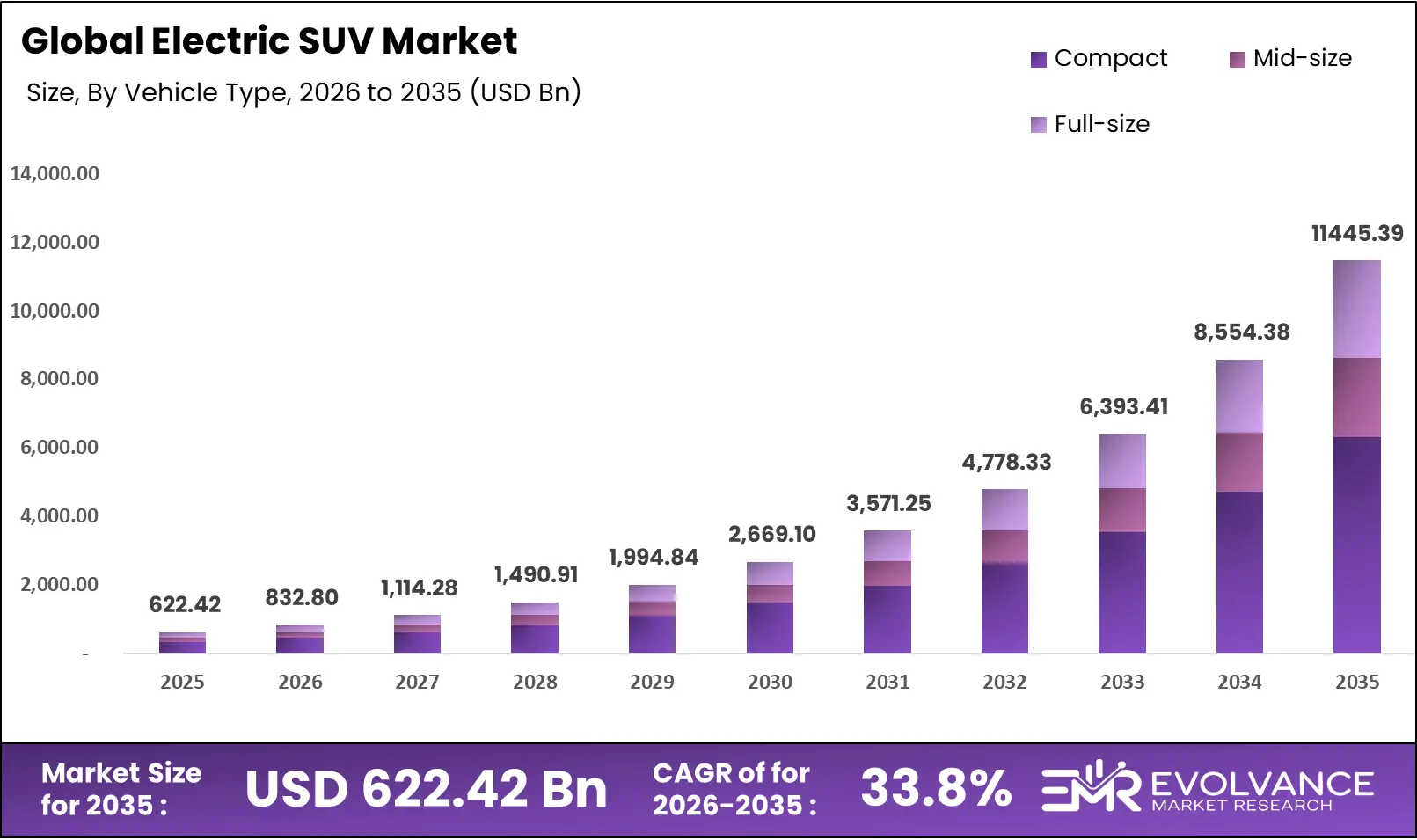
Global Electric SUV Market size is expected to be worth around USD 11445.39 Billion by 2035 from USD 622.42 Billion in 2025, growing at a CAGR of 33.8% during the forecast period 2026 to 2035. This rapid growth stems from rising consumer demand for spacious zero-emission vehicles and expanding fast-charging networks worldwide. According to The ICCT, global EV sales reached around 17 million units in 2024, capturing roughly 19% of new light-duty vehicle sales worldwide.
Market Highlights
- Global Electric SUV Market valued at USD 622.42 Billion in 2025, projected to reach USD 11445.39 Billion by 2035
- Market growing at a CAGR of 33.8% during forecast period 2026-2035
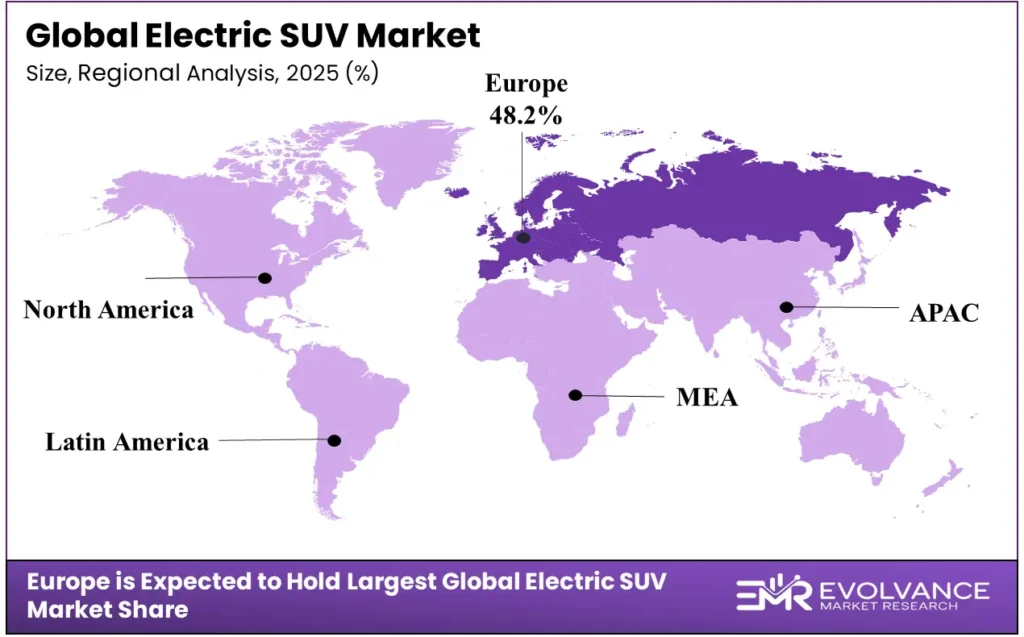
- Europe dominates with 48.2% market share, valued at USD 273.8 Billion
- Battery Electric Vehicle (BEV) segment leads with 70.2% share in propulsion type
- Compact SUVs hold dominant position with 55.2% share in vehicle type segment
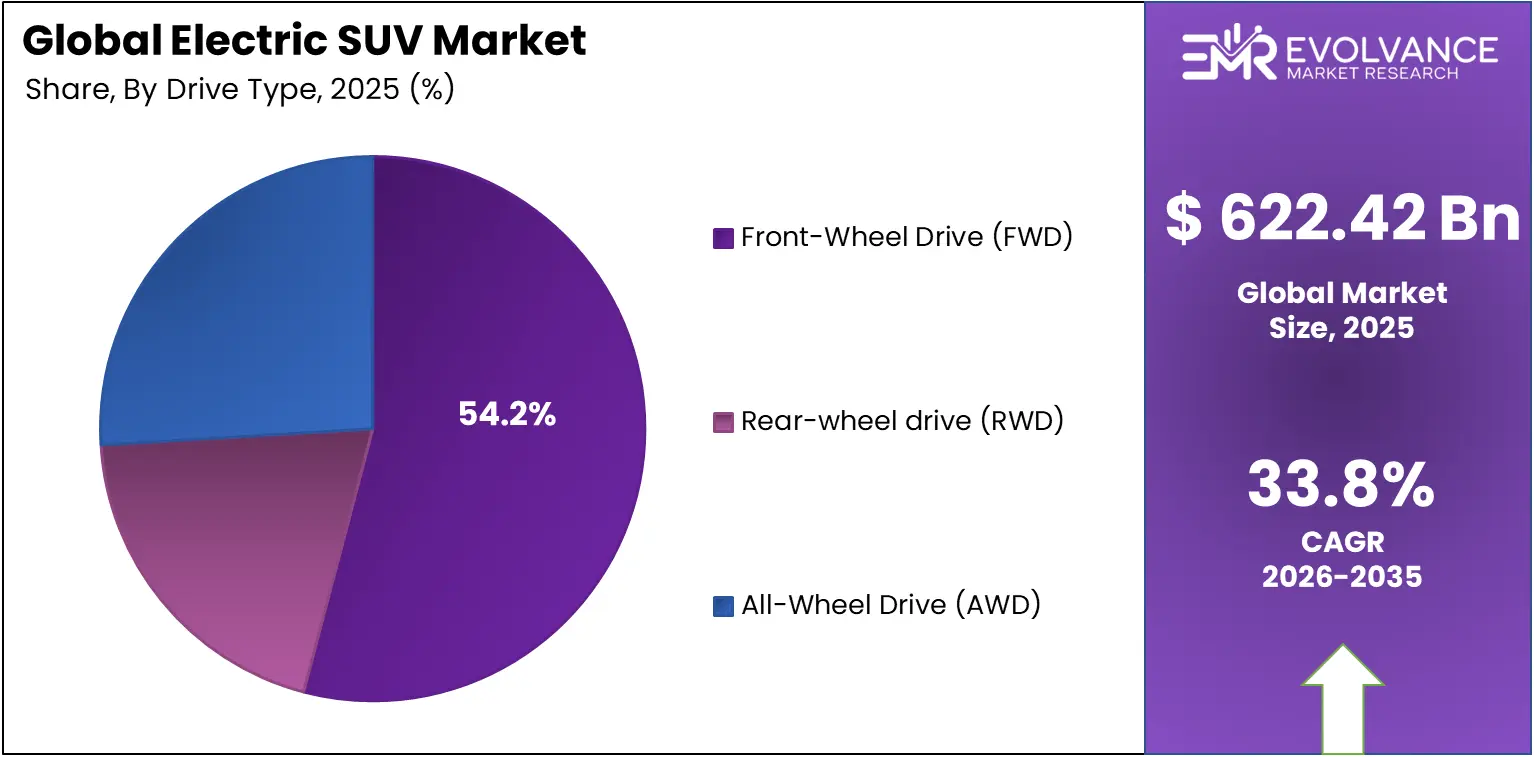
- Front-Wheel Drive (FWD) configuration captures 54.2% share in drive type segment
Market Overview
The Electric SUV Market covers the design, making, and sales of sport utility vehicles powered by electric drivetrains. These vehicles blend the spacious design and raised seating position of traditional SUVs with zero-emission electric propulsion systems. Models range from compact crossovers to full-size luxury SUVs, serving both personal and fleet buyers globally.
Market growth stems from multiple factors working together to reshape the auto industry. Buyers now prefer larger electric vehicles that offer space, comfort, and long driving range without tailpipe emissions. Cities worldwide push for cleaner transport options, and governments back this shift through tax breaks and purchase grants.
Automakers invest heavily in dedicated electric platforms designed specifically for SUV body styles. These platforms allow better battery placement, improved weight balance, and more cabin space compared to converted gas models. Major brands now offer multiple electric SUV options across different price points and size categories.
Charging networks expand rapidly across urban centers and highway corridors, making long-distance electric SUV travel more practical. Fast-charging stations cut wait times greatly, addressing a key concern for buyers considering the switch from gas vehicles. This setup helps fleet operators and ride-sharing services adopt electric SUVs more easily.
Battery tech advances drive down costs while boosting range and performance capabilities. Modern electric SUVs now match or exceed gas models in acceleration, towing capacity, and total driving range. All-wheel drive electric systems deliver superior traction control in varied weather and terrain conditions.
According to Qmerit, nearly 40% of the available EV models were SUVs in 2022, with 16% of SUVs sold that year being electric. This shows consumers prefer these vehicles over smaller EV options. As reported by the IEA, in 2023, SUVs cemented their lead in the EV market, with over 55% of new electric car sales globally being SUVs.
Commercial applications grow as delivery companies and corporate fleets seek to cut fuel costs and meet emissions targets. Electric SUVs offer the cargo capacity needed for business use while providing lower total ownership costs over the vehicle lifetime. Government fleets also shift toward electric SUVs to demonstrate climate action commitment.
In October 2025, Zeekr launched an updated version of the 7X SUV featuring a 900-volt setup and ultra-fast charging from 10% to 80% in roughly 10 minutes. This advance shows how quickly charging tech evolves to meet buyer needs and reduce downtime during travel.
Vehicle Type Analysis
Compact dominates with 55.2% due to affordability and urban maneuverability.
In 2025, Compact held a dominant market position in the By Vehicle Type segment of Electric SUV Market, with a 55.2% share. Compact electric SUVs appeal to urban buyers seeking manageable size, lower purchase prices, and easier parking in crowded cities. These models typically offer 250 to 350 mile range, meeting daily driving needs for most households and commuters.
Mid-size electric SUVs attract families and buyers needing more interior space and cargo capacity for weekend trips. These models balance passenger comfort with driving range, often featuring larger battery packs that support 300 to 450 mile trips. Mid-size options compete well against gas SUVs in the popular family vehicle segment.
Full-size electric SUVs serve luxury buyers and those requiring maximum seating and towing capability for boats or trailers. Premium brands focus here, offering advanced tech features, high-end materials, and powerful dual-motor setups. Full-size models command higher prices but deliver exceptional performance and prestige appeal to affluent buyers.
Propulsion Type Analysis
Battery Electric Vehicle (BEV) dominates with 70.2% due to pure electric operation and lower costs.
In 2025, Battery Electric Vehicle (BEV) held a dominant market position in the By Propulsion Type segment of Electric SUV Market, with a 70.2% share. BEV SUVs run entirely on battery power with no gas engine, offering the simplest design and lowest maintenance requirements. These vehicles qualify for maximum tax credits and benefit most from falling battery costs and expanding charging networks.
Plug-in Hybrid Electric Vehicle (PHEV) SUVs combine electric motors with gas engines, giving buyers backup range for long trips without charging stops. PHEVs appeal to buyers with range anxiety or limited charging access at home or work. These models let drivers use electric power for daily commutes while keeping gas capability for road trips.
Vehicle Range Analysis
Up to 250 Miles dominates as most daily driving falls well below this threshold.
Up to 250 Miles range covers compact and entry-level electric SUVs targeting budget-conscious buyers and urban markets. These models use smaller battery packs, reducing vehicle weight and purchase price while still meeting typical daily driving needs. Buyers with regular charging access find this range sufficient for commuting and local errands.
250-500 Mile range SUVs serve the mainstream market, offering enough capacity for weekend trips and eliminating most charging anxiety. Mid-size and some full-size models fall here, balancing battery cost against practical range needs. This segment grows rapidly as battery energy density improves and prices drop.
Above 500 Miles range represents premium electric SUVs with the largest battery packs and most advanced powertrains available. These vehicles match or exceed gas SUV range, appealing to luxury buyers and those who regularly drive long distances. Ultra-long range models reduce charging frequency and support towing without major range loss.
Drive Type Analysis
FWD dominates with 54.2% due to lower cost and weight efficiency.
In 2025, Front-Wheel Drive (FWD) held a dominant market position in the By Drive Type segment of Electric SUV Market, with a 54.2% share. Front-wheel drive electric SUVs use a single motor, cutting costs and vehicle weight compared to dual-motor setups. This config works well for compact and mid-size models in mild climates where traction demands stay moderate.
Rear-wheel drive (RWD) electric SUVs appeal to performance buyers seeking better weight balance and sportier handling characteristics than FWD models. Rear-drive layouts place the motor near the rear axle, improving weight spread and enabling more dynamic cornering. Premium brands often choose RWD for their electric SUV platforms.
All-Wheel Drive (AWD) electric SUVs use dual motors powering front and rear axles independently, delivering superior traction in snow, rain, and off-road conditions. All-wheel drive configs provide instant torque to each wheel, giving better acceleration and stability control than mechanical systems. Buyers in northern climates and mountain regions prefer AWD for year-round capability.
Market Segments Covered in the Report
By Vehicle Type
- Compact
- Mid-size
- Full-size
By Propulsion Type
- Battery Electric Vehicle (BEV)
- Plug-in Hybrid Electric Vehicle (PHEV)
By Vehicle Range
- Up to 250 Miles
- 250-500 Mile
- Above 500 Miles
By Drive Type
- FWD
- RWD
- AWD
Electric SUV Market Regional Insights
Europe Dominates the Electric SUV Market with a Market Share of 48.2%, Valued at USD 273.8 Billion
Europe leads the global electric SUV market with a 48.2% share, valued at USD 273.8 Billion, driven by strict emissions rules and strong government backing for EV adoption. Germany, France, and the UK invest heavily in charging networks and offer generous tax breaks for electric vehicle buyers. European automakers launch multiple electric SUV models targeting both premium and mass market segments across the region.
Asia Pacific Electric SUV Market Trends
Asia Pacific shows rapid growth led by China’s massive EV market and rising demand in Japan, South Korea, and India. Chinese brands like BYD and local startups launch affordable electric SUVs targeting middle-class buyers in urban centers. Government subsidies and license plate advantages in major cities accelerate adoption rates across the region’s diverse markets.
North America Electric SUV Market Trends
North America sees strong electric SUV sales driven by US buyers preferring larger vehicles and Canadian provinces offering purchase incentives. Tesla, Ford, and GM expand electric SUV lineups to capture market share from traditional gas models. Charging networks grow along highways connecting major cities, supporting long-distance electric SUV travel across the continent.
Latin America Electric SUV Market Trends
Latin America represents an emerging market for electric SUVs, with Brazil and Mexico showing early adoption among affluent buyers. Limited charging setup and higher vehicle costs slow mass market growth, but luxury segments gain traction in major cities. Governments explore incentive programs to boost EV sales and reduce urban air pollution levels.
Middle East & Africa Electric SUV Market Trends
Middle East and Africa markets develop gradually as countries invest in charging networks and consider EV incentives. GCC nations lead adoption with government fleets and luxury buyers choosing premium electric SUVs for urban use. South Africa shows growing interest among eco-conscious buyers, though high import costs limit market reach currently.
Key Regions and Countries
North America
- US
- Canada
Europe
- Germany
- France
- The UK
- Spain
- Italy
- Rest of Europe
Asia Pacific
- China
- Japan
- South Korea
- India
- Australia
- Rest of APAC
Latin America
- Brazil
- Mexico
- Rest of Latin America
Middle East & Africa
- GCC
- South Africa
- Rest of MEA
Regulatory Landscape
Global regulators tighten emissions standards between 2024 and 2026, pushing automakers toward electric SUV development and sales targets. The European Union enforces stricter CO2 limits for new vehicles, with penalties for makers missing fleet-wide emissions goals. These rules force brands to sell more electric SUVs to offset gas model emissions and avoid fines.
In 2025, several US states adopt California’s Advanced Clean Cars II rule, requiring 35% of new vehicle sales to be zero-emission by 2026. This mandate accelerates electric SUV launches as automakers adjust product plans to meet state-level requirements. China maintains its New Energy Vehicle mandate, requiring makers to earn credits through EV sales or face production limits.
Safety standards evolve to address electric SUV-specific concerns like battery crash protection and high-voltage system safeguards. Global bodies publish guidelines for battery testing, fire prevention, and emergency response protocols for first responders. These standards ensure consistent safety levels across markets while building buyer confidence in electric vehicle technology.
Drivers
Rapid Expansion of Fast-Charging Infrastructure Drives Market Adoption
Fast-charging networks expand rapidly across urban areas and major highway routes, cutting charging times to 15 to 30 minutes for most trips. Buyers gain confidence knowing they can recharge quickly during road trips or daily errands without long waits. According to Electric Drive, SUVs accounted for over 53% of all battery electric vehicle sales and 83% of plug-in hybrid sales in 2023.
Energy companies and automakers invest billions in charging station rollouts to support growing electric SUV sales and reduce range anxiety. High-power chargers rated at 150 to 350 kilowatts deliver much faster charging than home setups, making electric SUVs practical for buyers without garage charging. In September 2024, Zeekr launched the 7X electric SUV with up to 780 km range, showing how tech advances meet buyer needs.
Workplace and retail charging grows as businesses install stations to attract electric vehicle owners and employees. Shopping centers, hotels, and office parks add charging as a customer service, letting drivers top up batteries during normal activities. This expanding network makes electric SUVs viable for more buyers regardless of home charging options.
Restraints
High Upfront Costs Limit Market Growth Among Budget-Conscious Buyers
Electric SUVs cost $10,000 to $20,000 more than similar gas models due to expensive battery packs and electric drivetrains. This price gap deters middle-income buyers who cannot afford higher monthly payments or lack access to tax credits. Battery costs still account for 30 to 40 percent of total vehicle price despite recent improvements.
Limited charging access in rural and semi-urban areas slows adoption outside major cities where infrastructure lags behind demand. Buyers without home charging face inconvenience finding public chargers, making electric SUVs less practical for apartment dwellers and renters. Sparse charging networks in remote regions create range concerns for buyers who regularly travel beyond urban centers.
Insurance costs run higher for electric SUVs due to expensive battery repairs and limited technician training at many body shops. Some buyers face sticker shock when learning total ownership costs beyond the purchase price, including specialty insurance and maintenance requirements. These factors combine to keep some price-sensitive buyers in conventional gas SUVs for now.
Growth Factors
Affordable Mid-Range Models Target Mass Market Expansion
Automakers launch electric SUVs priced between $30,000 and 45,000 to compete directly with popular gas models and capture mainstream buyers. These affordable options use smaller battery packs and simpler features to hit lower price points while maintaining practical range. Volume sales at mid-market prices help brands achieve scale and drive battery cost reductions.
Vehicle-to-grid tech lets electric SUV owners sell stored battery power back to utilities during peak demand periods for extra income. This capability turns EVs into mobile energy storage assets, adding value beyond basic transport and improving ownership economics. Early adopters earn credits or payments for grid services, offsetting charging costs and monthly vehicle expenses.
Commercial fleets adopt electric SUVs for delivery, ride-sharing, and corporate transport to cut fuel costs and meet sustainability targets. Fleet operators benefit from lower maintenance needs and predictable charging costs compared to gas vehicles with varying fuel prices. Major fleet buyers also qualify for bulk purchase discounts and government grants supporting commercial EV adoption.
Emerging Trends
Solid-State Battery Research Promises Higher Energy Density
Solid-state battery development aims to replace liquid electrolytes with solid materials, boosting energy storage by 30 to 50 percent per unit weight. This tech could extend electric SUV range beyond 600 miles while reducing charging times and fire risks compared to current lithium-ion batteries. Major automakers partner with battery startups to accelerate solid-state commercialization for production vehicles.
AI-driven driver assist systems become standard in new electric SUVs, offering advanced safety features and semi-autonomous highway driving capabilities. These systems use cameras, radar, and machine learning to predict hazards, adjust speed, and maintain lane position automatically. Buyers increasingly expect sophisticated driver aids in premium electric SUVs as tech becomes more reliable and affordable.
All-wheel drive electric powertrains gain popularity as dual-motor systems drop in cost and buyers seek better traction control. AWD configs deliver instant torque to individual wheels, improving handling in bad weather and enabling sporty performance that gas SUVs cannot match. Growing demand for sustainable interior materials pushes brands to use recycled plastics, plant-based fabrics, and responsibly sourced wood in cabin design.
Electric SUV Market Key Companies Insights
Tesla Inc. dominates the premium electric SUV segment with the Model X and Model Y, combining long range, fast charging, and advanced autopilot features. The company operates its own Supercharger network, giving buyers reliable charging access across North America and Europe. Tesla’s direct sales model and over-the-air software updates set it apart from traditional automakers in customer experience.
BYD Company Ltd. leads China’s electric SUV market with affordable models like the Tang and Yuan series, targeting middle-class buyers in urban centers. The company makes its own batteries and electric motors, achieving vertical integration that lowers costs and speeds innovation. BYD expanded globally in 2024 and 2025, entering European and Latin American markets with competitive pricing.
Volkswagen AG invests heavily in its ID family of electric SUVs, including the ID.4 and ID.6, built on dedicated EV platforms for global markets. The German automaker plans to launch over 25 electric models by 2026, with SUVs forming a core part of its electrification strategy. VW’s scale and dealer network position it to capture mass market share as prices fall.
Ford Motor Company targets mainstream American buyers with the Mustang Mach-E and upcoming electric Explorer, leveraging strong brand recognition and dealer presence. In March 2025, Rivian spun off its micromobility project as Also, raising $105 million in Series B funding to develop lightweight EVs separately. Ford focuses on truck and SUV electrification to align with US buyer preferences for larger vehicles.
Key Companies
- Honda Motor Co., Ltd.
- Volkswagen AG
- Tesla Inc.
- Kia Corporation
- AB Volvo
- BYD Company Ltd.
- Chevrolet
- Ford Motor Company
- Toyota Motor Corporation
- Hyundai Motor Company
- Nissan Motor Corporation
Recent Development
- September 2024 – Zeekr officially launched the 7X electric SUV, priced starting at RMB 229,900 (roughly $32,500) in China with strong early pre-order interest and up to 780 km range capability.
- September 2025 – Zeekr officially launched the 9X flagship luxury SUV with advanced performance and premium features, with customer deliveries beginning immediately after the launch event.
- December 2025 – Chinese automaker Changan Automobile expanded its EV SUV sales into Italy and Spain, offering fully electric Deepal S05 and S07 models in the European market.
Market Scope
| Report Features | Description |
|---|---|
| Market Value (2025) | USD 622.42 Billion |
| Forecast Revenue (2035) | USD 11445.39 Billion |
| CAGR (2026-2035) | 33.8% |
| Base Year for Estimation | 2025 |
| Historic Period | 2020-2024 |
| Forecast Period | 2026-2035 |
| Report Coverage | Revenue Forecast, Market Dynamics, Competitive Landscape, Recent Developments |
| Segments Covered | By Vehicle Type (Compact, Mid-size, Full-size), By Propulsion Type (Battery Electric Vehicle (BEV), Plug-in Hybrid Electric Vehicle (PHEV)), By Vehicle Range (Up to 250 Miles, 250-500 Mile, Above 500 Miles), By Drive Type (FWD, RWD, AWD) |
| Regional Analysis | North America (US and Canada), Europe (Germany, France, The UK, Spain, Italy, and Rest of Europe), Asia Pacific (China, Japan, South Korea, India, Australia, and Rest of APAC), Latin America (Brazil, Mexico, and Rest of Latin America), Middle East & Africa (GCC, South Africa, and Rest of MEA) |
| Competitive Landscape | Honda Motor Co., Ltd., Volkswagen AG, Tesla Inc., Kia Corporation, AB Volvo, BYD Company Ltd., Chevrolet, Ford Motor Company, Toyota Motor Corporation, Hyundai Motor Company, Nissan Motor Corporation |
| Customization Scope | Customization for segments, region/country-level will be provided. Moreover, additional customization can be done based on the requirements. |
| Purchase Options | We have three licenses to opt for: Single User License, Multi-User License (Up to 5 Users), Corporate Use License (Unlimited User and Printable PDF) |